

Data Quality86%
MASS(Military Archive Scoring System)
ⓘ Regardless of era, the same scoring system applies to all units in the nerve agents & delivery systems category.
01 / Overview
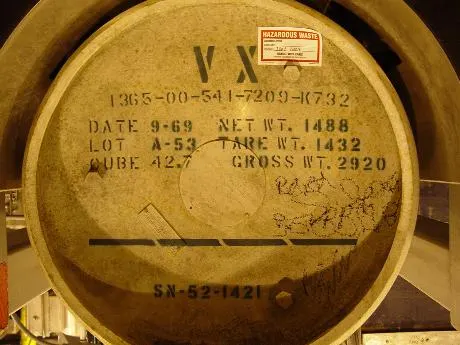
VX
💰 PERFORMANCE / PRICE ASSESSMENT Methodology ↗
NERVE AGENTS & DELIVERY SYSTEMS · EARLY COLD WAR
1
PERFORMANCE/PRICE
35
UNIT COST (2025 USD)
—
ⓘ Performance/Price and MASS score are computed across all units in the nerve agents & delivery systems category, regardless of era.
02 / Specs & Design
◎General6MOD.6
- CBRN TypeNerve agent
- CategoryChemical weapon
- First Developed1952
- Physical StateColorless, odorless liquid (oil)
- Treaty Status (CWC/BWC)Banned under the Chemical Weapons Convention
- In ServiceNo
◈Agent Properties7MOD.7
- Agent ClassOrganophosphate
- PersistencePersistent (low volatility, can remain on surfaces for weeks)
- Toxicity / LethalityExtremely high (LD50 ~10 mg via skin exposure)
- Onset TimeRapid (seconds to minutes)
- Route of ExposureSkin contact, inhalation
- LethalYes
- IncapacitatingNo
▣Delivery4MOD.4
- Delivery MethodAerosol spray, artillery shells, missiles, landmines
- DisseminationVapor and droplets
- Area CoverageDepends on delivery; can contaminate areas of several hundred meters
- WeaponizedYes
◇Detection & Protection3MOD.3
- Detection MethodGas chromatography, mass spectrometry, colorimetric detector kits
- Protection LevelFull protective suit and gas mask
- Decontamination MethodDecontamination with sodium hypochlorite (bleach) or specialized decontamination agents
◆Production1MOD.1
03 / History
SERVICE LIFESPANStill in Service
- 1952Production started
74
years in service
2
countries operating
ⓘ The producing country no longer actively operates it. 1 countries retired it.


05 / MASS Score
NERVE AGENTS & DELIVERY SYSTEMS RANKING Nerve Agents & Delivery Systems · Early Cold War


MASS RANKINGSMASS ↗
2NERVE AGENTS & DELIVERY SYSTEMS1EARLY COLD WAR · NERVE AGENTS & DELIVERY SYSTEMS18UNITED KINGDOM · ALL WEAPONS5PERFORMANCE/PRICE · NERVE AGENTS & DELIVERY SYSTEMS
ⓘ Rankings are within theNerve Agents & Delivery Systemscategory.
📖 TERMS ON THIS PAGE3terms
Lethal refers to the capability of a nerve agent or delivery system to cause death in targeted organisms, typically humans, upon exposure or impact.
Designation for chemical or biological agents adapted for use as weapons, including delivery systems engineered for dissemination.
These terms are listed automatically because they appear on this page.full encyclopedia →
📚 Sources