
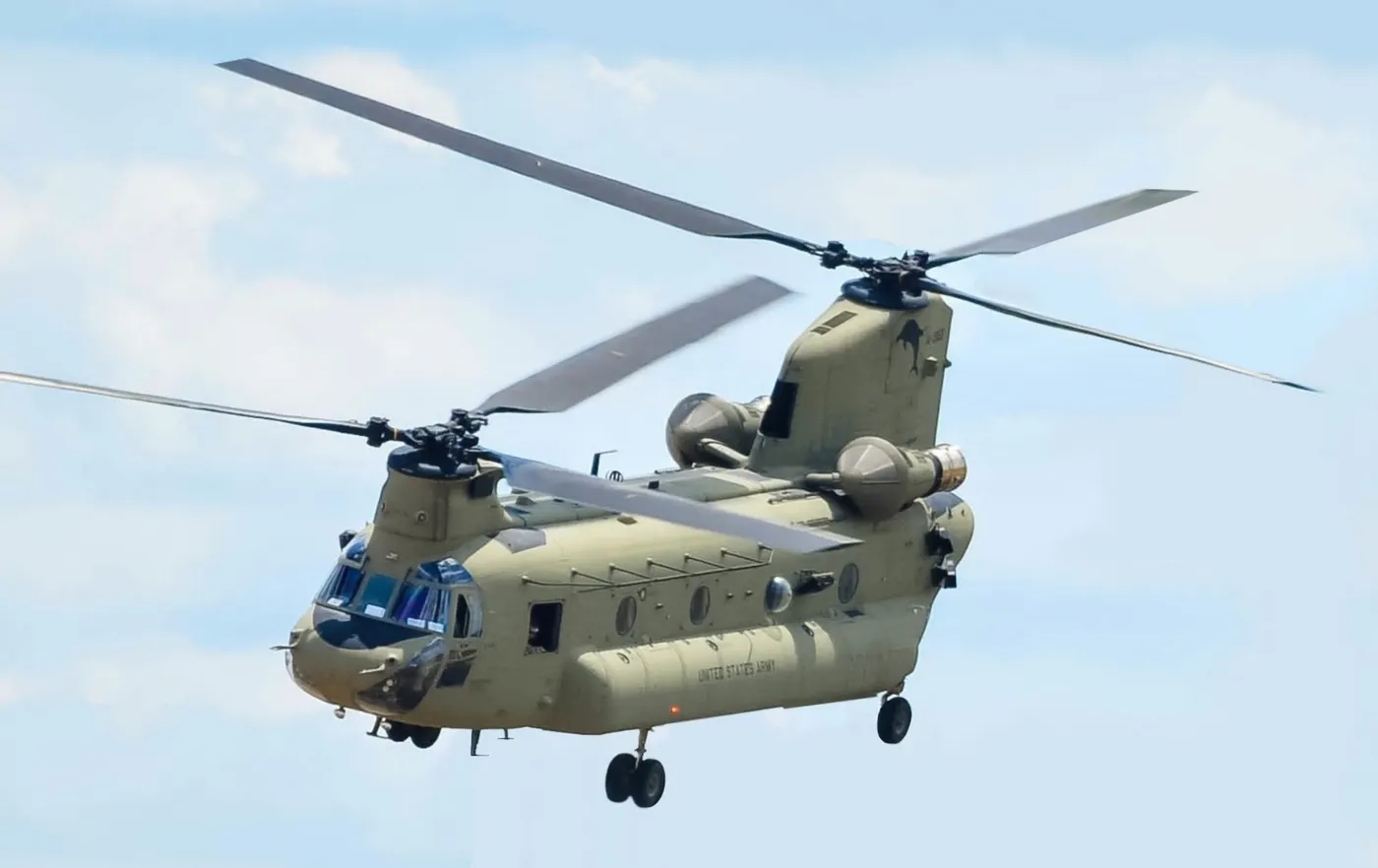
The Boeing CH-47 Chinook is a tandem-rotor, twin-turboshaft heavy-lift helicopter developed in the United States by Vertol and manufactured since 1962 by Boeing.1 It first flew in its production configuration on 21 September 1961 and was delivered to the U.S. Army from August 1962, which makes it one of the very few aircraft designs of the early 1960s still both in frontline service and in production more than six decades later.1,2 The type is planned to remain in Army service beyond 2060, a projected service life of roughly a century.1
- Tandem rotors put all engine power into lift, no tail rotor
- ~11 t external load, three cargo hooks for multiple simultaneous loads
- Fast for a heavy-lifter, about 170 knots
- Exceptional hot-and-high performance, proven in Afghan mountains
- 60+ years of upgrades, huge global support base
- Large twin-rotor footprint needs a big landing zone
- High operating and fuel cost versus medium helicopters
- Overlapping rotors demand careful maintenance and rigging
- Big, distinctive target, several high-profile combat shoot-downs
Unlike almost every other large helicopter, the Chinook has no tail rotor. Two counter-rotating rotors mounted one behind the other cancel each other's torque, so all of the engine power goes into lift and thrust rather than being spent holding the aircraft straight.1 That configuration, inherited from the earlier Piasecki tandem-rotor machines, gives the Chinook a wide, level cargo floor, a stable hover under heavy loads, and a usable payload that has climbed with each generation to around 11 tonnes on an external hook.1,13
The Chinook was built to move artillery, vehicles, and troops into places fixed-wing transports and smaller helicopters could not reach, and that mission has kept it relevant through Vietnam, the Falklands, Iraq, and Afghanistan.3,5 Its combination of speed, roughly 170 knots, and heavy lift is unusual: for decades no Western helicopter could carry as much as fast, and in the high, hot mountains of Afghanistan a single Chinook could do the air-assault work of several smaller helicopters.1,13
The defining feature of the Chinook is its tandem-rotor layout: two three-bladed (later four-bladed) rotors of equal size turning in opposite directions, the rear rotor mounted on a raised pylon so the two discs can overlap without the blades striking.1 Because the rotors cancel each other's torque, no power is diverted to a tail rotor, and the aircraft is trimmed and steered by tilting the rotor discs differentially. The result is a helicopter that hovers steadily while loading and unloading heavy, shifting cargo, and that keeps its cabin floor level rather than nose-down in a climb.1,4
- First Flight1961
- Service Entry Year1962
- Crew3
- Passengers33
- Primary RoleTransport helicopter
- In ServiceYes
Power has grown continuously across the type's life. The original CH-47A used two Lycoming T55 turboshafts of about 2,200 shaft horsepower each; later A-models and the B and C variants raised that to 2,850 and then 3,750 shp.1 The current CH-47F is powered by two Honeywell T55-GA-714A engines of roughly 4,700 shaft horsepower each, and the CH-47F Block II introduces a further ~20 percent more power with the T55-715.1,10 The engines drive both rotors through interconnecting shafts and a combining transmission, so that if one engine fails the other can still turn both rotors.4
- Engine TypeLycoming T55-GA-714A
- Number of Engines2
- Engine Power (each)3,750 kW
- Rotor Configurationtandem-rotor
- Main Rotor Diameter18.29 m
- Main Rotor Blades6
- Anti-Torque Typenone
The airframe is arranged around a long, unobstructed cargo hold loaded through a powered rear ramp, with a boat-like lower fuselage that allows limited water operations.1 Beneath the belly are three external cargo hooks, a centre hook rated for the heaviest single loads and forward and aft hooks that let the aircraft carry two or three separate slung loads at once and place them individually.1,13 A CH-47F can carry up to about 26,000 lb (11,800 kg) on the centre hook, and the Block II raises the rated external load to roughly 27,700 lb and the maximum takeoff weight to 54,000 lb (24,500 kg).1,10 Internally the hold accepts vehicles, pallets, and up to around 33 to 55 troops depending on seating.4
- Top Speed314.813 km/h
- Service Ceiling6,096 m
- Range740.8 km
- Ferry Range2,252.032 km
The CH-47F introduced a digital cockpit, the Common Avionics Architecture System (CAAS), a redesigned airframe with reduced vibration, and a digital automatic flight-control system that eases the pilot workload during heavy-load and brownout landings.1,10 The three-person crew is typically two pilots and a flight engineer or loadmaster who manages the cargo and the hoist.4 Defensive equipment on military examples includes missile and radar warning receivers, infrared jammers, and chaff and flare dispensers, with door and ramp machine-gun mounts for self-defence.1
- Fuselage Length29.87 m
- Height5.486 m
- Empty Weight11,148.581 kg
- Max Takeoff Weight22,680 kg
The CH-47 is designed and assembled by Boeing at Ridley Park, Pennsylvania, with the T55 engines supplied by Honeywell in the United States, so U.S. Army aircraft are overwhelmingly American in content.1,2 The main foreign share arises through licensed overseas production rather than imported parts: Kawasaki builds the CH-47J in Japan, and Leonardo (formerly AgustaWestland) has license-built the ICH-47F in Italy for European and export customers.1 For a U.S.-built CH-47F, domestic content is estimated at roughly 88 percent by value, with most of the remainder in globally sourced subsystems and avionics components rather than a single critical foreign module.
- Weapons Payload10,886 kg
- GunM60 machine gun
- Rocket PodsYes
- Rescue HoistYes
- Total Built1,200
- Operational StatusIn service
The Chinook grew out of the U.S. Army's search in the 1950s for a helicopter able to move heavy loads and troops well behind the front. Vertol, the successor to Frank Piasecki's pioneering tandem-rotor company, began work in 1957 on the Model 107, and in June 1958 the Army ordered a small number as the YHC-1A.1 Army officials judged the YHC-1A too heavy for the assault role yet too light for true transport work, and asked for a larger derivative, the Model 114, designated YCH-1B.1 That aircraft first flew on 21 September 1961, was redesignated CH-47A under the 1962 tri-service system, and was named "Chinook" after the Chinook people of the Pacific Northwest.1 Deliveries to the Army began in August 1962.1
From that baseline the type advanced through a continuous chain of upgrades rather than replacement. The CH-47B and CH-47C of the late 1960s brought more powerful engines and strengthened structures; the CH-47D of 1979 added composite rotor blades, a modernised cockpit, and improved avionics, and most D-models were rebuilt from earlier airframes.1,4 The CH-47F, which first flew on 23 October 2006, introduced a digital cockpit and a new-build airframe, and the F/Block II now in production raises power and payload again.1,10 More than 1,200 Chinooks had been built by 2012, and the line remains open, an unusually long production run that puts the Chinook alongside the C-130 Hercules as one of the longest-serving military aircraft in history.1
The Chinook went to war almost immediately. In Vietnam its most valued mission was placing artillery batteries on mountain fire-support bases that could be reached no other way, then keeping them supplied with ammunition; in the thin, hot mountain air the load was limited to around 7,000 lb, rising to about 8,000 lb near the coast.1 Of roughly 750 Chinooks in U.S. and South Vietnamese service, about 200 were lost to combat or wartime accidents.1 The Army also tried an armed version, the ACH-47A "Guns-A-Go-Go," four gunship conversions bristling with cannon, machine guns, and a grenade launcher; the experiment worked tactically but the aircraft were too valuable as transports, and three of the four were lost.1
In the 1982 Falklands War the Chinook produced one of its most famous episodes. Britain shipped several Chinooks south aboard the container ship Atlantic Conveyor, which was struck by an Argentine Exocet missile on 25 May 1982; the fire destroyed the helicopters, their spares, and their support equipment.1,6 A single aircraft, ZA718 "Bravo November," was airborne at the time and survived, and it then carried the load of the entire lost fleet, on one occasion lifting 81 troops in a single flight far beyond its normal capacity.6 "Bravo November" went on to serve through Iraq and Afghanistan and was retired to the Royal Air Force Museum in 2022.6,7
In Iraq and Afghanistan the Chinook became the coalition's indispensable heavy lifter. During Operation Anaconda in March 2002 Chinooks inserted troops into the Shah-i-Kot Valley at 8,000 to 10,000 ft under heavy fire, with several hit and one brought down on a ridge, yet they kept flying resupply and evacuation because nothing else could do the job at that altitude.5 The type's hot-and-high advantage was such that one Chinook could replace up to five smaller assault helicopters in the Afghan mountains.1 Pilots refined the "pinnacle landing," resting only the rear wheels on a peak while the front of the aircraft hangs over the drop, to work terrain no flat landing zone existed on.12 The war also produced the Chinook's worst single loss: on 6 August 2011 a CH-47 with the callsign Extortion 17 was shot down near Kabul, killing 38 people, the deadliest single incident of the entire Afghan campaign.1
The Chinook remains a first-call aircraft for crises. In April 2023 Chinooks flew the evacuation of the U.S. Embassy in Khartoum, and from 2020 Indian Air Force Chinooks supported high-altitude operations along the disputed frontier with China.1
 Boeing CH-47 Chinook
The Chinook has evolved through a clear line of military marks and a family of special-operations and export versions. The original CH-47A (1962) was followed by the CH-47B and the widely produced CH-47C, each adding engine power and structural strength.1 The CH-47D of 1979 was a major rebuild with composite blades and modern avionics and became the U.S. Army's standard for a generation. The current CH-47F, first flown in 2006, has a digital cockpit and a new-build airframe, and the CH-47F Block II raises engine power, external load to about 27,700 lb, and maximum weight to 54,000 lb.1,10
Special operations drove a parallel family. The MH-47D and MH-47E of the 1980s and 1990s added in-flight refuelling, terrain-following radar, and extra fuel for long, low-level infiltration; the current MH-47G, based on the CH-47F, carries the full special-operations avionics and defensive suite and is flown by the U.S. Army's 160th Special Operations Aviation Regiment.1,11 Export and license production produced the CH-47J and CH-47JA built by Kawasaki in Japan, the British Chinook HC1 through HC6A series, the Canadian CH-147F, and the Italian-built ICH-47F.1 A dedicated gunship, the Vietnam-era ACH-47A, was built only in tiny numbers.1 Alongside the military marks, the civil Boeing Model 234, now supported by Columbia Helicopters, serves logging, construction, petroleum, and firefighting operators worldwide.8
The single entry above reflects the Chinook's prominence in the 2013 film Lone Survivor, which depicts the loss of the CH-47 "Turbine 33" during Operation Red Wings in 2005; the type appears widely in war films and video games, but verified, specific depictions are limited.1


| Year | Buyer | Quantity | Amount | Present Value (2025) |
|---|---|---|---|---|
| 2026 | United States | 6 | $324.0 M | $324.0 M |
| 2025 | United States | 9 | $461.0 M | $461.0 M |
| 2024 | United States | 3 | $135.0 M | $138.6 M |
| 2023 |  Germany | 60 | $8.50 Mr | $8.98 Mr |
| 2023 |  Spain | 1 | — | — |
| 2022 |  Egypt | 23 | — | — |
| 2019 | Spain | 17 | — | — |
| 2017 |  Kingdom of the Netherlands | 6 | — | — |
| 2016 | Kingdom of the Netherlands | 12 | $308.0 M | $413.1 M |
| 2016 |  Saudi Arabia | 48 | $3.51 Mr | $4.71 Mr |
| 2015 |  India | 15 | $1.10 Mr | $1.49 Mr |
| 2009 |  Canada | 15 | $1.20 Mr | $1.80 Mr |
| 1984 |  Japan | 54 | — | — |
| 1981 | Egypt | 15 | — | — |
| 1978 |  United Kingdom | — | — | — |
| 1962 | United States | — | — | — |
The United States Army is by far the largest operator, flying the CH-47F and the special-operations MH-47G, and the type is a mainstay of Army heavy-lift and air-assault aviation.1,3 The United Kingdom's Royal Air Force is the second-largest user, operating the Chinook HC-series since the late 1970s.1,6 Japan fields a large fleet of Kawasaki-built CH-47J and JA aircraft across its Ground and Air Self-Defense Forces.1
Beyond those, the Chinook is operated by more than twenty nations, among them Australia, Canada, Egypt, Germany, Greece, India, Italy, the Netherlands, Saudi Arabia, Singapore, Spain, and Taiwan.1 Recent orders show the type's continuing demand: Germany selected 60 CH-47F Block II helicopters in 2022, India ordered 15 CH-47Fs, the Netherlands has taken 14 CH-47Fs, and Canada operates 15 CH-147Fs.1 The long production run and broad operator base give the Chinook a deep, sustainable support network that few heavy helicopters can match.9
Measured against other heavy helicopters, the Chinook occupies a distinct niche defined by its tandem-rotor layout. It does not lift as much as the single-rotor Soviet Mil Mi-26, which carries about 20 tonnes to the Chinook's roughly 11, but it is far more numerous, more easily supported, and more readily transported, which is why NATO built its heavy-lift capacity around fleets of Chinooks rather than a handful of giants.1,13 Against the American Sikorsky CH-53 series, the Chinook trades some single-lift capacity for speed, a level cargo floor, and the efficiency of putting all its power into lift with no tail rotor.1
The tandem-rotor choice is the heart of the comparison. A conventional helicopter spends a share of its engine power driving a tail rotor purely to counter torque; the Chinook spends none, which helps explain how a design first flown in 1961 still lifts competitively and flies faster than many newer types.1,13 Its practical value has always been the mix of speed, payload, and the ability to work from unprepared, high, hot landing zones, a combination that has repeatedly made it the only aircraft able to perform a given mission.5,13
Why does the Chinook have two rotors and no tail rotor?
The two rotors turn in opposite directions, so each cancels the other's torque and no tail rotor is needed to keep the aircraft straight.1 That lets all the engine power go into lift and thrust, gives a stable hover under heavy loads, and keeps the cargo floor level. It is the main reason the Chinook lifts so much for its size.1,4
How much can a CH-47 Chinook carry?
A current CH-47F can lift up to about 26,000 lb (11,800 kg) on its centre cargo hook, and the CH-47F Block II raises the rated external load to roughly 27,700 lb with a maximum takeoff weight of 54,000 lb (24,500 kg).1,10 It has three hooks, so it can also carry two or three smaller separate loads at once.1
How fast is the Chinook?
Its maximum speed is around 170 knots (about 315 km/h), which is fast for a heavy-lift helicopter and comparable to or better than many smaller types.1 The CH-47F can sustain over 175 mph while carrying a payload above 21,000 lb.1
How long has the Chinook been in service?
It entered U.S. Army service in 1962 and remains both in service and in production more than sixty years later, with plans to keep it flying beyond 2060.1 More than 1,200 have been built.1
What is the difference between the CH-47 and the MH-47?
The MH-47 is the special-operations version. It shares the Chinook airframe but adds in-flight refuelling, terrain-following radar, forward-looking infrared, an electronic-warfare suite, and fast-rope equipment for covert infiltration and exfiltration; the current model is the MH-47G.1,11 The CH-47F is the conventional heavy-lift and air-assault version.
Is there a civilian Chinook?
Yes. The Boeing Model 234 is a civil-certified Chinook used for logging, construction, oil-and-gas support, and firefighting; its type certificate is held by Columbia Helicopters, and it can seat up to 44 passengers or lift about 25,000 lb externally.8
How does the Chinook compare with the Mi-26?
The Mi-26 lifts more, around 20 tonnes against the Chinook's 11, but the Chinook is far more numerous, cheaper to operate, easier to transport, and supported by a much larger industrial base, which is why Western forces rely on fleets of Chinooks rather than a few very large helicopters.1,13
- "Boeing CH-47 Chinook", Wikipedia — en.wikipedia.org ↩
- "H-47 Chinook", Boeing — boeing.com ↩
- "CH-47 Chinook Helicopter", U.S. Army — army.mil ↩
- "CH-47D/F / MH-47E Chinook Transport Helicopter", Airforce Technology — airforce-technology.com ↩
- "Chinooks Over Afghanistan: The Unsung Workhorse of America's Never Ending War", The War Zone — twz.com ↩
- "Bravo November", Wikipedia — en.wikipedia.org ↩
- "Bravo November", Royal Air Force Museum — rafmuseum.org.uk ↩
- "Columbia's 234: A true multi-mission heavy-lift helicopter", Vertical Magazine — verticalmag.com ↩
- "CH-47 Chinook: why the iconic helicopter design is still a heavy-lift contender", Shephard Media — shephardmedia.com ↩
- "Army Accelerates Capability to the Force with a Rapid Fielding Effort for Chinook Block II", U.S. Army — army.mil ↩
- "CH-47 Vs. MH-47 Chinook: What Is the Difference Between These Two Military Helicopters?", SlashGear — slashgear.com ↩
- "CH-47 Evacuates Climber and Six Rescuers with Impressive Steep-Slope Pinnacle Landing", The Aviationist — theaviationist.com ↩
- "The CH-47 Chinook Can Carry 26,000 Pounds at 170 MPH", Military Machine — militarymachine.com ↩