


The CH-46A Sea Knight was the first production version of the tandem-rotor helicopter that United States Marine Corps assault squadrons flew into Vietnam starting in 1966, and it stayed in Marine Corps and Navy service for more than fifty years after that first combat tour.1 Built by Vertol Aircraft Corporation, which became the Boeing Vertol Division after Boeing's 1960 acquisition of the company, the CH-46A carried Marines and cargo between amphibious ships and inland landing zones as the Corps' standard medium assault transport, a role category the Marines later folded into the same broad heavy lift helicopters class that also holds the larger CH-47 Chinook.2 The type's twin General Electric T58 turboshaft engines and counter-rotating tandem rotors gave it a wide, flat cabin and no tail rotor to lose to ground fire, a layout that traced back to Frank Piasecki's earlier tandem-rotor designs.1
- Tandem-rotor layout with no exposed tail rotor
- Wide flat cabin floor for troops, litters, or cargo pallets
- Rear loading ramp for vehicles and bulky loads
- Twin-engine redundancy over open water
- Early T58-GE-8 engines prone to foreign object damage
- Tail pylon and rear transmission mount failures in early production
- Troop capacity limited to about 17 with the original engines
- Airframe corrosion from shipboard and coastal basing
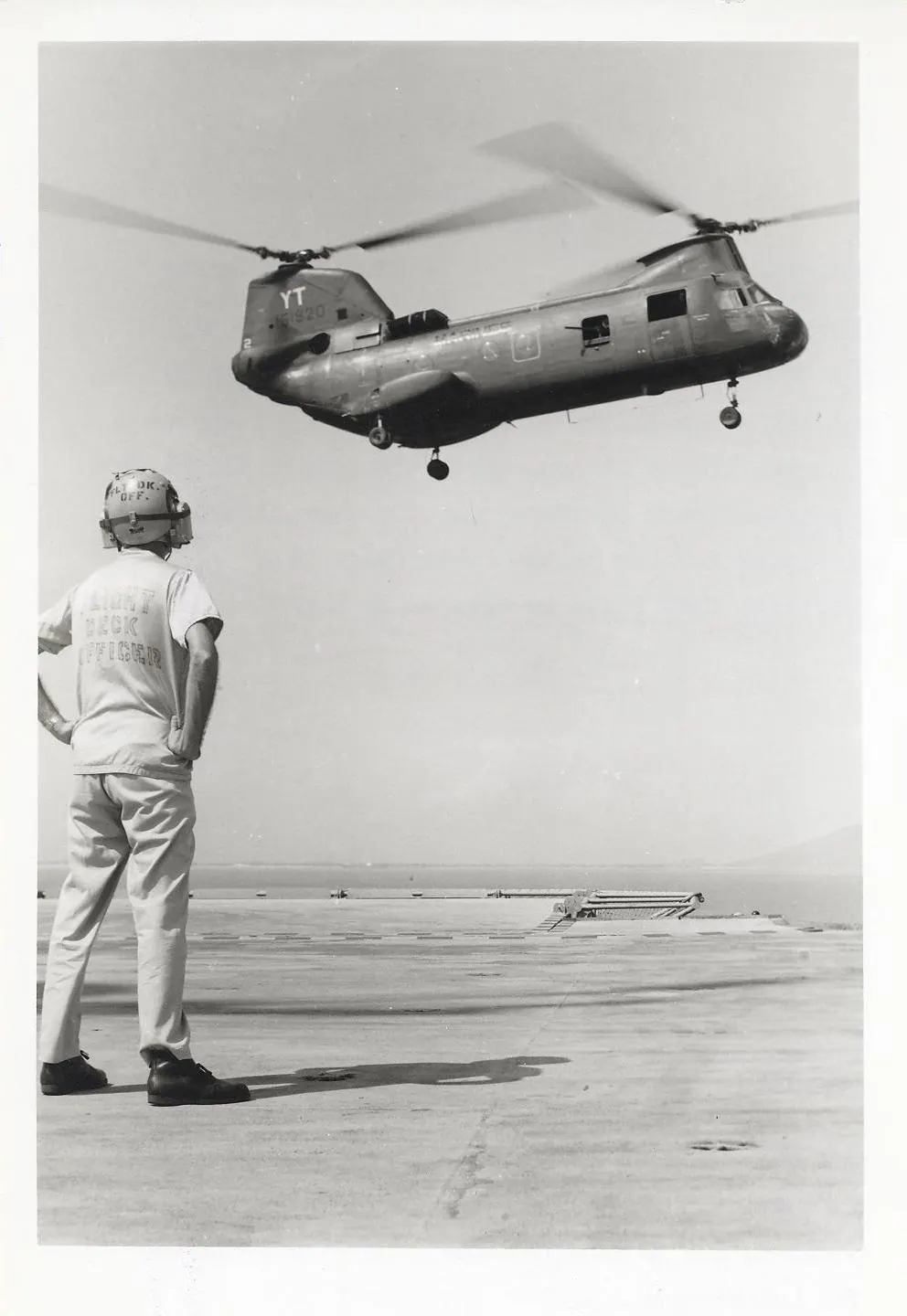
Production of the CH-46A ran from 1962 to 1971 and totaled 161 airframes for the Marine Corps, a small run compared to the more than 500 Sea Knights eventually built across every US variant.1,6 Most surviving CH-46A airframes were later rebuilt to CH-46D or CH-46E standard, so the pure A-model configuration was mostly gone from front-line squadrons by the mid-1970s even though the Sea Knight family as a whole soldiered on in Marine Corps service until 2015.1 The CH-46A Sea Knight's Vietnam War record, its early reliability problems, and its eventual replacement by the V-22 Osprey all trace back to design and manufacturing decisions made in this first production batch.
Twin T58 Turboshafts and the Tandem-Rotor Layout
The CH-46A Sea Knight was powered by two General Electric T58-GE-8 turboshaft engines, each rated at 1,250 shp (935 kW), mounted side by side in the aft pylon and cross-linked so either engine could drive both rotors if the other failed.1,6 The two three-bladed rotors turned in opposite directions, canceling torque without a tail rotor, which let the CH-46A put its full fuselage length to use as cabin space instead of losing several feet to a tail boom and anti-torque rotor. Each rotor measured 15.24 m (50 ft) in diameter, and the aircraft's fuselage ran 13.66 m (44 ft 10 in) long, figures that are smaller than some published spec sheets suggest once the fully extended landing gear and rotor overlap are stripped out of the measurement.1,6 Overall height to the rear rotor head was about 5.1 m (16 ft 9 in).1,6
- First Flight1958
- Service Entry Year1964
- Crew3
- Passengers17
- Primary Rolemedium lift assault and cargo transport helicopter
- In ServiceNo
Cabin, Payload, and the Corrected Capacity Numbers
Empty weight was approximately 7,000 kg (15,537 lb), with a maximum takeoff weight of 11,000 kg (24,300 lb), giving a useful load in the neighborhood of 4,000 kg once fuel is deducted.1 With the original T58-GE-8 engines, the CH-46A Sea Knight could lift up to 17 combat-equipped Marines or roughly 1,815 kg (4,000 lb) of internal cargo, a figure that only grew to the commonly quoted 25 troops after the more powerful T58-GE-10 and T58-GE-16 engines arrived on the CH-46D and CH-46E.1,6 Standard crew was three, a pilot, copilot, and crew chief, though Vietnam-era combat configurations regularly added a door gunner and sometimes a tail gunner behind the ramp, bringing the working crew to five on assault missions.1 A rear ramp under the tail pylon let crews load jeeps, artillery pieces, and pallets directly into the cabin, a feature the CH-46A shared with the much larger CH-47 Chinook Boeing Vertol built for the United States Army around the same tandem-rotor formula.
- Engine Typeturboshaft
- Number of Engines2
- Engine Power (each)935 kW
- Rotor Configurationtandem rotor
- Main Rotor Diameter15.24 m
- Main Rotor Blades6
- Anti-Torque Typetandem
Maximum speed was about 267 km/h (166 mph), cruise speed around 225 km/h (140 mph), and range on internal fuel roughly 1,020 km (550 nmi), though combat radius with a full troop or cargo load was considerably shorter.1,6 Defensive armament was a pair of pintle-mounted 0.50 caliber M2 Browning machine guns fired from the cabin door and, on some missions, the rear ramp.1 Later in the war several CH-46A airframes were fitted with a rescue hoist for casualty evacuation, though a hoist was standard equipment on the dedicated search-and-rescue HH-46A variant rather than the baseline assault transport.3
- Top Speed267 km/h
- Cruise Speed225 km/h
- Service Ceiling4,000 m
- Range1,020 km
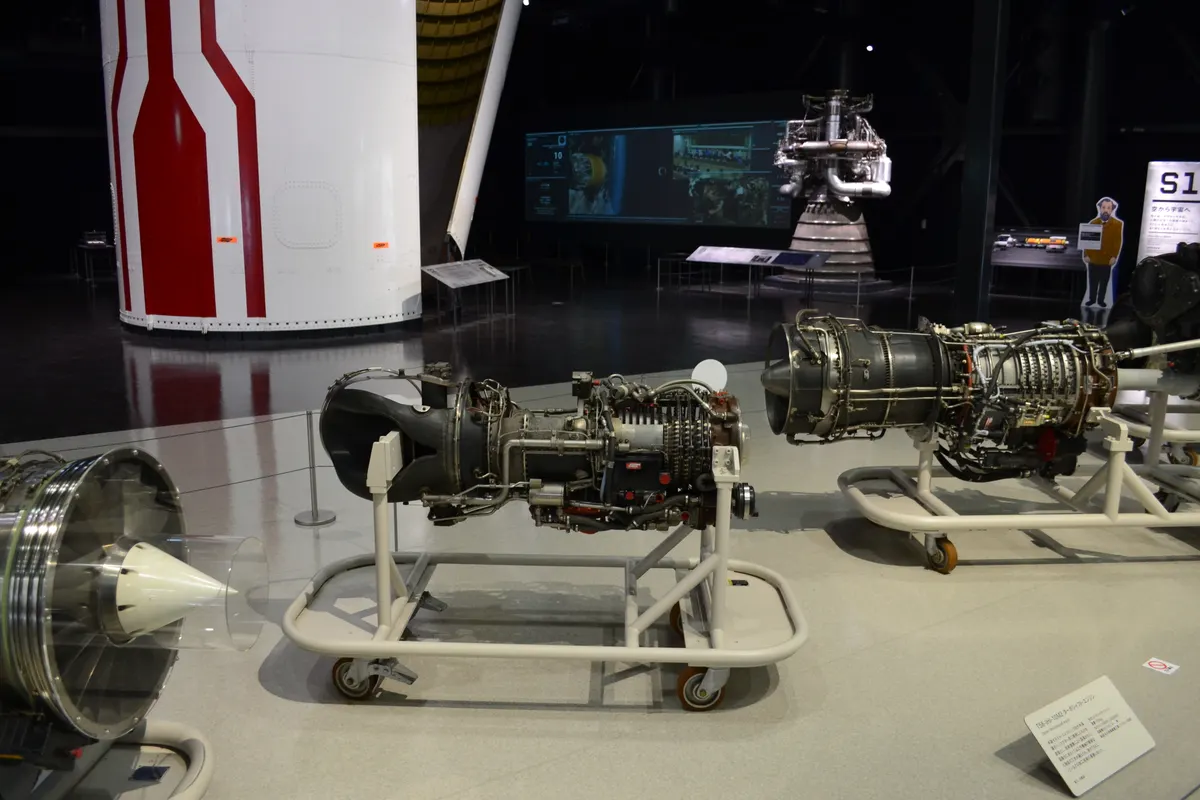
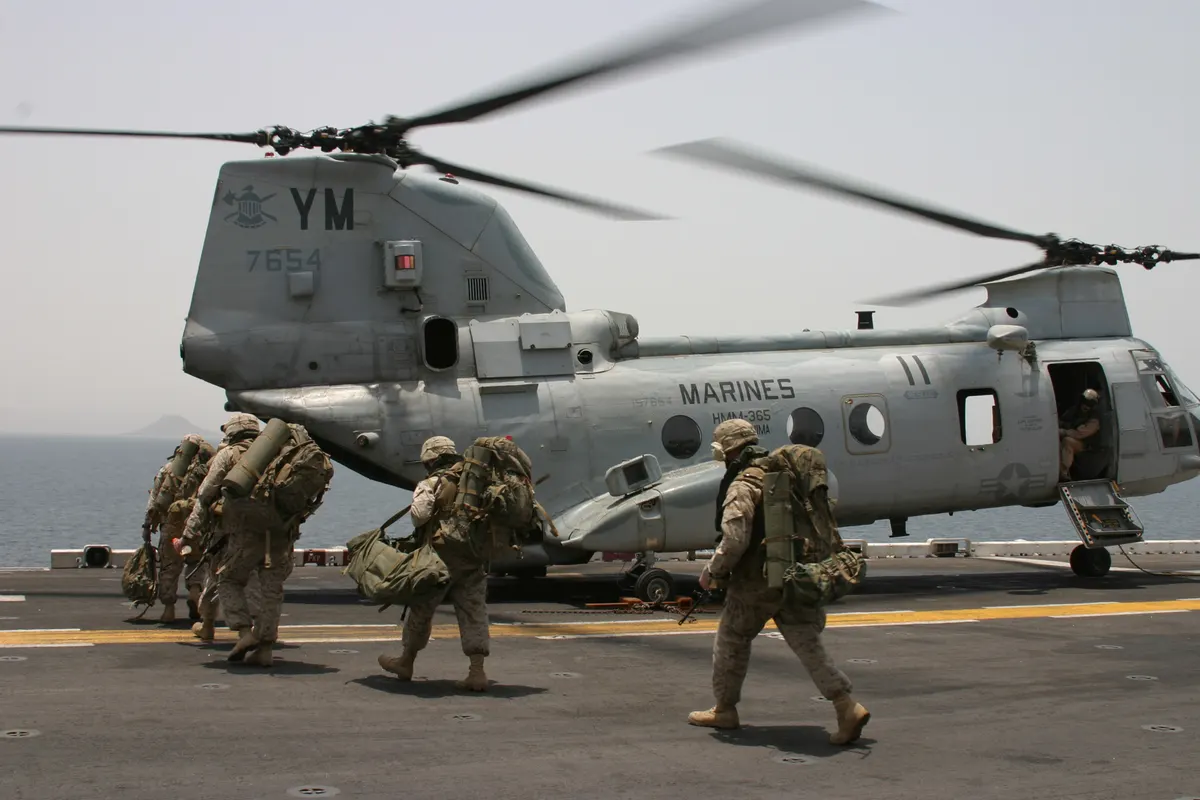
The CH-46A Sea Knight's flat, unobstructed cabin floor, roughly 7.6 m long and 2.3 m wide, made it useful for litters, cargo nets, and vehicle loading in a way that the narrower Bell UH-1 Iroquois cabin could not match, one reason the Marine Corps used the Sea Knight to fill the medium-lift gap between the UH-1 Iroquois and the heavier Sikorsky CH-53 Sea Stallion.4
- Fuselage Length13.66 m
- Height5.1 m
- Empty Weight7,000 kg
- Max Takeoff Weight11,000 kg
- Gun.50 caliber M2 Browning machine gun
- Rescue HoistYes
- Total Built161
- Retirement Year2015
- Production Start1962
- Production End1971
- Operational Statusretired
From the Piasecki Tandem-Rotor Formula to the Vertol Model 107
The CH-46A Sea Knight descended from the Vertol Model 107, a commercial tandem-rotor design that first flew on 22 April 1958, three years after Frank Piasecki's original helicopter company was renamed Vertol Aircraft Corporation.1 Boeing bought Vertol in 1960 and continued the Model 107 program as its Boeing Vertol Division, based at Morton, Pennsylvania, near Philadelphia.1 The US Marine Corps picked the Model 107M in early 1961 to replace its aging piston-engine Sikorsky UH-34 transports, and the type was designated HRB-1 before the Pentagon's 1962 tri-service naming overhaul redesignated it CH-46A.1
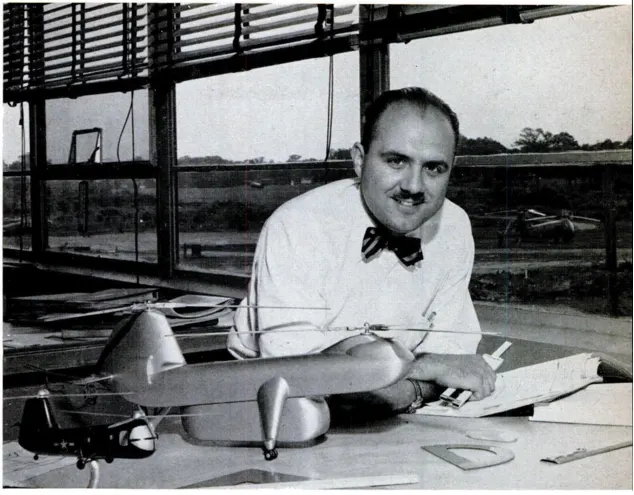
The US Navy and Marine Corps took delivery of the first production CH-46A Sea Knights beginning in June 1964, with formal fleet introduction in November 1964, roughly two years after production had started and the aircraft had first flown under its new designation.9 HMM-265 at Marine Corps Air Station New River, North Carolina, was the first operational squadron, and its early flight hours through 1964 and 1965 shaped the tactics and maintenance procedures later squadrons carried into Vietnam.9
Early Reliability Problems and the CH-46D Rebuild Program
The CH-46A Sea Knight's early service record was rough. Its T58-GE-8 engines, sensitive to dust and debris ingestion while hovering close to the ground, sometimes lasted as little as 85 flight hours between failures, and on 21 July 1966 the Marine Corps grounded every CH-46 fleet-wide until improved intake filters could be fitted.1 Rear transmission mounts and tail pylons also failed on several aircraft in 1967, and roughly 80 CH-46A airframes were flown to Marine Corps Air Station Futenma, Okinawa, between December 1967 and February 1968 for structural modification.1 Boeing Vertol addressed the underlying issues with the CH-46D, which introduced cambered droop-snoot rotor blades and more powerful T58-GE-10 engines rated at 1,400 shp, and roughly 33 CH-46A airframes were progressively re-manufactured to CH-46D standard rather than scrapped.7
The CH-46A Sea Knight in the Vietnam War
The Vietnam War was the CH-46A Sea Knight's defining conflict. HMM-164 flew the type's combat debut in March 1966, and within weeks the CH-46A had become one of the Marine Corps' primary assault-transport helicopters in South Vietnam, working alongside the smaller UH-1 Iroquois and the heavier Sikorsky CH-53 Sea Stallion to move troops between amphibious ships and inland landing zones.3,4 The type's worst single day came during Operation Hastings in July 1966, when two CH-46As from HMM-164 collided over Landing Zone Crow in the Ngan Valley and a third crashed avoiding them, killing two Marines, and a fourth CH-46A from HMM-265 was shot down later that day with the loss of thirteen more.7 Marines afterward called the valley Helicopter Valley, a name that stuck through the rest of the war.7

By 1968, upgraded CH-46D Sea Knights, many of them rebuilt CH-46A airframes, flew the resupply missions that kept the besieged Marine base at Khe Sanh supplied after North Vietnamese forces cut the overland route in January 1968.8 The most effective tactic, nicknamed the Super Gaggle, sent eight to sixteen Sea Knights in a single formation escorted by A-4 Skyhawk attack aircraft and Huey gunships, and after its adoption in late February 1968 Marine helicopters delivered 465 tons of supplies to Khe Sanh that month alone.8 Only two Sea Knights were lost during Super Gaggle missions, both crews recovered immediately by escorting Huey helicopters.8
The broader Sea Knight family's Vietnam War service closed with Operation Frequent Wind in April 1975, when Sea Knights (by then upgraded well beyond the original A-model standard) flew the final evacuation of the US Embassy in Saigon, including the helicopter Lady Ace 09, which carried out the American ambassador.5 The pure CH-46A configuration was largely gone from front-line squadrons by then, converted to CH-46D or retired, but the aircraft that closed out the war traced its cabin, rotor system, and airframe directly back to the 161 CH-46A Sea Knights built between 1962 and 1971.1
The CH-46A was the baseline Marine Corps assault transport covered here, built alongside the near-identical UH-46A, a US Navy logistics variant used for vertical replenishment between supply ships and carriers rather than assault landings.1 Two other early variants were derived directly from CH-46A airframes for specialized roles rather than mass production, the search-and-rescue HH-46A, fitted with a rescue hoist and rescue swimmer equipment for Navy SAR duty, and the NCH-46A, a small batch of testbed aircraft used by the Naval Air Test Center for engineering trials rather than operational squadrons.2
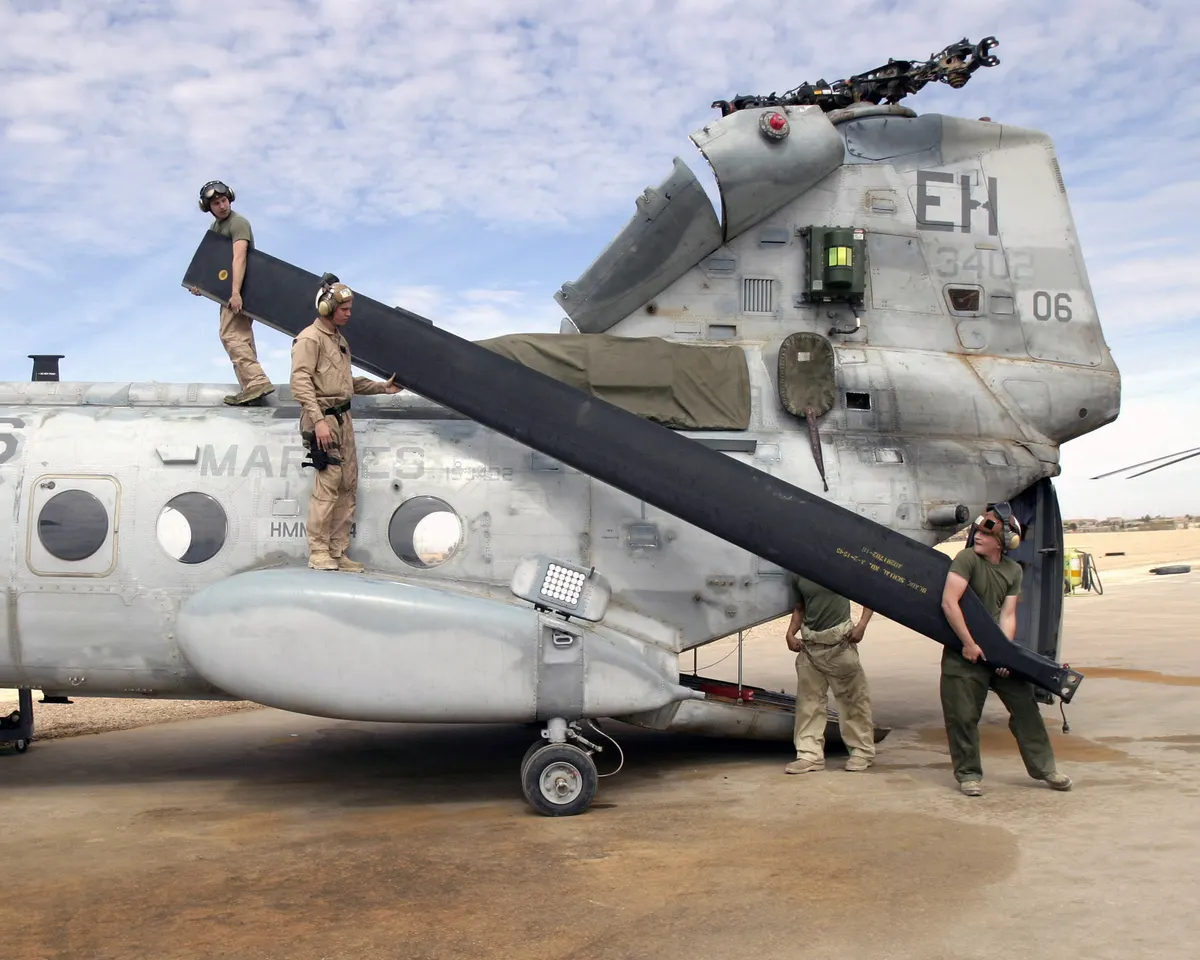
Later Marine Corps development moved through the CH-46D (266 built, T58-GE-10 engines, cambered rotor blades) and the CH-46E (275 built, fiberglass rotor blades, reinforced airframe, and night-vision compatibility), which became the definitive Marine Corps configuration through the type's 2015 retirement.6 Kawasaki Heavy Industries in Japan separately built a licensed derivative, the KV-107, after acquiring worldwide sales rights to the Model 107-II from Boeing Vertol in 1965, and KV-107s served with Japan, Sweden, and Canada (as the CH-113 Labrador) well outside the CH-46A's own US-only service history.10


The CH-46A Sea Knight itself served exclusively with the US Marine Corps, which took all 161 production aircraft between 1962 and 1971 and flew them primarily out of Marine Corps Air Station New River and Marine Corps Air Station Tustin before and during Vietnam deployments.9 The near-identical UH-46A variant served with the US Navy in the logistics role. No CH-46A airframes were exported, unlike the later, more numerous CH-46D and CH-46E, some of which reached foreign operators through resale programs after Marine Corps retirement.1
The CH-46A Sea Knight and the CH-47 Chinook came out of the same Boeing Vertol tandem-rotor engineering group within a few years of each other, and the resemblance is obvious in silhouette, yet the two aircraft were never really competitors because the Army sized the Chinook for a heavier mission from the start. The CH-46A Sea Knight's maximum takeoff weight of 11,000 kg is barely a third of the CH-47's, and where the CH-46A carried about 17 combat troops on its original engines, the Chinook was built from the outset to lift artillery pieces and vehicles the Sea Knight's cabin could not accommodate.6 The Marine Corps wanted a helicopter that would fit on amphibious assault ship elevators and flight decks, a constraint that capped the CH-46A Sea Knight's size long before its payload became the limiting factor, while the Army's Chinook requirement had no such shipboard footprint to satisfy.
| Spec | CH-46A Sea Knight | CH-47 Chinook (A model) |
|---|---|---|
| Engines | 2x T58-GE-8, 1,250 shp each | 2x T55, over 2,000 shp each |
| Max takeoff weight | ~11,000 kg | ~15,000 kg+ |
| Typical troop capacity | ~17 | ~33-44 |
| Primary service | US Marine Corps | US Army |
Within the Marine Corps itself, the CH-46A Sea Knight's closer rival for procurement dollars was the Sikorsky CH-53 Sea Stallion, which entered service a few years later and eventually took over the true heavy-lift missions the underpowered early Sea Knight could not manage, including bulk external cargo and helicopter-borne artillery moves. The Marine Corps kept both types in parallel service for decades precisely because the CH-46A Sea Knight and its later D and E derivatives filled a genuinely different assault-transport niche below the CH-53's tonnage, not because one design had simply beaten the other.

How fast was the CH-46A Sea Knight? The CH-46A Sea Knight had a maximum speed of about 267 km/h (166 mph) and a cruise speed of roughly 225 km/h (140 mph) on its original T58-GE-8 engines.1,6
Is the CH-46 Sea Knight still in service? No. The US Marine Corps retired its last CH-46 Sea Knights, by then all upgraded to CH-46E standard, on 1 August 2015, ending more than fifty years of service that began with the CH-46A in 1964.5 The V-22 Osprey replaced it in Marine Corps assault-transport squadrons.
Why was the CH-46 Sea Knight called the Phrog? Marines nicknamed it the Phrog for its frog-like crouched stance on the ground, with a raised nose and squat rear landing gear that made it look ready to hop.5
How many CH-46A helicopters were built? Boeing Vertol built 161 CH-46A Sea Knights for the Marine Corps between 1962 and 1971, out of more than 500 Sea Knights built across all US variants.1,6
What replaced the CH-46 Sea Knight? The Marine Corps replaced its Sea Knight fleet with the tiltrotor V-22 Osprey, completing the transition by 2015.5
- "Boeing Vertol CH-46 Sea Knight", Wikipedia — en.wikipedia.org ↩
- "CH-46D Sea Knight", Naval History and Heritage Command — history.navy.mil ↩
- "CH-46 Sea Knight Operations in South Vietnam", Naval History and Heritage Command — history.navy.mil ↩
- "It's a Plane . . . a Helicopter . . . a Phrog!", Naval History Magazine (USNI) — usni.org ↩
- "Phrog Farewell", National Air and Space Museum — airandspace.si.edu ↩
- "Boeing Vertol CH-46 Sea Knight Medium-Lift, Tandem Rotor Transport Helicopter", MilitaryFactory — militaryfactory.com ↩
- "Operation Hastings", Wikipedia — en.wikipedia.org ↩
- "On Super Gaggles, CH-46s and Re-Supplying Khe Sanh", Bravo! The Project — bravotheproject.com ↩
- "History of HMM-265", HMM/VMM-265 VETS — hmm-265.org ↩
- "Kawasaki KV-107", Aeropedia — aeropedia.com.au ↩