

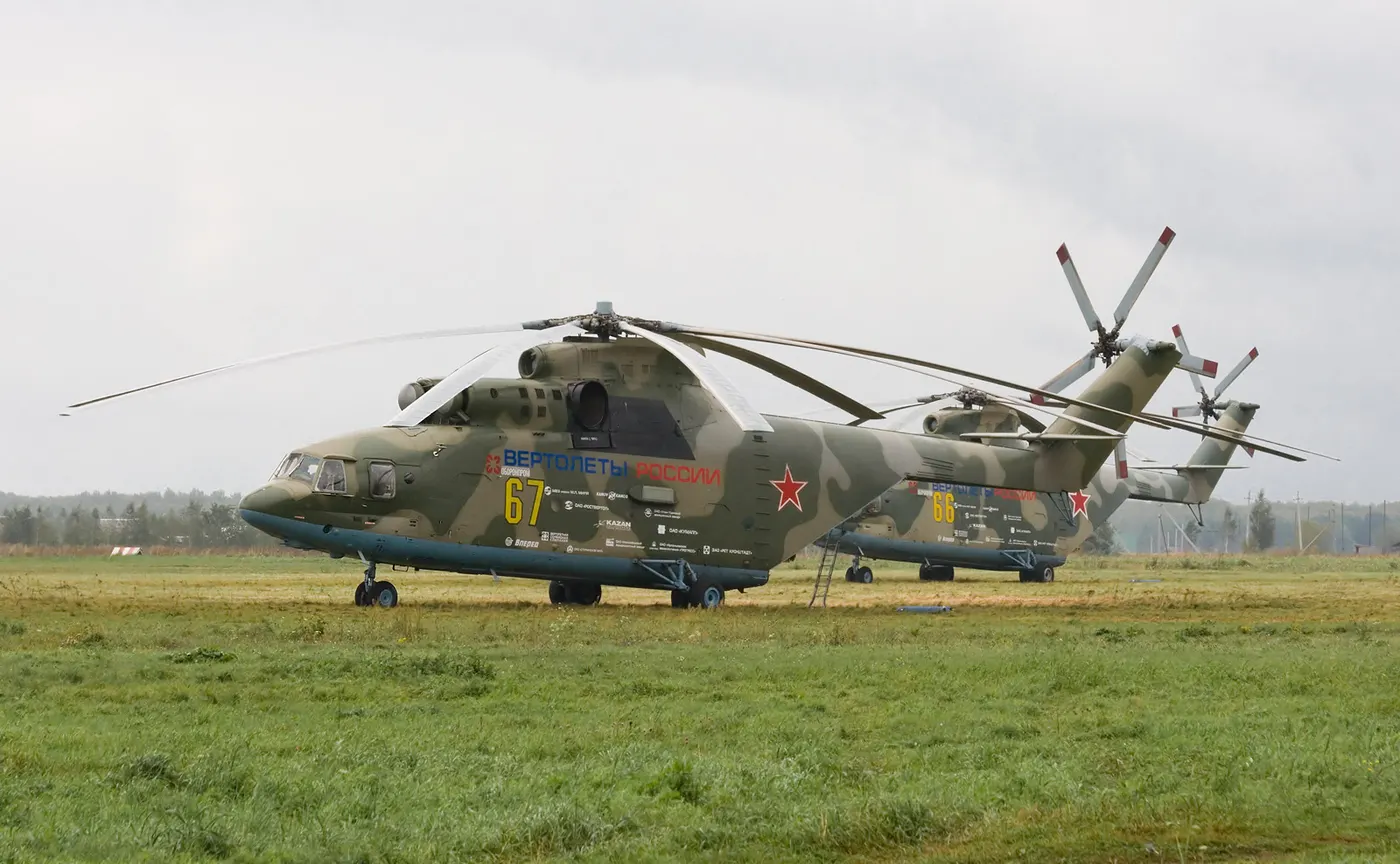
The Mil Mi-26 (NATO reporting name "Halo") is a twin-turboshaft heavy-lift helicopter developed by the Mil design bureau (OKB-329, later the Mil Moscow Helicopter Plant) in the Soviet Union and produced by Rostvertol in Rostov-on-Don.1 It first flew on 14 December 1977 under the internal designation V-26 (Izdeliye 90), was rolled out in production form in October 1980, and reached operational Soviet service around 1983.1,18 It holds the distinction of being the heaviest and most powerful helicopter ever to enter series production, and it remains second in physical size only to the experimental Mil V-12, which was never produced.1,17
- Carries a 20,000 kg load internally or as a single sling load, a capacity unmatched by any Western production helicopter and roughly double that of the CH-47 Chinook
- Enclosed cargo hold accepts vehicles, artillery, and even other helicopter airframes without disassembly, loaded over a rear ramp by internal winches
- Purpose-built VR-26 split-torque gearbox provides multiple torque paths and, with the eight-blade rotor, allows continued flight on one engine at reduced weight
- Proven cold-weather and unprepared-site performance from decades of Siberian, Arctic, and high-altitude operation
- High fuel burn and a five-person baseline crew make it costly to operate relative to smaller heavy-lift types, and short-range at maximum payload
- Its D-136 engines were built only in Ukraine, leaving Russian production and overhaul dependent on a supply chain that collapsed after 2022
- Large rotor disc and ground footprint restrict access to confined or urban landing zones
- Documented accident record includes several overload- and cargo-shift crashes tied directly to operating at its extreme gross weights
The design answered a specific Soviet problem rather than a general desire for a large helicopter. The exploitation of Siberian oil and gas fields, and construction across permafrost and swamp where roads and fixed-wing airstrips were absent, created a requirement to move loads in the 15-to-20-tonne class into unprepared sites that the earlier Mi-6 could not fully satisfy.1,18 The specification that resulted was unusually strict: the empty airframe, without fuel, was required to weigh no more than half of the maximum takeoff weight, a mass-fraction target that forced advances in the rotor, transmission, and structure and that shaped almost every subsequent engineering decision.18
What distinguishes the Mi-26 from every heavy-lift helicopter that preceded it is its ability to carry a 20-tonne load either inside an enclosed cargo hold or beneath the fuselage on a sling, a payload roughly matching the internal cargo capacity of the four-engine Lockheed C-130 turboprop transport.1,2 That single-lift capacity, delivered by a machine that can set down on unprepared ground, defined its operational niche for four decades and explains why civil operators, disaster-relief agencies, and Western armed forces have chartered Soviet and Russian Mi-26s for tasks their own fleets could not perform.6,10
The Mi-26's defining engineering feature is its eight-blade main rotor, the first successful application of an eight-blade rotor on a production helicopter.1,18 The choice was driven by the mass-fraction requirement. To lift nearly double the Mi-6's payload, the bureau needed far more thrust, but simply enlarging a five-blade rotor of the Mi-6 type would have demanded a larger disc, a heavier hub, and a heavier transmission, working against the empty-weight ceiling. Distributing the lift across eight narrower composite blades allowed a rotor of 32 m diameter, smaller than the Mi-6's 35 m rotor, to absorb the greater power while keeping blade and hub mass down.1,18 The blades use glass-fibre spars in place of the metal spars of the earlier generation, and the rotor head is titanium, both decisions serving the same weight discipline.18 Electrical de-icing on the main and five-blade tail rotor extends the operating envelope into the Arctic conditions the type was built for.2
- First Flight1977
- Service Entry Year1979
- Crew3
- Passengers24
- Primary RoleHeavy lift transport
- In ServiceYes
The transmission is the component that made the whole concept feasible. Mil's usual gearbox supplier could not design a unit able to absorb the roughly 20,000 shaft-horsepower of the two engines within an acceptable mass, so the bureau designed the VR-26 gearbox in-house.1 Rather than the planetary reduction common to helicopter transmissions, the VR-26 uses a non-planetary, split-torque layout: the torque from each engine is divided among multiple parallel gear trains that recombine on the main rotor shaft, so that no single gear tooth carries the full load.1,25 Torque from each engine passes through spiral bevel reduction gears into spur-gear trains that ultimately drive two central gears on the main shaft, with quill shafts equalising the torque between the parallel paths.1 Splitting the power across many load paths lets each gear be smaller and lighter, and provides inherent redundancy, which is why the finished gearbox weighs about 3,639 kg yet is rated to transmit up to 14,700 kW.1 That combination of high power density and multiple load paths is the practical reason the Mi-26 can hold its lift record and can tolerate the loss of drive elements that would disable a single-path transmission.1,25
- Engine TypeLotarev D-136 turboshaft
- Number of Engines2
- Engine Power (each)22,800 kW
- Rotor ConfigurationSingle main rotor with tail rotor
- Main Rotor Diameter21.3 m
- Main Rotor Blades4
- Anti-Torque TypeTail rotor
The two engines are ZMKB Progress (Lotarev/Ivchenko) D-136 turboshafts, each producing about 8,500 kW at takeoff.1,15 The D-136 was not a clean-sheet helicopter engine; it is a three-spool turboshaft derived from the D-36 turbofan that Vladimir Lotarev's bureau in Zaporizhzhia developed for the Yak-42, An-72, and An-74 airliners, reusing the gas-generator core and much of the D-36's modular architecture.15,16 The engine is built from replaceable modules, which lets field technicians swap a damaged section rather than remove the whole engine, a maintainability feature that matters for a machine expected to operate far from major bases.15 Two engines rather than one gave the payload margin the specification demanded and provided the redundancy that underlies the type's single-engine flight capability, which allows the helicopter to continue flying if one engine fails, though only at reduced weights and with the surviving engine automatically boosted to a contingency rating.1,18 The engine-out margin is finite, and the 2002 Khankala shoot-down demonstrated the boundary of it: an Igla missile that struck one engine of an aircraft loaded far beyond its design weight left the remaining engine unable to sustain flight, and the helicopter came down.7 Selecting an engine derived from an existing airliner turbofan, rather than developing a wholly new helicopter powerplant, also shortened the development timeline and gave the Mi-26 a proven core at a point when the airframe itself demanded every other major component to be designed from scratch.15,16
- Top Speed295 km/h
- Cruise Speed260 km/h
- Service Ceiling5,000 m
- Range1,615 km
- Rate of Climb8 m/s
- Endurance5
The airframe is arranged around the cargo hold, which is roughly 12 m long, 3.3 m wide, and 3.2 m high and is loaded through clamshell rear doors and a powered ramp.2 Two electric winches running on overhead rails, together with a system of pulleys, allow the crew to drag wheeled and tracked vehicles up the ramp and reposition them inside without ground handling equipment, and the hold was sized to take vehicles and cargo pallets in the same class the Soviet Army moved by fixed-wing transport.2 For external work the load is carried on a central sling, and a closed-circuit television system lets the flight engineer watch the load during pickup, transit, and placement, which is what makes precision crane work possible.2 The trade-off embedded in this layout is structural: an enclosed, vehicle-capable hold adds weight and frontal area that a dedicated flying-crane such as the Sikorsky CH-54 avoided by discarding the fuselage entirely, and the Mi-26 accepted that penalty to gain the ability to carry troops, casualties, and weather-sensitive cargo internally as well as slung loads externally.2,22
- Fuselage Length40 m
- Height8.15 m
- Rotor Disc Area356
- Empty Weight20,200 kg
- Max Takeoff Weight56,000 kg
- Useful Load34,800 kg
- Cabin Volume200
Range is governed by payload, and the figures reflect the physics of lifting 20 tonnes with turboshaft engines. At or near maximum cargo the practical radius is short, on the order of 500 km, while with reduced load and auxiliary internal tanks the ferry range extends beyond 1,900 km.1,2 Fuel is carried in tanks totalling around 12,000 litres, with provision for additional cabin tanks on long positioning flights, the same flexibility that let civilian operators reposition the type between continents for charter work.1 The standard baseline crew of five, two pilots plus a navigator, flight engineer, and flight technician, reflects 1970s Soviet avionics; the later Mi-26T2 and T2V cut the crew to a pilot and co-pilot by replacing analog instruments and the dedicated navigator's station with digital, satellite-aided flight management.1,3,12 Military examples add infrared jammers, exhaust suppressors to reduce the heat signature, and flare and chaff dispensers, defensive measures whose limits were exposed in combat.2,7
- Hardpoints0
- Weapons Payload20,000 kg
- Gun12.7 mm machine gun
- Anti-Tank MissilesNo
- Air-to-Air MissilesNo
- Rocket PodsNo
- Sling Load Capacity20,000 kg
- Rescue HoistYes
The Mi-26 airframe is built by Rostvertol (part of the Russian Helicopters holding) in Rostov-on-Don, Russia, with the rotor system, the in-house VR-26 transmission, structure, and avionics integrated domestically.1 The two D-136 turboshaft engines, however, were designed by the Ivchenko-Progress bureau and manufactured by Motor Sich, both in Zaporizhzhia, Ukraine, making the engine the program's one critical foreign-sourced module.15,14 Motor Sich broke its Russian business after 2014 following the annexation of Crimea and associated sanctions, and supply ended entirely after Russia's full-scale invasion in 2022, leaving Russian production and overhaul dependent on stored engines.14,19 Russia has since tried to substitute a domestic powerplant, first proposing the PD-12V (a helicopter derivative of the PD-14 airliner engine) and then, from 2022, the lower-thrust PD-8, with a stated goal of fielding 20 re-engined Mi-26T2V helicopters, a target complicated by the fact that PD-8 flight testing only began that same year.19 Overall Russian domestic content is estimated at roughly 80 percent by value, with the engine and its accessory gearing representing the largest historically non-Russian share.
- Total Built400
- Unit Cost12,000,000 USD
- Variants5
- Production Start1979
- Operational StatusIn service
The Mi-26 is the third generation of Soviet heavy-lift thinking, and its shape was determined by the failure of the second. The Mi-6 of the late 1950s established the single-rotor heavy helicopter, and the Mil bureau's next step, the twin-rotor V-12 (sometimes designated Mi-12), was conceived to lift the components of large ballistic missiles into remote launch sites, carrying its two Mi-6 rotor-and-engine groups on outriggers in a side-by-side arrangement.17 The V-12 set payload records that still stand, but it never entered production. The strategic mission that justified it disappeared as the missiles it was meant to move were reconsidered, and the transverse twin-rotor layout brought aerodynamic and structural problems, at that scale, that had defeated similar configurations elsewhere; development was halted in 1974.17 The lesson the bureau drew was that a single-rotor machine, if a rotor and transmission of sufficient power could be built, would be lighter, simpler, and cheaper to operate than a twin-rotor giant, and the Mi-26 program pursued exactly that.17,18
Marat Tishchenko, who succeeded Mikhail Mil as head of the bureau, led the effort under a specification issued in the early 1970s that demanded roughly double the Mi-6's payload within the half-of-MTOW empty-weight limit.18 Meeting it required the new eight-blade rotor, the in-house split-torque gearbox, titanium and composite structures, and the D-136 engine developed in parallel from the D-36 turbofan.15,18 The prototype made its first hovering flight on 14 December 1977, the type was displayed publicly at the 1981 Paris Air Show, the first production aircraft was completed in October 1980, and state acceptance and operational service followed by 1983.18 Export began with the Indian Air Force in June 1986.18 Production was concentrated at Rostvertol, and total output through 2015 reached roughly 300 to 320 aircraft, a modest number for a three-decade production run and a reflection of the type's high unit cost, reported around 10 to 12 million US dollars, and the narrowness of the heavy-lift market.1,23,24
- 1977Production started
- 1986Sale: India
- 2014Sale: Algeria (6 units)
- 2015Sale: Algeria (8 units)
- 2024Last sale: India (3 units)
The event that fixed the Mi-26 in public memory came within three years of its service entry. After the 26 April 1986 explosion at the Chernobyl Unit 4 reactor, Mi-26s and the smaller Mi-8 flew the aerial campaign to smother the exposed core, dropping thousands of tonnes of sand, boron, dolomite, clay, and lead through the open roof, and later surveying radiation from the air.4 Soviet military aviation mounted on the order of 1,800 sorties over the reactor between late April and early October 1986 while the concrete-and-steel Sarcophagus was built to entomb the ruin, and crews flew with cockpits partially lined with lead sheeting and wore lead aprons, improvised shielding that did little against the radiation fields they crossed on every pass.4 A dedicated Mi-26S was produced for the effort, fitted with tanks of decontaminating liquid and additional screening.1 The operation demonstrated the type's lift and precision-drop capability and also its vulnerability to the environment, as airframes accumulated contamination that ended their service lives.4
Civil and disaster work produced the type's most distinctive individual missions. In October 1999 a Russian Mi-26 lifted a block of frozen Siberian permafrost weighing about 23 tonnes, encasing the intact carcass of the Jarkov woolly mammoth, from the Taymyr Peninsula to a refrigerated laboratory at Khatanga, and the aircraft required a structural inspection afterward because of the load's mass and awkward centre of gravity.8,5 Researchers then thawed the block slowly with handheld hairdryers to avoid damaging tissue that had been frozen for roughly 20,000 years, work that would not have been possible without a helicopter able to move the entire soil block in one piece rather than excavating the remains in the field.5 The type has performed other unusual lifts recorded by its operators, including the recovery of an orphaned polar bear cub in the Arctic.5 After the May 2008 Wenchuan earthquake in Sichuan, a Chinese-operated Mi-26 flew bulldozers and excavators to the rim of the Tangjiashan landslide-dammed lake, whose rising water threatened more than a million people downstream, allowing engineers to cut a diversion channel and drain the reservoir before the barrier failed.1 In 2009 an Mi-26 lifted a stranded Tupolev Tu-134 airliner clear of a St. Petersburg-area airfield, and in December 2012 a Russian Mi-26 recovered a Royal Norwegian Air Force Westland Sea King that had force-landed, carrying it to Banak air station.5,1 The firefighting role is flown by the Mi-26TP and by Emergency Situations Ministry Mi-26Ts, which can carry an internal 15,000-litre retardant tank or a slung VSU-15 bucket discharging 15 tonnes of water in a single drop, and the type has fought wildfires in Russia, Cyprus, and other operators' territory.1,23
The Mi-26 first deployed to a war zone in 1984, when Soviet forces used it in Afghanistan to move equipment and evacuate casualties, work suited to a machine that could lift outsized loads into rough mountain sites.5 It returned to Afghanistan after 2001 in an unusual role, recovering downed Western helicopters under commercial contract. In early 2002 a civilian Mi-26, traced through the Toronto brokerage Skylink Aviation to the Tajikistan-based operator Sportsflite, was leased for about 300,000 US dollars to recover a U.S. Army MH-47E Chinook that had been abandoned on a mountain near Takur Ghar; with fuel, rotors, and non-essential equipment stripped to bring it down to about 12 tonnes, the Chinook was slung under the Mi-26 and flown first to Kabul and then to Bagram for shipment back to Fort Campbell, Kentucky.6 In October 2009 a Netherlands-contracted Mi-26 recovered a Royal Netherlands Air Force CH-47 Chinook that had made a damaging hard landing in Uruzgan province.10 The same conflict showed the risk of contracted heavy-lift operations: in July 2009 a Moldovan-registered Mi-26 flying a NATO humanitarian logistics contract for the operator Pecotox-Air was shot down in Helmand province, killing six Ukrainian crew.1
The type's worst loss is the deadliest helicopter accident in history. On 19 August 2002, Chechen fighters fired a 9K38 Igla shoulder-launched missile at an Mi-26 of the Russian army's 487th Separate Helicopter Regiment as it approached Khankala air base near Grozny.7 The helicopter was carrying 142 soldiers and crew, far beyond the roughly 80 troops it was designed to seat, and the missile struck an engine.7,9 The overloaded aircraft came down in a minefield forming part of the base perimeter defences and burned; 127 of the 147 aboard were killed, some of them survivors of the crash who set off anti-personnel mines while trying to escape the wreck.7 The disaster prompted President Vladimir Putin to declare national mourning and led to the disciplining of 19 officers, among them 12 generals, and the resignation of the head of Russian Army Aviation, because the death toll was traced directly to the decision to load the single aircraft with the personnel of several units.7 The accident record includes a second overload-related pattern: on 14 December 2010 an Indian Air Force Mi-26 crashed on approach at Jammu after improperly secured cargo shifted in flight and unbalanced the aircraft, injuring nine and effectively ending India's operation of its three remaining airframes.1 Both events point to the same operating reality, that a machine built to work at extreme gross weights leaves little margin when loads are mishandled or seating limits ignored.1,7 In the war in Ukraine from 2022, Russian forces have used the Mi-26 for battlefield logistics, including troop and equipment movements around Izium and Kupiansk during the 2022 Kharkiv fighting, while the engine-supply rupture with Ukraine simultaneously constrained the fleet that was flying those missions.1,19
The Mi-26 has been adapted into military, civil, medical, tanker, firefighting, and naval configurations over four decades, most sharing the baseline airframe and differing in mission equipment; the principal versions, from the original production aircraft to the current Rostvertol-built T2V, trace the type's evolution from an analog Soviet transport to a two-crew digitally equipped machine.1,11


| Year | Buyer | Quantity | Amount | Present Value (2025) |
|---|---|---|---|---|
| 2024 |  India | 3 | — | — |
| 2018 |  Russia | — | — | — |
| 2015 |  Algeria | 8 | — | — |
| 2014 | Algeria | 6 | — | — |
| 1986 | India | — | — | — |
| 1980 | Russia | — | — | — |
Russia is by far the largest operator, flying the Mi-26 and Mi-26T2V with the Aerospace Forces and the Border Service of the FSB, alongside the Emergency Situations Ministry, which uses the type for firefighting and disaster relief; the civil operator UTair also flies Mi-26Ts commercially.1,23 Algeria is the principal recent export customer, taking Mi-26T2s under contracts signed in 2014 and 2015 as part of a broad rearmament with Russian equipment.1 China operates the type in both the People's Liberation Army Ground Force and, commercially, through China Flying Dragon Aviation, and Chinese-operated Mi-26s flew the Tangjiashan quake-lake relief in 2008.1 Other current or recent military operators include Kazakhstan, Venezuela, Jordan, Cambodia, the Democratic Republic of the Congo, Equatorial Guinea, Mexico, and North Korea.1
Former operators trace the type's Cold War and post-Soviet history. The Soviet Air Force and Aeroflot were the launch users, and the successor states inherited fleets, including the Ukrainian Air Force and the Belarusian Air Force; Peru's Army also operated the type.1 India's case shows how thin the support base can be for a niche heavy-lifter: after the 2010 Jammu accident and years of grounding for want of spare parts, the Indian Air Force retired its three surviving Mi-26s, and in 2024 India signed a Russian-brokered contract to overhaul the grounded airframes rather than buy a replacement, a decision that keeps the type flying because no Western helicopter matches its lift.1,10 Beyond national air arms, a specialised commercial market has long chartered Mi-26s for work no other helicopter can do, with operators such as Belgium-registered Skytech and Central Asian firms including Sportsflite leasing aircraft internationally for outsized-cargo lifts, oil-and-gas support, firefighting, and the Afghanistan Chinook recoveries.1,6
Placed against the Western heavy-lift fleet, the Mi-26 occupies a payload class of its own. The Boeing CH-47 Chinook, the standard NATO heavy-lift helicopter, carries a maximum external load in the region of 10 to 12 tonnes, and the newest American type, the Sikorsky CH-53K King Stallion, was designed around a roughly 16-tonne external lift; the Mi-26's 20-tonne capacity exceeds both, and it can carry that load inside an enclosed hold rather than only on a hook.1,2 The reason no Western equivalent exists is partly economic and partly doctrinal. The United States met its heavy-lift needs with larger fleets of the more numerous, more transportable Chinook and, historically, the dedicated CH-54 Tarhe flying-crane, which lifted about 9 tonnes on a single hook and served in Vietnam, rather than one very large helicopter, and the narrow market for a 20-tonne-class machine never justified a competing Western program.22 The CH-54 illustrates how a smaller crane could still deliver strategic value: US Army Skycranes recovered more than 380 downed aircraft in Vietnam, worth on the order of 210 million dollars, the same battlefield-recovery role Soviet and Russian Mi-26s later performed for downed Chinooks, but with roughly half the single-lift capacity and no enclosed hold.22 When the CH-54 was retired the United States did not replace it with a larger crane, choosing instead to carry heavy loads under Chinooks and, later, the CH-53 series, leaving the enclosed-hold 20-tonne class to the Mi-26 alone.22,1
| SPEC | Mil Mi-26 | Boeing CH-47 Chinook | CH-53K King Stallion | Sikorsky CH-54 Tarhe |
|---|---|---|---|---|
| Max Takeoff Weight | 56000 kg | 22680 kg | 38400 kg | 21320 kg |
| Weapons Payload | 20000 kg | 10886 kg | 16330 kg | 9070 kg |
| Range | 1615 km | 740.8 km | 852 km | 370 km |
| Top Speed | 295 km/h | 314.813 km/h | 315 km/h | 240.739 km/h |
On raw lift and logistics the Mi-26 leads its peers, and the gap is structural rather than marginal, resting on the eight-blade rotor and split-torque transmission that let one airframe move loads that would otherwise require several Chinook sorties or a fixed-wing transport plus ground handling.1,25
Range and endurance give a more mixed picture. Against its own predecessor the Mi-6 the Mi-26 is a clear advance, lifting far more with a smaller rotor, but its practical radius at maximum payload is short, because carrying 20 tonnes consumes power and fuel quickly, so the type is a heavy short-haul lifter whose ferry range depends on trading cargo for auxiliary fuel.1,18
Where the Mi-26 trails is avionics generation and supportability. The baseline aircraft flies with a five-person crew and 1970s Soviet instrumentation, and even the modernized T2V, with its NPK90-2V suite, entered service alongside a Western contemporary, the CH-53K, that was designed from the outset around digital fly-by-wire flight control, health-monitoring systems, and a Western sustainment base.12,1 The Mi-26's most serious current weakness is industrial rather than aerodynamic, namely the loss of its Ukrainian engine supply and the still-unproven domestic replacement, a constraint that has no analogue on the Western types it is measured against.19,14

How many blades does the Mi-26's main rotor have, and why eight?
Eight, made with glass-fibre spars, together with a five-blade tail rotor of 7.61 m diameter.1,2 It was the first production helicopter with an eight-blade main rotor. Spreading the lift across eight narrower blades let the bureau meet the payload target with a 32 m rotor, smaller than the Mi-6's, keeping hub and transmission weight within the strict empty-weight limit the specification imposed.1,18
What is the maximum payload of the Mi-26?
Up to 20,000 kg, carried either inside the roughly 12 m by 3.3 m by 3.2 m cargo hold or slung beneath the fuselage, within a 56,000 kg maximum takeoff weight.1,2 That internal-and-external 20-tonne capacity is roughly double the Chinook's and is the figure that defines the type's niche.1
Why were only about 300 Mi-26s built?
Production through 2015 totalled roughly 300 to 320 aircraft over three decades.1 The market for a 20-tonne-class helicopter is narrow, the unit cost is high (reported around 10 to 12 million US dollars), and few operators need or can support such a machine, so demand came from a small set of military and specialised civil users rather than a mass market.23,24
Why is the Mi-26's engine supply a problem for Russia today?
The two D-136 turboshafts were designed by Ivchenko-Progress and built by Motor Sich, both in Zaporizhzhia, Ukraine.15 Motor Sich cut its Russian business after the 2014 annexation of Crimea, and supply ended after Russia's 2022 invasion, leaving Russian production and overhaul dependent on stored engines.14,19 The company was itself a geopolitical flashpoint: a Chinese-backed firm, Skyrizon, tried to acquire it from 2016, the United States pressed Ukraine to block the sale on the grounds that the technology could accelerate Chinese engine production, and Ukraine ultimately nationalised the enterprise, after which Skyrizon sued for billions in compensation.20,21
What is Russia doing to replace the D-136 engine?
Russia is developing a domestic powerplant for the Mi-26, first proposing the PD-12V, a helicopter derivative of the PD-14 airliner engine, and from 2022 shifting to the lower-thrust PD-8, with a stated goal of fielding 20 re-engined Mi-26T2V helicopters.19 The effort is difficult because PD-8 flight testing only began in 2022 and the engine must be qualified for the helicopter before series installation.19
How does the Mi-26 compare with the CH-47 Chinook and CH-53K King Stallion?
The Mi-26 carries a substantially larger load, about 20 tonnes against roughly 10 to 12 for the Chinook and about 16 for the CH-53K, and it can take that load in an enclosed hold.1,2 The Western types lead in avionics generation, digital flight control, and sustainment, and are more numerous and more easily transported, which is why NATO relies on fleets of them rather than a single very large helicopter.22,1
What happened at Khankala in 2002?
On 19 August 2002 an Mi-26 of the 487th Separate Helicopter Regiment, carrying 142 people against a design limit of about 80 troops, was hit by a 9K38 Igla missile on approach to Khankala near Grozny and came down in a minefield, killing 127 of 147 aboard.7,9 It remains the deadliest helicopter accident in history, and Russian investigators attributed the toll to the overloading of the aircraft.7
Did an Mi-26 really lift another helicopter?
Yes, more than once. Civilian Mi-26s recovered a stripped U.S. Army MH-47E Chinook near Takur Ghar, Afghanistan, in 2002 and a Royal Netherlands Air Force CH-47 in Uruzgan in 2009, and a Russian Mi-26 carried a Royal Norwegian Air Force Sea King to Banak in 2012.6,10,5
- "Mil Mi-26", Wikipedia — en.wikipedia.org ↩
- "Mi-26 Halo Heavy Lift Helicopter", Airforce Technology — airforce-technology.com ↩
- "Heaviest load lifted by helicopter", Guinness World Records — guinnessworldrecords.com ↩
- "The Pilots of Chernobyl: Flying Helicopters Over an Open Nuclear Reactor", MiGFlug — migflug.com ↩
- "10 facts about Russia's giant helicopter, which once carried a frozen mammoth", Russia Beyond — rbth.com ↩
- "MI-26 Recovers Coalition Chinook Helicopter in Afghanistan", Defense Aerospace — defense-aerospace.com ↩
- "2002 Khankala Mi-26 crash", Wikipedia — en.wikipedia.org ↩
- "Jarkov Mammoth", Wikipedia — en.wikipedia.org ↩
- "Chechnya: Dozens Reported Dead In Helicopter Crash", Radio Free Europe/Radio Liberty — rferl.org ↩
- "MI-26 Recovers Dutch Chinook Helicopter in Afghanistan", HeliHub — helihub.com ↩
- "Mi-26 Halo - Variants", GlobalSecurity.org — globalsecurity.org ↩
- "Russian Rostvertol Mi-26T2V helicopter makes maiden flight", Aerospace Testing International — aerospacetestinginternational.com ↩
- "Russia to acquire Mil Mi-26T2V heavylift helicopters", Army Recognition — armyrecognition.com ↩
- "Motor Sich and America's Pressure Campaign in Ukraine: Can It Keep the Chinese at Bay?", Wilson Center — wilsoncenter.org ↩
- "Lotarev D-136", Wikipedia — en.wikipedia.org ↩
- "Lotarev D-36", Wikipedia — en.wikipedia.org ↩
- "Mil V-12", Wikipedia — en.wikipedia.org ↩
- "Mil Mi-26 helicopter — development history, photos, technical data", Aviastar — aviastar.org ↩
- "New Russian Mi-26 Helicopters Will Have Engines Embezzled From SSJ-100 Airliners", Defense Express — en.defence-ua.com ↩
- "China-backed Skyrizon and local partner up pressure for Motor Sich acquisition", FlightGlobal — flightglobal.com ↩
- "US firms 'evaluating' Motor Sich amid pressure to block sale to China", South China Morning Post — scmp.com ↩
- "Sikorsky CH-54 Tarhe", Wikipedia — en.wikipedia.org ↩
- "Mi-26, Mi-8, and Ka-32 Help in Firefighting", Helis.com — helis.com ↩
- "Mil Mi-26 Halo Specs, Engine, Cockpit, and Price", Helicopter Specs — helicopterspecs.com ↩
- "Dynamics of a Split Torque Helicopter Transmission", Defense Technical Information Center (DTIC) — apps.dtic.mil ↩