

Data Quality88%
MASS(Military Archive Scoring System)
ⓘ Regardless of era, the same scoring system applies to all units in the heavy lift helicopters category.
01 / Overview
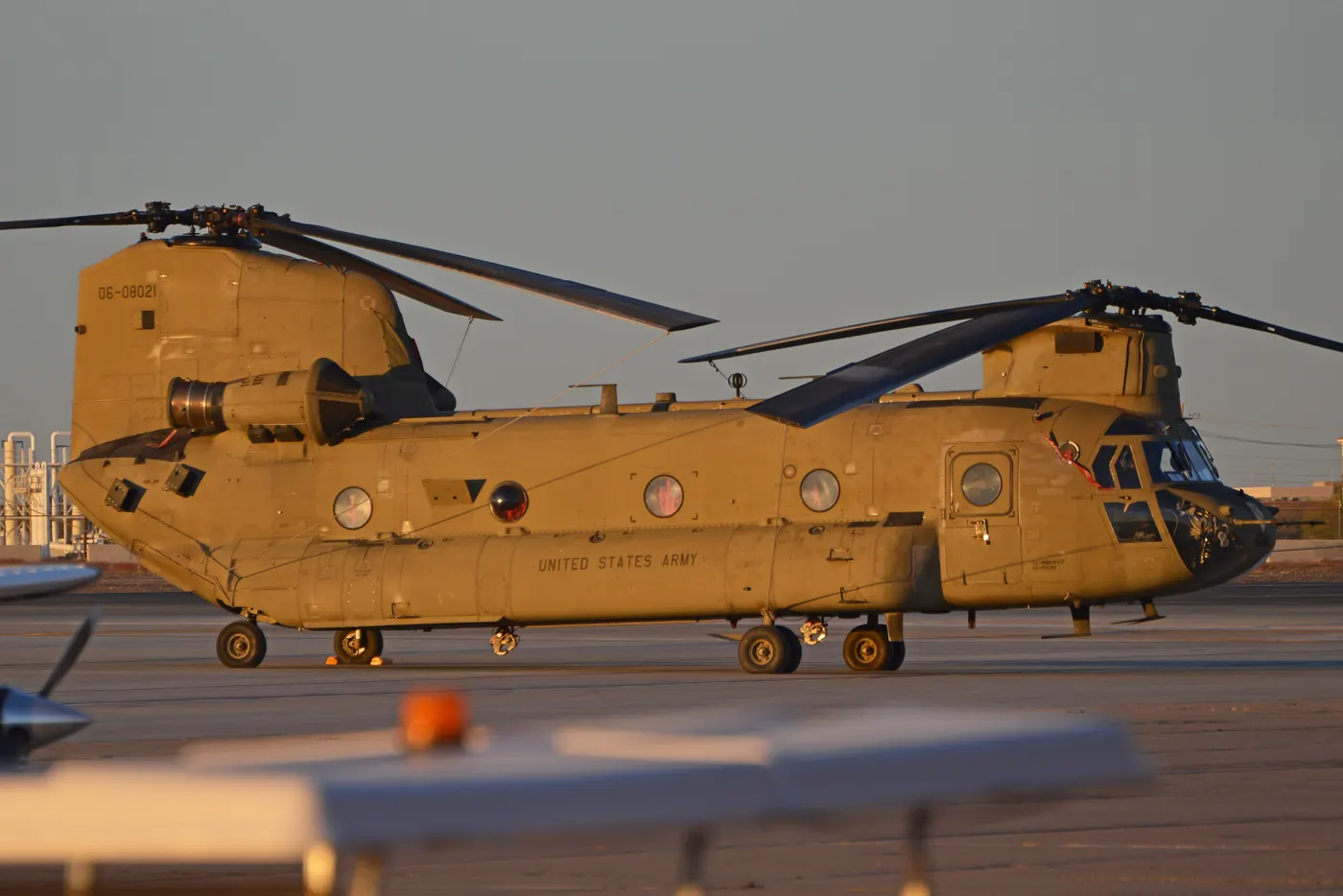
CH-47F Chinook
Category
Country
Prime contractor
Production
1962–
Operators
💰 PERFORMANCE / PRICE ASSESSMENT Methodology ↗
HEAVY LIFT HELICOPTERS · EARLY COLD WAR
1
PERFORMANCE/PRICE
92
UNIT COST (2025 USD)
—
ⓘ Performance/Price and MASS score are computed across all units in the heavy lift helicopters category, regardless of era.
02 / Specs & Design
◎General6MOD.6
- First Flight1961
- Service Entry Year1962
- Crew3
- Passengers33
- Primary RoleHeavy-lift transport helicopter
- In ServiceYes
◈Powerplant8MOD.8
- Engine TypeLycoming T55-GA-714A
- Number of Engines2
- Engine Power (each)3,039 kW
- Transmission Rating5,500 kW
- Rotor ConfigurationTandem-rotor
- Main Rotor Diameter18.29 m
- Main Rotor Blades3
- Anti-Torque TypeNOTAR
▣Performance10MOD.10
- Top Speed315 km/h
- Cruise Speed270 km/h
- Never-Exceed Speed (VNE)315 km/h
- Service Ceiling5,640 m
- Hover Ceiling (IGE)3,960 m
- Hover Ceiling (OGE)2,850 m
- Range740 km
- Ferry Range2,250 km
- Rate of Climb7.7 m/s
- Endurance180
◇Dimensions & Weights7MOD.7
- Fuselage Length15.54 m
- Height5.68 m
- Rotor Disc Area525.3
- Empty Weight12,700 kg
- Max Takeoff Weight22,680 kg
- Useful Load12,495 kg
- Cabin Volume43.9
◆Armament & Mission8MOD.8
- Hardpoints0
- Weapons Payload10,886 kg
- GunM240 7.62mm machine guns (door mounts)
- Anti-Tank MissilesNo
- Air-to-Air MissilesNo
- Rocket PodsYes
- Sling Load Capacity12,700 kg
- Rescue HoistYes
▤Avionics7MOD.7
⬢Survivability6MOD.6
▲Service History2MOD.2
- Production Start1962
- Operational StatusIn service
03 / History
SERVICE LIFESPANStill in Service
- 1962Production started
- 2005Entered service
64
years in service
14
countries operating
ⓘ The producing country still actively operates it.
04 / Variants
▚ WEAPON FAMILY
 CH-47F Chinook
// SIBLING VARIANTS
05 / Operators
Operator Inventory4country · 553units


553active
06 / MASS Score
HEAVY LIFT HELICOPTERS RANKING Heavy Lift Helicopters · Early Cold War
MASS RANKINGSMASS ↗
1HEAVY LIFT HELICOPTERS1EARLY COLD WAR · HEAVY LIFT HELICOPTERS19UNITED STATES · ALL WEAPONS3PERFORMANCE/PRICE · HEAVY LIFT HELICOPTERS
ⓘ Rankings are within theHeavy Lift Helicopterscategory.
📖 TERMS ON THIS PAGE12terms
Autopilot/AFCS (Automatic Flight Control System) is an avionics suite that automatically controls a helicopter’s attitude, navigation and flight path, providing stability augmentation and reducing pilot workload.
Chaff/Flare: Countermeasures deployed by attack helicopters to disrupt radar- or heat-seeking missiles by creating false targets or decoys.
Seats designed to absorb crash forces, reducing injury to occupants.
DIRCM/IRCM systems on attack helicopters that detect and disrupt infrared-guided missiles using directed energy or counter-radiation signals.
Combined forward-looking infrared (FLIR) and electro-optical (EO) sensor turret for target acquisition and tracking, typically mounted on aircraft or ground vehicles.
A glass cockpit is an aircraft cockpit featuring electronic instrument displays, typically LCD or CRT screens, replacing traditional analog gauges.
A helmet-mounted system that projects flight, targeting, and sensor data directly into a pilot's field of view.
Electronic receiver system that detects and identifies radar signals, alerting aircraft to potential threats for defensive countermeasures.
A mechanical device used to lift personnel or cargo via a cable, typically mounted on helicopters for rescue or recovery operations.
Aerodynamic containers mounted on aircraft, typically helicopters or fighter jets, that hold and launch unguided rockets in rapid succession.
Fuel tanks equipped with a material that automatically seals punctures from small arms fire or shrapnel to prevent leakage and reduce fire risk.
A radar system used to detect and track precipitation, storm intensity, and wind patterns to assist in flight operations and mission planning.
These terms are listed automatically because they appear on this page.full encyclopedia →
📚 Sources