

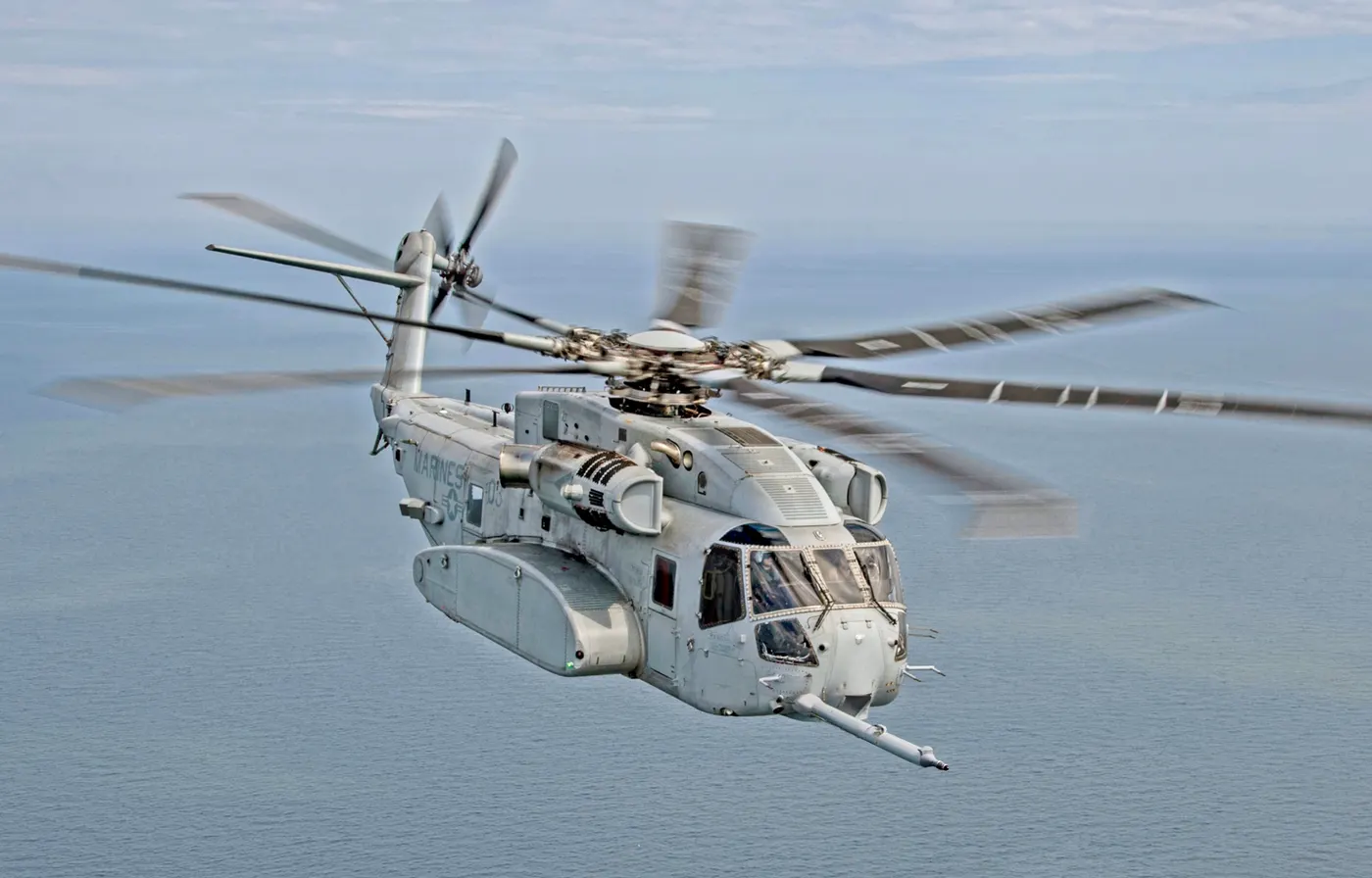
The Sikorsky CH-53K King Stallion is a three-engine heavy-lift helicopter developed for the United States Marine Corps as the replacement for the CH-53E Super Stallion.1 It first flew on 27 October 2015, entered low-rate production in 2017, and reached initial operational capability with Marine Heavy Helicopter Squadron 461 (HMH-461) on 22 April 2022.2,3 The Marine Corps' program of record calls for 200 aircraft, and Israel has ordered 12 more under its own designation, "Pere."4,19
- ~27,000 lb external lift at 110 nmi, roughly triple the CH-53E under the same conditions
- Full-authority fly-by-wire, hands-off brownout approach to a hover
- Split-torque gearbox and T408 engines cut parts count and maintenance hours sharply
- Three independent cargo hooks, internal HMMWV and 463L pallet capacity
- Same rotor-fold/tail-fold footprint as CH-53E, no new shipboard infrastructure needed
- Roughly seven-year schedule slip and tens of billions in program cost growth
- Unit price near or above 100 million dollars depending on lot and accounting method
- Early testing found gearbox, tail-boom vibration, and exhaust-reingestion faults
- Sole-source, single-manufacturer program with limited competitive leverage on price
- First operational deployment not scheduled until FY2027, over a decade after first flight
Externally the King Stallion resembles its predecessor, a deliberate choice, but almost nothing under the skin is shared with the CH-53E.5 Three General Electric T408 (GE38) turboshaft engines, each rated at roughly 7,500 shaft horsepower, drive a seven-blade elastomeric main rotor through a split-torque main gearbox, and a full-authority digital fly-by-wire flight-control system replaces the mechanical linkages of every earlier CH-53.1,6 Maximum takeoff weight is about 88,000 lb (40,000 kg), and the aircraft is rated to carry 27,000 lb externally over 110 nautical miles in Navy high-hot conditions, a figure the Marine Corps and Sikorsky both describe as roughly three times the CH-53E's performance against the same requirement.7,8
That performance did not come cheaply or on schedule. The program was authorized in December 2005, was expected to reach IOC around 2015, and slipped by roughly seven years while absorbing a gearbox redesign, an exhaust-gas reingestion problem that took years and 135 evaluated design options to fix, and a list of structural findings serious enough that the Pentagon's testing office delayed operational testing to address them.9,10,11 Total program cost, procurement plus development, grew to roughly 26 billion dollars, and the Government Accountability Office recommended capping annual purchases at six airframes until reliability was demonstrated.12,13 Unit flyaway cost has been quoted at figures from 87 million to over 130 million dollars depending on what is counted, numbers that fed a running argument in Congress and the trade press over whether a helicopter should cost as much as a fighter squadron's worth of aircraft.13,14
The King Stallion's airframe was built to fit inside the same shipboard footprint as the CH-53E, the same rotor-fold and tail-fold envelope, the same elevator dimensions on amphibious ships, so the Navy would not have to modify flight decks or hangar bays to operate it.5,15 Chief engineer Andreas Bernhard summarized the relationship between the two aircraft bluntly: "there is nothing small, and frankly there is nothing delicate, about this aircraft," adding that there is "no common part number between this aircraft and the old aircraft."5 The fuselage is about 73 ft (22.3 m) long and the seven-blade main rotor spans 79 ft (24.1 m); maximum takeoff weight is roughly 88,000 lb (40,000 kg), a 20 percent increase over the CH-53E's rated gross weight.7,16
- First Flight2015
- Service Entry Year2022
- Crew4
- Passengers55
- In ServiceYes
Power comes from three GE Aerospace T408-GE-400 (GE38-1B) turboshafts, each producing about 7,500 shp, for a combined output above 22,000 shp, which GE and Sikorsky describe as the most power ever fitted to a U.S. military helicopter.6,17 The T408 has roughly 63 percent fewer parts than the T64 engine it replaces, a design choice aimed directly at the CH-53E's punishing maintenance burden, where the fleet averaged over 40 maintenance man-hours for every flight hour.5,17 Engine changes that took most of a day on the E-model are intended to take about half a shift on the K.5 The three engines feed a split-torque main gearbox, a design that routes power from each engine through parallel gear paths to the rotor mast rather than a single combining stage, which lets the transmission handle more torque without a larger, heavier gearbox or a wider rotor disc.18 That gearbox was not trouble-free in development: bench testing turned up a retention-rod fault in the design that required a redesign and contributed to the program's schedule slip, though the Marine Corps' program manager stated in 2016 that "our gearbox issues are basically largely resolved."5,9
- Number of Engines3
- Engine Power (each)5,593 kW
- Transmission Rating13,423 kW
- Main Rotor Diameter24.08 m
- Main Rotor Blades7
The main rotor itself uses an elastomeric hub, rubber-and-metal laminate bearings that need no lubrication, carrying seven composite blades with anhedral, swept tips; the design eliminates the pressurized titanium spar used on the CH-53E's blades, which had to be monitored for internal pressure loss as a proxy for structural damage.1,18 Flight control is fully fly-by-wire, with no mechanical backup, an active first for a U.S. heavy-lift type, using sidearm cyclic controllers with tactile cueing that push back against the pilot's hand as engine or structural limits approach.6,5 Sikorsky's chief experimental test pilot, Stephen McCulley, described the handling qualities in terms that would have been unthinkable in the CH-53E: "now I can go into a brownout without touching the controls and come to a hover," and, more pointedly, "I hate to say it, but the aircraft flies better than I do."5 The flight-control system can hold a hover position to within about one foot laterally and vertically indefinitely, a precision aimed squarely at confined landing zones and shipboard vertical replenishment.5
- Top Speed315 km/h
- Cruise Speed314.813 km/h
- Never-Exceed Speed (VNE)315 km/h
- Service Ceiling4,876.8 m
- Hover Ceiling (IGE)3,500 m
- Hover Ceiling (OGE)2,900 m
- Range852 km
- Ferry Range1,600 km
- Rate of Climb12.7 m/s
- Endurance360
The CH-53K is designed and built by Sikorsky (a Lockheed Martin company) primarily at its Stratford, Connecticut and West Palm Beach, Florida facilities, with final assembly in Florida, making the airframe overwhelmingly American in origin.1,2 The three T408 engines are built by GE Aerospace in the United States, and the fly-by-wire flight control system draws on BAE Systems' active-inceptor technology, also produced domestically.6,5 Sikorsky and the Navy have also brought some avionics and mission systems from allied suppliers into export configurations, most visibly for Israel, where Elbit Systems is integrating Israeli-specified systems into that country's aircraft under a separate contract.19 For the U.S. Marine Corps baseline aircraft, domestic content is estimated at roughly 90 percent or higher by value, with the most significant foreign content limited to allied avionics packages fitted only to export airframes.
The cabin is wide enough to carry a High Mobility Multipurpose Wheeled Vehicle internally or two 4,500 kg 463L pallets side by side, letting a King Stallion reload directly from a C-5 or C-17 without breaking pallets down first.20 Externally, the aircraft retains three independent cargo hooks, so it can pick up, carry, and release two or three separate slung loads on a single sortie, and it is rated to lift 27,000 lb over 110 nautical miles under Navy-specified high-and-hot conditions (3,000 ft density altitude, 91.5°F), a key performance parameter the Marine Corps and Sikorsky both describe as roughly triple the CH-53E's capability against the identical requirement.7,8 Maximum external lift under less demanding conditions reaches 36,000 lb, and in 2016 a test aircraft demonstrated the 27,000 lb, 110 nmi combination during flight trials.21,22
- Fuselage Length30.175 m
- Height8.534 m
- Rotor Disc Area455.3
- Empty Weight19,903.061 kg
- Max Takeoff Weight38,400 kg
- Useful Load23,329 kg
- Cabin Volume31.1
- Hardpoints0
- Weapons Payload16,330 kg
- Anti-Tank MissilesNo
- Air-to-Air MissilesNo
- Rocket PodsNo
- Sling Load Capacity16,330 kg
- Rescue HoistYes
- Total Built19
- Variants1
- Production Start2015
The Marine Corps began looking for a CH-53E replacement in the early 2000s as the Super Stallion fleet aged and readiness suffered; a 2016 internal review would later describe the CH-53E's inventory and availability as inadequate and unacceptable, underscoring the urgency behind the new program.5 The Heavy Lift Replacement program, which became the CH-53K, was authorized on 22 December 2005 to begin a development effort valued at roughly 4.4 billion dollars, and Sikorsky received an initial system development and demonstration contract worth 8.8 million dollars in January 2006, followed by a much larger, roughly 3 billion dollar contract modification in April 2006.9 Sikorsky was awarded the work sole-source; as the original CH-53E's manufacturer, the Navy judged it the only source realistically capable of designing and building the required aircraft.9
Development ran far longer than planned. A Ground Test Vehicle, essentially an unflyable test rig, ignited its engines and spun a bare rotor head (without rotor blades attached) in January 2014 to validate the drivetrain before committing it to a flying prototype.23 The first flight, planned for years earlier, slipped repeatedly, in part because of the titanium quill-shaft and gearbox retention-rod issues discovered during bench testing, and finally took place on 27 October 2015 at Sikorsky's West Palm Beach facility, an approximately 30-minute flight with Stephen McCulley at the controls.23,1 By December 2016 the test fleet, four flight-test aircraft, had logged 314 flight hours, was adding 50 to 60 hours a month, and had reached 185 knots and 10,000 ft, alongside lifts up to 27,000 lb.5
Testing surfaced a lengthy list of technical problems through the late 2010s. Exhaust gas reingestion, hot engine exhaust drawn back into the engine intakes or impinging on the airframe, degraded engine performance, threatened composite skin temperature limits, and forced early termination of some test maneuvers; fixing it meant evaluating 135 candidate design changes before Sikorsky and NAVAIR settled on a production solution, work Sikorsky said was largely validated by late 2019 with a roughly two-year knock-on delay to the schedule.10,11,25 Parallel test reports from the Pentagon's Director, Operational Test and Evaluation flagged tail-boom vibration and resonance risking hydraulic lines, delamination and cracking in the tail-rotor flexbeam, overheating main-rotor dampers, airspeed-indication anomalies, and low reliability in the main rotor gearbox, prompting DOT&E to push initial operational test and evaluation into 2021 so fixes could be verified before the fleet relied on them.11,26 A 2021 GAO report found a moderate risk that the program would not meet its reliability or payload requirements by the end of operational testing and recommended the Navy cap production at six aircraft a year until testing was complete, warning that ramping production ahead of finished testing risked expensive retrofits.12,13
The aircraft cleared these hurdles well enough to reach IOC with HMH-461 on 22 April 2022, followed by full-rate production approval later that year.3,27 By 2025 to 2026 four squadrons, HMH-461, the training squadron HMHT-302, and the developmental and operational test squadrons HX-21 and VMX-1, were flying about 25 delivered aircraft past 10,000 combined fleet flight hours, with NAVAIR's H-53 program manager describing herself as "extremely happy with how the aircraft is performing" operationally.28 Total program cost growth, driven by both the technical fixes and a Marine Corps decision to raise total planned procurement from 156 to 200 aircraft, has been estimated at roughly 15.3 billion dollars above original projections.12
As of mid-2026 the CH-53K has not deployed to a combat theater; the Marine Corps' first scheduled operational deployment, with the 26th Marine Expeditionary Unit, is set for fiscal year 2027, more than a decade after the type's first flight.28,29 The aircraft's closest approach to a real-world mission so far came in September 2021, before IOC, when Marine test-squadron King Stallions recovered a downed Navy MH-60S Seahawk from a 12,000 ft mountain ridge near Bishop, California, a heavy-lift recovery mission of exactly the kind the type was designed for, described by the officer in charge as "exactly what the K is made to do."24 The predecessor CH-53E, which the King Stallion is replacing, remains the Marine Corps' combat-proven heavy lifter and is scheduled to serve alongside the newer type until roughly 2032.28
The baseline and, so far, only variant in service is the CH-53K King Stallion built for the U.S. Marine Corps, differentiated mainly by production lot as engine, software, and structural fixes were incorporated across the test and early production aircraft.9 Israel's order covers a dedicated export configuration, locally named "Pere" (Wild), fitted with Israeli-specified mission systems integrated by Elbit Systems under a March 2025 contract, with first Israeli deliveries expected around 2028.19,30 Germany evaluated the CH-53K for its Schwerer Transporthubschrauber requirement but ultimately selected the CH-47F Chinook instead, so no German-specific King Stallion variant exists.31
Beyond the in-service configuration, the Navy and Marine Corps have discussed, but not funded, a mine-countermeasures variant that could succeed the Navy's aging MH-53E Sea Dragon, which is slated for withdrawal around 2027; Navy officials have said only that they remain "open to that in the future, should that need arise."32 Analysts have argued the King Stallion's digital, networked design would let such a variant act less like a traditional minesweeper and more like an airborne coordination node for uncrewed underwater and surface mine-hunting systems, though this remains a proposal rather than a program.33 Sikorsky has also floated combat-search-and-rescue and heavy special-operations roles built on the same airframe, none of which had entered formal development as of 2026.1

| Year | Buyer | Quantity | Amount | Present Value (2025) |
|---|---|---|---|---|
| 2025 |  Israel | 12 | — | — |
| 2025 |  United States | 99 | $10.80 Mr | $10.80 Mr |
| 2023 | United States | 27 | $2.70 Mr | $2.85 Mr |
| 2022 | Israel | 12 | $2.00 Mr | $2.20 Mr |
| 2006 | United States | — | $3.00 Mr | $4.79 Mr |
| — | Israel | 12 | — | — |
The U.S. Marine Corps is the only current operator, flying the CH-53K from four squadrons, HMH-461 as the first fully stood-up fleet squadron, HMHT-302 as the fleet replacement and training squadron, and the test units HX-21 (Naval Air Systems Command, Patuxent River) and VMX-1 (Marine Corps, Yuma), with roughly 25 aircraft delivered against a program of record of 200.28 Israel is the first confirmed export customer, having signed a contract in March 2025 for 12 CH-53K helicopters (locally "Pere") to replace its CH-53D "Yasur" fleet, with deliveries expected to begin around 2028; the CH-53D had already been kept in Israeli service well past its planned retirement date because no replacement was ready.19,30
Germany represents the most consequential non-sale. Berlin's Schwerer Transporthubschrauber competition pitted the CH-53K against the CH-47F Chinook; Germany briefly cancelled the program in 2020 over cost, restarted it in 2021, and in June 2022 selected 60 Chinooks instead, citing the Chinook's roughly 32 million dollar unit cost against the King Stallion's approximately 91.6 million dollar flyaway cost, as well as interoperability benefits with the Netherlands and other Chinook-operating NATO members.31,34 Sikorsky has said it continues to view Germany as a potential future customer despite the loss.35
The King Stallion's closest points of comparison are its own predecessor and the aircraft that beat it in Germany. Against the CH-53E Super Stallion, the King Stallion's case rests on payload and maintainability rather than a fundamentally different concept: same three-engine, single-main-rotor layout, similar external size and shipboard footprint, but roughly triple the external lift at the Navy's high-hot reference mission (27,000 lb at 110 nmi versus the CH-53E's baseline), a maximum takeoff weight about 20 percent higher, and an engine and gearbox architecture built explicitly to cut the CH-53E's maintenance load, which had run past 40 man-hours per flight hour.7,5 Whether that gain justifies a unit price several times the CH-53E's has been the program's central argument in Congress, and it is the same argument, inverted, that cost Sikorsky the German contract.13,31
Against the Boeing CH-47F Chinook, the comparison is less about raw lift, the two aircraft's payload figures are broadly similar at comparable mission radii, and more about configuration and price. The Chinook's tandem-rotor layout needs no tail rotor and offers a simpler, cheaper, twin-engine design with a much larger fielded fleet and deeper multinational support base; the King Stallion's three-engine, single-main-rotor layout and full fly-by-wire controls are newer and, its advocates argue, better suited to degraded hover precision and shipboard operations, but at a flyaway cost close to three times the Chinook's roughly 32 million dollars.31,34 Germany's decision to choose the Chinook is the clearest real-world test of that trade-off, and it went against Sikorsky on cost and interoperability grounds rather than on capability.31
How much can the CH-53K King Stallion actually lift?
Under the Navy's high-hot reference condition (3,000 ft density altitude, 91.5°F), the King Stallion is rated to carry 27,000 lb externally over 110 nautical miles, a figure the program describes as roughly triple the CH-53E's performance against the same requirement.7,8 Under less demanding conditions its maximum external lift rises to about 36,000 lb, and the aircraft can carry internal loads including a HMMWV or two 4,500 kg 463L pallets.21,20
Why did the program take so long and cost so much?
The CH-53K was authorized in 2005 and expected to reach service around 2015, but slipped roughly seven years to an April 2022 initial operational capability. Contributing problems included a main-gearbox retention-rod redesign, an exhaust-gas reingestion issue that took years and 135 evaluated fixes to resolve, and structural findings (tail-boom vibration, rotor-damper overheating, flexbeam cracking) flagged by Pentagon testers.9,10,11 Total program cost grew by an estimated 15.3 billion dollars, partly from these fixes and partly from a Marine Corps decision to raise total procurement from 156 to 200 aircraft.12
Why did Germany choose the CH-47 Chinook instead of the CH-53K?
Germany's Schwerer Transporthubschrauber competition came down largely to cost and interoperability. The CH-47F Block II's roughly 32 million dollar unit cost was far below the CH-53K's approximately 91.6 million dollar flyaway cost, and choosing the Chinook also aligned Germany with the Netherlands and other NATO Chinook operators.31,34
Has the CH-53K seen combat?
No. As of mid-2026 the King Stallion has not deployed to a combat theater; its first scheduled operational deployment, with the 26th Marine Expeditionary Unit, is planned for fiscal year 2027.28,29 Its most operationally significant real-world mission to date was a September 2021 recovery of a downed Navy MH-60S Seahawk from a mountain ridge in California, flown before the type had even reached initial operational capability.24
What makes the CH-53K's flight controls different from earlier CH-53 models?
The King Stallion uses a full-authority digital fly-by-wire flight-control system with no mechanical backup, the first U.S. heavy-lift helicopter built this way, replacing the mechanical linkages of the CH-53E entirely.6,5 The system can hold a hover to within about one foot of a fixed point indefinitely and can fly a hands-off approach through brownout dust conditions to a stable hover, a maneuver earlier CH-53 pilots had to manage manually.5
Who else besides the U.S. Marine Corps flies or has ordered the CH-53K?
Israel ordered 12 CH-53Ks (locally named "Pere") in March 2025 to replace its CH-53D "Yasur" fleet, with Elbit Systems integrating Israeli mission systems and first deliveries expected around 2028.19,30 Germany evaluated but ultimately rejected the type in favor of the CH-47F Chinook.31
- "Sikorsky CH-53K King Stallion", Wikipedia — en.wikipedia.org ↩
- "CH-53K King Stallion", NAVAIR — navair.navy.mil ↩
- "Marine Corps declares IOC for CH-53K King Stallion", U.S. Marine Corps — marines.mil ↩
- "Sikorsky Starts Assembling Israel's CH-53K Pereh Fleet", TURDEF — turdef.com ↩
- "Meet the King", Vertical Magazine — verticalmag.com ↩
- "CH-53K Helicopter", Lockheed Martin — lockheedmartin.com ↩
- "CH-53K King Stallion Achieves 27,000 Pound External Lift", PR Newswire — prnewswire.com ↩
- "CH-53K King Stallion Heavy Lift Replacement (HLR)", GlobalSecurity.org — globalsecurity.org ↩
- "CH-53K Heavy-Lift Helicopter Program Acquisition Case History", Defense Technical Information Center — apps.dtic.mil ↩
- "CH-53K Team Fixes Engine Exhaust Gas Reingestion", Aviation Week — aviationweek.com ↩
- "'Multiple Design Deficiencies' To Delay CH-53K Testing, DOT&E Says", Defense Daily — defensedaily.com ↩
- "Marines Should Reduce King Stallion Helicopter Buys Until Tech Problems Fixed, GAO Says", Military.com — military.com ↩
- "Total cost of CH-53K is $131 million per helicopter: Here's the breakdown", Defense News — defensenews.com ↩
- "Is $138 Million for the CH-53K Helicopter Justified?", The Defense Post — thedefensepost.com ↩
- "The CH-53K 'King Stallion' Facts", Second Line of Defense — sldinfo.com ↩
- "Sikorsky CH-53K King Stallion Specs, Interior, Cockpit, and Price", Helicopter Specs — helicopterspecs.com ↩
- "T408 Turboshaft Engine", GE Aerospace — geaerospace.com ↩
- "CH-53K King Stallion: Heavy-Lift Evolution & Future", Combat Tech — combattech.net ↩
- "Sikorsky to integrate Israeli systems on Israel's CH-53K helicopters", Breaking Defense — breakingdefense.com ↩
- "Interesting Facts about the Sikorsky CH-53K King Stallion", Crew Daily — crewdaily.com ↩
- "CH-53K King Stallion Heavy Lift Transport Helicopter, USA", Naval Technology — naval-technology.com ↩
- "CH-53K King Stallion achieves 27,000-pound external lift", Vertical Magazine — verticalmag.com ↩
- "CH-53K King Stallion: 10 Years since First Flight", NAVAIR — navair.navy.mil ↩
- "Marines' CH-53K King Stallion Lifts Stricken MH-60 Seahawk In Its First Real-World Mission", The War Zone — twz.com ↩
- "Sikorsky deems CH-53K engine exhaust issue fixed", Vertical Magazine — verticalmag.com ↩
- "CH-53K IOC pushed back to 2021 for multiple design deficiencies", The Aviation Geek Club — theaviationgeekclub.com ↩
- "USMC's New CH-53K King Stallion Cleared For Full-Rate Production", The War Zone — twz.com ↩
- "Confidence In CH-53K King Stallion Grows Ahead Of First Operational Deployment", The War Zone — twz.com ↩
- "Heavy lift helicopter program prepping for 2025 first deployment", Defense News — defensenews.com ↩
- "Israeli Air Force to fly new CH-53k helicopter in 2026", The Jerusalem Post — jpost.com ↩
- "Germany Picks Chinook Over King Stallion For New Heavy-Lift Helicopter", The War Zone — twz.com ↩
- "Senate Suggests Sikorsky CH-53K For Navy Mine Hunting", Defense Daily — defensedaily.com ↩
- "From Sea Dragon to Kill Web Node: The CH-53K as Airborne Manager of the Mine-Warfare Fight", Defense.info — defense.info ↩
- "Germany chooses Chinook for future heavy lift competition", Breaking Defense — breakingdefense.com ↩
- "Sikorsky still eyeing Germany for CH-53K sale, despite Chinook deal", FlightGlobal — flightglobal.com ↩