

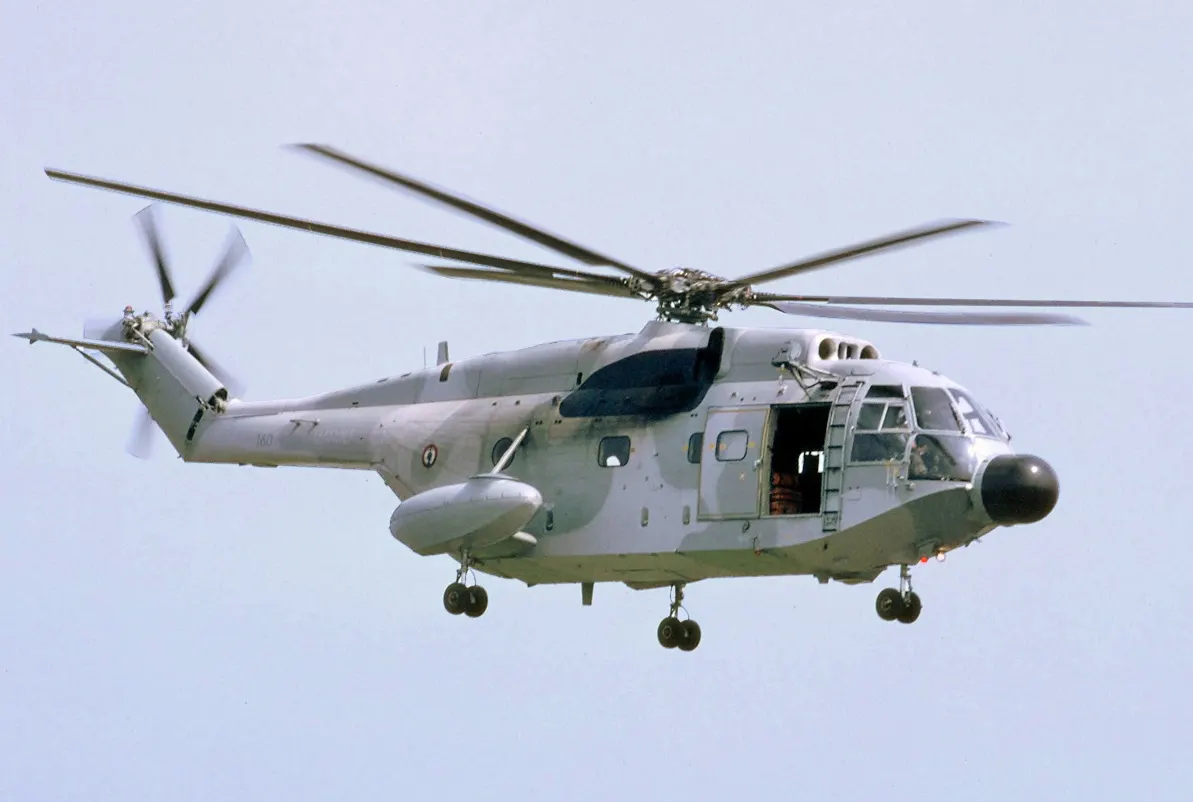
The Aérospatiale SA 321 Super Frelon is a three-engine heavy transport helicopter developed in France by Sud Aviation, first flown on 7 December 1962 and produced until 1981.1,2 It grew out of an earlier, underpowered design, the SE 3200 Frelon, and reached its final form only after Sud Aviation brought in Sikorsky Aircraft of the United States to redesign the rotor system, transmission mounting, and fuselage.1 At roughly 13 tonnes maximum takeoff weight, it was for years the most powerful helicopter built in Western Europe, and a modified prototype held the world absolute helicopter speed record from July 1963.1,2
- Three-engine redundancy, survivable single-engine-out flight
- Boat-hull fuselage allowed brief alighting on calm water
- Held the world helicopter speed record (350 km/h, 1963)
- Heaviest, most powerful helicopter built in Western Europe at introduction
- Exocet-capable anti-ship variant, unusual for a helicopter of its era
- Only about 110 built, thin production run versus Puma or CH-53
- Three engines meant high fuel burn and maintenance cost
- Limited to calm-water alighting only, not true sea-state landings
- Cabin narrower than the Sikorsky CH-53, constrains vehicle loads
Sud Aviation, absorbed into Aérospatiale in 1970, built about 110 Super Frelons in total, a modest run compared with contemporaries such as the Sikorsky CH-53 or the firm's own SA 330 Puma.1 Buyers were correspondingly few but strategically significant: the French Navy, the Israeli Air Force, Iraq, Libya, South Africa, and China, the last of which reverse-engineered the design into the Changhe Z-8 family that still forms the backbone of Chinese naval helicopter aviation.1,14 A boat-shaped, watertight lower fuselage let the naval version alight briefly on calm water, a Sikorsky-licensed feature almost unique among Cold War-era heavy helicopters.1,4
Militarily, the Super Frelon's career reads as a chain of specific, often obscure operations rather than one dominant role: French anti-submarine patrols shadowing the Force de Frappe's ballistic-missile submarines, Israeli commando insertions deep into Egyptian and Lebanese territory, and Iraqi Exocet-armed anti-ship strikes during the Tanker War of the 1980s.1,3,7 Production ended decades ago, but derivatives descended from its airframe remain in first-line service with the Chinese navy today.14
The Super Frelon's airframe is built around a semi-monocoque hull rather than a conventional helicopter belly, with a bow, a planing bottom, and watertight bilge compartments, a configuration modeled directly on Sikorsky's flying-boat and amphibious-helicopter research going back to the 1930s.1,4 Two external fuel tanks, mounted low on the fuselage sides, double as stabilizing floats, and the arrangement lets the naval version settle briefly onto calm water for search-and-rescue or torpedo-recovery work, though it was never intended for landings in any real sea state.1,4 The cabin measures 6.12 m long and 1.90 m wide, adequate for 27 to 30 troops, 15 to 18 stretcher casualties, or a slung underbelly load, but notably narrower than the cargo hold of the American Sikorsky CH-53 it competed against on the export market.1,2
- First Flight1962
- Service Entry Year1966
- Crew3
- Passengers37
- In ServiceYes
Sikorsky-Designed Rotor and Transmission
The aircraft that flew in December 1962 bore little resemblance to Sud Aviation's original 1959 Frelon prototypes, which had proven overweight and vibration-prone. A 1961 technical agreement brought in Sikorsky, which supplied the design for a new six-blade main rotor and five-blade tail rotor, together with hydraulically actuated, self-retracting rotor-blade hardware that French industry could not yet build on its own; a small initial batch of these assemblies was built at Sikorsky before Sud Aviation took over production under license.1,5 Italian manufacturer Fiat contributed the design of the combining gearbox that geared all three engines into a single main transmission, rated at up to 4,080 kW and engineered so that any one engine could fail without stopping the rotor.1 The six-blade main rotor turns at 207 rpm; both rotors carry a Blade Inspection Method system that senses internal pressure loss and flags fatigue cracking before it becomes critical.1
- Number of Engines3
- Engine Power (each)1,500 kW
- Transmission Rating4,500 kW
- Main Rotor Diameter19 m
- Main Rotor Blades6
Three Turbomeca Turmo Turboshafts
Power comes from three Turbomeca Turmo IIIC turboshafts of roughly 1,160 kW (1,550 hp) each in series production, mounted side by side above the cabin and geared into the common transmission.1,2 The arrangement was expensive to run, a three-engine helicopter needs three sets of hot-section inspections and three fuel systems, but it bought genuine engine-out survivability that contemporary twin-engine designs of similar weight could not match, and it let Sud Aviation build a helicopter heavier than any twin-engine European type of the period.1 Standard fuel capacity is 3,975 liters, extendable with auxiliary tanks to give a still-air range of about 1,020 km and an endurance near four hours; cruise speed is 249 km/h with a never-exceed speed of 275 km/h.1,2
- Top Speed350 km/h
- Cruise Speed249 km/h
- Never-Exceed Speed (VNE)275 km/h
- Service Ceiling3,150 m
- Hover Ceiling (IGE)2,000 m
- Hover Ceiling (OGE)1,500 m
- Range1,020 km
- Ferry Range1,650 km
- Rate of Climb6.5 m/s
- Endurance240
The Super Frelon was assembled in France by Sud Aviation (later Aérospatiale) at Marignane, with Turbomeca supplying the three Turmo turboshaft engines domestically, so French final assembly and propulsion content was high. The critical exception was the drivetrain: the main and tail rotor systems, the hydraulic blade-folding gear, and the boat-hull hydrodynamics were designed by Sikorsky in the United States and the main gearbox by Fiat in Italy, with only later production runs license-built on French soil.1,5 China's Changhe Z-8 derivative inherited this dependency at one remove, reaching only about 86 percent localization by 1994 and needing further French production assistance into the early 2000s before Chinese industry could build the type unaided.14
- Fuselage Length23.03 m
- Height6.66 m
- Rotor Disc Area283.5
- Empty Weight6,863 kg
- Max Takeoff Weight13,000 kg
- Useful Load6,137 kg
- Cabin Volume21.2
- Hardpoints2
- Weapons Payload5,000 kg
- Sling Load Capacity5,000 kg
- Rescue HoistYes
- Total Built110
- Variants15
- Retirement Year2010
- Production Start1962
- Production End1981
Sud Aviation's helicopter effort began with the SE 3200 Frelon, intended to replace the Sikorsky H-34 during the Algerian War; its two 1959 prototypes proved roughly a tonne overweight and mechanically troublesome, and the design stalled.1 A 1961 cooperation agreement with Sikorsky produced a thoroughly reworked machine, the SA 321, selected from three competing in-house configurations and fitted with the American-designed rotor, transmission mounting, and hull.1 The first prototype, F-ZWWE, flew at Marignane on 7 December 1962 under chief test pilot Jean Boulet, powered by three Turbomeca Turmo IIIC2 engines.1
On 22 and 23 July 1963 a specially prepared prototype, flown by Boulet and Roland Coffignot, set three FAI world records in succession: 341.2 km/h over a 3 km course, 350.5 km/h over an unrestricted 15 to 25 km course (the absolute helicopter speed record of the day), and 334.3 km/h over a 100 km closed circuit.1,2 The flights were aerodynamically refined by engineer Marcel Riffard and were aimed squarely at generating export interest; West Germany and Italy both evaluated the type before ultimately buying Sikorsky designs (the CH-53 and SH-3 Sea King) instead.1
Series production ran from 1964, with the type entering French Naval Aviation service from October 1965 and the Israeli Air Force's 114 Squadron from April 1966, the Hebrew nickname Tzir'a ("Hornet") echoing the French Frelon.1,6 Total output over the run stayed near 110 airframes, a small number that reflected the aircraft's cost: at roughly 1.25 million dollars apiece in 1965 and about 7,500 Swiss francs an hour to operate, the three-engine Super Frelon could not compete commercially with the cheaper, single-turbine Puma that Sud Aviation was selling alongside it, and civil orders (Olympic Airways in Greece, Bergen Air Transport in Norway, Pelita Air Service in Indonesia) never grew beyond a handful of aircraft.1 Production ceased in 1981 for lack of further orders, by which point most surviving airframes were already serving with the export customers who would define its combat record.1
Israel took delivery of its first Super Frelons in April 1966, and only four were in service when the Six-Day War began in June 1967; they nonetheless flew medical evacuation from the opening day and, on 7 June, landed troops at Sharm el-Sheikh at the southern tip of Sinai.6 A single Super Frelon also flew a deep-penetration night mission into Egyptian airspace to extract a downed Israeli officer, Major Shahar, returning him to Israeli territory before dawn.6 By war's end the squadron had flown 41 sorties with an aircraft type barely a year into service.6
The following War of Attrition produced the type's most distinctive missions. On 26 to 27 December 1969, three Super Frelons flew paratroopers across the Red Sea to Ras Gharib on the Egyptian coast in Operation Rooster 53, where the troops dismantled a complete Soviet-supplied P-12 early-warning radar system, including its four-ton main unit, before dawn; two Sikorsky CH-53s then airlifted the disassembled radar back to Sinai, one so overloaded by the main unit that it was damaged and forced into an emergency landing.8 The operation gave Israeli and American intelligence direct access to Soviet radar technology without a single shot fired at the site itself.8 Weeks earlier, in July 1969's Operation Bulmus 6, Israeli forces destroyed an Egyptian radar and electronic-intelligence post on Green Island in the Gulf of Suez; the assault itself went in by sea, but the wider campaign of raids in the area relied on Super Frelons to move troops and equipment along the Sinai coast.7
Iraq operated the Super Frelon in an anti-ship role, arming the SA 321H variant with AM39 Exocet missiles and nose-mounted search radar to strike shipping bound for Iranian ports during the Tanker War phase of the Iran-Iraq War.3,11 With a combat radius of roughly 150 nautical miles, Iraqi Super Frelons could reach convoys well up the Gulf, and during the peak years of 1984 to 1985 Exocet-armed strikes, launched from Super Frelons, Mirage F1s, and Super Étendards together, accounted for the overwhelming majority of Iraqi attacks on merchant shipping.11 The type's most documented single engagement did not go Iraq's way: on 14 February 1986, a Super Frelon crew fired an Exocet at what they took to be a tanker near Khark Island, then lost track of two intercepting Iranian F-4 Phantoms that had approached under radar silence; one Phantom's air-to-air missile brought down the rotor and the helicopter crashed into the Gulf with no survivors, a loss for which Saddam Hussein reportedly imprisoned the squadron's commanding officer.10
By the 1991 Gulf War Iraq's Exocet-capable Super Frelons were a known target set; on 13 February 1991, two U.S. Navy F/A-18A Hornets of squadron VFA-195 destroyed at least one Iraqi Super Frelon on the ground in southern Iraq as part of the broader effort to eliminate Iraq's anti-ship missile capability before it could be used against coalition shipping.12,13
The lineage begins with the SE 3200 Frelon, an underpowered 1959 prototype that never reached production, and continues through the reworked SA 321 family that resulted from the Sikorsky collaboration.1 The French Navy's SA 321G was the definitive military type, fitted for anti-submarine warfare with dunking sonar, homing torpedoes, and depth charges, and later modified on some airframes to carry nose radar and two AM39 Exocet missiles for anti-ship strikes and submarine-escort sanitization patrols.1,3 Civil variants followed the same airframe with the rear ramp removed and a restyled nose: the SA 321F, certified in 1968 and flown briefly by Olympic Airways between Greek islands, and the SA 321J, an oil-industry transport used by operators including Bergen Air Transport.1
Export customers received dedicated marks. Israel's SA 321K was configured for troop transport and commando insertion; South Africa's SA 321L served as a general military transport; Iraq's SA 321H carried the Exocet and search-radar fit; and Libya received two related versions in 1980 and 1981, the radar-equipped SA 321GM and the SA 321M configured for search and rescue and transport.1 China took delivery of 12 navalized Super Frelons, in anti-submarine and search-and-rescue configurations, between December 1975 and April 1977, the first helicopter in Chinese naval aviation history able to operate from a ship's flight deck.14
That Chinese purchase seeded a separate production line. Changhe Aircraft Industries began reverse-engineering the design in 1976 as the Z-8, a program delayed through 1979 by technical difficulties and funding shortfalls; France formally licensed the Z-8 designation in 1981, and Changhe's first prototype flew in December 1985, with the type entering PLA Naval Air Force service in August 1989.14 Chinese engineers struggled for years to master the license-built drivetrain without direct French support, and the localization rate had reached only about 86 percent by 1994; French assistance continued to resolve production problems into the early 2000s.14 Later Chinese derivatives, the re-engined Z-8F and the further-modernized Z-18 with a glass cockpit and improved powerplants, remain the People's Liberation Army Navy's standard shipboard heavy helicopters, a service life the original French design never itself achieved at home.14


| Year | Buyer | Quantity | Amount | Present Value (2025) |
|---|---|---|---|---|
| 1981 |  People's Republic of China | — | — | — |
| 1980 |  Libya | 14 | — | — |
| 1977 |  Iraq | 16 | — | — |
| 1975 | People's Republic of China | 12 | — | — |
| 1966 |  Israel | 12 | — | — |
| 1966 |  South Africa | 16 | — | — |
| 1964 |  France | 99 | — | — |
France was the largest single operator, with the Marine Nationale eventually flying about 99 Super Frelons across several flotilles, escorting Redoutable-class ballistic-missile submarines and flying search-and-rescue and commando-transport duties until the last examples retired from Lanvéoc-Poulmic on 30 April 2010.1,3 Israel operated 12 aircraft with the 114 Squadron from 1966 until retirement in 1991, several of which are preserved at the Israeli Air Force Museum at Hatzerim.6 Iraq received roughly 16 Exocet-capable SA 321H helicopters from 1977, used through both the Iran-Iraq War and the 1991 Gulf War.11,13 Libya took delivery of nine aircraft (six SA 321GM, three or more SA 321M) in 1980 to 1981, and South Africa operated 16 SA 321Ls until the type was superseded by the locally built Denel Oryx in the early 1990s.1,16 China's 12 imported airframes were followed by a much larger indigenous Z-8 family still in front-line service.14 A single aircraft went to Zaire, and civil examples flew briefly in Greece, Norway, and Indonesia.1
Against the Sikorsky CH-53, the helicopter France ultimately lost the West German and Italian orders to, the Super Frelon gave up raw lift capacity: the CH-53's twin-engine layout and wider cabin allowed larger vehicle and cargo loads, and Sikorsky's own hull technology, which France had licensed to build the Super Frelon in the first place, went on to a more successful amphibious career on the S-61 and CH-53 family itself.1,4 What the French design offered instead was the redundancy of a third engine, a genuine safety margin for a type flown extensively over the sea and behind enemy lines, and a compact enough footprint to complicate Egyptian and Syrian radar coverage during deep-penetration Israeli raids where the Sikorsky-derived CH-53's greater size was less of an advantage.1,6
The Soviet Mil Mi-6, roughly contemporary and far more numerous, outclassed the Super Frelon in raw lift, over 12 tonnes of payload against the French design's five, but sacrificed the amphibious hull and the fine handling that let Super Frelon crews fly precision commando-insertion profiles at very low level over water and desert.1 The clearest long-run comparison is with its own descendant, the Changhe Z-8: where the original French airframe went out of production in 1981 after roughly 110 built, the reverse-engineered Chinese line has run for decades longer, evolving through the Z-8F and Z-18 into the standard shipboard helicopter of a navy operating dozens of destroyers and carriers, a production afterlife the Super Frelon itself never enjoyed in France.14


Why did the Super Frelon have three engines instead of two?
Sud Aviation needed enough installed power to lift a helicopter heavier than any twin-engine European design of the early 1960s, and a three-engine layout meant the aircraft could survive the loss of any single engine, a meaningful margin for a helicopter that spent much of its career over open water or deep inside hostile airspace.1 The tradeoff was cost: three sets of engines to maintain made the Super Frelon markedly more expensive to fly than contemporary twin-engine types.1
Did the Super Frelon actually land on water?
Its lower fuselage was built as a genuine hull, with a bow, planing bottom, and watertight compartments derived from Sikorsky's amphibious-helicopter research, and the naval version could alight briefly on calm water for torpedo recovery or rescue work.1,4 It was never rated for landings in any real sea state, and the capability was closer to an emergency and utility feature than a routine operating mode.4
What was Israel's most notable Super Frelon mission?
Operation Rooster 53 in December 1969, in which three Super Frelons flew paratroopers into Egypt to dismantle an intact Soviet P-12 radar station, which two Sikorsky CH-53s then airlifted back to Israeli-held Sinai, is generally regarded as the type's signature Israeli operation, giving Israeli and American analysts direct access to Soviet radar hardware.8
How did Iraq use the Super Frelon in the Iran-Iraq War?
Iraq fitted its SA 321H helicopters with search radar and AM39 Exocet anti-ship missiles and used them, alongside Mirage F1 and Super Étendard strike aircraft, against tankers and merchant shipping bound for Iranian ports during the Tanker War, a campaign that at its peak accounted for the great majority of Iraqi attacks on Gulf shipping.3,11 One Iraqi Super Frelon was shot down by an Iranian F-4 Phantom near Khark Island in February 1986 after its own crew lost situational awareness mid-attack.10
Is the Super Frelon still flying anywhere?
The original French-built aircraft is fully retired, the last French Navy examples having stood down in April 2010, but its direct descendant, the Chinese Changhe Z-8 and its later variants (Z-8F, Z-18), remains in active service with China's naval and army aviation as of the mid-2020s.1,14
- "SA 321 Super Frelon", Heli Archive — heli-archive.ch ↩
- "Aérospatiale SA 321 Super Frelon", Wikipedia — en.wikipedia.org ↩
- "SA 321 Super Frelon Helicopter, French Navy (Marine Nationale)", Seaforces Naval Information — seaforces.org ↩
- "Sikorsky S-61: 140 knots Amphibious Helicopter & Boat Hull Engineering", Speedo Science — speedoscience.com ↩
- "Super Frelon and developments", Secret Projects Forum — secretprojects.co.uk ↩
- "IAF Aircraft Inventory: Aerospatiale SA 321 Super Frelon", Jewish Virtual Library — jewishvirtuallibrary.org ↩
- "The Israeli Commando Assault on Green Island (July 1969)", Jewish Virtual Library — jewishvirtuallibrary.org ↩
- "Operation Rooster 53", Wikipedia — en.wikipedia.org ↩
- "Rotor from Israeli helicopter crash 50 years ago recovered in Syrian Hermon", Ynetnews — ynetnews.com ↩
- "Super Frelon Kill Over the Persian Gulf", IIAF (Imperial Iranian Air Force history site) — iiaf.net ↩
- "Legacy of the Exocet", U.S. Naval Institute, Naval History Magazine — usni.org ↩
- "Aérospatiale SA 321H Super Frelon, 13 February 1991", Aviation Safety Network — asn.flightsafety.org ↩
- "H-058-1: Operation Desert Storm in January 1991", Naval History and Heritage Command — history.navy.mil ↩
- "Changhe Z-8", Wikipedia — en.wikipedia.org ↩
- "Category:Aérospatiale SA 321 Super Frelon", Internet Movie Plane Database — impdb.fandom.com ↩
- "Atlas Oryx", Wikipedia — en.wikipedia.org ↩