

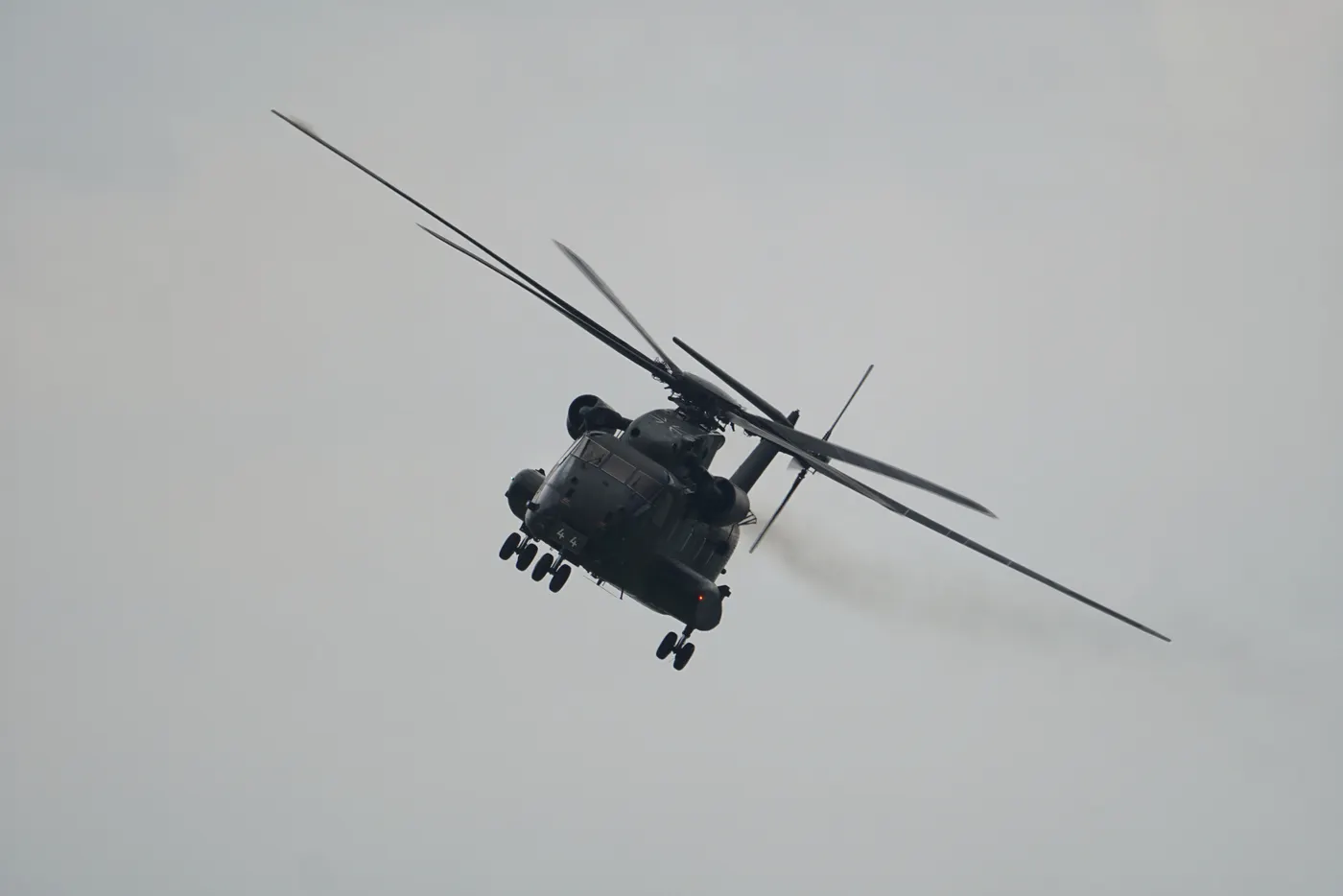
The Sikorsky CH-53 Sea Stallion is a twin-turboshaft, heavy-lift helicopter built for the United States Marine Corps and first flown as the YCH-53A on 14 October 1964, four months behind Sikorsky's own schedule.1,2 It reached the fleet in September 1966, powered by two General Electric T64 engines and built around a six-blade main rotor, a boat-shaped watertight hull, and a rear ramp that let crews drive jeeps, artillery, and pallets straight into the cargo hold.1,2 This article covers the original twin-engine family, the CH-53A and CH-53D and their direct derivatives, the mine-hunting RH-53D, the German-built CH-53G, and the U.S. Air Force's HH-53 and MH-53 lines. The three-engine CH-53E Super Stallion, which replaced these aircraft in Marine Corps service from 1981, is a substantially larger design with its own article.
- Two independent T64 engines, aircraft flyable on one
- Rear ramp and boat-hull, built for shipboard and amphibious work
- Automatic blade and tail fold for carrier stowage
- Up to 55 troops or 8,000 lb internal cargo, era-leading lift
- Six decades of service across five air forces
- Modest hot-and-high margin next to the later three-engine CH-53E
- Three separate hydraulic systems demand heavy maintenance hours
- Large, slow-moving target for man-portable missiles
- Desert-One failure exposed readiness and dust-operation gaps
- Airframe and engine both edge-of-1960s technology by the time production ended
The requirement behind the aircraft dates to 1960, when the Marine Corps went looking for a replacement for its piston-engine CH-37 Mojave.1 After briefly considering a tri-service tilt-wing transport that proved impractical for ship operations, the Navy's Bureau of Naval Weapons issued a March 1962 specification for a "Heavy Helicopter Experimental" able to lift 8,000 pounds over a 100-nautical-mile radius at 150 knots.1,2 Boeing Vertol, Kaman, and Sikorsky all bid; Sikorsky won in July 1962 with a design that combined the general fuselage arrangement of its S-61R (the aircraft the Air Force flew as the CH-3) with the rotor, transmission, and engine layout already proven on the S-64/CH-54 Skycrane crane-helicopter.1 Sikorsky reportedly secured the contract in part by proposing only two flying prototypes instead of the usual four, holding the government's development bill to under ten million dollars.1
Once in service the type spread well beyond its original Marine assault role. The Navy adapted it into the RH-53D minesweeper, the Air Force built the HH-53 into the "Super Jolly Green Giant" for combat search and rescue and later the MH-53 Pave Low for special operations, Germany's army aviation corps flew a license-built version as the CH-53G, and Israel's air force has flown its "Yas'ur" (Petrel) since 1969 and, as of the mid-2020s, still does.1,3,4 Iran received a small batch before the 1979 revolution and, by some accounts, keeps a handful marginally airworthy under sanctions.1
The Sea Stallion's main rotor carries six fully articulated, all-titanium blades on a 72-foot 3-inch (22 m) disc, paired with a four-blade tail rotor using a NACA 0011-derivative airfoil.1,2 Both the tail boom and the main rotor blades fold, and Sikorsky built an automated folding system into the CH-53D specifically to cut the manpower needed to strike the aircraft below deck on an assault carrier.1 The fuselage runs about 67 feet 6 inches nose to tail (around 88 feet 6 inches overall with the rotor turning), is watertight, and carries its fuel in external side sponsons rather than inside the main cabin, freeing the full-width hold for cargo.1,2 Water landings were built into the design as an emergency option, not a routine one; the aircraft was never intended to operate as a true amphibian.1
Power climbed steadily across the type's short production run. The original CH-53A used two General Electric T64-6 turboshafts rated at 2,850 shaft horsepower each; later re-engining raised that to 3,080 shp on the T64-1 and 3,485 shp on the T64-16.1,2 The CH-53D, introduced from 1969, used the T64-GE-412 (3,695 shp) and then the T64-413 (3,925 shp), and carried a strengthened transmission to match.1 Germany's later CH-53GS/GE and CH-53GA rebuilds went further still, fitting the T64-100 specifically to claw back power lost to Afghanistan's heat and altitude.3 Three independent hydraulic systems back up the purely mechanical flight controls, so a single hydraulic failure does not strand the crew.1
Cabin capacity grew alongside the engines: the CH-53A carried up to 38 combat-equipped troops or 24 litters, while the CH-53D's larger cabin and lighter seating pushed that to as many as 55 troops.1,2 Internal cargo capacity was rated at 8,000 pounds, with a single external sling load of up to 13,000 pounds on the standard cargo hook; the RH-53D minesweeping variant, with more powerful engines, was rated to sling loads as heavy as 25,000 pounds.1 Cruise speed sat around 150 knots, with a maximum speed near 170 knots (about 196 mph), a combat radius of roughly 100 nautical miles at full load, and a ferry range approaching 886 nautical miles with auxiliary tanks.11 Defensive fit ran from twin 7.62mm M60 machine guns on early CH-53As to .50-caliber guns, armor around the crew and critical systems, and, from the 1980s, chaff/flare dispensers and infrared jammers retrofitted to combat-committed airframes.1
For a U.S.-built CH-53A/D, the airframe was designed and assembled by Sikorsky in Stratford, Connecticut, and the T64 engines came from General Electric, so the baseline aircraft is almost entirely American content.1,2 The largest departure from that pattern was Germany's CH-53G program, where Sikorsky supplied two pre-production aircraft in 1969 and then VFW-Fokker built the remaining 108 of the 110-strong Luftwaffe fleet under license at Speyer between 1971 and 1975, meaning most of a German unit's own airframe was locally assembled rather than imported whole.3 Israel's Yas'ur fleet was delivered from U.S. production but has been extensively rebuilt and re-avionicked at home by Israel Aerospace Industries and Elbit Systems since the 1980s, so its sensors, defensive systems, and cockpits are now substantially Israeli even though the airframe and dynamic components remain American in origin.6,7 The T64 engine itself, wherever the helicopter was finally assembled, has stayed a General Electric product throughout the type's life.
Sikorsky's contract, worth just under $9.97 million for engineering and two prototypes, was signed in September 1962; the Marine Corps followed in September 1964 with an order for 16 production aircraft before the first prototype had even flown.1 The YCH-53A lifted off from Sikorsky's Stratford plant on 14 October 1964, and deliveries to the fleet began on 12 September 1966, with 141 CH-53As eventually built, including the two prototypes.1,2 A four-aircraft detachment from Marine Heavy Helicopter Squadron 463 reached Marble Mountain Air Facility near Da Nang in December 1966, and within months the type had proven its value simply by dragging damaged American helicopters out of the field faster than anything the Marines had flown before.1
The CH-53D followed in January 1969, essentially a CH-53A rebuilt around the more powerful T64-412/413 engines, an uprated transmission, and the larger 55-troop cabin; 126 were built.1 The Navy paralleled it with the RH-53A and then RH-53D minesweepers, towing sled-mounted sonar and magnetic sweep gear low over mined water, and the Air Force ordered its own combat variant, the HH-53B, which first flew in March 1967 and entered Southeast Asian combat search-and-rescue service that same year as the "Super Jolly Green Giant."1 Germany, needing a heavy-lift helicopter for its army aviation corps, took delivery of two Sikorsky-built pre-production aircraft in 1969 and then had VFW-Fokker license-build the rest at Speyer; by 1975 the Bundeswehr had 110 CH-53Gs in service, the largest single foreign fleet of the type ever assembled.3 Israel received its first Yas'ur helicopters on 2 October 1969, during the War of Attrition, and stood up its first dedicated squadron, No. 118 "Night Birds," at Tel Nof on 6 August 1970.4,6
Vietnam gave the type its combat introduction and its first real reputation: CH-53As arriving with HMH-463 in early 1967 quickly became the Marines' tool of choice for retrieving downed and damaged helicopters from the field, a role the type kept for the rest of the war.1 The Air Force's HH-53s carried that further into a dedicated combat search-and-rescue mission, flying under call signs like "Jolly Green" through some of the most heavily defended airspace in Southeast Asia; the Air Force lost 17 Super Jollies in the war, 14 of them to enemy action, including one shot down by a North Vietnamese MiG-21 during a rescue attempt over Laos in January 1970.1 On 21 November 1970, five HH-53s and a single HH-3 flown by crews including Lieutenant Colonels Warner Britton, Herbert Zehnder, Royal Brown, and John Allison, and Majors Frederic Donohue and Kenneth Murphy, inserted an Army Special Forces team into the Son Tay prison camp only 23 miles from Hanoi; helicopter gunners suppressed the guard towers so effectively that the raiders needed only minutes to clear the compound, but the prisoners had already been moved and the camp was empty.10 In May 1975, in the war's final act, five CH-53s and three HH-53s carried Marines onto Koh Tang island to recover the crew of the merchant ship SS Mayaguez from Khmer Rouge forces; several helicopters were shot down or crippled in the assault, and of the 41 Americans killed in the operation, 18 died on or near the island itself.12
Operation Eagle Claw, the failed attempt to rescue 52 American hostages from Tehran on 24 April 1980, remains the type's most consequential single mission. Eight Navy RH-53Ds launched from the carrier USS Nimitz for a staging site in the Iranian desert code-named Desert One, but a series of mechanical failures and an unforecast dust storm (a haboob) reduced the number of flyable helicopters to five, one below the minimum the mission commander needed to continue.1 As the force prepared to withdraw, one RH-53D, repositioning in the choking dust its own rotor wash had raised, struck a fuel-laden EC-130E and set off a fire that killed eight servicemen. Delta Force operator Staff Sergeant Mike R. Vining, riding in the EC-130E, recalled the moment bluntly: "Then 'bang' I heard a noise from the front port side. The helicopter first hit our vertical stabilizer, then the propellers of engine number 1 and 2."5 The five remaining, undamaged RH-53Ds were abandoned intact in the desert and later put on display by Iran, a lasting propaganda loss layered on top of the operation's human cost.1,5
Israel's Yas'ur fleet, meanwhile, had already been blooded twice over. In December 1969, during the War of Attrition, two CH-53s were tasked with flying a captured, four-ton Soviet P-12 early-warning radar out of Egyptian territory after paratroopers seized it in a night raid; the load so overstressed one helicopter that a hydraulic line burst mid-flight, and the pilot only barely put it down inside Israeli lines before a second CH-53 could recover the radar itself.6 Less than four years later, in the October 1973 Yom Kippur War, the entire 15-helicopter strength of 118 Squadron flew 626 paratroopers to the summit of Mount Hermon in a single, dangerous, low-level daylight lift during the battle to retake the position, while other Yas'urs spent the war moving artillery, evacuating wounded, and pulling downed pilots out from behind Egyptian and Syrian lines.4,9 Israeli CH-53s of the same lineage were shot down decades later too: Hezbollah destroyed one with an anti-tank missile during the 2006 Lebanon war, its only Israeli aircraft loss of that conflict, and on 7 October 2023, at the opening of the Gaza war, Hamas destroyed another with a Kornet missile while it was carrying roughly 50 paratroopers, well above the type's approved 33-troop combat load; the crew landed the burning aircraft and the occupants escaped before a second missile finished it off.6,7
Germany's CH-53Gs, re-engined with the hot-and-high-rated T64-100 and fitted with defensive countermeasures as the CH-53GS and CH-53GA, spent more than eighteen years flying troop transport, casualty evacuation, and personnel-recovery missions in Afghanistan, alongside earlier deployments to Bosnia and Kosovo.3 By contrast, twin-engine Sea Stallions played a comparatively minor part in the 1991 Gulf War, where the newer three-engine CH-53E had already taken over most Marine heavy-lift work; the Marine Reserve's HMH-772 mobilized its older RH-53Ds to fill gaps in that heavier fleet rather than to spearhead the air campaign.1
The core U.S. line ran CH-53A (141 built) to CH-53D (126 built), the D-model adding the more powerful T64-412/413 engines, a reinforced transmission, automatic blade folding, and room for up to 55 troops.1 The Navy's RH-53A (15 conversions from CH-53A airframes) and purpose-built RH-53D (30 built) added towed mine-sweeping gear and, on the D, more powerful engines and heavier sling capacity; a handful of RH-53Ds went to Iran before 1979, and five more became the aircraft abandoned at Desert One in 1980.1 A small VIP transport, the VH-53D, and a stripped-down training airframe, the TH-53A, rounded out the American family in small numbers.1
The Air Force built its own combat lineage in parallel. The HH-53B and HH-53C, nicknamed the "Super Jolly Green Giant," added a refueling probe, drop tanks, a rescue hoist, and heavier armor and armament for combat search and rescue, while the unarmed CH-53C handled general USAF airlift.1 From the 1970s the Air Force progressively rebuilt its HH-53 fleet into the MH-53 Pave Low series, adding terrain-following radar, forward-looking infrared, and an inertial navigation suite for low-level penetration missions; the final MH-53J/M Pave Low variants flew until the U.S. Air Force retired the whole family in September 2008.1
Germany's CH-53G, built almost entirely under license by VFW-Fokker, was progressively modernized rather than replaced outright: the CH-53GS added missile warning, chaff/flare dispensers, external tanks, and night-vision-compatible cockpits; the CH-53GE (originally CH-53GSX) served as a dedicated combat search-and-rescue configuration; and the CH-53GA, first flown in modernized form in February 2010, brought a new digital flight deck, autopilot, forward-looking infrared, and electronic countermeasures to roughly 40 airframes.3 Israel's export version, built as the S-65C-3 and known locally as the Yas'ur, has gone through two major life-extension programs, Yas'ur 2000 in the 1990s and Yas'ur 2025 more recently, both intended to keep 1969-vintage airframes flying safely into a fifth decade of service.6,7 Austria briefly flew two S-65Ö variants for Alpine high-altitude rescue from 1970, selling both to Israel in 1981 once their operating cost proved too high for a small air arm to sustain.1
The three-engine CH-53E Super Stallion, which entered Marine Corps service in 1981, is not a further rebuild of this twin-engine family but a substantially larger aircraft: a third T64 engine, a seven-blade main rotor, and a redesigned transmission raised lift capacity well past anything the CH-53A/D could manage, and it progressively took over the U.S. heavy-lift mission through the 1980s and 1990s.1 It, and the Navy's related MH-53E Sea Dragon minesweeper, are covered separately.


| Year | Buyer | Quantity | Amount | Present Value (2025) |
|---|---|---|---|---|
| 2003 |  Mexico | 4 | — | — |
| 1975 |  Iran | 6 | — | — |
| 1973 |  Israel | 35 | — | — |
| 1971 |  Germany | 108 | — | — |
| 1970 |  Austria | 2 | — | — |
| 1969 |  United States | 126 | — | — |
| 1969 | Germany | 2 | — | — |
| 1969 | Israel | 7 | — | — |
| 1968 | United States | 44 | — | — |
| 1967 | United States | 8 | — | — |
| 1964 | United States | 16 | — | — |
| 1962 | United States | 2 | $10.0 M | $106.3 M |
The United States Marine Corps was the founding and largest operator, flying the CH-53A and CH-53D from 1966 until retiring its last Sea Stallions in 2012, a 46-year run.1 The U.S. Navy flew RH-53A/D minesweepers into the mid-1990s, and the U.S. Air Force's HH-53 and MH-53 combat and special-operations variants remained in front-line use until the type's retirement in September 2008.1
Germany was the largest and longest-serving foreign operator, flying its license-built CH-53G fleet from 1971 into the 2020s, first under Army Aviation and, from January 2013, under the Air Force's Helicopter Wing 64.3 Israel has flown the Yas'ur continuously since 1969 through its 118 Squadron, the last IAF unit still operating the type as of the mid-2020s while it awaits CH-53K replacements, with candidates required to complete a three-year flight-academy course and six months on the Black Hawk before ever qualifying on the Sea Stallion; Iran received a handful before its 1979 revolution and, isolated from U.S. parts supply ever since, is believed to keep only a few marginally airworthy under sanctions.1,7,8 Austria operated two examples for Alpine rescue between 1970 and 1981 before selling them on to Israel, and Mexico flew four surplus, ex-Israeli CH-53Ds from 2003 until 2013, though only two were ever kept in active flying condition.1
Set against its own direct successor, the three-engine CH-53E Super Stallion, the CH-53A/D gives up a great deal of lift and hot-and-high performance for an aircraft that is smaller, cheaper to run, and, in the German and Israeli fleets, still flying more than fifty years after it was built; the extra engine and rotor blade on the E-model exist specifically to answer the power shortfall that the twin-engine design could not solve as engine technology moved on.1
Set against the Boeing CH-47 Chinook, the comparison is older than either aircraft's combat record. The U.S. Marine Corps rejected a Chinook variant during the same early-1960s competition that produced the Sea Stallion, arguing that Secretary of Defense Robert McNamara's push for tri-service "commonality" around the Chinook could not meet Marine shipboard and lift requirements without costly changes.1 The two designs solve the same heavy-lift problem in opposite ways: the Chinook's tandem rotors put all of its engine power into lift with no tail rotor to feed, giving it a flatter cargo floor and a higher rated external load, while the Sea Stallion's single main rotor and boat-hull fuselage were built explicitly around Navy and Marine shipboard operation, folding for elevator and hangar-deck storage in a way a tandem-rotor airframe cannot match as compactly.1

Why did Operation Eagle Claw fail?
A combination of mechanical breakdowns and an unforecast desert dust storm reduced the eight RH-53D helicopters launched from USS Nimitz to five flyable aircraft at the Desert One staging site, one below the mission's minimum, forcing an abort.1 During the withdrawal, one RH-53D collided with a fuel-laden EC-130E in the blinding dust its own rotor wash had raised, and the resulting fire killed eight servicemen; the five intact helicopters were abandoned in Iran.1,5
How much can a CH-53A/D carry?
The CH-53D can lift up to 8,000 pounds internally or 13,000 pounds on its external cargo hook, and carry as many as 55 troops or 24 litters in its cabin, figures that made it the heaviest-lifting helicopter in Western service when it entered the fleet.1,2 The Navy's RH-53D minesweeper, with more powerful engines, was rated for external loads up to 25,000 pounds.1
What is the difference between the CH-53 and the CH-53E Super Stallion?
The CH-53E adds a third T64 engine, a seventh main rotor blade, and a strengthened transmission, all aimed at recovering the payload and hot-and-high performance the twin-engine CH-53A/D lost as combat weights grew; it entered Marine Corps service in 1981 and progressively replaced the twin-engine family in U.S. use.1
Why is Israel still flying a helicopter this old?
Israel's Yas'ur fleet has been kept flying through two major Israeli-led modernization programs, Yas'ur 2000 and Yas'ur 2025, which replaced avionics, defensive systems, and structural components without changing the basic 1969-vintage airframe, and by the mid-2020s Israel had become the first export customer for the CH-53K replacement while the older fleet worked out its final years.6,7
What was Operation Rooster?
A December 1969 Israeli raid during the War of Attrition in which paratroopers seized an entire Soviet-supplied P-12 early-warning radar station from the Egyptian coast; two CH-53s were sent to fly the four-ton radar and its support equipment back to Israel, and the strain of the load ruptured a hydraulic line on one helicopter mid-flight before it landed safely just inside Israeli territory.6
Is the twin-engine CH-53 still in military service anywhere?
Yes, in limited numbers. Israel's 118 Squadron still flies the Yas'ur pending CH-53K deliveries, and Iran is believed to retain a handful of its original 1970s-era airframes despite decades of sanctions cutting off parts supply; the U.S. Marine Corps, Navy, Air Force, and Germany have all fully retired their twin-engine fleets.1,3,7
- "Sikorsky CH-53 Sea Stallion", Wikipedia — en.wikipedia.org ↩
- "CH-53 Sea Stallion", Fort Worth Aviation Museum — fortworthaviationmuseum.com ↩
- "CH-53G - German Luftwaffe", GlobalSecurity.org — globalsecurity.org ↩
- "IAF Aircraft Inventory: Sikorsky CH-53 Sea Stallion (Yas'ur) Helicopter", Jewish Virtual Library — jewishvirtuallibrary.org ↩
- "Delta Force Operator on EC-130E Hit by RH-53 During Operation Eagle Claw Remembers the Accident", The Aviation Geek Club — theaviationgeekclub.com ↩
- "The War of Attrition: Operation 'Rooster' (December 1969)", Jewish Virtual Library — jewishvirtuallibrary.org ↩
- "Why Israel Loves the Sikorsky CH-53 Sea Stallion", 19FortyFive — 19fortyfive.com ↩
- "Inside Israel's CH-53 Squadrons", Aviation Week Network — aviationweek.com ↩
- "Our CH-53D Sea Stallion", Pearl Harbor Aviation Museum — pearlharboraviationmuseum.org ↩
- "The Son Tay Raid", Air & Space Forces Magazine — airandspaceforces.com ↩
- "CH-53D Sea Stallion", Naval History and Heritage Command — history.navy.mil ↩
- "The Last Battle of Vietnam: The SS Mayaguez Incident of 1975", Veterans Breakfast Club — veteransbreakfastclub.org ↩
- "Watch This Massive CH-53 Sea Stallion Chopper Do Loops And Rolls", Jalopnik — jalopnik.com ↩
- "CH53 sea stallion", PPRuNe Forums — pprune.org ↩