

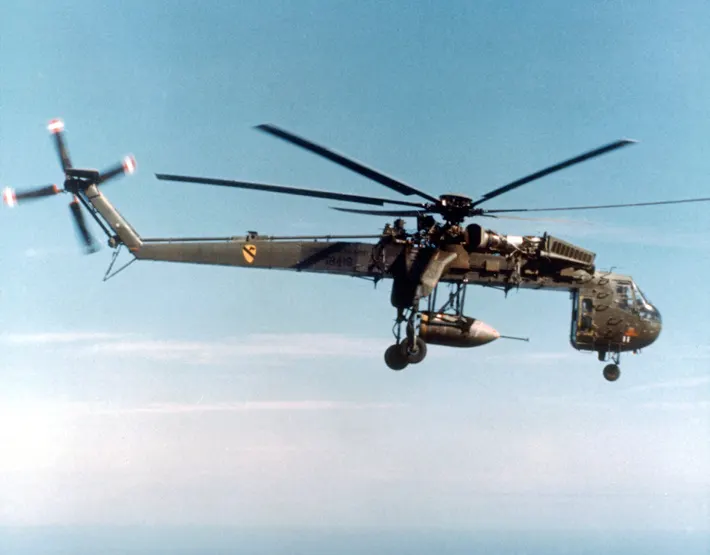
The Sikorsky CH-54 Tarhe, built by Sikorsky as the S-64 Skycrane, is a twin-turbine heavy-lift helicopter developed for the United States Army and first flown on 9 May 1962.1,2 It has no cargo hold. The airframe is a skeletal boom running from a glazed forward cockpit to the tail rotor, with the engines, transmission, and rotor mast mounted openly on top and almost nothing enclosed in between.2 Everything the Tarhe carries either hangs from a hook under its belly or rides inside one of several detachable pods that bolt onto the same hardpoints, an arrangement that let one airframe serve as a crane, a troop carrier, a flying ambulance, or a maintenance shop depending on which pod was clipped underneath it that day.1,2
- External payload up to 25,000 lb (11,340 kg) on the CH-54B
- Interchangeable pods turn one airframe into crane, troop carrier, or hospital
- Aft-facing pilot station gives a direct, unobstructed view of the load
- Modular build lets cabin, drivetrain, and boom sections swap in the field
- Decades-long civilian second career in firefighting and logging
- No enclosed cargo hold of its own, always needs a pod or a sling
- Short range and modest cruise speed, around 100 to 115 knots
- Exposed rotor and drivetrain hardware demand constant field maintenance
- Small production run limited spares and long-term Army sustainment
The design traces to Sikorsky's earlier S-60 flying-crane prototype of 1959, but the S-64 was a larger, turbine-powered rework built around two Pratt & Whitney JFTD12 (military designation T73) turboshafts driving a six-blade main rotor.1,2 The Army bought six evaluation aircraft in 1963 as the YCH-54A, then went on to acquire roughly 105 Tarhes in CH-54A and CH-54B configuration through the early 1970s.2 Deployed to Vietnam with the 1st Cavalry Division from 1965, the type spent most of the war retrieving downed aircraft, hauling artillery and bulldozers into hilltop firebases, and, on occasion, dropping a bomb the size of a small car to blast a landing zone out of the jungle.1,3,4 The Army retired its last Tarhes in the 1990s, but the airframe did not stop working. Sikorsky sold the commercial rights to Erickson Air-Crane in 1992, and the type has since spent three decades as one of the world's principal aerial firefighting and heavy-lift platforms under the name Aircrane.6,7
Sikorsky stripped away everything on the S-64 that was not needed to lift or fly. There is no fuselage skin between the cockpit and the tail, only a slender boom carrying fuel, wiring, and the drive shaft to the tail rotor, with the transmission, engines, and rotor head sitting exposed on top rather than tucked under cowlings.1,2 That decision, deliberate rather than accidental, cut weight and made the dynamic components easy to inspect and repair without pulling panels, at the cost of leaving them open to weather and small-arms fire.2 The main rotor is a fully articulated, six-blade unit 72 feet (21.95 m) in diameter, driven by two Pratt & Whitney JFTD12 turboshafts; the CH-54A's engines produced about 4,500 shp each, and the CH-54B, introduced in 1969, stepped up to roughly 4,800 shp per engine along with a strengthened airframe that raised gross weight from 38,000 lb to 47,000 lb and external payload from 20,000 lb to 25,000 lb.1,2
- First Flight1962
- Service Entry Year1963
- Crew3
- Passengers40
- In ServiceNo
Because the aircraft has no hold, everything it carries is either slung beneath its single main hook, rated at 20,000 lb, or fitted to one of the interchangeable pods that clip onto the same universal attachment points between the landing gear.1,2 Four auxiliary hoists of 5,000 lb each supplemented the main hook for smaller, simultaneous loads.2 The Army's principal accessory was the Universal Military Pod, a container with its own windows, side doors, and a rear ramp that could be configured to carry troops, casualties, cargo, or a field workshop; about 22 of these pods were built, and one, fitted out as a personnel carrier, let a single Tarhe lift 90 people (87 troops plus a crew of three) in a 1965 demonstration, a record for a single helicopter at the time.13
- Number of Engines2
- Engine Power (each)3,356 kW
- Transmission Rating3,356 kW
- Main Rotor Diameter21.95 m
- Main Rotor Blades6
The CH-54 was designed and built by Sikorsky Aircraft at its Connecticut plants, with both JFTD12/T73 turboshafts supplied by Pratt & Whitney, another Connecticut-based manufacturer, so U.S. Army airframes were almost entirely American in origin.1,2 The main foreign involvement in the program's history was West Germany's co-funding of the early test fleet and its purchase of two S-64 prototypes for evaluation, though Bonn ultimately chose the Sikorsky CH-53 instead and never bought the type in quantity.2 For the roughly 105 aircraft the Army itself operated, domestic content is effectively total; the closest thing to an imported dependency was the later Erickson-era global customer base for spare pods and support equipment rather than any single critical foreign component.
The Tarhe's most distinctive engineering feature is its crew arrangement. In addition to the forward two-pilot cockpit, a third seat faces backward, low in the nose, giving an operator an unobstructed view straight down and to the rear during a pickup or set-down.1,2 That aft station has its own cyclic and collective, wired through what Sikorsky's own historians describe as one of the first fly-by-wire control links fitted to a helicopter, with roughly ten percent control authority so the rear operator can fine-tune the aircraft's position over a load without wrestling full control away from the forward pilots.1,2
- Top Speed240.739 km/h
- Cruise Speed169 km/h
- Never-Exceed Speed (VNE)240 km/h
- Service Ceiling3,658 m
- Hover Ceiling (IGE)3,200 m
- Hover Ceiling (OGE)2,500 m
- Range370 km
- Ferry Range760 km
- Rate of Climb6.756 m/s
- Endurance180
The airframe was also built in interchangeable modules, cabin, drivetrain, and tail sections, that could be swapped in the field rather than repaired on the spot, an approach unusual for its era and useful for a machine expected to fly hard in a warzone with minimal depot support.2 Landing gear is tricycle rather than the S-60's earlier arrangement, and the main legs can be lowered to let the aircraft "kneel" over an awkward load for hookup, with a retractable tail skid to protect against nose-up hard landings.1
- Fuselage Length26.822 m
- Height7.75 m
- Rotor Disc Area378.1
- Empty Weight8,980 kg
- Max Takeoff Weight21,320 kg
- Useful Load12,340 kg
- Cabin Volume30
- Hardpoints0
- Weapons Payload9,070 kg
- Sling Load Capacity9,070 kg
- Rescue HoistNo
- Total Built105
- Variants64
- Retirement Year1993
- Production Start1962
Igor Sikorsky had talked publicly about an "aerial crane" concept as early as 1955, and the company began serious design work in May 1958 on the S-60, a piston-engined testbed built around a stripped boom fuselage and an aft-facing cockpit.1 The S-60 first flew on 25 March 1959, logged roughly 335 hours over two years of Navy and Army evaluation, and crashed in April 1961; it had proven the concept but was underpowered for real military payloads.1,2 Sikorsky secured internal approval to build a larger, turbine-powered successor that same month, and the resulting S-64 flew for the first time on 9 May 1962, only about thirteen months after the program was funded.2 Because no existing turboshaft matched the aircraft's power needs, Sikorsky and Pratt & Whitney adapted the JT12 turbojet into the new JFTD12 turboshaft specifically for the program.1
The prototype went to Fort Benning, Georgia for Army trials in July 1962, and the service ordered six evaluation aircraft in June 1963 for about 13 million dollars, designating them YCH-54A and naming the type Tarhe, after an eighteenth-century Wyandot chief known to contemporaries as "The Crane."2
Production aircraft followed as the CH-54A, and civil certification came through the FAA on 30 July 1965.1,2 The heavier, more powerful CH-54B entered production in 1969.2 Total Army acquisition across both marks ran to roughly 105 helicopters, a modest number by the standards of contemporary transport helicopters, reflecting the type's role as a specialist rather than a general-purpose lifter.2
The Army retired the Tarhe from active and National Guard service through the early-to-mid 1990s; the last Guard flight came on 10 January 1993, flown by the 113th Aviation Regiment.2 By then Sikorsky had already sold its manufacturing and support rights for the commercial S-64 to Erickson Air-Crane, on 13 February 1992, and Erickson began rebuilding surplus Army airframes into civilian Aircranes rather than letting the type disappear with its last uniform.6,7
In 1988, three gray whales became trapped in forming sea ice off Point Barrow, Alaska. The Alaska Army National Guard's 207th Aviation Company flew a CH-54B, nicknamed Isabelle, to the site and used it to swing a multi-ton weight against the ice in an attempt to break a channel to open water, an improvised job far outside the aircraft's usual cargo work; the effort became international news and was later dramatized, with Guard personnel and aircraft assisting the production, in the 2012 film Big Miracle.10
The Tarhe's only war was Vietnam, and it arrived early. The 478th Aviation Company, the first unit equipped with the type, deployed to Vietnam with the 1st Cavalry Division and began flying from An Khe with six CH-54As in 1965; the 273rd and 355th Aviation Companies later fielded the type as well, all under the 1st Aviation Brigade.3,5 Vietnamese ground troops nicknamed the type the "Flying Crane," and its yellow-triangle tail marking became a familiar sight over I and II Corps.3,5
Its signature mission was recovery. By 24 December 1968, Tarhes had recovered 423 downed aircraft valued at more than 220 million dollars, salvage that would otherwise have been destroyed in place or abandoned to the enemy.1 The same lifting capacity moved artillery pieces, bulldozers, road graders, and armored vehicles onto hilltop fire-support bases that had no road access, letting the Army and Marine Corps build and resupply positions in terrain that would otherwise have been unreachable except by foot.1,5 Beyond raw tonnage, the Tarhe's pod system gave it a flexibility no single-role transport could match: the same aircraft that lifted a howitzer one day might carry a personnel pod full of troops the next, or a pod rigged as a mobile surgical unit for the 15th Medical Battalion the day after that.4,5
The type's strangest wartime job was demolition. Beginning in December 1968, the Air Force's 834th Air Division ran a ten-weapon operational trial in South Vietnam under the name Combat Trap, using CH-54s to airdrop the M121, a 10,000-lb bomb derived from the World War II British Tallboy design, from around 6,000 feet.4 Detonated a few feet above the ground by a long fuze extension, the M121 blew a roughly 100-foot clearing out of dense jungle canopy in seconds, stunned or killed any troops within about 500 meters, and exposed booby traps that ground clearance crews would otherwise have had to find the hard way.4 The trial, first used operationally in support of Operation Taylor Common that December, grew into the sustained Project Commando Vault; M121 stocks ran out and the last was dropped on 8 August 1970, after which the newer BLU-82 "Daisy Cutter," dropped from fixed-wing aircraft rather than helicopters, took over the same instant-landing-zone role.4 The M121 missions were, by the Air Force's own later assessment, expensive and inefficient given the CH-54's limited range and the need to fly the bomb to target under load, but they produced usable landing zones in places no bulldozer could reach and no other weapon could clear as fast.4
The line began with six pre-production YCH-54A evaluation aircraft ordered in 1963, followed by 54 production CH-54As powered by JFTD12A-4A engines rated around 4,500 shp, with a maximum external payload of 20,000 lb at a gross weight of 38,000 lb.1,2 The CH-54B, introduced from 1969, added JFTD12A-5A engines of roughly 4,800 shp, raised gross weight to 47,000 lb, and increased external payload to 25,000 lb; the Army bought roughly 35 to 37 examples.1,2 Both marks used the same six-blade rotor and airframe layout, with the B distinguished mainly by its strengthened structure and added power rather than a different silhouette.2
Civilian variants ran in parallel. Sikorsky itself sold or leased about ten Skycranes between 1968 and 1976 under the S-64E and S-64F designations, mostly to Erickson's predecessor operation, before Erickson acquired the type certificate outright in 1992 and began both new production and the remanufacture of retired Army airframes into the current Erickson S-64F Aircrane standard.2,6 Erickson's rebuilds carry substantial internal changes, more than a thousand documented modifications over the decades, to instrumentation, drivetrain components, and payload systems, alongside externally fitted firefighting tanks and precision water/foam delivery systems developed from 1993 onward, none of which existed on the wartime Army airframe.6,7 A larger, three-engine S-64B growth study with a 79-foot rotor and roughly 17.9-ton payload was proposed in 1968 but never built; some of its thinking fed into the far larger Boeing Vertol Heavy Lift Helicopter competition of the early 1970s, which itself ended in cancellation before production.2

| Year | Buyer | Quantity | Amount | Present Value (2025) |
|---|---|---|---|---|
| 1966 |  United States | 105 | — | — |
| 1963 | United States | 6 | $13.0 M | $136.8 M |
| 1962 |  Germany | 2 | — | — |
The United States Army was the type's only large-scale military operator, flying the CH-54A and CH-54B from 1964 until final retirement from active and Army National Guard units in the early-to-mid 1990s, including units such as the Kansas National Guard's 137th Army Aviation Group and Alaska's 207th Aviation Company.2,10 West Germany evaluated two S-64 prototypes and helped fund early testing but bought the CH-53 instead, and no other country operated the Tarhe as a combat type.2
Its second life has been overwhelmingly civilian. Erickson Incorporated, based in Oregon, is by far the largest operator and the type's manufacturer of record, flying and leasing its S-64 Aircrane fleet for logging, construction, and firefighting contracts around the world; in April 2024 Erickson's aerial firefighting division and its S-64 fleet were sold to Helicopter Express.6,7,8 Other civil operators, including Siller Helicopters in California, have flown rebuilt ex-Army airframes for heavy-lift and firefighting work for decades.8 Aircranes under lease or contract have flown seasonal firefighting duty in Australia since 1997, and further airframes have gone to South Korean and Italian government firefighting services.6,8
The Tarhe's closest Cold War counterpart was the Soviet Mil Mi-10, a flying crane developed from the Mi-6 and introduced in 1963, a year after the S-64 first flew.15 Where Sikorsky built a slim boom fuselage on conventional tricycle gear, Mil solved the same visibility and ground-clearance problem with four tall, widely spaced legs that let the aircraft straddle a load and taxi over it before hooking on.15 The Mi-10 could lift more, up to about 15 tonnes over short distances against the CH-54B's 11.3 tonnes, but it saw a shorter and narrower career; only around 40 long-legged Mi-10s plus a further batch of short-legged Mi-10K conversions were built, mostly for Soviet Air Force and industrial use, and most had left service by the early 2000s.15 The Skycrane, built in similar numbers, ended up with the longer working life by a wide margin, because Sikorsky sold the design itself into a private aftermarket rather than letting it retire with its air force.
Against the much larger Soviet Mi-26, which can carry roughly 20 tonnes, the Tarhe and its Chinook stablemate look modest, and the comparison exposes a genuine doctrinal choice rather than a simple capability gap.14 The Soviet Union built the Mi-26 to move heavy industrial and military equipment into a country with nine time zones and vast stretches with no roads or rail; the United States instead chose to split the same problem between fixed-wing airlifters, the C-130 and C-17, for the very heaviest and most oversized loads, and a larger fleet of Chinooks and (in Vietnam) Skycranes for everything that needed vertical lift.14 Washington tried building an Mi-26-class helicopter of its own, the Boeing Vertol XCH-62 under the Army's Heavy Lift Helicopter program of the early 1970s, and cancelled it in 1974 after a single example was built, well short of production.2 More helicopters of a manageable size, in other words, proved cheaper to build, easier to maintain, and simpler to disperse across a battlefield than one machine capable of doing the work of several, a logic that has held for the U.S. fleet from the Tarhe's era into the present.14

Why does the CH-54 have no cargo compartment?
Sikorsky designed the S-64 purely as an external-load lifter. Removing the cabin saved weight that went directly into payload, and it let one airframe accept different interchangeable pods, cargo, troop, hospital, or workshop, on the same universal attachment points rather than being built around a single fixed role.1,2
What was the Universal Military Pod?
It was a detachable container, roughly the size of a small bus body, with its own doors, windows, and rear ramp, that clipped onto the Tarhe's belly hardpoints in place of a sling load. About 22 were built for the Army, configured variously to carry troops, litters, cargo, or specialized equipment such as a field surgical unit.4,13
How much can a CH-54 Tarhe lift?
The original CH-54A was rated for 20,000 lb (about 9 tonnes) externally at a gross weight of 38,000 lb. The improved CH-54B, in service from 1969, raised that to 25,000 lb (about 11.3 tonnes) at a gross weight of 47,000 lb.1,2
Why does the Tarhe have a pilot seat facing backward?
A third crew station low in the nose faces the tail, giving that operator a direct, unobstructed view of the load during hookup and placement. It has its own flight controls, an early application of fly-by-wire on a helicopter, with limited authority so the rear pilot can nudge the aircraft precisely without overriding the forward crew.1,2
Is the Skycrane still flying today?
Yes, as a civilian aircraft. The U.S. Army retired the CH-54 in the 1990s, but Erickson Incorporated bought the manufacturing rights in 1992 and has kept a fleet of S-64 Aircranes flying ever since, mainly for aerial firefighting and heavy-lift construction and logging work worldwide.6,7
How does the Tarhe compare with the Mil Mi-26?
The Mi-26 lifts nearly twice as much, about 20 tonnes against the Tarhe/Aircrane's 11.3 tonnes, but it represents a different logistical philosophy built around Soviet-era heavy industrial airlift. The United States instead paired fixed-wing transports for its heaviest cargo with fleets of smaller helicopters like the CH-54 and CH-47, a choice reinforced when its own Mi-26-class helicopter project, the Boeing Vertol XCH-62, was cancelled in 1974.2,14
- "Sikorsky S-64A Sky Crane Helicopter", Heli Archive — heli-archive.ch ↩
- "Sikorsky S-64", Igor I. Sikorsky Historical Archives — sikorskyarchives.com ↩
- "478th Aviation Company (Heavy Helicopter) 'Hurricanes'", Vietnam Helicopter Pilots Association Museum — museum.vhpa.org ↩
- "M118 (T55) Demolition Bomb, Project Combat Trap", GlobalSecurity.org — globalsecurity.org ↩
- "Vietnam: The Helicopter War, Support Aircraft", Vietnam Center and Sam Johnson Vietnam Archive, Texas Tech University — vietnam.ttu.edu ↩
- "Erickson Air-Crane", The Oregon Encyclopedia — oregonencyclopedia.org ↩
- "Erickson and the Air Crane", ROTOR Media — rotormedia.com ↩
- "Sky Cranes in Action, from California to Athens", AerialFire Magazine — aerialfiremag.com ↩
- "Commemorating 25 Years in Australia", Erickson Incorporated — ericksoninc.com ↩
- "Alaska Guard helping Hollywood with film on saving whales", U.S. Army — army.mil ↩
- "Freedom Statue Lifted From Capitol Dome", UPI Archives — upi.com ↩
- "Freedom Lands On Her Feet", The Washington Post — washingtonpost.com ↩
- "CH-54A Tarhe with Universal Military Pod", ICM Holding — icm.com.ua ↩
- "We Haul It All", Smithsonian Magazine — smithsonianmag.com ↩
- "Mil Mi-10", Global Military — globalmilitary.net ↩