

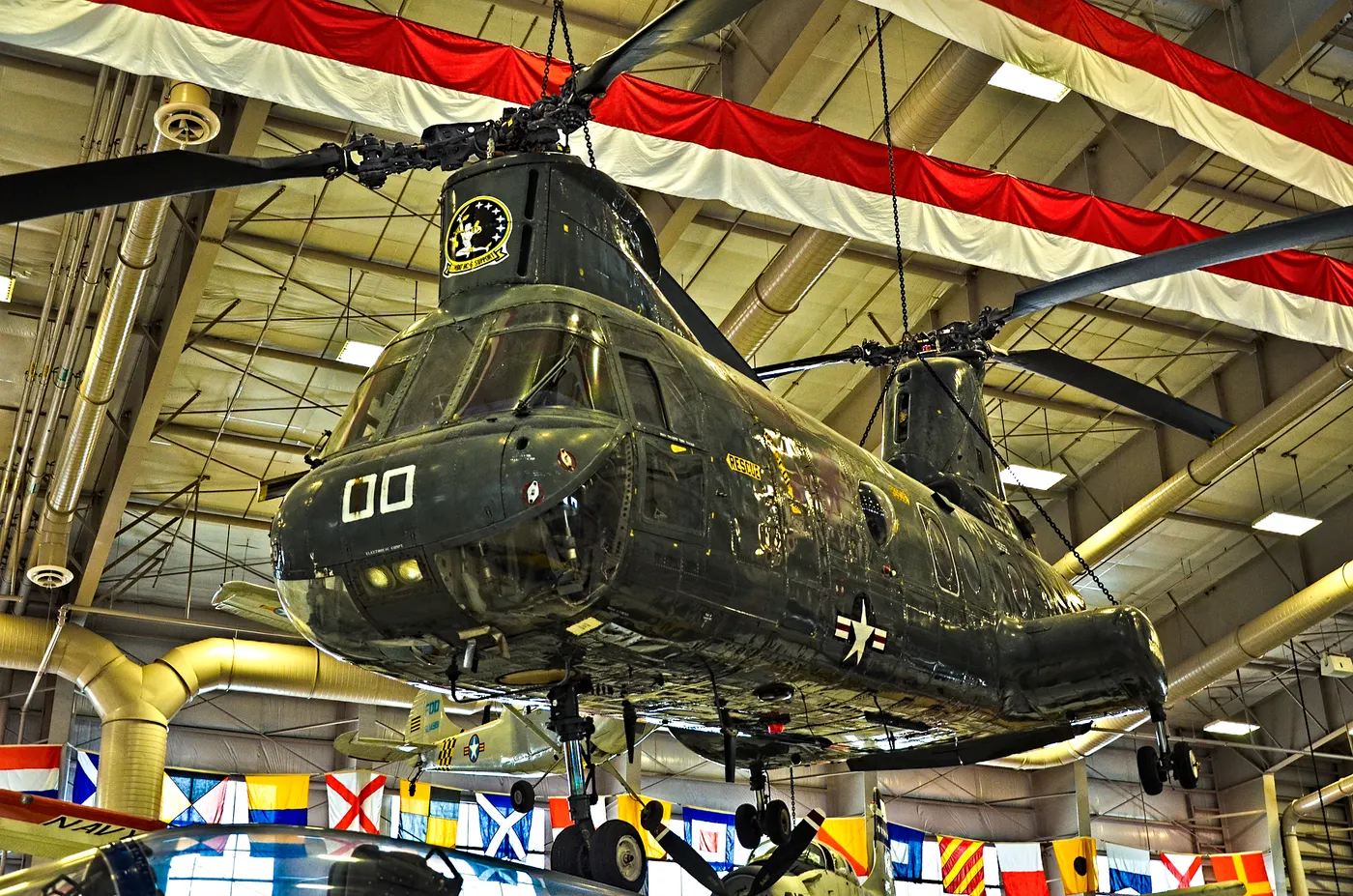

The Boeing Vertol HH-46A Sea Knight is the United States Navy search and rescue variant of the CH-46A Sea Knight, a twin-engine, tandem rotor transport helicopter. Roughly 50 Navy CH-46A airframes were pulled from utility and logistics duty and fitted with a Doppler search radar, an external rescue hoist, and a hull reinforced for emergency water landings, then redesignated HH-46A for shipboard plane guard duty.1,2 Plane guard meant hovering off an aircraft carrier's flight deck during every launch and recovery cycle, ready to pull a downed pilot out of the water within minutes. It is a narrower, more specialized role than the CH-46A's cargo and troop-transport mission, and the HH-46A designation exists specifically because the Navy needed an all-weather, over-water rescue platform rather than another cargo hauler.
- twin-engine redundancy over water
- automatic Doppler-coupled hover for night/all-weather rescue
- dedicated external hoist and reinforced hull for water operations
- shared logistics/spares base with the wider CH-46 fleet
- smaller rescue-hoist capacity than later dedicated Navy SAR helicopters
- airframe age limited service life relative to newer types
- converted, not purpose-built, so cabin space still reflects a cargo-helicopter layout
Unlike the Marine Corps CH-46A, which is remembered above all for Vietnam assault-support work, the HH-46A rarely left the vicinity of a carrier battle group. Its story is one of routine, unglamorous readiness. The helicopter that plucked a pilot from the sea after a bad catapult shot, that shadowed a carrier's flight deck for hours at a time, and that later became the basis for the Navy's shore-based search and rescue training program at Naval Air Station Pensacola.3 The HH-46A also shares a parent airframe with the NCH-46A, a Naval Air Test Center testbed conversion used for engineering trials rather than operational rescue work.
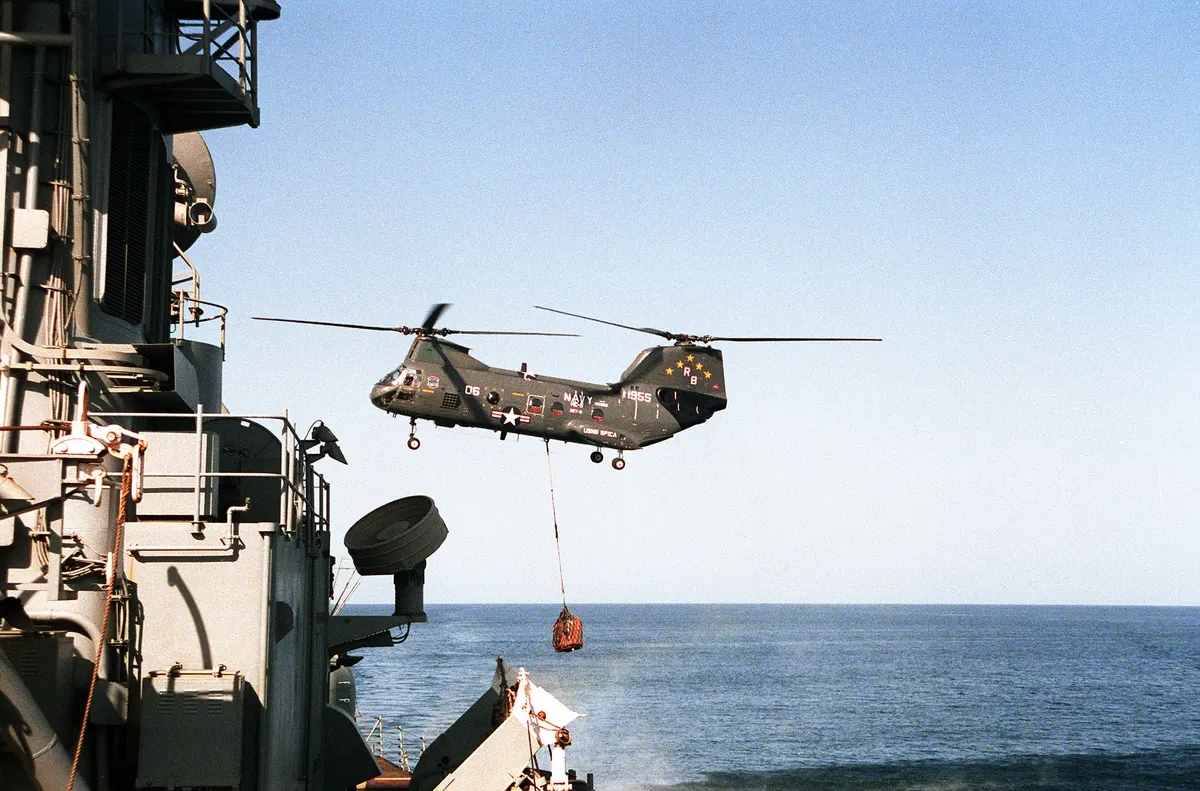
The HH-46A Sea Knight belongs to the same heavy lift helicopters category tracked across this archive, even though its individual mission profile, carrier plane guard and shipboard rescue, is lighter and more specialized than the leaf's typical heavy-cargo role. Understanding how the HH-46A Sea Knight specifications compare to the base CH-46A explains why the Navy accepted a narrower cargo capacity in exchange for rescue-specific equipment.
A Doppler-Guided Hover Built for Rescue at Sea
The core airframe of the HH-46A Sea Knight is unchanged from the CH-46A, two General Electric T58-GE-8 turboshaft engines, each rated at 1,250 shp (932 kW), driving counter-rotating three-blade rotors front and rear.4,5 What separates the HH-46A is the equipment bolted onto that airframe. An 18 inch by 18 inch Doppler radar unit sits behind the nose landing gear, feeding a hover coupler that let the pilot hold a stable, automatic over-water hover day or night, a capability few Navy helicopters of the mid-1960s offered.1 A rescue hoist was mounted near the forward crew door, and the lower hull received reinforcement so the aircraft could set down directly on the water if needed, a wet landing capability most CH-46A cargo airframes never required.1,2
- First Flight1958
- Service Entry Year1964
- Crew4
- Passengers17
- Primary Rolecarrier plane guard / shipboard search and rescue helicopter
- In ServiceNo
The tandem rotor layout that defines the whole Sea Knight family carried over unchanged. Two 15.24 meter rotors, mounted fore and aft rather than a single main rotor and tail rotor, let the HH-46A Sea Knight hover with a wide, stable center of gravity, useful when a hoist operator is winching a swimmer or survivor up through open water. The tradeoff is a larger footprint on a crowded flight deck compared with a single-rotor helicopter of similar weight.
- Engine TypeGeneral Electric T58-GE-8
- Number of Engines2
- Engine Power (each)932 kW
- Transmission Rating1,491 kW
- Rotor Configurationtandem rotors
- Main Rotor Diameter15.24 m
- Main Rotor Blades6
- Anti-Torque TypeNo tail rotor (tandem rotors)
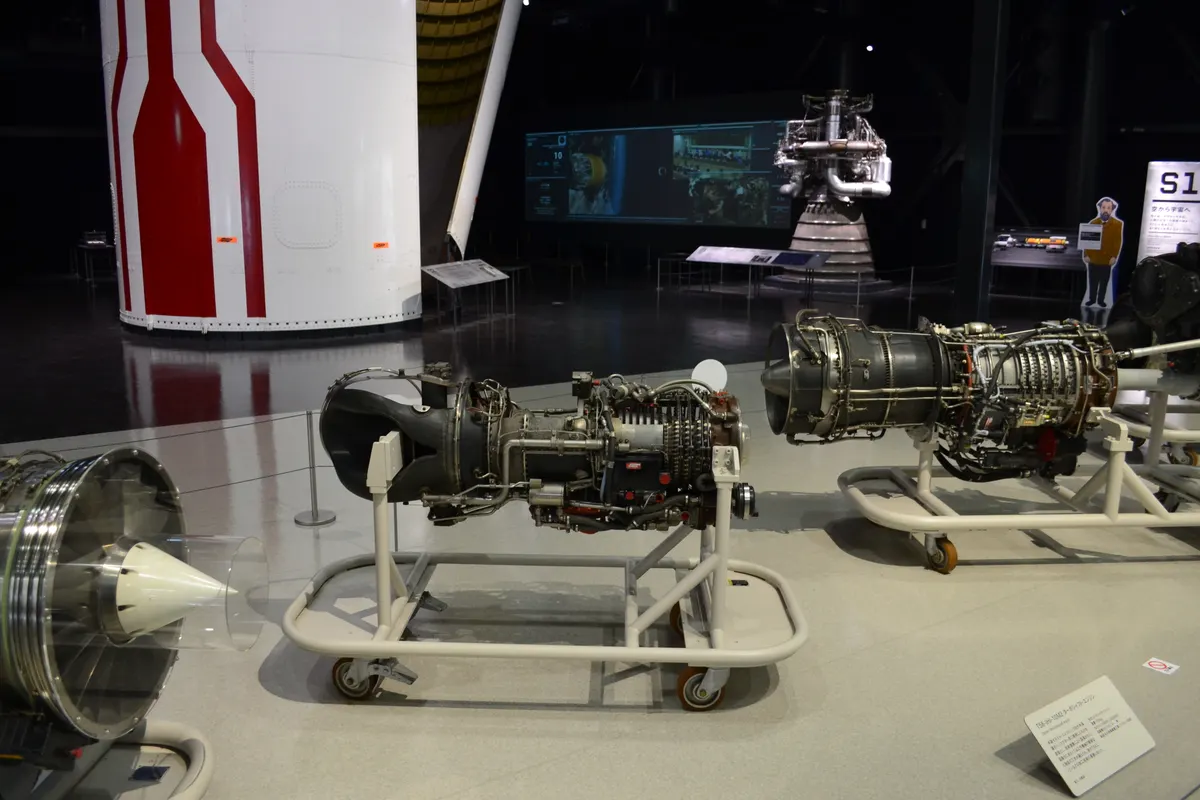
Cruise speed sat around 222 km/h with a maximum speed near 265 km/h, a service ceiling of roughly 4,265 meters, and an unrefueled range around 998 km, figures essentially identical to the CH-46A it was converted from since the SAR equipment added weight but not power.2,4 A typical HH-46A crew numbered four, pilot, copilot, crew chief, and hoist operator, smaller than the five-man crew flown on later armed CH-46 variants, since the plane guard mission did not require a door gunner.1
- Top Speed265 km/h
- Cruise Speed222 km/h
- Never-Exceed Speed (VNE)265 km/h
- Service Ceiling4,265 m
- Hover Ceiling (IGE)2,438 m
- Hover Ceiling (OGE)1,829 m
- Range998 km
- Ferry Range1,110 km
- Rate of Climb8.38 m/s
- Endurance180
- Fuselage Length13.66 m
- Height5.09 m
- Rotor Disc Area361.6
- Empty Weight5,255 kg
- Max Takeoff Weight10,433 kg
- Useful Load5,178 kg
- Cabin Volume14.2
- Hardpoints0
- Weapons Payload2,268 kg
- Gun.50-caliber M2 Browning machine gun
- Sling Load Capacity3,175 kg
- Rescue HoistYes
- Total Built50
- Variants10
- Retirement Year2004
- Production Start1964
- Production End1971
- Operational Statusretired from US Navy service (2004)
The Sea Knight family traces back to the Vertol Model 107, a civil demonstrator that first flew in 1958. The military derivative, ordered as the YHC-1B, first flew in October 1962, and Boeing's newly formed helicopter division, created after Boeing bought Vertol Aircraft Corporation in 1960, delivered the first production CH-46A Sea Knights to the Marine Corps in November 1964, with the closely related UH-46A entering Navy utility squadrons the same year.4,6 The Navy needed a dedicated rescue platform to match, and beginning in the mid-1960s it pulled a batch of roughly 50 CH-46A airframes out of the utility/logistics pipeline for conversion to the HH-46A search and rescue standard.1,2
Once converted, HH-46As went to sea with Helicopter Combat Support squadrons attached to Pacific and Atlantic Fleet carriers, standing plane guard during flight operations. Helicopter Combat Support Squadron ONE (HC-1), nicknamed the Pacific Fleet Angels, flew plane guard duty for every modern attack carrier operating out of the Pacific, one of several Navy support squadrons that rotated HH-46A detachments aboard deployed carriers through the late 1960s and into the 1970s.7 The role was routine by design. A helicopter loitering off the flight deck for hours, useful only in the minutes after something went wrong.
That routine turned fatal more than once. On 12 December 1966, an HH-46A approaching USS Valley Forge off Southern California crashed into the sea, killing all ten crewmen aboard.8 On 20 June 1967, another HH-46A lost power and went down in the South China Sea off South Vietnam.8 Both accidents underline how thin the margin was for a helicopter whose entire job was operating low and slow over open water.
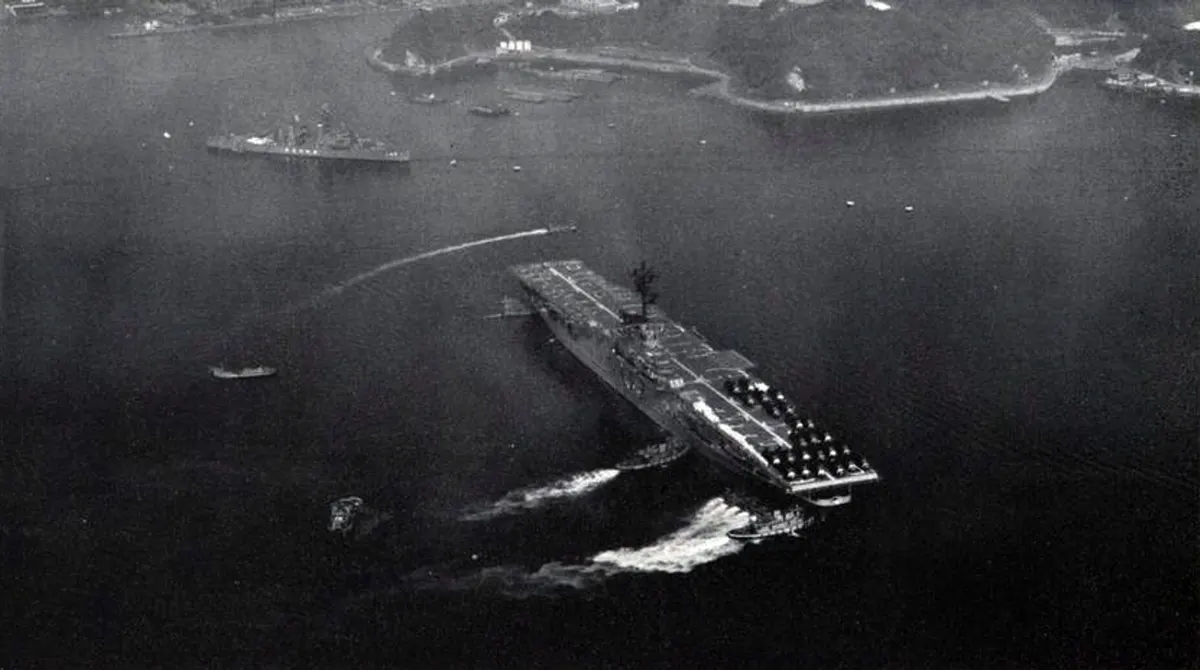
In September 1973, the HH-46A took on a second role beyond shipboard duty. The type arrived at Sherman Field, part of Naval Air Station Pensacola, marking the start of an all-weather search and rescue capability and a dedicated Search and Rescue Training Squadron there.9 From 1974, the newly formed Helicopter Combat Support Squadron SIXTEEN (HC-16), first stood up as HCT-16, flew HH-46As for plane guard duty aboard the training carrier USS Lexington and for search and rescue coverage around the Naval Air Training Command's Pensacola-area airfields, a shore-based mission that kept the type flying well after the Vietnam War wound down.9
The US Navy retired the HH-46A, along with its remaining CH-46 and UH-46 helicopters, on 24 September 2004, replacing the type fleet-wide with the Sikorsky MH-60S Seahawk.10 The Marine Corps kept flying its own, separately converted CH-46E Pedro search and rescue helicopters out of Cherry Point for another decade, finally retiring that unrelated program in 2015, a fact frequently, and incorrectly, attributed to the Navy's HH-46A instead.11
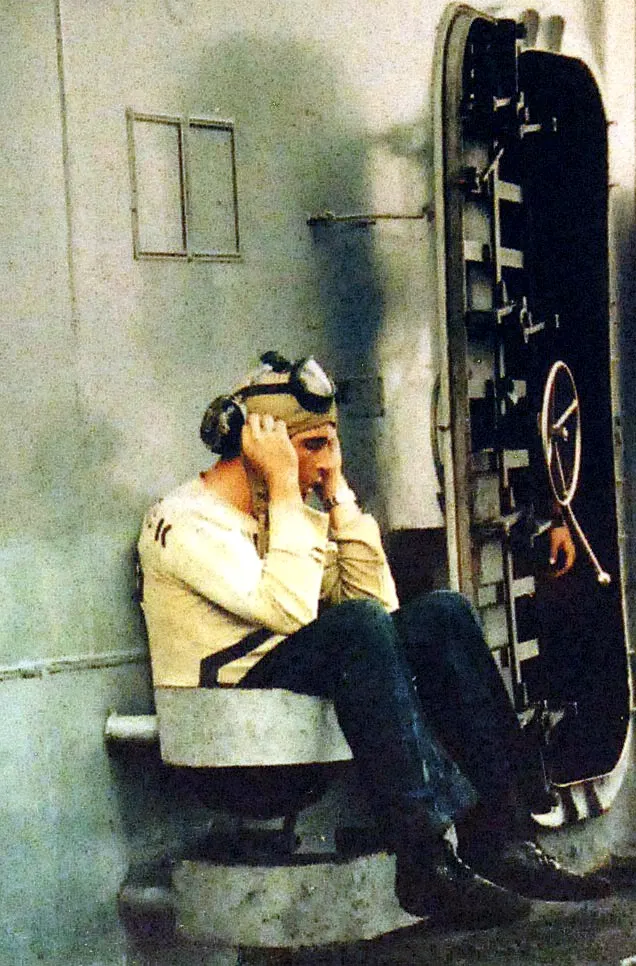
The HH-46A's Navy Sea Knight relatives, principally the UH-46A and CH-46A flown by Helicopter Combat Support squadrons, carried the bulk of vertical replenishment traffic to the US Seventh Fleet off the coast of Vietnam, moving ammunition, mail, and personnel between combat support ships and the carriers on Yankee Station.12 The HH-46A's own role in the Vietnam War was narrower, standing plane guard aboard the same carriers running strike missions over North and South Vietnam, ready to recover aviators who ditched near the ship rather than flying into the interior. The 20 June 1967 loss of an HH-46A in the South China Sea off South Vietnam happened in direct support of that carrier presence.8
Because the plane guard mission is inherently reactive, the HH-46A's combat record consists mostly of near-misses and non-events by design, a rescue that was never needed is the mission working as intended. The documented losses come from routine flight operations near the carrier rather than from enemy fire, which was typical for the type across its Navy service.
The HH-46A was one of several parallel Sea Knight designations built on the same airframe. The CH-46A was the baseline Marine Corps troop and cargo transport the HH-46A was converted from, and the closely related UH-46A served Navy utility squadrons in the unarmed, unconverted logistics role. A small number of aircraft were further modified for engineering trials as the NCH-46A, flown by the Naval Air Test Center rather than by fleet squadrons.4
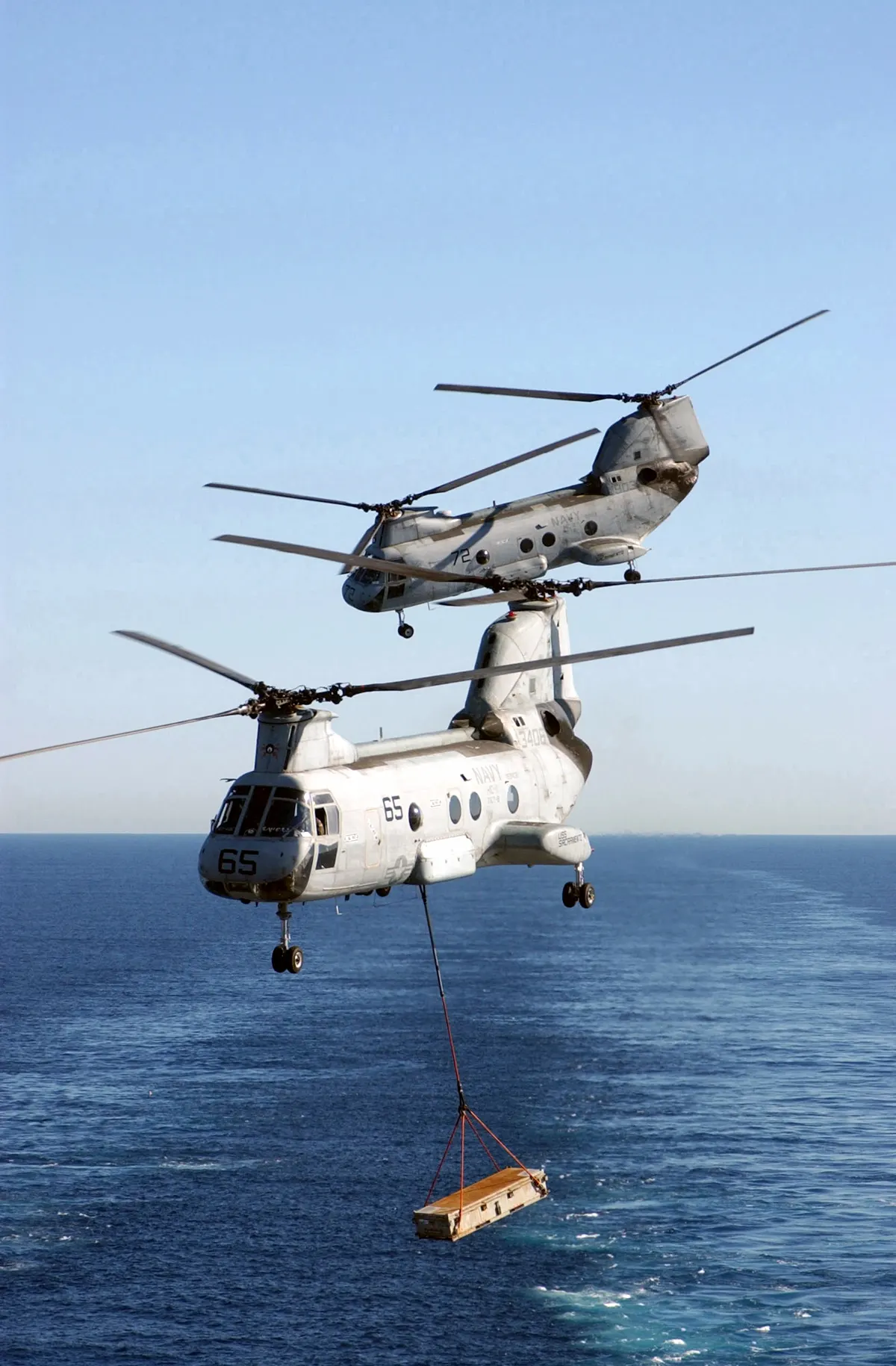
Later in the program, surviving HH-46As were upgraded to the HH-46D standard, adding refinements to the Doppler hover system, while the more powerful CH-46D, fitted with uprated T58-GE-10 engines at 1,400 shp each, became the backbone of Marine Corps medium-lift squadrons through the rest of the Vietnam era.4,13 The Marine Corps' own, entirely separate SAR conversion, the CH-46E Pedro, flew from Cherry Point decades later and should not be read as a continuation of the Navy's HH-46A program.


The HH-46A Sea Knight flew exclusively with the United States Navy, assigned in small detachments to Helicopter Combat Support squadrons rather than concentrated in one dedicated unit.1,7,9 HC-1 covered Pacific Fleet carriers, while HC-16 flew the type from its Pensacola base for both training-carrier plane guard duty and shore-based search and rescue coverage. No export or foreign operator of the HH-46A specifically has been documented, in contrast to the CH-46A and later CH-46E cargo variants, which several allied air arms eventually acquired or license-built.
The HH-46A Sea Knight's closest shipboard counterpart through the late 1960s was not another Sea Knight variant but the Sikorsky SH-3 Sea King, a single-main-rotor helicopter that handled the Navy's other major rescue role, primary astronaut recovery for Project Mercury, Gemini, and Apollo splashdowns. The two aircraft split the Navy's rescue mission by proximity rather than by capability. The Sea King, built around anti-submarine sonar gear and a boat-shaped hull, operated far from the carrier over open ocean for scheduled recovery events, while the tandem-rotor HH-46A stayed close aboard, cycling in the plane guard position for every single launch and recovery during flight operations.
| HH-46A Sea Knight | SH-3 Sea King | |
|---|---|---|
| Rotor layout | tandem, twin main rotors | single main rotor, tail rotor |
| Engines | 2x T58-GE-8 (1,250 shp each) | 2x T58-GE-8B (comparable class) |
| Primary Navy role | carrier plane guard / shipboard SAR | ASW, primary astronaut recovery |
| Water landing | reinforced hull, emergency use | designed amphibious hull |
The Sea King's true amphibious hull gave it a real water-landing margin the HH-46A's reinforced-but-not-boat-shaped fuselage could not match, which is part of why NASA leaned on Sea Kings rather than Sea Knights for splashdown recovery.14 The HH-46A's advantage was numbers and flexibility. A converted cargo airframe already in Navy service was cheaper to field across many carriers simultaneously than a purpose-built amphibian, and the tandem rotor layout gave plane guard crews a more stable hover platform for hoist work in a stiff carrier-deck crosswind.


What was the HH-46A Sea Knight used for? The HH-46A Sea Knight was the US Navy's carrier-based plane guard and search and rescue helicopter, hovering near aircraft carriers during flight operations to recover downed aviators from the water.1,2
How many HH-46A Sea Knights were built? None were built new. Approximately 50 existing CH-46A airframes were converted to the HH-46A search and rescue configuration, out of a total CH-46/H-46 family production run of 524 helicopters between 1962 and 1971.1,4
Is the HH-46A Sea Knight still in service? No. The US Navy retired the HH-46A on 24 September 2004, replacing it with the Sikorsky MH-60S Seahawk.10
What is the difference between the HH-46A and the CH-46A? The CH-46A is the baseline Marine Corps troop and cargo transport. The HH-46A is a Navy conversion of the same airframe fitted with a Doppler search radar, rescue hoist, and reinforced hull for the shipboard search and rescue role.1,4
What engine did the HH-46A Sea Knight use? Two General Electric T58-GE-8 turboshaft engines, each rated at 1,250 shp (932 kW), the same powerplant fitted to the CH-46A it was converted from.4,5
- "HH-46A Sea Knight", GlobalSecurity.org — globalsecurity.org ↩
- "Boeing-Vertol HH-46A Sea Knight", Skytamer — skytamer.com.html) ↩
- "HH-46 Sea Knight", USS Midway Museum — midway.org ↩
- "Boeing Vertol CH-46 Sea Knight", Wikipedia — en.wikipedia.org ↩
- "Boeing Vertol CH-46 Sea Knight Medium-Lift, Tandem Rotor Transport Helicopter", MilitaryFactory.com — militaryfactory.com ↩
- "CH-46 Sea Knight: Military Helicopters Specs and Operators", GlobalMilitary.net — globalmilitary.net ↩
- "Helicopter Combat Support Squadron ONE HC-1", GlobalSecurity.org — globalsecurity.org ↩
- "Helicopter Accidents Boeing-Vertol 107M H-46 Sea Knight", Helis.com — helis.com ↩
- "Helicopter Combat Support Squadron SIXTEEN HC-16", GlobalSecurity.org — globalsecurity.org ↩
- "5 Things You Didn't Know About The CH-46 Sea Knight", AVgeekery — avgeekery.com ↩
- "Marines Bid 'Phrog' Farewell to Last Active CH-46E Sea Knight Squadron", USNI News — news.usni.org ↩
- "Helicopter Sea Combat Squadron THREE [HC-3]", GlobalSecurity.org — globalsecurity.org ↩
- "Boeing-Vertol CH-46D Sea Knight", Skytamer — skytamer.com.html) ↩
- "50 Years Ago: Hornet + 3, The Recovery of Apollo 11", NASA — nasa.gov ↩