

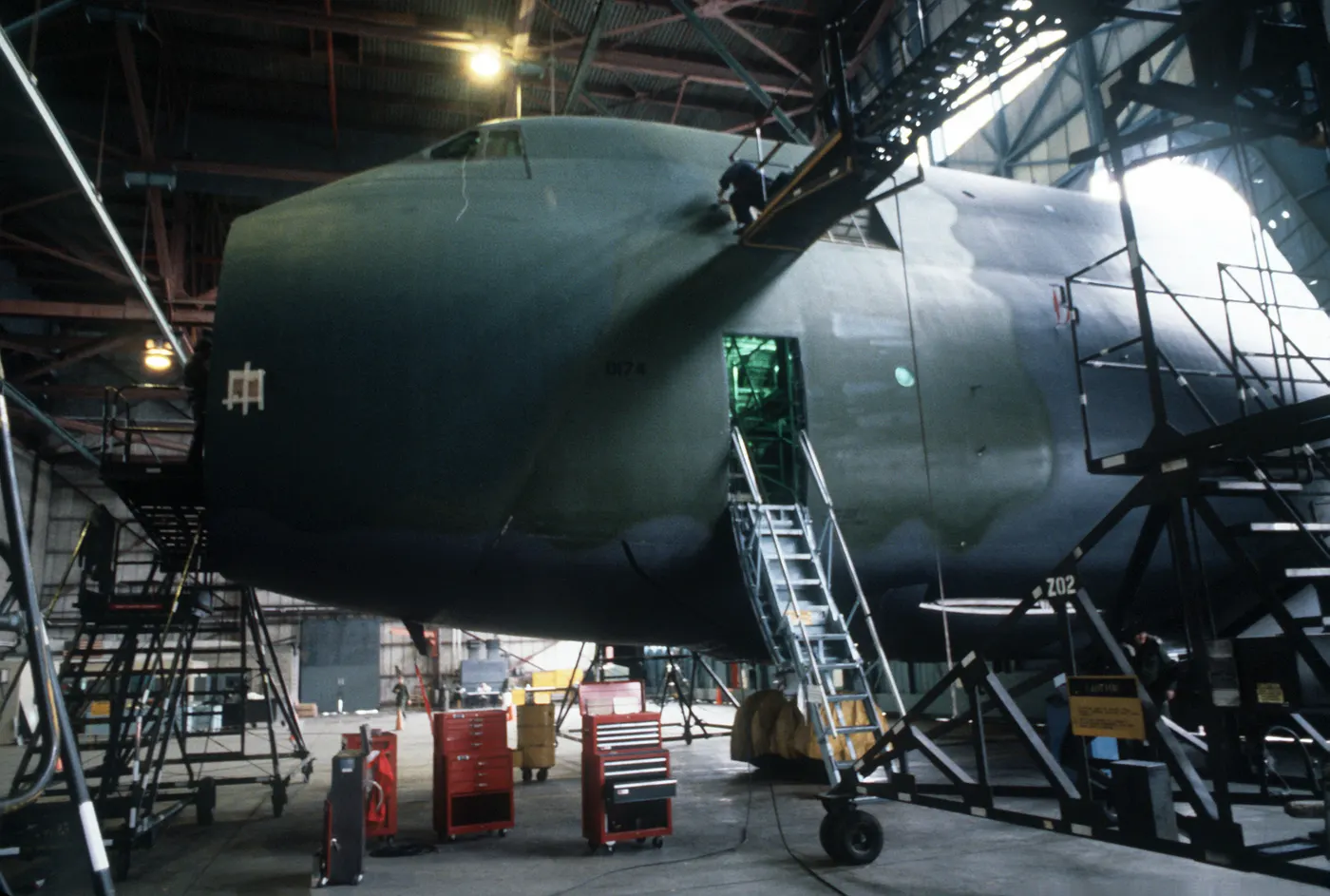

The Lockheed C-5A Galaxy is the original production version of the C-5 Galaxy family, 81 of which the United States Air Force bought between 1969 and 1973 under a fixed-price contract that turned into one of the most closely studied cost overrun and structural failure cases in American defense procurement history. The general story of the C-5 Galaxy program, its CX-HLS design competition, the drive-through nose and tail loading system, and the modern C-5M Super Galaxy still flying today, is covered in full in the main Lockheed C-5 Galaxy article. This entry is about the A-model specifically, the 1969 to 1973 production run, the wing that failed its own strength tests within a year of entering service, the decade-long acquisition scandal that followed, the 1980s wing-replacement program that rebuilt the fleet from the spar out, and the slow retirement of the last pure C-5A airframes between 2003 and 2017.
- Outsize cargo hold unmatched by any Western transport when it entered service in 1970
- Four-engine GE TF39 turbofan, the first high-bypass turbofan built for any production aircraft
- 36 463L pallet positions and a drive-through hold usable by both crew and cargo simultaneously
- H-Mod re-winging restored full payload after the 1970s wing crisis
- Wing fatigue cracks discovered within a year of testing forced years of reduced cargo loads
- Program cost overruns became a landmark case study in defense procurement failure
- Never upgraded with the modern engines, glass cockpit or avionics later fitted to the C-5M
- Fully retired by 2017, replaced in the active fleet by C-5M conversions and the C-17
Ground crews had already started calling the type FRED (widely explained as short for Fantastic Ridiculous Economic Disaster) before the aircraft had flown a single operational mission, a nickname earned directly from the story told below rather than from any later problem.1 Lockheed Corporation (the manufacturer at the time, absorbed decades later into today's Lockheed Martin) built every C-5A at its Marietta, Georgia plant, and every one of the 81 aircraft was assigned to Air Mobility Command's predecessor organizations as part of the broader mission of moving outsize military cargo, the same strategic airlifters role the type still fills in its modernized C-5M form.
Two comparisons place the A-model in context. Its own descendant, the re-engined and modernized C-5M Super Galaxy, is covered at length in the main Lockheed C-5 Galaxy article, and the gap between the two shows just how much the C-5A's original General Electric TF39 engines and 1968 avionics limited it. Its rough Cold War contemporary in raw scale, the Soviet Antonov An-124 Ruslan, did not fly until 1982, a full decade after the C-5A's wing problems were already public and years into the re-winging effort described below.
The General Electric TF39, the Engine Before the C-5M's F138
Every C-5A left the Marietta plant with four General Electric TF39-GE-1 turbofans (later upgraded in place to the TF39-GE-1C standard), each rated at roughly 41,000 pounds of thrust (about 182 kilonewtons).1 The TF39 was the first high-bypass turbofan engine built for any production aircraft, developed specifically to meet the enormous thrust and fuel-efficiency demands of the CX-HLS transport competition, and its core technology went on to power the commercial General Electric CF6 engine family used in early wide-body airliners.1 That single engine program is one of the C-5A's genuinely important technical legacies, even though the airframe it was built for spent its first decade under a cargo-load restriction the engines themselves had nothing to do with. The C-5M Super Galaxy replaced the TF39 entirely with the modern F138 turbofan decades later, a change covered in the main Lockheed C-5 Galaxy article rather than repeated here, since no C-5A ever received that engine.
{{photo-req side=right q="General Electric TF39 turbofan engine C-5 Galaxy pylon" caption="A General Electric TF39 turbofan on its pylon. The engine was the first high-bypass turbofan built for a production aircraft, developed specifically for the C-5A." alt="General Electric TF39 turbofan engine mounted under the wing of a C-5 Galaxy"}}
As originally delivered, a C-5A cruised at roughly Mach 0.77 (about 830 kilometers per hour, 518 miles per hour) with a maximum speed near Mach 0.79, a service ceiling of around 10,400 meters (34,000 feet) at heavy weight, and an empty ferry range of roughly 9,560 kilometers (5,165 nautical miles).2 With a maximum payload aboard, range fell to around 4,685 kilometers (2,530 nautical miles).1 The cargo hold itself measured about 36.9 meters (121 feet) long, 4.1 meters (13.5 feet) high and 5.8 meters (19 feet) wide, big enough for 36 standard 463L cargo pallets, or roughly 270 combat troops on the lower deck with room for another 75 in the upper deck aft compartment in a personnel configuration.2 A basic flight crew of six, pilot, copilot, two flight engineers and two loadmasters, operated the aircraft, with a relief crew added for long transoceanic legs.2 The nose-visor and tail-ramp drive-through loading design that made all of this possible is described in full in the main Lockheed C-5 Galaxy article, since the mechanism was identical across the C-5A, C-5B and C-5M.
A Wing Built Thinner Than the Contract Specified
The C-5A's defining design flaw traces to the wing box itself. A 1969 full-scale static test found the wing failing at just 128 percent of its required limit load, well under the 150 percent the contract demanded, and a second test in July 1970, after design changes, still only reached 125 percent.3 The U.S. Government Accountability Office later investigated who was financially responsible for fixing it and found that Lockheed-Georgia had deviated from the contract's own specifications during manufacturing, reducing wing skin and structural material thickness below what the design called for, in a bid to hit the aircraft's demanding empty-weight targets.4 That finding meant Lockheed bore direct responsibility for at least part of the correction, though a separate 1969 to 1970 supplemental agreement between the company and the Air Force had already restructured the original contract's obligations in a way that let Lockheed argue it owed nothing further, a dispute the GAO sided against the Air Force on in a 1983 report even after the repair contract had already been awarded and paid.4
{{photo-req side=left q="aircraft wing static structural test rig hangar" caption="A wing undergoing full-scale static structural testing. The C-5A's wing failed its 150 percent limit-load requirement twice, at 128 percent in 1969 and 125 percent in 1970, before a redesign began." alt="Large aircraft wing mounted in a structural test rig inside a hangar"}}
By the mid-1970s cracks were appearing throughout the operational fleet, and the interim fix cut routine peacetime cargo loads on some missions to as little as 22,680 kilograms (50,000 pounds) per aircraft, a fraction of what the type had been sold to Congress as capable of carrying.3 The table below shows how far the payload swung across the crisis and the repair that followed.
| Configuration | Certified max payload |
|---|---|
| C-5A as designed (pre-restriction) | up to 127,460 kg (281,000 lb)2 |
| C-5A under 1970s interim wing restriction | as low as 22,680 kg (50,000 lb) on some missions3 |
| C-5A after 1980s H-Mod re-wing | 86,000 kg (190,000 lb)3 |
| C-5B, new-build with factory wing (for reference, not part of this record) | up to 127,460 kg (281,000 lb)1 |
The 1965 Total Package Procurement Contract
The Air Force awarded Lockheed the C-5A contract in 1965 using a newly invented acquisition method called Total Package Procurement, meant to lock in a single fixed-price commitment covering research, development and production of all 115 aircraft the Air Force originally wanted, rather than negotiating each phase separately.5 The theory, championed by Defense Secretary Robert McNamara's Pentagon, was that forcing contractors to bid firm prices years before the design was finished would end the cost growth that had plagued earlier programs. In practice, the Air Force and Lockheed were pricing in 1965 a design whose final engineering would not be finished until 1972, and a complex built-in repricing formula let costs balloon once the true scope of the wing and systems problems became clear.5 The general CX-HLS design competition that Lockheed won against Boeing and Douglas, and how Boeing's losing design became the basis for the 747, is told in the main Lockheed C-5 Galaxy article. What matters for the C-5A specifically is that Total Package Procurement, not the wing defect alone, is why the cost overrun became a program-defining scandal rather than a quiet engineering fix.
By January 1969 a Lockheed and Pentagon cost analyst named A. Ernest Fitzgerald had documented a projected overrun of roughly $2 billion against the original $1.9 billion bid for the full 115-aircraft buy.6 Fitzgerald testified to Senator William Proxmire's Joint Economic Committee subcommittee on 13 November 1968, and Proxmire opened formal Senate hearings into the overrun on 3 September 1969, accusing the Air Force of concealing the true cost growth from Congress.7 The fallout reached the White House. Fitzgerald was dismissed from his Pentagon job in late 1969, officially described as a reorganization, and his subsequent legal fight produced the landmark Supreme Court case on presidential immunity, Nixon v. Fitzgerald, more than a decade later.6
{{photo-req side=right q="A. Ernest Fitzgerald Pentagon cost analyst portrait" caption="A. Ernest Fitzgerald, the Pentagon cost analyst whose 1968 testimony on the C-5A's overruns triggered a Senate investigation and, eventually, his own dismissal." alt="Portrait photograph of A. Ernest Fitzgerald, the Pentagon cost analyst who exposed the C-5A cost overruns"}}
The Department of Defense's 14 November 1969 decision to cap the buy at 81 aircraft, four squadrons, rather than proceed toward the original 115-aircraft plan was a direct outcome of the overrun fight, and it is the reason the C-5A's production run ended where it did.7 A separate, later-decade purchase of an improved second-generation aircraft, the C-5B, would not be authorized until 1982, and that program is not part of this record, it is covered as a distinct successor variant in the main Lockheed C-5 Galaxy article.
Restricted Cargo Loads Through the 1970s
The wing crisis described in Specs and Design turned into a years-long operational constraint rather than a one-time fix. From roughly 1971 onward, every C-5A in the fleet flew under an 80 percent load restriction, and by the middle of the decade fatigue cracks visible during routine inspections had pushed some units down to the 22,680-kilogram (50,000-pound) peacetime cargo limit noted above, a fraction of the load the aircraft had been designed and sold to move.3 The restriction did not ground the fleet outright. C-5As kept flying cargo and troop missions into the Vietnam War throughout this period, but airlift planners had to work around an outsize-cargo aircraft that, for practical day-to-day missions, often could not fly outsize loads.
{{photo-req side=left q="C-5A Galaxy Charleston Air Force Base 437th airlift wing 1970s" caption="A C-5A Galaxy of the 437th Airlift Wing, the type's first operational unit at Charleston Air Force Base, during the early 1970s, the years the wing restriction was in effect." alt="Lockheed C-5A Galaxy transport aircraft on the ground at an airlift wing base in the 1970s"}}
Lockheed delivered the first C-5A to the Air Force in December 1969 for training at Altus Air Force Base, Oklahoma, and the first operational aircraft reached the 437th Airlift Wing at Charleston Air Force Base, South Carolina, in June 1970.1 The type's first mission flew into Southeast Asia on 9 July 1970, and additional squadrons stood up through the early 1970s at Dover Air Force Base, Delaware, and Travis Air Force Base, California, the same three bases that anchored C-5 operations for the next four decades.1
The C-5A's worst single loss came on 4 April 1975, when one of the type crashed during the first mission of Operation Babylift, the emergency evacuation of Vietnamese orphans in the final weeks before the fall of Saigon, killing 138 of the 314 people aboard. That accident is covered in full in the main Lockheed C-5 Galaxy article, since it involved the C-5 program broadly rather than any wing-restriction issue specific to the A-model.
The H-Mod Wing Replacement, 1976 to 1987
Lockheed and the Air Force began engineering work on a redesigned wing, internally called the H configuration, as early as November 1973, using a new aluminum alloy that had not existed when the original C-5A wings were built a few years earlier.8 The full replacement effort, informally known as H-Mod, formally began in 1976 as a $1.5 billion program (roughly $8.5 billion in today's dollars), covering new center wing boxes, inner wing boxes and outer wing panels while reusing the original leading edges, trailing edges, flaps and pylons.3 Avco's Nashville, Tennessee aerostructures division, which had already built C-5A airframe parts since the program began, took on fabrication of the new wing sections starting in August 1980, and installation across the fleet ran from 1980 or 1981 through 1987.8,9 The 76th and final re-winged C-5A rejoined the operational fleet in 1987, restoring the type's routine certified payload to 86,000 kilograms (190,000 pounds), still short of the aircraft's original design maximum but a large recovery from the 1970s restriction, and extending the wing's structural service life to a minimum of 30,000 flight hours.3
The C-5B, ordered separately in 1982 and delivered between 1985 and 1989 with the improved wing and other systems built in from the factory rather than retrofitted, is a distinct production standard and is not part of this record. Its full history, along with the later Avionics Modernization Program and Reliability Enhancement and Re-engining Program that turned surviving C-5Bs (and one C-5A) into today's C-5M Super Galaxy, is covered in the main Lockheed C-5 Galaxy article.
The 1990 Ramstein Crash During the Desert Shield Airlift
The C-5A's other major operational loss came on 29 August 1990, when an aircraft of the 60th Airlift Wing at Travis Air Force Base, crewed that day by Air Force Reserve personnel from the 433rd Military Airlift Wing at Kelly Air Force Base, Texas, crashed on takeoff from Ramstein Air Base while flying medical supplies and equipment toward Dhahran, Saudi Arabia in support of Operation Desert Shield, the buildup that followed Iraq's invasion of Kuwait weeks earlier.10 Investigators found the crash was caused by an uncommanded, inadvertent deployment of the number one engine's thrust reverser shortly after the aircraft left the runway at night, rolling it left before the crew could recover.11 Thirteen of the seventeen people aboard were killed, making it one of the deadliest single losses in the type's history and a stark reminder that the C-5A was still flying front-line strategic airlift missions two decades after entering service, wing crisis and all.10
{{photo-req side=right q="Ramstein Air Base Germany aerial view runway" caption="Ramstein Air Base in Germany, where a C-5A Galaxy crashed on takeoff on 29 August 1990 while flying a Desert Shield support mission to Saudi Arabia." alt="Aerial view of Ramstein Air Base runway and flightline in Germany"}}
Drawdown and Retirement, 2003 to 2017
By the early 2000s the C-5A fleet, some airframes then more than 30 years old, was showing the maintenance costs and low mission-capable rates typical of an aging, largely un-modernized transport fleet, even after the H-Mod wing repair. The Air Force retired its first C-5A to the 309th Aerospace Maintenance and Regeneration Group (AMARG, the Davis-Monthan Air Force Base boneyard commonly called the boneyard) on 4 November 2003, and thirteen more followed into storage there by 2005.12 Unlike the C-5B fleet, which was almost entirely converted into the modern C-5M Super Galaxy under the Avionics Modernization Program and Reliability Enhancement and Re-engining Program described in the main Lockheed C-5 Galaxy article, only a single C-5A ever received that upgrade. The rest of the type was drawn down as the smaller, more austere-field-capable Boeing C-17 Globemaster III absorbed a growing share of day-to-day tactical lift, including support for the Iraq War and the war in Afghanistan, while the shrinking pool of C-5As and unconverted C-5Bs handled what outsize missions remained.13
{{photo-req side=left q="C-5 Galaxy retired storage Davis-Monthan boneyard AMARG" caption="Retired C-5 Galaxy airframes in long-term storage at the 309th Aerospace Maintenance and Regeneration Group, Davis-Monthan Air Force Base, the destination for the last C-5As withdrawn from service." alt="Retired Lockheed C-5 Galaxy transport aircraft parked in storage at an Air Force boneyard"}}
The Air Force flew its last four operational C-5As with the 439th Airlift Wing at Westover Air Reserve Base, Massachusetts, into the mid-2010s.14 The final one, having logged more than 44 years of service, roughly 22,500 flight hours and over 5,470 landings since its original 1970 delivery to the 437th Airlift Wing, made its last flight to AMARG on 7 September 2017, closing out the operational career of the C-5A as a distinct type after almost half a century.14
The C-5A Galaxy's combat and contingency history runs from the last years of the Vietnam War, where the type flew cargo and troop-support missions from 1970 onward and carried out the Operation Babylift evacuation in April 1975, through the Gulf War buildup two decades later.1 During Operation Desert Shield and the following Gulf War, C-5As flew alongside newer C-5Bs to move armored vehicles, helicopters and bulk equipment into Saudi Arabia faster than sealift ever could, the mission that cost the type its 1990 Ramstein loss described above.10 By the time the Iraq War and the war in Afghanistan began in the 2000s, the C-5A fleet was already being drawn down toward retirement, and its remaining airframes flew alongside the newer Boeing C-17 Globemaster III and modernized C-5Ms rather than carrying the bulk of the mission themselves.13
{{photo-req side=right q="C-5 Galaxy loading military vehicles Desert Shield Saudi Arabia 1990" caption="A C-5 Galaxy loads cargo during the Operation Desert Shield buildup in Saudi Arabia, the deployment a C-5A was supporting when it crashed at Ramstein in August 1990." alt="Lockheed C-5 Galaxy transport aircraft being loaded with military cargo during the Desert Shield buildup"}}
The C-5A designation covers two real configurations of the same 81 airframes, not two separate builds. As delivered between 1969 and 1973, the C-5A carried its original wing and General Electric TF39-GE-1 engines and operated under the load restrictions described above.1 Following the 1980s H-Mod program, the same tail numbers carried a rebuilt wing and, in most cases, upgraded TF39-GE-1C engines, and are sometimes informally called the C-5A(WS) in enthusiast literature even though the Air Force never adopted a formal separate designation.3 Two C-5A airframes were also converted to the C-5C configuration in the 1980s, with a widened aft cargo door and no troop compartment, specifically to move oversize NASA and Space Shuttle program hardware, a conversion covered in more detail in the main Lockheed C-5 Galaxy article.1 The C-5B, a separate 50-aircraft production run delivered between 1985 and 1989 with the improved wing built in from the factory, is not a variant of the C-5A and is not part of this record. Neither is the later C-5M Super Galaxy modernization, which only one former C-5A ever received, the remaining conversions all coming from the C-5B fleet.12
The United States is the only country that ever operated the C-5A Galaxy. Every one of the 81 aircraft built flew with the U.S. Air Force, split at various points between active-duty Air Mobility Command wings, Air Force Reserve Command squadrons and Air National Guard units, based principally at Charleston, Dover, Travis, Altus and, in the type's final years, Westover Air Reserve Base.1 At the fleet's peak in the early 2000s, C-5s of all models filled 15 squadrons across these three components before the retirements described above reduced the total C-5 fleet, C-5A and C-5B combined, to the smaller, all-C-5M force flying today.12 No C-5A was ever exported or flown by any air force outside the United States, unlike its rival the Antonov An-124 Ruslan, which several other countries and commercial operators have flown.
{{photo-req side=left q="C-5A Galaxy Travis Air Force Base flightline California" caption="A C-5A Galaxy on the flightline at Travis Air Force Base, California, one of the type's three original operational bases alongside Charleston and Dover." alt="Lockheed C-5A Galaxy transport aircraft parked on an air force base flightline"}}
The most useful comparison for the C-5A Galaxy is not against a rival aircraft at all, it is against its own descendant. The C-5M Super Galaxy, covered in full in the main Lockheed C-5 Galaxy article, uses the same basic fuselage and drive-through loading system as the original C-5A but replaces the TF39 engines with modern F138 turbofans rated at roughly 22 percent more thrust, cuts takeoff roll by about 30 percent, and improves climb rate to initial cruising altitude by roughly 38 percent.15 Put simply, the aircraft the U.S. Air Force flies today under the C-5 name climbs and takes off dramatically better than any C-5A ever could, even a fully re-winged one, a gap that exists entirely because of engine and avionics upgrades the A-model never received.
Against the Soviet Antonov An-124 Ruslan, the comparison is as much about timing as raw size. The An-124 did not fly until December 1982, a full decade after the C-5A entered service and well into the years the type spent flying under its wing-fatigue restrictions.16 By the time the An-124 reached Soviet squadrons in the mid-1980s, the U.S. Air Force was already several years into the H-Mod rewinging program described above, quietly fixing the exact structural weakness that had made headlines a decade earlier. The An-124's cargo hold is both wider and taller than the C-5's, and its commonly cited maximum payload, around 150 tonnes, exceeds even the C-5A's post-repair certified load of 86,000 kilograms (190,000 pounds), though it never had to survive a wing-fatigue scandal of its own on the way to service.16
| Metric | C-5A Galaxy (as originally built) | C-5A Galaxy (after H-Mod, 1987) | Antonov An-124 Ruslan |
|---|---|---|---|
| Entered service | 1970 | 1987 (rewing complete) | 1986 |
| Engines | GE TF39-GE-1, ~41,000 lbf each | GE TF39-GE-1C, ~43,000 lbf each | Progress D-18T |
| Certified max payload | up to 127,460 kg (281,000 lb)2 | 86,000 kg (190,000 lb)3 | ~150,000 kg16 |
| Export operators | none | none | multiple16 |


What was the C-5A Galaxy? The C-5A Galaxy was the original production version of the Lockheed C-5 Galaxy strategic airlifter, 81 of which the U.S. Air Force bought between 1969 and 1973, before the improved C-5B and the later modernized C-5M Super Galaxy.1
What happened to the C-5A's wings? Structural tests in 1969 and 1970 found the C-5A's wing failing well below its required 150 percent limit load, and cracks that appeared across the fleet through the mid-1970s forced payload restrictions as low as 22,680 kilograms (50,000 pounds) on some missions until a $1.5 billion wing-replacement program installed strengthened wings on the fleet between 1980 and 1987.3
Why was the C-5A Galaxy such a famous cost overrun scandal? The Air Force bought the C-5A under Total Package Procurement, a fixed-price contracting method meant to control costs, but a projected $2 billion overrun on the original $1.9 billion, 115-aircraft contract triggered Senate hearings led by Senator William Proxmire in 1969 and led directly to the Department of Defense capping the buy at 81 aircraft.7
Is the C-5A Galaxy still in service? No. The last operational C-5A retired to the Davis-Monthan Air Force Base boneyard on 7 September 2017. All C-5s remaining in U.S. Air Force service today are C-5M Super Galaxy conversions built from the later C-5B fleet.14
What is the difference between the C-5A and the C-5B Galaxy? The C-5A was the original 1969 to 1973 production run that suffered the wing-cracking crisis described above. The C-5B, ordered separately in 1982 and delivered between 1985 and 1989, incorporated the strengthened wing and other improvements from the factory rather than as a retrofit, and is treated as a distinct successor rather than a variant of the C-5A.1
How much did a C-5A Galaxy cost? Testimony to Congress in 1968 put the per-aircraft cost at roughly $44 million in 1968 dollars, itself already well above the original bid, and the overall program cost overrun that triggered congressional hearings was estimated at close to $2 billion across the planned 115-aircraft buy.6
- "Lockheed C-5 Galaxy", Wikipedia — en.wikipedia.org ↩
- "C-5A/B Galaxy", Federation of American Scientists — man.fas.org ↩
- "PLRD-82-38, C-5A Wing Modification", U.S. Government Accountability Office — gao.gov ↩
- "Financial Responsibility for the C-5A Wing Modification", U.S. Government Accountability Office — gao.gov ↩
- "Total Package Procurement", Wikipedia — en.wikipedia.org ↩
- "Professionalism/Ernest Fitzgerald and the Lockheed C-5A", Wikibooks — en.wikibooks.org ↩
- "Congress Begins Hearings on Overspending for the C-5A Galaxy", EBSCO Research Starters — ebsco.com ↩
- "Lockheed C-5 Galaxy Cargo Plane Specs and History", The Aviation Zone — theaviationzone.com ↩
- "Carlyle Aerostructures", Tennessee Encyclopedia — tennesseeencyclopedia.net ↩
- "Accident, Lockheed C-5A Galaxy 68-0228, Wednesday 29 August 1990", Aviation Safety Network — aviation-safety.net ↩
- "U.S. troops killed in crash of gulf-bound plane", UPI Archives — upi.com ↩
- "Last C-5A Galaxy retires to AMARG", Davis-Monthan Air Force Base — dm.af.mil ↩
- "C-5 Galaxy vs C-17 Globemaster III, What's the Difference Between These Cargo Aircraft?", War History Online — warhistoryonline.com ↩
- "USAF Retires Its Last C-5A Airlifter", The Aviation Geek Club — theaviationgeekclub.com ↩
- "Saving the Galaxy, The C-5 AMP/RERP Program", Defense Industry Daily — defenseindustrydaily.com ↩
- "A look at the biggest cargo aeroplanes, Antonov An-124 and Lockheed C-5 Galaxy", Evergreen Aviation — evergreenaviation.com ↩