

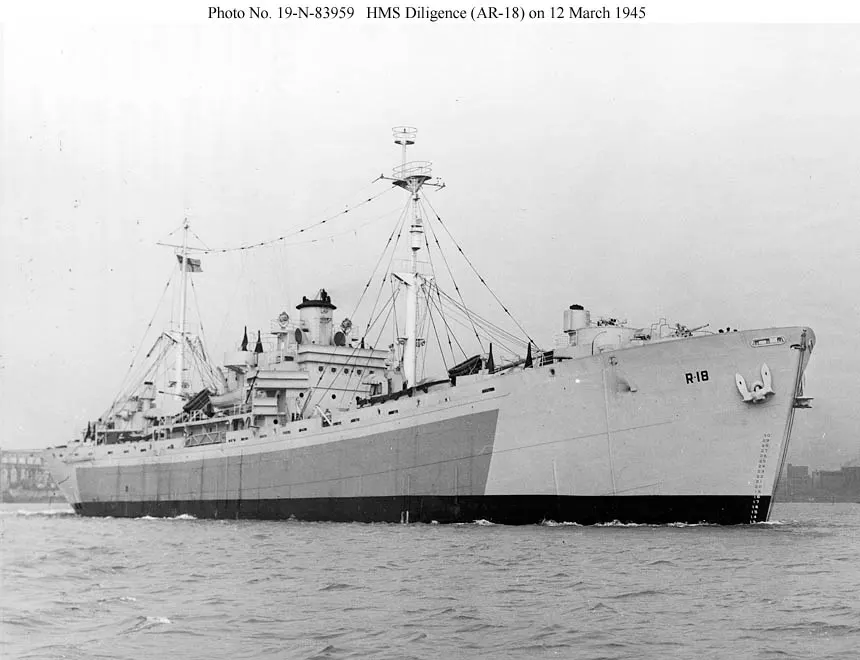

The Xanthus-class repair ship was a five-hull class of United States Navy auxiliary vessels converted from partially built Liberty ship hulls in 1944 and 1945 to give the fleet mobile heavy-repair capacity in the final year of the World War II Pacific campaign. Three of the five, USS Xanthus (AR-19), USS Laertes (AR-20) and USS Dionysus (AR-21), served under the American flag, while the other two, HMS Assistance (F173) and HMS Diligence (F174), were completed for the Royal Navy under Lend-Lease before returning to US custody after the war. Each ship displaced roughly 10,920 tons at full load, ran a triple-expansion steam-reciprocating plant good for 12.5 knots, and carried a wartime armament of one 5 inch gun, three 3 inch guns, four 40 mm guns and twelve 20 mm guns manned by a crew of about 525.1,2
- cheap, fast conversion from existing Liberty hulls
- full machine-shop and foundry capability at forward anchorages
- moderate crew size kept operating cost low
- hull already in mass production, avoiding a new design cycle
- slow, 12.5 knot top speed limited fleet mobility
- thinner, mercantile-grade hull compared to purpose-built repair ships
- limited crane capacity next to larger fleet repair ships
- only useful once towed or steamed to a forward base, not a combatant asset
None of the five ships fired those guns in anger. Their value was the machine shops, foundries, electrical repair bays and cranes built into a Liberty hull, which let a task force patch torpedo damage, replace gun barrels or repair boilers at an advanced anchorage instead of sending a ship back to a stateside navy yard. That capability sits at the center of the repair-salvage-ships category the class belongs to, alongside larger purpose-built repair ships and smaller landing-craft repair tenders that filled the same logistical niche at different scales.
USS Xanthus was named, like several other repair ships of the era, after a figure from Greek mythology, in this case the immortal, human-speaking horse of Achilles.3 The naming pattern extended across the class, with Laertes drawn from the father of Odysseus and Dionysus from the god of wine, while the two British-flagged sisters kept plain Royal Navy service names. The Xanthus-class repair ship entered service too late to affect the outcome of the Pacific war, but its ships went on to support the occupation of Japan, the stabilization of postwar China, and, in Laertes' case, the Korean War.
The Xanthus-class repair ship began as an EC2-S-C1 Liberty ship hull, the same standardized cargo design that built more than 2,700 Liberty ships during the war.4 Rather than draw up a bespoke repair-ship hull, the Navy's Bureau of Ships selected five hulls already under construction at the Bethlehem-Fairfield Shipyard in Baltimore and had them finished as repair vessels instead of cargo ships, following a conversion plan based on the earlier Luzon-class repair ships that had already proven the concept in Pacific service.5 That reuse of an existing hull made the class fast and cheap to deliver at a point in the war when new fleet auxiliaries were needed immediately, not after a multi-year design and construction cycle.
- PropulsionSteam Reciprocating
- Top Speed12.5 kn
The converted hull ran 441 feet 6 inches long with a 56 foot 11 inch beam and a 22 foot draft, and the ships kept the Liberty ship's original steam-reciprocating triple-expansion machinery, good for only 12.5 knots, well below the speed of the fast carrier task forces the ships were meant to support.1 That was an acceptable trade in a repair ship, which spent most of its career anchored at a forward base rather than steaming with a battle line, but it meant the Xanthus-class hulls could not keep pace with a fast carrier group if the tactical situation changed.
Where the class differed from a purpose-built fleet repair ship was in defensive armament and crane capacity. The Xanthus-class repair ship carried a modest gun battery, one 5 inch dual-purpose gun, three 3 inch guns and a mix of 40 mm and 20 mm automatic weapons, purely for self-defense against air attack rather than for any offensive role.2 The ships had none of the heavy-lift booms fitted to larger contemporaries, limiting them to hull, engine, electrical and ordnance repair work rather than the crane-heavy salvage tasks assigned to true salvage vessels.
{{photo-req side=right q="Bethlehem-Fairfield Shipyard Liberty ship launch Baltimore 1944" caption="A Liberty ship hull under construction at Bethlehem-Fairfield Shipyard, Baltimore, the yard that built and converted all five Xanthus-class hulls." alt="Liberty ship under construction on a shipyard slipway"}}
Structurally the ships remained closer to a merchant hull than a warship. The single-hull, riveted-and-welded Liberty design lacked the compartmentation and armor protection of a combatant, a deliberate trade that kept unit cost and build time down. For a support ship expected to operate behind the battle line at a secured anchorage such as Eniwetok or Ulithi, that risk was judged acceptable, and no Xanthus-class hull was lost to enemy action during the war.
Fleet Admiral Ernest J. King, then Chief of Naval Operations, authorized construction of five Heavy Duty Fleet Repair Ships on 26 February 1944 in response to a Royal Navy request for repair capacity to support the British Pacific Fleet's push into Japanese home waters.5 All five hulls were initially assigned British names and slated for transfer under Lend-Lease, but on 23 November 1944 the Navy reallocated the last three of the five back to American service before they were finished, leaving only two, HMS Assistance and HMS Diligence, in British hands.5,6
{{photo-req side=right q="Fleet Admiral Ernest J. King portrait 1944" caption="Fleet Admiral Ernest J. King, who authorized the Heavy Duty Fleet Repair Ship program that produced the Xanthus class." alt="Portrait of Fleet Admiral Ernest J. King in dress uniform"}}
HMS Assistance was laid down in May 1944 at Bethlehem-Fairfield and delivered to the Royal Navy on 20 January 1945. She served initially as an aircraft repair and depot ship in home waters before sailing for Australia with the British Pacific Fleet Train, reaching Manus in the Admiralty Islands in September 1945 after the Japanese surrender, then moving on to Singapore.6,7 HMS Diligence, laid down the following month, crossed the Atlantic in 1945 and worked as a destroyer repair ship in British service before returning to United States Navy custody in 1946, after which both ships passed into the National Defense Reserve Fleet.7,8
{{photo-req side=right q="HMS Diligence repair ship Royal Navy 1945" caption="HMS Diligence, one of two Xanthus-class hulls completed for the Royal Navy under Lend-Lease, seen during her 1945 British service." alt="British repair ship at anchor with cranes and workshops visible"}}
USS Xanthus, laid down at Bethlehem-Fairfield on 6 June 1944, was originally intended for the Royal Navy as HMS Hecla before being reassigned and commissioned as AR-19 on 9 May 1945.1 After a Panama Canal transit she reached Pearl Harbor on 20 July 1945 and then sailed for Adak, Alaska, on 11 August to join the buildup for the planned invasion of the Kuril Islands and northern Japan, an operation the Japanese surrender made unnecessary days later.1 Reassigned to Task Group 40.2, Xanthus arrived at Ominato, Japan, on 9 September 1945 and served as flagship of the occupation repair and logistics group through late November, then supported Service Squadron 104 out of Okinawa into January 1946.
USS Laertes, converted from the Liberty ship hull SS Dutiful and commissioned on 24 March 1945, reached Pearl Harbor in June and spent almost four months repairing battle-damaged ships at Eniwetok Atoll before moving to Okinawa in October 1945.9 USS Dionysus, commissioned 28 April 1945 from the Liberty hull SS Faithful, arrived at Pearl Harbor on 30 June 1945 and served at Eniwetok through early September before entering Tokyo Bay on 17 September 1945 to support the occupation fleet.10
Xanthus's postwar path was the shortest of the three American hulls. On 10 February 1946 she sailed for Tsingtao, China, helping stabilize the port in the wake of the Japanese withdrawal before returning home that spring, laid up in the James River Reserve Fleet the same year, struck from the Navy list on 1 September 1962, and sold for scrap in 1974.1 Laertes and Dionysus, by contrast, both went on to a second active career in the 1950s, discussed under Conflicts below.
Every American-flagged hull of the Xanthus-class repair ship saw active World War II Pacific service in the closing months of the war, even though none arrived early enough to support the invasion of Okinawa itself. Xanthus, Laertes and Dionysus each repaired ships at forward anchorages such as Eniwetok and supported occupation forces in Japan after the surrender, work that mattered logistically even without a combat engagement to show for it.1,9,10
{{photo-req side=right q="Eniwetok Atoll US Navy anchorage 1945" caption="Eniwetok Atoll, the forward Pacific anchorage where Laertes and Dionysus carried out most of their World War II repair work." alt="Aerial view of a Pacific atoll with anchored US Navy ships"}}
USS Laertes returned to active duty for the Korean War, recommissioning on 19 December 1951 at San Diego after six years in reserve. She deployed to the Far East in mid-1952, reaching Sasebo, Japan, on 10 July to join Service Squadron 3, and spent more than five months servicing US Seventh Fleet ships at Sasebo and at Pusan, Korea, before returning to San Diego in January 1953.9 For that deployment Laertes earned two battle stars, the only Korean War combat credit any hull of the class received.9
{{photo-req side=right q="US Navy Sasebo Japan naval base Korean War" caption="Sasebo, Japan, the Service Squadron 3 base from which USS Laertes serviced Seventh Fleet ships during the Korean War." alt="US Navy ships moored at Sasebo naval base"}}
USS Dionysus was recommissioned in February 1952 as well, but served the Atlantic Fleet from Norfolk rather than deploying to Korea, with a period repairing ships out of Roosevelt Roads, Puerto Rico, in 1953 and 1954.10 Neither Xanthus nor the two British-flagged sisters saw any further conflict service after 1946, each having already been laid up or transferred out of front-line duty by the time the Korean War began.
The class produced no distinct sub-variant beyond the split between American and British completion standards. The two Royal Navy hulls, HMS Assistance and HMS Diligence, were fitted out to British repair-ship practice with equipment tailored for servicing Royal Navy destroyers and carrier aircraft, while the three US Navy hulls followed the standard American AR outfit used across the broader family of wartime repair ships.6,5 All five nonetheless shared the same EC2-S-C1 Liberty hull, propulsion plant and basic dimensions, so the differences were a matter of internal fit-out and flag rather than a formal separate design.

The United States Navy operated three of the five Xanthus-class hulls, Xanthus, Laertes and Dionysus, from 1945 onward, with Laertes and Dionysus each returning to service for the 1950s before final decommissioning.1,9,10 The United Kingdom's Royal Navy operated the remaining two hulls, HMS Assistance and HMS Diligence, from their 1945 delivery under Lend-Lease until both were returned to United States Navy custody in 1946.6,7
{{photo-req side=right q="US Navy repair ship Pacific fleet anchorage World War II" caption="A US Navy repair ship at a forward Pacific anchorage, the operational picture Xanthus, Laertes and Dionysus filled in the closing months of World War II." alt="US Navy auxiliary repair ship at anchor with smaller vessels alongside"}}
None of the five ships was ever exported or transferred to a third navy. Both British hulls went to the reserve fleet rather than any further foreign transfer, and the American hulls stayed in US Navy hands for their entire service life, whether active or in reserve.7,1
The most useful comparison for the Xanthus-class repair ship is not a rival design but its own larger stablemate, the Vulcan-class repair ship. Where Xanthus-class hulls were Liberty-ship conversions rushed into service in 1944 and 1945 to meet an urgent wartime shortage, the Vulcan class was purpose-built from the keel up, commissioned as early as 1941, and displaced up to 17,000 tons at full load against the Xanthus class's roughly 10,920 tons.11 The Vulcan-class ships carried heavier cranes, rated up to 30 tons, against the Xanthus-class hulls' more limited lifting gear, and could sustain nearly 19 knots against the Xanthus class's 12.5 knots.11,1 That gap in speed and lift capacity meant the Vulcan class could keep pace with a fast carrier task force and handle heavier salvage and crane work, while the Xanthus class was better understood as a stopgap, a way to add repair capacity quickly and cheaply using hulls already on the ways rather than waiting years for a new purpose-built ship.
The tradeoff paid off in the metric that mattered most in early 1944, delivery time. A Liberty hull conversion could reach the fleet in under a year, while a new Vulcan-class design took substantially longer to build from scratch. The cost was a slower, thinner-hulled ship with a smaller machine shop and less crane capacity, a compromise the Navy accepted because the war in the Pacific needed repair tonnage at forward anchorages immediately, not the best possible repair ship arriving too late to matter.
| Metric | Xanthus-class repair ship | Vulcan-class repair ship |
|---|---|---|
| Full load displacement | ~10,920 tons1 | ~17,000 tons11 |
| Top speed | 12.5 kn1 | ~19.2 kn11 |
| Origin | Liberty ship (EC2-S-C1) conversion4 | Purpose-built hull11 |
| Commissioned | 19451 | 1941–194411 |
A second useful contrast is with the two-ship British transfer itself. HMS Assistance and HMS Diligence were built to the identical Xanthus-class hull and machinery but outfitted for Royal Navy destroyer and carrier-aircraft repair standards rather than the American AR outfit, showing how the same hull design could flex between two allied navies' differing repair priorities within a single wartime program.6,5

How fast was the Xanthus-class repair ship? The class topped out at 12.5 knots, powered by triple-expansion steam-reciprocating machinery inherited unchanged from its Liberty ship origin.1
How many Xanthus-class repair ships were built? Five hulls were completed, three for the US Navy (Xanthus, Laertes, Dionysus) and two for the Royal Navy (Assistance, Diligence) under Lend-Lease.5,6
Did the Xanthus-class repair ship see combat? The ships carried defensive armament but were not combatants. USS Laertes earned two battle stars for Korean War service supporting the US Seventh Fleet at Sasebo and Pusan, the only combat-theater credit any hull of the class received.9
Is the Xanthus-class repair ship still in service? No. All five hulls were decommissioned by the mid-1950s at the latest, and the last surviving hull, USS Dionysus, was sunk as an artificial reef off North Carolina in 1978.10
What replaced the Xanthus-class repair ship? No direct one-for-one successor class followed. The Navy's repair-ship fleet shrank steadily after Korea as newer, larger tenders and shore facilities absorbed the workload the wartime Liberty-hull conversions had filled.
- "Xanthus (AR-19)", Naval History and Heritage Command — history.navy.mil ↩
- "Xanthus-class repair ship", Wikipedia — en.wikipedia.org ↩
- "Xanthus (mythology)", Wikipedia — en.wikipedia.org) ↩
- "Liberty ship", Wikipedia — en.wikipedia.org ↩
- "The Pacific War Online Encyclopedia, Xanthus Class, U.S. Repair Ships", Pacific War Online Encyclopedia — pwencycl.kgbudge.com ↩
- "H.M.S. Assistance", Royal Navy Research Archive — royalnavyresearcharchive.org.uk ↩
- "HMS Diligence (F 174)", uboat.net — uboat.net ↩
- "HMS Assistance", Wikipedia — en.wikipedia.org ↩
- "Laertes (AR-20)", Naval History and Heritage Command — history.navy.mil ↩
- "Dionysus", Naval History and Heritage Command — history.navy.mil ↩
- "The Pacific War Online Encyclopedia, Vulcan Class, U.S. Repair Ships", Pacific War Online Encyclopedia — pwencycl.kgbudge.com ↩