

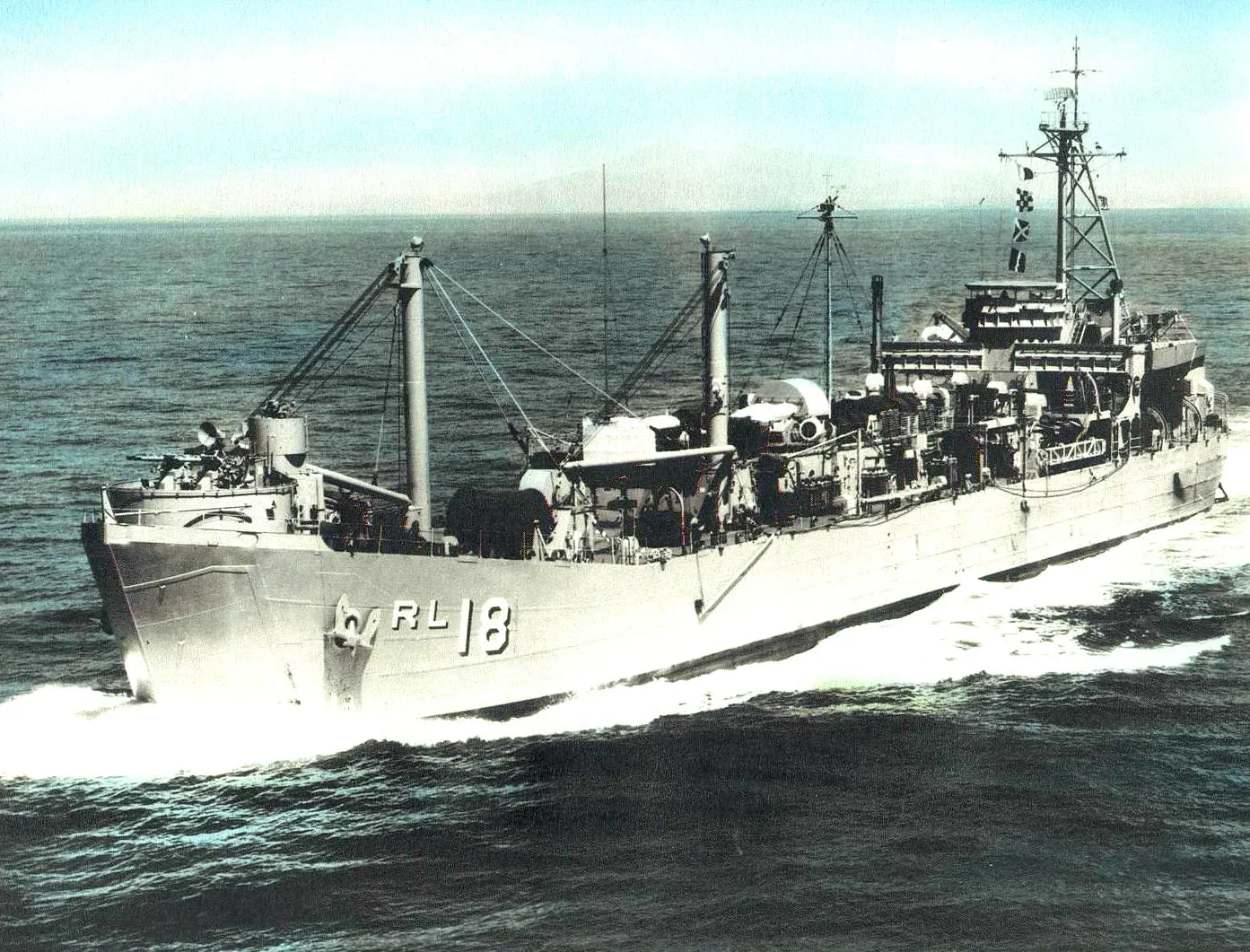

The Achelous-class repair ship was the United States Navy's only class of vessel to carry the designation ARL, Auxiliary Repair, Light. Thirty-nine hulls were converted between 1943 and 1945, and every one of them started life as a standard LST-1-class tank landing ship or LST-542-class tank landing ship hull pulled off the production line before completion. The Navy needed a mobile workshop that could follow an amphibious assault into a beachhead and fix the small craft that assault depended on, and it found that the shallow-draft LST hull, already built by the thousand, was the cheapest and fastest way to get one.
- Shallow LST draft reaches beachheads and river mouths large repair ships cannot
- Onboard machine, electrical, and hull shops fix landing craft on the spot
- 60-ton A-frame crane lifts swamped or beached small craft clear of the water
- Cheap, fast conversion from an existing wartime production hull
- Unarmored, lightly armed hull vulnerable close to a contested beach
- Slow, at barely over 11 knots, with no independent offensive capability
- Limited to light-craft repair, unable to service larger fleet units
- Small foundry and shop space caps how much major structural work it can absorb at once
An Achelous-class repair ship carried no landing ramp and no tank deck cargo. Its bow doors were welded shut, and the open tank deck that would have carried armor on an LST was instead partitioned into machine shops, electrical shops, carpentry shops, and a foundry. Two forward cargo booms and a 60-ton amidships A-frame crane let the ship lift a beached or swamped Landing Craft, Vehicle, Personnel clean out of the water for hull repair on deck, something no fleet repair ship built along cruiser or merchant lines could do in a forward anchorage. A crew of roughly 250 to 255 officers and men, well over half of them assigned to the repair department rather than to ship handling, ran the workshops around the clock.
Roughly a third of the class, ten ships built on LST-1-class hulls, entered service first, with the remaining twenty-seven built on the improved LST-542-class hull and one on an LST-491-class hull. The lead ship, USS Achelous (ARL-1), gave the class its name after the Greek river god, continuing the Navy's practice of naming auxiliary repair ships after mythological figures.1 The type served the repair and salvage ships role for three decades, well past the end of World War II, and outlasted the Navy's own use of unconverted LSTs in front-line combat roles.
{{photo-req side=right q="USS Achelous ARL-1 landing craft repair ship" caption="An Achelous-class repair ship at anchor, its A-frame crane and forward booms visible above the former LST tank deck" alt="Achelous-class repair ship ARL at anchor with cargo booms raised"}}
Search interest in "Achelous class repair ship specifications" or "ARL landing craft repair ship" tends to focus on how a landing ship became a floating workshop, and the answer is almost entirely in the conversion, not in any new hull design. No new keel of this type was ever laid, every ARL was reclassified out of an LST contract already underway, which is also why unit cost and production numbers for the class read differently than for a purpose-built warship.
At full load an Achelous-class repair ship displaced approximately 4,100 long tons, against roughly 2,125 tons light, figures documented consistently across contemporary Navy sources.2 That full-load figure reflects the added weight of shop machinery, the A-frame crane, spare parts stowage, and additional fuel and stores the ship carried to sustain independent repair work away from a main base, well above the light displacement of an unconverted LST. The class ran 328 feet overall and 316 feet between perpendiculars, with a 50-foot beam and an 11.2-foot limiting draft, dimensions taken straight from the LST hull it was built on.2
- Full Load Displacement1,781 t
Propulsion was likewise inherited from the LST design, two General Motors diesel engines driving twin screws through electric transmission for roughly 1,800 shaft horsepower, giving a top speed just above 11.6 knots.2 That was slow even by the standards of amphibious shipping, and the class was never expected to keep pace with a fast carrier task force. It only had to reach an anchorage or a beachhead and stay there.
{{photo-req side=left q="A-frame crane lifting landing craft repair ship deck" caption="The 60-ton A-frame crane amidships could hoist a swamped or beached landing craft entirely out of the water for repair on deck" alt="Large A-frame crane on a US Navy repair ship lifting a small landing craft"}}
Standard armament as fitted was one 3-inch/50 caliber dual-purpose gun forward, plus 40mm and 20mm anti-aircraft guns distributed around the superstructure, typically two twin 40mm mounts and eight single 20mm guns, though the exact mix varied ship to ship and changed over each vessel's service life.3 USS Achelous herself carried one 3-inch gun, eight 40mm guns, and eight 20mm guns at various points in her career.4 None of this made an ARL a combatant. The armament existed to give the ship a fighting chance against air attack while working exposed off a beachhead, not to engage surface targets.
The most distinctive visual feature was the 60-ton A-frame crane mounted amidships, supplementing two lighter cargo booms forward. Together they let the crew hoist a damaged Landing Craft, Vehicle, Personnel, an LCM, or a similar small craft entirely out of the water and set it on deck or on a cradle for hull welding, propeller work, or engine replacement, repairs that would otherwise require towing the boat back to a fleet base days or weeks away.1 Below deck, the former tank space held a machine shop, electrical repair shop, carpenter shop, small foundry, and parts storerooms, run by a repair department that made up a large share of the roughly 250-man crew, on top of the usual deck, engineering, and communications departments any LST-derived hull required.3
The requirement grew directly out of early Pacific amphibious operations. As American forces pushed through the Central Pacific Campaign and the Western Pacific Campaign, planners found that landing craft losses to battle damage, grounding, and simple mechanical wear could outpace what a beachhead's improvised repair facilities could handle, and that towing every damaged boat back to a rear-area base tied up scarce tugs and delayed the next wave. The Navy's answer was to pull LST hulls already under construction and convert them into dedicated repair ships before they ever launched as landing ships.1
{{photo-req side=right q="Pacific Ocean theater map World War II amphibious campaigns" caption="The Central and Western Pacific campaigns generated the small-craft repair backlog that led the Navy to convert LST hulls into Achelous-class repair ships" alt="Map of the Pacific Ocean theater showing World War II amphibious campaign areas"}}
Nine of the first ten conversions, all on LST-1-class hulls, were done at Bethlehem's Key Highway yard in Baltimore, with two more finished at a San Francisco yard, and the remaining hulls converted at yards including Boston Navy Yard, Chicago Bridge & Iron Company, and Jeffboat.3 Bethlehem Shipbuilding Corporation, through its Key Highway and related yards, converted the largest single block of the class. USS Achelous herself was laid down as the unnamed LST-10 at the Dravo Corporation yard in Pittsburgh on 15 August 1942, launched on 25 November 1942, redesignated ARL-1 and named Achelous on 13 January 1943, and commissioned on 2 April 1943 at Baltimore.4
{{photo-req side=left q="landing craft repair Pacific invasion beachhead World War II" caption="Landing craft undergoing field repair during a Pacific amphibious operation, the kind of work Achelous-class ships were built to support" alt="US Navy landing craft being repaired near a beachhead in the Pacific during World War II"}}
Once in service, Achelous-class ships followed the amphibious force forward rather than staying at a fixed rear base. USS Achelous herself earned two battle stars, one for supporting the invasion of southern France between 21 August and 25 September 1944, and a second for the assault and occupation of Okinawa, her last combat operation of the war.4 USS Agenor (ARL-3) arrived off Iwo Jima on 20 February 1945 and joined Task Group 51.3, carrying out repair work under intermittent air attack and in heavy surf until 25 June.5 That pattern, arriving with or shortly after the assault waves and working exposed until the beachhead stabilized, was typical of the class across Leyte, Iwo Jima, and Okinawa.
Peacetime did not end the class's usefulness. Because the design's whole purpose was fixing small craft cheaply and close to where they operated, ARLs found continued work during the Korean War repairing landing craft supporting the UN offensive into North Korea and later amphibious and logistic operations along the Korean coast, and again during the Vietnam War, where several hulls were reassigned to Mobile Riverine Force support, repairing the small patrol and assault boats that fought the War in southern Vietnam's riverine campaigns rather than oceangoing landing craft.1 Most of the class was decommissioned through the 1960s and early 1970s as the Navy drew down its Vietnam-era river forces and reassessed the value of a slow, lightly armed workshop hull in a service increasingly built around missile combatants and fast amphibious ships.
The Achelous class's combat record is a service record, not a weapons record, since these were repair ships, not combatants. During World War II the class supported invasion after invasion across the Pacific and, in at least one case, the Mediterranean theater. USS Achelous's two battle stars, for southern France and for Okinawa, illustrate the range, an amphibious repair ship built for the Pacific also worked the European theater when the Navy needed the hull there.4 USS Agenor's extended, contested stay off Iwo Jima, continuing repair work through air raids and rough seas rather than withdrawing, was typical of how exposed these ships remained once committed to an active beachhead.5
{{photo-req side=right q="Iwo Jima invasion landing craft beach 1945" caption="Landing craft crowd the beach during the invasion of Iwo Jima, the kind of operation that generated the small-craft repair backlog Achelous-class ships were built to clear" alt="US Navy landing craft massed on the beach during the Iwo Jima invasion"}}
In the Korean War, Achelous-class ships supported the amphibious and coastal logistics effort that followed the Inchon landing and the subsequent UN offensive into North Korea, keeping landing craft and small support vessels serviceable along a coastline with few fixed repair facilities. In the Vietnam War, the mission shifted from ocean beachheads to inland waterways. Ships reassigned to riverine support kept the Mobile Riverine Force's patrol boats and armored troop carriers running in the Mekong Delta, a role that stretched the original amphibious-repair concept into brown-water river warfare in Vietnam it was never explicitly designed for but proved well suited to, thanks to the same shallow draft that let it work close inshore in 1944.1
No formally distinct sub-class exists within the Achelous class in the way later ship classes are subdivided, but the 39 hulls split cleanly by the LST hull generation each was built on. Ten were converted from LST-1-class hulls, the earliest production standard, one from a single LST-491-class hull, and the remaining twenty-seven, the bulk of the class, from the improved LST-542-class tank landing ship hull that became the definitive wartime LST design.3 The later, LST-542-based conversions benefited from minor hull and machinery refinements the earlier LST-1 design lacked, though the repair-ship fit-out itself, the shops, booms, and A-frame crane, was essentially identical across both hull generations.
{{photo-req side=right q="LST-542 class tank landing ship underway" caption="An unconverted LST-542-class hull underway. Twenty-seven of the 39 Achelous-class conversions were built on this improved LST generation" alt="LST-542-class tank landing ship underway at sea"}}
Individual ships also differed in their final armament fit and in whether they were later transferred abroad and renamed, but there was no separate repair-ship variant built to a materially different specification. The class is best understood as one conversion package applied twice, to two successive generations of the same LST hull.
Most of the 39 hulls were scrapped after decommissioning, following USS Achelous's own path to a Hong Kong shipbreaker in 1974, and no example of the class survives today as a preserved museum ship, unlike some of the combat LSTs the type was converted from.1


The United States Navy operated all 39 Achelous-class repair ships during World War II and retained the majority of the class into the Korean War and Vietnam War periods before decommissioning the last hulls in the early 1970s. Several ships were transferred abroad as the US Navy drew down its ARL inventory.
The United Kingdom's Royal Navy received at least one hull, USS ARL-5, which served as HM LSE-1 before being sold onward.6 The Argentine Navy took delivery of two former US hulls in 1947, ARL-5 (via the Royal Navy) becoming ARA Ingeniero Iribas (Q-21) and ARL-6 becoming ARA Ingeniero Gadda (Q-22), both put to work supporting Argentina's own amphibious and logistics forces.6 South Korea received USS Minotaur (ARL-15) on loan in 1955, where the ship served the Republic of Korea Navy as ROKS Duk Soo (ARL 1), continuing the same landing-craft repair mission it had performed for the US Navy during the Korean War itself.7 Smaller numbers of additional hulls also eventually passed to the Philippine Navy of the Philippines and the Republic of China Navy on Taiwan in the 1960s and 1970s, extending the type's service life by decades in secondary fleets that valued a cheap, capable repair hull long after the US Navy had moved on to purpose-built replacements.1
{{photo-req side=left q="Republic of Korea Navy 1950s ship" caption="A Republic of Korea Navy vessel of the 1950s, the era in which South Korea received its own former US Achelous-class repair ship" alt="Republic of Korea Navy ship underway in the 1950s"}}
The Achelous class's real rival was never another repair ship so much as the fleet's alternative, towing damaged landing craft back to a main base and doing without forward repair entirely. Against a purpose-built fleet repair ship like the later Vulcan-class repair ship, the comparison is one of scale and reach rather than raw capability. Vulcan-class ships were larger, faster, and equipped to service full-size fleet destroyers and cruisers, work an Achelous-class hull's small shops and light cranes could never attempt, but a Vulcan-class ship also drew too much water and needed too much of a protected anchorage to work a Pacific beachhead in the days after an assault landing. The Achelous class's LST draft, roughly 11 feet against a fleet repair ship's much deeper hull, was the entire point.
| Achelous-class repair ship | Vulcan-class repair ship | |
|---|---|---|
| Hull basis | Converted LST | Purpose-built repair ship |
| Full load displacement | ~4,100 tons | ~16,000 tons |
| Draft | ~11.2 ft | ~24 ft |
| Primary customer | Small landing craft | Fleet destroyers, cruisers |
| Beachhead capable | Yes | No |
A closer match by role is the Xanthus-class repair ship, another World War II landing-craft repair type built to a broadly similar brief, and the aircraft-focused Chourre-class aircraft repair ship, which applied the same "convert a hull already in production into a forward workshop" logic to seaplane and aircraft maintenance instead of small craft. All three reflect the same wartime Pacific insight, that forward repair capacity mattered more than raw shop size when the alternative was losing a small landing craft to attrition rather than combat damage.
Anyone searching "is the Achelous class still in service" gets a simple answer, no. The last hulls left US Navy service by the early 1970s and the type was fully retired from every operator's fleet decades ago, with surviving vessels either scrapped or preserved only in photographs and Navy records rather than as museum ships.
What was the Achelous-class repair ship's role? It was a forward repair ship for small landing craft, fixing battle-damaged or grounded boats close to an active beachhead instead of towing them back to a main fleet base.1
How was an Achelous-class repair ship built? Every hull started as a standard World War II LST under construction and was converted mid-build, with the tank deck turned into machine, electrical, carpentry, and hull-repair shops and a 60-ton A-frame crane added amidships.3
How many Achelous-class ships were built? Thirty-nine ships were converted between 1943 and 1945, ten on LST-1-class hulls, one on an LST-491-class hull, and twenty-seven on LST-542-class hulls.3
What was the Achelous class's displacement and speed? Roughly 2,125 tons light and about 4,100 tons at full load, with a top speed just above 11.6 knots on 1,800 shaft horsepower, figures inherited almost entirely from the underlying LST hull.2
Did the Achelous class see combat? The ships themselves were lightly armed auxiliaries, but several worked exposed off contested beachheads, including USS Agenor at Iwo Jima and USS Achelous during the invasion of southern France and the assault on Okinawa, and multiple hulls carried anti-aircraft guns for self-defense.4,5
Is the Achelous-class repair ship still in service anywhere? No. The US Navy decommissioned its last hulls by the early 1970s, and the ships transferred to the United Kingdom, Argentina, South Korea, the Philippines, and Taiwan have likewise all been retired.6,7
- "Achelous-class repair ship", Wikipedia — en.wikipedia.org ↩
- "USS Achelous (ARL-1) Class", Shipscribe — shipscribe.com ↩
- "Achelous-class repair ship", Military Wiki (Fandom) — military-history.fandom.com ↩
- "Achelous (ARL-1)", Naval History and Heritage Command, Dictionary of American Naval Fighting Ships — history.navy.mil ↩
- "Agenor (ARL-3)", Naval History and Heritage Command, Dictionary of American Naval Fighting Ships — history.navy.mil ↩
- "USS ARL-5", Wikipedia — en.wikipedia.org ↩
- "USS Minotaur", Wikipedia — en.wikipedia.org ↩