

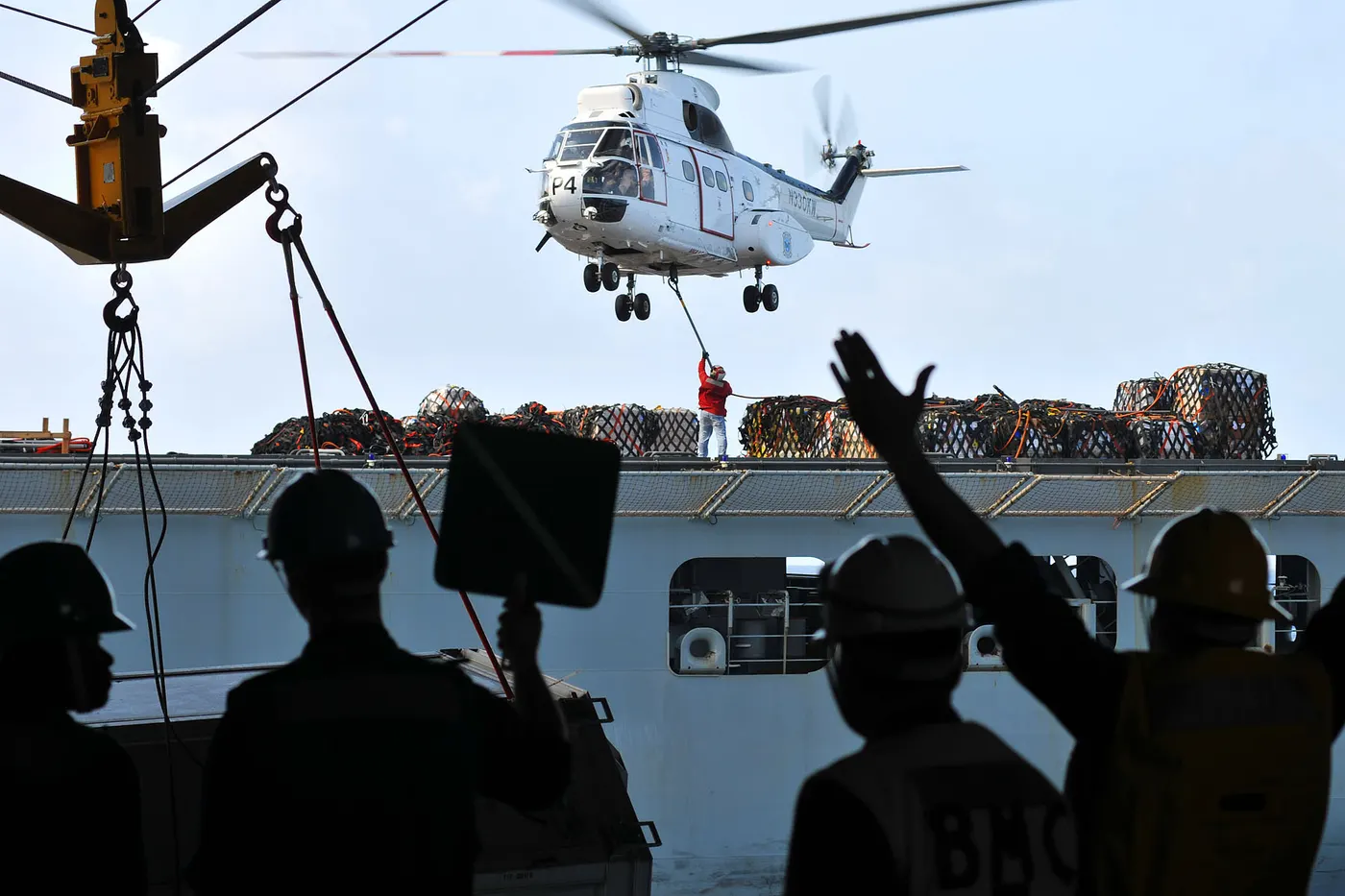

Fourteen ships make up the Lewis and Clark-class dry cargo ship, designated T-AKE by the United States Navy's Military Sealift Command. The lead ship, USNS Lewis and Clark (T-AKE-1), entered service in June 2006, and the class finished delivery with USNS Cesar Chavez (T-AKE-14) in October 2012.1 Unlike a combat warship, a T-AKE carries no weapons of its own beyond crew-served small arms, it exists purely to keep a carrier strike group fed, armed and fueled without that group ever having to break off station and sail to port.1 The type belongs to the same broad transport & cargo ships category as vehicle carriers, but its actual job sits inside the Navy's Combat Logistics Force, the fleet of unarmed or lightly defended auxiliaries that resupply warships while they remain at sea.
- Single hull replaces three older ship classes
- 14,000 nm unrefueled range at 20 knots
- Five simultaneous CONREP stations plus VERTREP
- Built to lower-cost commercial hull standards
- No fuel-tanker capacity of its own, unlike an AOE
- Effectively unarmed, relies on escorts for defense
- Crewed by a shrinking pool of civilian mariners
- Slower and less survivable than the AOE it partly replaced
Each ship can move nearly 7,000 tons of dry cargo and ammunition, plus roughly 23,500 barrels of marine diesel for other ships, across an unrefueled range of about 14,000 nautical miles at 20 knots.2 The class was built to replace three separate, aging ship types at once: the Kilauea-class ammunition ships, the Mars-class combat stores ships and the Sirius-class combat stores ships, all dating to the 1960s and 1970s.3 Consolidating ammunition, food, spare parts and fuel resupply into a single hull cut the number of separate logistics ships the Navy needed to keep at sea, and when a T-AKE operates paired with a Henry J. Kaiser-class replenishment oiler, the pair can substitute for the older, larger Supply-class fast combat support ships.3
{{photo-req side=right q="USNS Lewis and Clark T-AKE dry cargo ship underway" caption="USNS Lewis and Clark (T-AKE-1), lead ship of the class, underway." alt="Lewis and Clark-class dry cargo ship underway at sea"}}
Every ship in the class is named for an explorer, adventurer or pioneering figure rather than a place, a break from the naming pattern of most Navy auxiliaries. The lead ship honors Meriwether Lewis and William Clark, and her sister USNS Sacagawea (T-AKE-2) honors the Shoshone guide who traveled with their expedition.4 Later hulls carry names such as USNS Alan Shepard (T-AKE-3), USNS Amelia Earhart (T-AKE-6) and USNS Carl Brashear (T-AKE-7), spreading the theme from 19th-century exploration into aviation, undersea diving and civil rights history.5 The Lewis and Clark-class dry cargo ship's full designation, T-AKE, breaks down under Navy convention as A for auxiliary, K for cargo ship and E for ammunition or explosives, spelling out its dual dry cargo and ammunition role in the hull symbol itself.
The Lewis and Clark-class dry cargo ship measures 689 feet (210 m) in length with a beam of 106 feet (32 m), and displaces roughly 41,000 long tons at full load, a light-ship displacement near 25,400 tons before cargo is loaded.2 Draft runs about 30 feet (9 m). The design speed is 20 knots, achieved at roughly 80 percent of maximum continuous rating on the propulsion plant, and the ships were built with commercial rather than military hull specifications to hold down cost, though the Navy added military-specific features on top of that commercial base.6
Diesel-Electric Propulsion and Why the Navy Chose It
Propulsion is diesel-electric, generated by diesel engines driving generators that feed electric propulsion motors rather than turning propeller shafts mechanically.7 The T-AKE class was one of the vessels that helped establish integrated electric-drive propulsion as a mainstream choice for large US Navy auxiliaries, a layout that decouples engine speed from propeller speed and lets the ship run its diesels at their most efficient point regardless of how fast the ship itself needs to move.7 That efficiency matters directly to the mission, a ship that spends most of its career loitering at modest speed to rendezvous with a carrier strike group burns less of its own fuel keeping a diesel-electric plant efficient across a wide speed range than it would running mechanical shafts optimized for one design speed.
Cargo handling is built around five simultaneous connected replenishment (CONREP) stations, or alternatively three CONREP stations run alongside a vertical replenishment (VERTREP) flight deck operation, letting the ship transfer cargo to two or more warships positioned alongside at once while a helicopter lifts a third load elsewhere.8 Four 5-metric-ton cranes handle pierside and anchorage loading. A hangar and flight deck support two embarked helicopters, and in practice the ships have typically operated contracted civilian Eurocopter (now Airbus) SA330 Puma helicopters for VERTREP rather than Navy MH-60S Knight Hawks, keeping the aircrew as civilian mariners consistent with the rest of the crew.8 Crewing runs around 124 civil-service mariners from the Military Sealift Command's civilian-mariner workforce, plus a small military detachment, usually under a dozen sailors, to operate ordnance-handling equipment and communications gear the Navy keeps under uniformed control.2
{{photo-req side=left q="MH-60S helicopter vertical replenishment Navy supply ship flight deck" caption="An MH-60S Knight Hawk conducts a vertical replenishment lift, the aviation half of a T-AKE's dual CONREP/VERTREP capability." alt="Helicopter conducting vertical replenishment over a US Navy supply ship deck"}}
Self-defense is minimal by design. The ships are officially non-combatants and carry no missile or gun systems beyond crew-served .50-caliber machine guns for close-in small-boat defense, relying instead on escorts and situational awareness when operating in contested waters.9 That tradeoff, a large, valuable, slow-moving hull with almost no organic defense, is the same one every underway-replenishment ship accepts in exchange for the internal volume and simple structure needed to carry that much cargo efficiently.
The T-AKE program traces to a Navy effort in the late 1990s to consolidate its aging Combat Logistics Force auxiliaries rather than replace each worn-out class one-for-one.3 National Steel and Shipbuilding Company (NASSCO) of San Diego, a subsidiary of General Dynamics, won the detailed design and construction contract in October 2001.1 USNS Lewis and Clark's keel was laid on 22 April 2004, she was launched on 21 May 2005, co-sponsored by descendants of the ship's namesakes, and delivered to the Navy on 20 June 2006.4 NASSCO went on to deliver all fourteen ships of the class through USNS Cesar Chavez in October 2012, a production run of roughly six years across the full class.1
The ships proved versatile beyond their original carrier-support brief. Second Line of Defense's reporting on the class describes T-AKEs supporting humanitarian and disaster-response missions, forward-deployed Marine equipment prepositioning, and multinational exercises, in addition to their baseline job of resupplying a strike group at sea.10 Two hulls in the class are held in the Maritime Prepositioning Program in a reduced operational status, ready to activate rather than continuously crewed, reflecting how the Navy uses part of the class as a standing logistics reserve rather than keeping every hull underway year-round.11
{{photo-req side=right q="NASSCO San Diego shipyard construction Navy auxiliary ship" caption="NASSCO's San Diego shipyard, where all 14 Lewis and Clark-class hulls were built between 2004 and 2012." alt="Shipyard construction of a US Navy auxiliary ship at NASSCO San Diego"}}
By the mid-2020s, the class ran into the same problem afflicting the rest of Military Sealift Command, a severe shortage of qualified civilian mariners to crew the ships already built. Reporting in 2024 described a Navy plan to sideline as many as 17 Military Sealift Command support ships, easing the strain on a mariner pool with barely more than one qualified sailor per open billet, by placing hulls into extended maintenance or planned inactivation rather than keeping every ship fully crewed.12 The pressure fell across the Combat Logistics Force broadly, not only the T-AKEs, but it is the clearest sign that the class's operational availability now depends as much on the Navy's ability to recruit and retain mariners as on the ships' own material condition.
T-AKE ships do not fight, but several have deployed directly into contested waters to keep carrier strike groups supplied. During the Red Sea crisis that followed the escalation of Houthi attacks on commercial vessels from late 2023 onward, USNS Amelia Earhart (T-AKE-6) conducted underway replenishments with carrier strike groups operating in the region, including a resupply of USS Carl Vinson in the US Central Command area in May 2025.15 That kind of mission, transferring fuel, ordnance and stores to a carrier group operating under active missile and drone threat, is precisely the scenario the T-AKE design was built around, even though the ship herself carries essentially no means of defending against that threat directly.
{{photo-req side=left q="US Navy carrier strike group Red Sea Houthi 2024 underway replenishment" caption="A US carrier strike group operating in the Red Sea, the kind of deployment a Lewis and Clark-class dry cargo ship is built to resupply." alt="US Navy warships underway in the Red Sea during 2024 operations"}}
The broader risk of that mission was underscored in February 2026, when the destroyer USS Truxtun collided with the fast combat support ship USNS Supply (T-AOE-6) during a Caribbean underway replenishment, injuring two sailors.16 USNS Supply is not a T-AKE, she belongs to the older Supply-class the T-AKE partially replaced, but the incident is a reminder that the close-quarters maneuvering every CONREP evolution requires, station-keeping two large ships a few dozen meters apart at speed while transferring cargo, carries real risk regardless of which Combat Logistics Force hull is on the receiving end.
NASSCO did not build distinct sub-variants within the class, all fourteen hulls share the same basic hull form, propulsion plant and cargo-handling arrangement.1 The most meaningful differences across the run are incremental, later-delivered ships incorporated lessons learned and minor system updates from the earlier hulls without a formal variant designation, the kind of continuous improvement typical of a single production run built by one yard over six years rather than a deliberate re-design partway through.
{{photo-req side=left q="USNS Sacagawea T-AKE 2 dry cargo ship" caption="USNS Sacagawea (T-AKE-2), the second hull of the class, sharing the same design as all 14 ships." alt="USNS Sacagawea dry cargo ship at sea"}}
What does vary hull to hull is deployment pattern rather than design. Some ships, like USNS Robert E. Peary, have run long single-theater deployments in support of a numbered fleet, while others rotate more conventionally alongside a carrier strike group's workup and deployment cycle, and two hulls sit in reduced operational status as part of the Maritime Prepositioning Program rather than deploying at all in a given year.11

The United States Navy, through Military Sealift Command, operates all 14 ships of the Lewis and Clark-class dry cargo ship, no export customer has acquired the design.1 The ships are staffed by MSC's civilian-mariner workforce augmented by a small US Navy military detachment, and they deploy worldwide in support of US carrier strike groups, amphibious ready groups and, at times, allied navies operating alongside the US fleet during CONREP evolutions.2
{{photo-req side=right q="Military Sealift Command civilian mariner crew Navy support ship" caption="Civilian mariners of Military Sealift Command, who crew every Lewis and Clark-class dry cargo ship alongside a small uniformed Navy detachment." alt="Civilian Military Sealift Command mariners aboard a US Navy support ship"}}
That civilian-first crewing model is also the class's biggest operational constraint. Military Sealift Command draws its mariners from a single, fairly small pool that has to be shared across every auxiliary type it operates, oilers, cargo ships, hospital ships and prepositioning vessels alike, so a shortfall in that pool affects the T-AKEs' availability directly rather than through any fault in the ships themselves.12 With the class's full production run complete since 2012 and no announced follow-on order, the operator picture for the Lewis and Clark-class dry cargo ship is expected to remain a single-nation fleet through the ships' service lives, subject to that mariner-staffing pressure.
The Lewis and Clark-class dry cargo ship's closest institutional relative inside the Combat Logistics Force is not a rival so much as a partner it is designed to operate beside, the Henry J. Kaiser-class replenishment oiler. A T-AKE carries dry cargo, ammunition and only a modest fuel reserve for other ships, while a Kaiser-class oiler carries the bulk fuel a carrier group actually burns, so the two ship types typically resupply a strike group in tandem rather than either one doing the job alone.3 Where the comparison sharpens into a genuine role tradeoff is against the older Supply-class replenishment oiler (AOE), the fast combat support ship the T-AKE/Kaiser pairing was meant to substitute for. A Supply-class AOE combines fuel, ammunition and stores on one faster hull built to keep pace with a carrier at over 25 knots, at roughly double the cost and crew of a T-AKE, while the Lewis and Clark design trades that speed and single-hull convenience for a cheaper, slower, commercially-based ship that needs an oiler alongside it to deliver fuel.3
| Lewis and Clark-class (T-AKE) | Supply-class (T-AOE) | |
|---|---|---|
| Role | Dry cargo / ammunition only | Fuel + dry cargo + ammunition |
| Speed | 20 knots2 | 25+ knots17 |
| Full load displacement | ~41,000 long tons2 | ~48,800 long tons17 |
| Hull standard | Commercial-based | Military |
Against non-US designs, the closest analogue is China's Fuyu-class replenishment ship family, which pursues the same combined ammunition-and-stores mission for a carrier-centered navy, though the Fuyu-class ships generally carry proportionally more fuel capacity onboard than a T-AKE does, reflecting a Chinese fleet design that has leaned toward fewer, more multi-role auxiliaries rather than the US Navy's oiler-plus-cargo-ship pairing.
What does T-AKE stand for on a Lewis and Clark-class dry cargo ship? T-AKE follows US Navy hull-classification convention, A for auxiliary, K for cargo ship, E for ammunition or explosives, describing the ship's combined dry-cargo and ammunition resupply role.1
How many Lewis and Clark-class dry cargo ships were built? Fourteen, from USNS Lewis and Clark (T-AKE-1), delivered in June 2006, to USNS Cesar Chavez (T-AKE-14), delivered in October 2012.1
Is the Lewis and Clark-class dry cargo ship armed? No. The class is officially a non-combatant, carrying crew-served .50-caliber machine guns for close-in defense but no missile or gun weapon systems, and it relies on escorts for protection in contested waters.9
What is the Lewis and Clark-class dry cargo ship's range and speed? Roughly 14,000 nautical miles at a design speed of 20 knots, powered by a diesel-electric propulsion plant.2
Is the Lewis and Clark-class dry cargo ship still in service? Yes, all surviving hulls remain in the Military Sealift Command inventory as of 2026, though the class faces reduced operational tempo tied to a Navy-wide civilian mariner shortage that has put some Combat Logistics Force ships into extended maintenance or reduced status.12
Who manufactures the Lewis and Clark-class dry cargo ship? National Steel and Shipbuilding Company (NASSCO), a General Dynamics subsidiary based in San Diego, California, built all 14 ships of the class.1
- "Lewis and Clark-class dry cargo ship", Wikipedia — en.wikipedia.org ↩
- "USNS Lewis and Clark (T-AKE 1) Class", ShipScribe — shipscribe.com ↩
- "T-AKE Lewis and Clark / ADC(X) Auxiliary Dry Cargo Carrier", GlobalSecurity.org — globalsecurity.org ↩
- "USNS Lewis and Clark", Wikipedia — en.wikipedia.org ↩
- "T-AKE Program", General Dynamics NASSCO — nassco.com ↩
- "Dry Cargo / Ammunition Ship Lewis and Clark (T-AKE 1) Class Fact Sheet", NASSCO — nassco.com ↩
- "Diesel-electric propulsion pushes ahead", Professional Mariner — professionalmariner.com ↩
- "A Very Capable Multi-Mission Support Ship in the MSC Fleet", Second Line of Defense — sldinfo.com ↩
- "Dry Cargo/Ammunition Ships T-AKE", US Navy Fact File — navy.mil ↩
- "A Very Capable Multi-Mission Support Ship in the MSC Fleet: Demand Drives Operational Diversity for the T-AKE Ship", Second Line of Defense — sldinfo.com ↩
- "Dry Cargo/Ammunition Ships", Military Sealift Command — msc.usff.navy.mil ↩
- "Navy Could Sideline 17 Support Ships Due to Manpower Issues", USNI News — news.usni.org ↩
- "Carl Brashear", Wikipedia — en.wikipedia.org ↩
- "USNS Robert E. Peary Enables 4th Fleet Combat Readiness with 154-Day Deployment", US Navy — navy.mil ↩
- "USNI News Fleet and Marine Tracker: May 12, 2025", USNI News — news.usni.org ↩
- "Destroyer USS Truxton Collides With Support Ship During At-Sea Resupply", The War Zone — twz.com ↩
- "Supply-class fast combat support ship", Wikipedia — en.wikipedia.org ↩