


Data Quality85%
01 / Overview
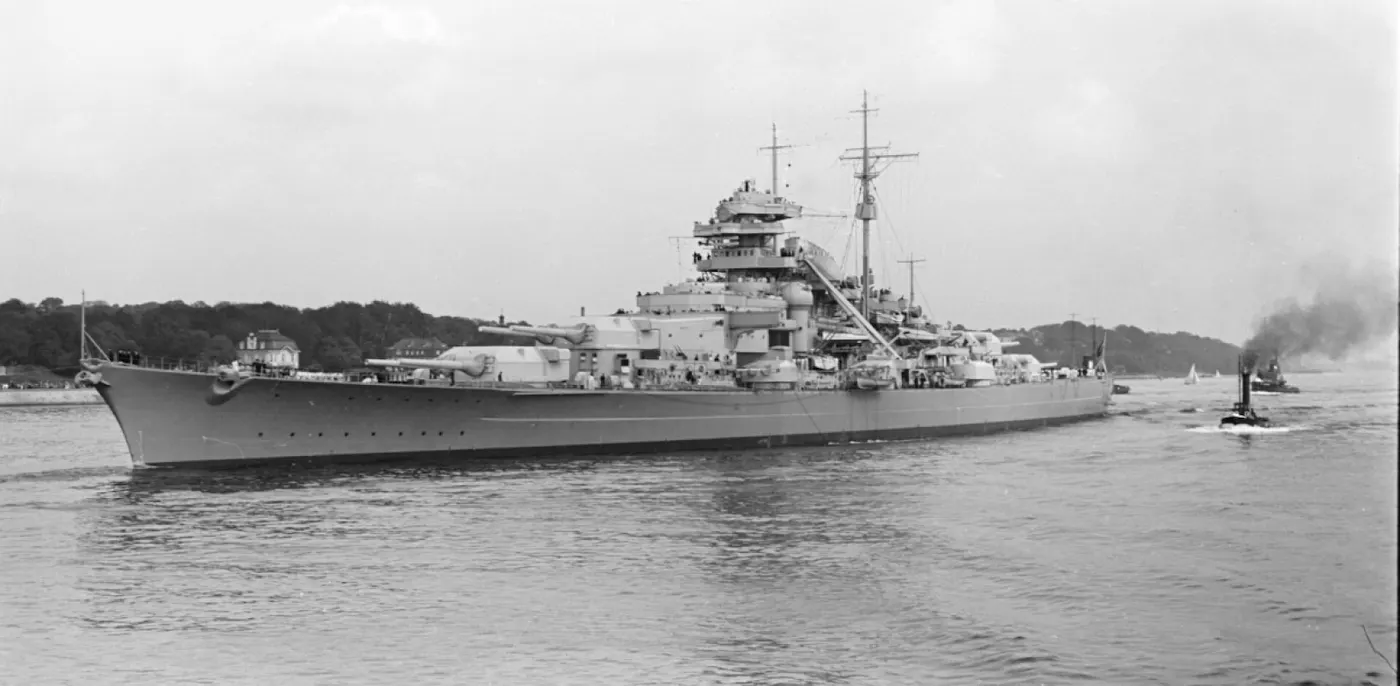
Bismarck-class battleship
02 / Specs & Design
◎Identification5MOD.5
- Laid Down1936
- Launched1939
- Commissioned1940
- Ships in Class2
- In ServiceNo
◈Displacement2MOD.2
- Standard Displacement41,700 t
- Full Load Displacement50,300 t
▣Dimensions4MOD.4
- Length (overall)251 m
- Length (waterline)241.6 m
- Beam36 m
- Draft9.3 m
◇Propulsion6MOD.6
- PropulsionSteam Turbine
- Shaft Power110,450 kW
- Shafts / Screws3
- Top Speed30 kn
- Range8,525
- Nuclear-PoweredNo
◆Gun Armament2MOD.2
- Main Gun Calibre380 mm
- Main Gun Count8
▤Missile Armament3MOD.3
⬢Underwater Warfare3MOD.3
▲Aviation3MOD.3
◎Sensors & Combat Systems3MOD.3
◈Survivability4MOD.4
▣Armour2MOD.2
- Belt Armour320 mm
- Deck Armour100 mm
03 / History
SERVICE LIFESPANStill in Service
- 1939Production started
- 1941Production ended
87
years in service
2
years in production
2
units produced
1
countries operating
ⓘ The producing country still actively operates it.

05 / MASS Score
Not enough weapon data to rank this category.
📖 TERMS ON THIS PAGE5terms
Automated Damage Control is a shipboard system that detects, assesses, and mitigates combat damage on aircraft carriers using sensors and software to enhance response speed and reduce crew workload.
A technique to reduce a ship's magnetic signature by neutralizing its internal magnetic field, minimizing vulnerability to magnetic mines or detection.
Sonar system installed on the hull of a ship, used for underwater detection and navigation by emitting and receiving sound waves.
A mechanical device that converts steam pressure into rotational energy, used to drive shipboard generators or propulsion systems.
These terms are listed automatically because they appear on this page.full encyclopedia →
📚 Sources