

Data Quality87%
MASS(Military Archive Scoring System)
ⓘ Regardless of era, the same scoring system applies to all units in the multirole fighters category.
01 / Overview
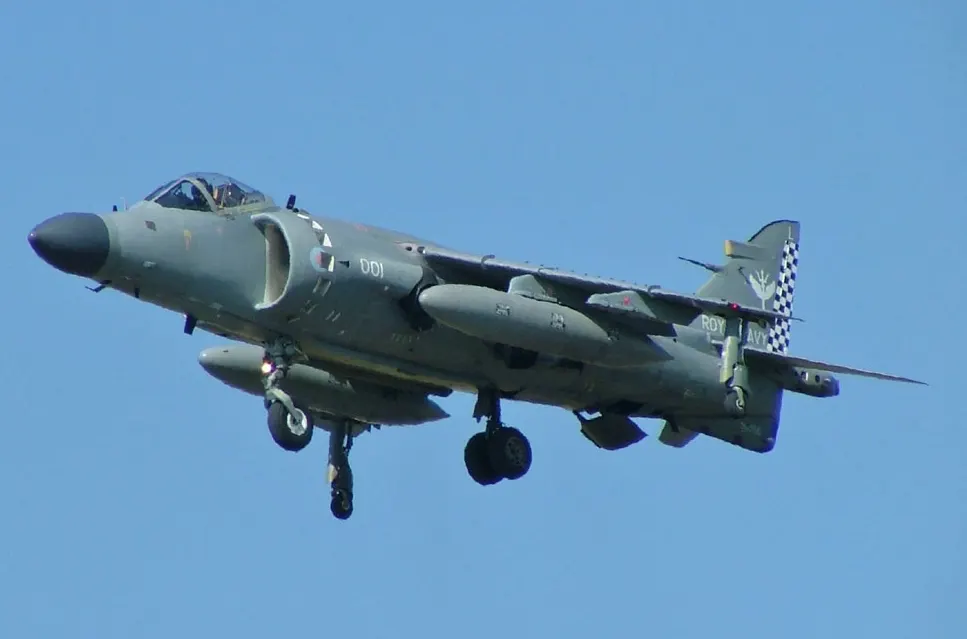
British Aerospace Sea Harrier
Category
Country
Prime contractor
Production
1979–1998
Quantity
98
Operators
💰 PERFORMANCE / PRICE ASSESSMENT Methodology ↗
MULTIROLE FIGHTERS · COLD WAR
18
PERFORMANCE/PRICE
85
UNIT COST (2025 USD)
—
ⓘ Performance/Price and MASS score are computed across all units in the multirole fighters category, regardless of era.
02 / Specs & Design
◎General6MOD.6
- First Flight1975
- Service Entry Year1978
- Crew1
- Primary RoleV/STOL strike fighter
- Generationfirst
- In ServiceNo
◈Powerplant9MOD.9
- Engine TypeRolls-Royce Pegasus 106
- Engine ModelRolls-Royce Pegasus
- Number of Engines1
- Thrust (dry, each)180
- Thrust-to-Weight0.65
- AfterburnerNo
- SupercruiseNo
- Thrust VectoringYes
- Internal Fuel2,500 kg
▣Performance10MOD.10
- Top Speed1,144.437 km/h
- Top Speed (Mach)0.9 Mach
- Cruise Speed900 km/h
- Stall Speed0 km/h
- Service Ceiling15,544.8 m
- Ferry Range3,222.48 km
- Combat Radius400 km
- Rate of Climb254 m/s
- G-Limit7
- Takeoff Run0 m
◇Dimensions & Weights7MOD.7
- Length14.021 m
- Wingspan7.62 m
- Height3.9 m
- Wing Area21.5
- Empty Weight6,615.756 kg
- Loaded Weight11,000 kg
- Max Takeoff Weight11,884.32 kg
◆Armament8MOD.8
- Hardpoints4
- Weapons Payload3,500 kg
- Internal Gun2× 30 mm (1.18 in) ADEN cannon pods under the fuselage, with 130 rounds each
- Internal Weapons BayNo
- Air-to-Air MissilesYes
- Air-to-Ground MissilesYes
- Anti-Ship MissilesYes
- Nuclear CapableNo
▤Avionics & Stealth8MOD.8
- RadarPulse-Doppler
- AESA RadarNo
- Stealth / Low ObservableNo
- IRSTNo
- Electronic Warfare SuiteYes
- Helmet-Mounted SightYes
- Tactical DatalinkYes
- Targeting PodYes
⬢Production1MOD.1
- Total Built98
▲Service History2MOD.2
- Retirement Year2016
- Operational StatusRetired
03 / History
SERVICE LIFESPANStill in Service
- 1978Entered service
- 1979Production started
- 1982First deployment: Falklands War
- 1998Production ended
47
years in service
19
years in production
98
units produced
6
countries operating
ⓘ The producing country still actively operates it.


05 / MASS Score
MULTIROLE FIGHTERS RANKING Multirole Fighters · Cold War


MASS RANKINGSMASS ↗
58MULTIROLE FIGHTERS18COLD WAR · MULTIROLE FIGHTERS154UNITED KINGDOM · ALL WEAPONS26PERFORMANCE/PRICE · MULTIROLE FIGHTERS
ⓘ Rankings are within theMultirole Fighterscategory.
📖 TERMS ON THIS PAGE8terms
Air-to-air missiles are guided missiles fired from aircraft to engage other aircraft. They are used for self-defense and to gain air superiority.
Air-to-Ground Missiles are guided missiles fired from aircraft to attack ground targets. They enable aircraft to engage and destroy enemy ground positions, vehicles, and installations.
Anti-ship missiles are guided missiles designed to engage and destroy naval vessels. They are typically used by aircraft, ships, or submarines to attack enemy ships.
A collection of integrated electronic systems on a military aircraft designed to detect, identify, disrupt, or deceive enemy radar, communications, and guided weapons.
A helmet-mounted display system that allows pilots to aim weapons by looking at targets, tracking head movements to direct sensors or weapons.
Enables real-time sharing of position, targeting, and sensor data among aircraft and platforms for coordinated combat operations.
A targeting pod is an external sensor module mounted on aircraft that provides laser designation, infrared imaging, and range‑finding to support precision strike and reconnaissance.
The ability to direct engine thrust in varying directions to control aircraft attitude or trajectory.
These terms are listed automatically because they appear on this page.full encyclopedia →
📚 Sources