


Data Quality86%
MASS(Military Archive Scoring System)
ⓘ Regardless of era, the same scoring system applies to all units in the multiple launch rocket systems (mlrs) category.
01 / Overview
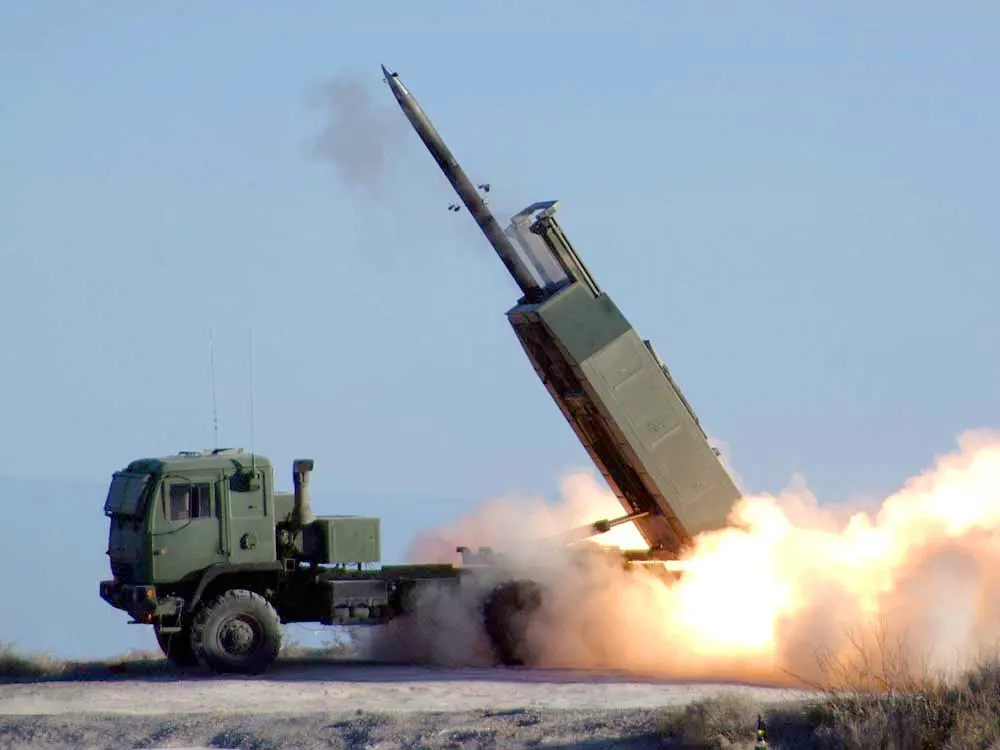
M142 HIMARS
Country
Prime contractor
Production
1996–2013
Quantity
750
Operators
Conflicts
💰 PERFORMANCE / PRICE ASSESSMENT Methodology ↗
MULTIPLE LAUNCH ROCKET SYSTEMS (MLRS) · POST-COLD WAR
1
PERFORMANCE/PRICE
90
UNIT COST (2025 USD)
—
ⓘ Performance/Price and MASS score are computed across all units in the multiple launch rocket systems (mlrs) category, regardless of era.
02 / Specs & Design
◎General6MOD.6
- Service Entry Year2005
- Combat Weight16,250 kg
- Travel Weight13,500 kg
- Crew3
- Carriage TypeWheeled / Towed
- In ServiceYes
◈Ordnance7MOD.7
- Calibre227 mm
- Barrel Length (calibres)6
- Ordnance TypeGMLRS rockets, ATACMS missiles, GLSDB
- Breech TypeSliding Block
- Recoil SystemHydro-Pneumatic
- Muzzle BrakeNo
- Bore EvacuatorNo
▣Performance6MOD.6
- Minimum Range15 km
- Maximum Range (standard)92 km
- Maximum Range (rocket-assisted)150 km
- Maximum Range (guided)300 km
- Elevation-2 to +55 degrees
- Traverse360°
◇Ammunition7MOD.7
- Ammunition TypesM26, M26A1 ER, M26A2 ER, AT2, M30, M31, M32, ER GMLRS, GLSDB, M39, M39A1, M48, M57, PrSM
- HE RoundYes
- Smoke RoundNo
- Illumination RoundNo
- Cluster / DPICMYes
- Precision-Guided RoundYes
- MRSI CapableYes
◆Fire Control5MOD.5
▤Mobility6MOD.6
- Self-PropelledYes
- Prime MoverFMTV 5-ton 6x6 truck
- Shoot-and-ScootYes
- Road Speed (if SP)85 km/h
- AutoloaderNo
- Protected Crew CabYes
⬢Ammunition Handling3MOD.3
- Ready Rounds6
- Total Rounds Carried6
- Resupply VehicleM985 HEMTT
▲Dimensions3MOD.3
- Length6.94 m
- Width2.44 m
- Height3.18 m
◎Production3MOD.3
- Total Production750
- Production Start2,003 year
- Unit Cost4,901,857 USD
◈Self-Propelled Chassis6MOD.6
- Engine Power300 hp
- TransmissionAllison 4500SP 6-speed automatic
- SuspensionIndependent, air-adjustable
- Hull ArmourSTANAG 4569 Level 1
- Secondary ArmamentM2 Browning .50 cal
- NBC ProtectionNo
03 / History
SERVICE LIFESPANStill in Service
- 1945First deployment: Cold War
- 1996Production started
- 2013Production ended
- 2022Sale: Estonia (6 units)
- 2023Sale: Australia (42 units)
- 2025Sale: Australia (48 units)
30
years in service
17
years in production
750
units produced
19
countries operating
ⓘ The producing country still actively operates it.
04 / Conflicts
M142 HIMARS · CONFLICTS SERVED IN0% win·20% ongoing·20% loss
Total Conflicts
5
Victories
0
Ongoing
1
Losses
1
2022–full-scale Russo-Ukrainian warOngoing→2022–2022 Russian invasion of Ukraine—→2014–2017Iraqi Civil War of 2014–2017—→2011–2024Syrian Civil WarDecisive victory→2001–2021War in Afghanistan (2001–2021)—→
ⓘ Shown only from conflicts recorded in our database.
05 / Operators
Operator Inventory11country · 634units


634active
M142 HIMARSSALES5records
| Year | Buyer | Quantity | Amount | Present Value (2025) |
|---|---|---|---|---|
| 2025 |  Australia | 48 | — | — |
| 2025 |  Estonia | 3 | — | — |
| 2023 | Australia | 42 | — | — |
| 2022 | Estonia | 6 | — | — |
| 2022 |  Jordan | — | — | — |
ⓘ "Present Value" is an estimated amount adjusted for inflation.
06 / MASS Score
MULTIPLE LAUNCH ROCKET SYSTEMS (MLRS) RANKING Multiple Launch Rocket Systems (MLRS) · Post-Cold War

MASS RANKINGSMASS ↗
2MULTIPLE LAUNCH ROCKET SYSTEMS (MLRS)1POST-COLD WAR · MULTIPLE LAUNCH ROCKET SYSTEMS (MLRS)184UNITED STATES · ALL WEAPONS12PERFORMANCE/PRICE · MULTIPLE LAUNCH ROCKET SYSTEMS (MLRS)
ⓘ Rankings are within theMultiple Launch Rocket Systems (MLRS)category.
📖 TERMS ON THIS PAGE14terms
Automated laying is a fire‑control capability that uses sensors and a computer to automatically set a towed artillery or mortar’s elevation and azimuth to the calculated firing solution.
Cluster/DPICM refers to artillery ammunition that disperses submunitions for anti-personnel and anti-vehicle effects.
A digital fire-control system employs computational algorithms to calculate and adjust artillery fire parameters, enhancing accuracy and efficiency in towed systems.
Using GPS data to guide a projectile or system to its target, enhancing accuracy.
High Explosive (HE) round: an artillery or mortar projectile containing explosive filler designed to inflict damage through blast and fragmentation effects.
Recoil system using a combination of liquid and compressed gas to absorb and return energy from firing.
Inertial navigation is a self-contained system that determines a vehicle’s position, orientation, and velocity by integrating data from accelerometers and gyroscopes, without external signals.
Multiple Round Simultaneous Impact: artillery tactic where multiple rounds from the same or different howitzers land on target within seconds.
Artillery or mortar munition equipped with guidance systems to alter its trajectory after firing for increased accuracy.
An armored crew compartment on towed artillery or mortar systems designed to protect operators from small arms fire, shrapnel, and blast effects during operation.
Artillery system with integrated propulsion, enabling movement under its own power rather than being towed.
Artillery tactic where a firing unit rapidly deploys, fires, and relocates to avoid counter-battery fire.
A breech mechanism in artillery where a solid block slides horizontally to open and close the breech for loading.
Artillery classification distinguishing self-propelled wheeled vehicles from weapons towed by external means.
These terms are listed automatically because they appear on this page.full encyclopedia →
📚 Sources