

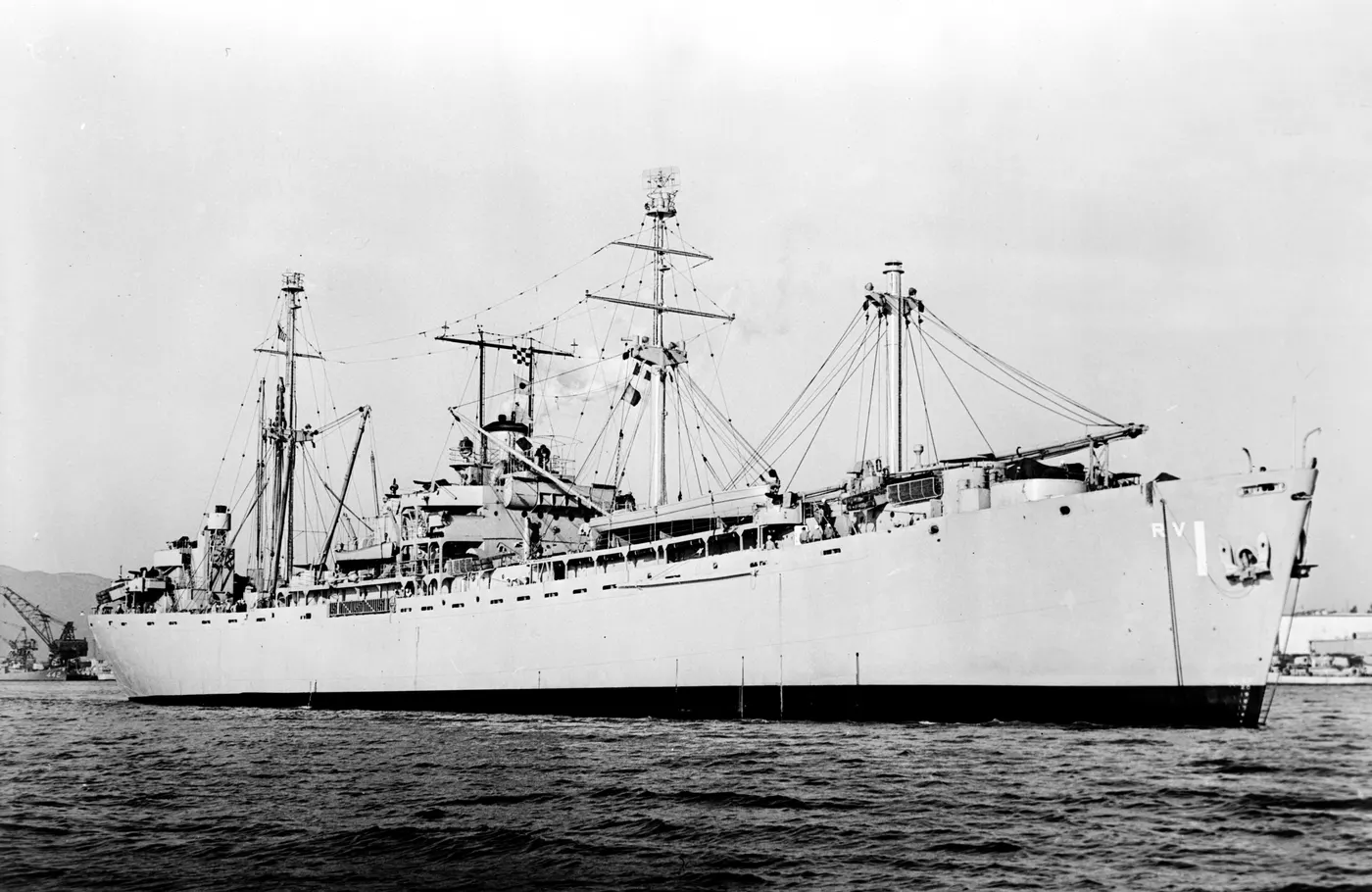
The Chourre-class aircraft repair ship was a pair of United States Navy forward-deployed maintenance vessels converted from standard Liberty ship hulls during World War II. Built to keep carrier aircraft flying without sending damaged airframes all the way back to a rear-area naval air station, the class gave the fleet a floating engine shop, instrument shop, and parts warehouse that could follow the carriers into newly captured anchorages. Only two ships were completed, USS Chourre (ARV-1) and USS Webster (ARV-2), and both entered service too late to see heavy 1944 carrier fighting, arriving instead in the closing months of the Pacific War and, in Chourre's case, again during the Korean War.
- Full machine shop and engine overhaul capability close to the front
- Cheap, fast Liberty-hull conversion instead of a purpose-built design
- Large aviation parts stock reduced dependence on rear-area depots
- Reused a proven, well-understood merchant hull and machinery layout
- Slow, unarmored merchant-hull speed of only 12 to 12.5 knots
- Light self-defense armament for a ship meant to work near the front
- Only two ships built, so any single loss would have been a major capability gap
- Steam reciprocating propulsion was already outdated technology by 1944
{{photo-req side=right q="USS Chourre ARV-1 aircraft repair ship underway 1945" caption="USS Chourre (ARV-1), lead ship of the class, underway during her 1945 Pacific deployment." alt="US Navy aircraft repair ship underway at sea"}}
Both hulls began life as ordinary EC2-S-C1 cargo Liberty ships, the mass-produced, welded-hull design that the United States Maritime Commission turned out by the thousand between 1941 and 1945. Chourre was originally laid down as the engine-repair ship Dumaran (ARG-14) before being reclassified specifically for aircraft repair work on 22 February 1944, and Webster started under the name Masbate before its own reclassification that same year. Both were finished at the Bethlehem Fairfield Shipyard in Baltimore, Maryland, making the class part of the broader wartime pattern of converting a cheap, expendable transport hull into a specialized support ship rather than designing one from scratch. This is one of many repair and salvage ships the Navy fielded to keep a globally deployed carrier fleet in the fight, and it sat alongside the separate replenishment and logistics ships category that moved fuel, ammunition, and food rather than machine tools.
Displacing roughly 14,350 long tons fully loaded on a hull 441 feet 6 inches long, the Chourre-class ships were not fast or heavily defended. Their value was inside the hull: workshops, spare engines, propellers, instruments, and radios that a fleet carrier's own limited maintenance spaces could not carry. The class name itself, and the ship USS Chourre, honored Lieutenant Commander Emile Chourre, a naval aviator and engineering officer killed in a 1938 aircraft accident, a detail that ties the ship's name directly to the aviation maintenance mission it was built to perform.
The Chourre-class aircraft repair ship kept the EC2-S-C1 Liberty ship's hull, machinery, and general arrangement essentially intact and rebuilt the cargo holds and deck structure into repair shops. Each ship measured 441 ft 6 in (134.6 m) in length overall, with a beam of 56 ft 11 in (17.35 m) and a draft of 22 ft (6.7 m), for a full-load displacement around 14,350 long tons and a gross tonnage near 7,210 GRT.1 Propulsion came from a single steam reciprocating vertical triple-expansion engine driving one shaft, rated at roughly 2,500 horsepower, giving the class a top speed of only 12 to 12.5 knots.1 That was standard Liberty ship performance and it meant the ships operated at the pace of the slowest fleet train convoy, never at the speed of the carrier task forces they supported.
- TahrikBuharlı Pistonlu (Triple Expansion)
- Azami Hız12,5 knot
Self-defense armament was modest, matching the ship's role as a rear-area support vessel rather than a combatant. Each ship carried one 5-inch dual-purpose gun, plus two twin 40mm Bofors mounts and a quadruple 40mm mount, backed by smaller 20mm guns typical of auxiliary ships of the period.2 Crew complement ran to 71 officers and 507 enlisted men, a large crew for a converted merchant hull, reflecting how many specialists (machinists, riggers, electricians, instrument technicians) the aviation repair mission required beyond the deck and engineering department needed to simply run the ship.1
{{photo-req side=right q="Liberty ship EC2-S-C1 launching Bethlehem Fairfield shipyard Baltimore" caption="A Liberty ship on the ways at the Bethlehem Fairfield yard in Baltimore, the same shipyard that converted both Chourre-class hulls." alt="Liberty ship under construction at a wartime American shipyard"}}
Internally, the ships were fitted out as a self-contained aviation depot. Their holds held machine shops for engine overhaul, an instrument repair shop, propeller and airframe repair spaces, and stowage for a substantial inventory of spare parts, so a squadron's damaged aircraft engines, hydraulics, and electronics could be repaired and returned to service without shipping the airframe back to Pearl Harbor or the continental United States.3 This made the class functionally closer to a floating fleet aircraft carrier support depot than to a combat repair ship for hull and battle damage, a distinction that separated it from destroyer and cruiser repair ships operating in the same theater.
The Chourre-class program grew out of a straightforward wartime problem. By 1944, the fast carrier task forces of the Pacific Fleet were operating thousands of miles from the nearest major naval air station, and every aircraft that needed an engine change or major instrument repair either had to be shipped home or fixed at an improvised forward base. The Navy's answer, alongside expanding shore-based Carrier Aircraft Service Units, was to convert two Liberty ship hulls into self-propelled floating repair depots that could move with the fleet.
{{photo-req side=left q="Espiritu Santo Pacific islands map World War II" caption="A map of the South Pacific staging areas including Espiritu Santo, the forward base Chourre used to funnel repaired aircraft back to the fleet in 1945." alt="Map of Pacific island chains and naval bases in World War II"}}
USS Chourre (ARV-1) was launched 22 May 1944 and commissioned at Baltimore on 7 December 1944.4 She sailed from Norfolk on 2 March 1945, transited the Panama Canal, and reached Pearl Harbor on 12 April 1945 to embark aviation repair personnel bound for the forward base at Espiritu Santo in the New Hebrides, arriving there 29 April.4 From Espiritu Santo she carried an aviation repair unit forward to Saipan, then continued to San Pedro Bay, Leyte, in the Philippines, where she served as a station repair and supply ship replenishing carrier air groups from 26 May to 17 July 1945, right through the final weeks of the Pacific War.4
{{photo-req side=left q="US Navy fleet carrier Pacific 1945 flight deck aircraft" caption="A US Navy fleet carrier at sea in the Pacific during 1945, the kind of ship the Chourre-class repair ships were built to keep flying." alt="US Navy aircraft carrier flight deck with aircraft, 1945"}}
USS Webster (ARV-2) followed a similar path on a slightly later schedule. Originally ordered as the internal-combustion-engine repair ship Masbate (ARG-1), she was renamed and reclassified ARV-2 on 30 March 1944, launched 5 August 1944, and commissioned at Baltimore on 17 March 1945.5 Webster reached Eniwetok Atoll on 10 August 1945 and remained there through mid-September, so her arrival coincided almost exactly with the Japanese surrender that ended the war.5 In the weeks that followed she serviced aviation equipment from several fleet carriers passing through the atoll, including USS Wasp, USS Antietam, and USS Intrepid, overhauling engines and instruments and returning serviceable stock to the fleet.5 Webster went on to perform occupation-related duty into November 1945 before being decommissioned on 8 June 1946, her wartime career effectively over almost as soon as it began.
Chourre's own war ended with a return to the United States, but her career did not stop there. She was recommissioned on 21 February 1952 during the Korean War and departed San Francisco on 1 September for the Western Pacific, where she operated out of Japan supplying ships off the Korean coast until 28 February 1953.7 She returned for a second Far East tour from 17 August 1953 to 11 April 1954, and a third from 30 August 1954 to 1 March 1955, before being placed out of commission in reserve on 13 September 1955.7 For that service she earned three battle stars for the Korean War, in addition to whatever campaign credit she carried from her brief but consequential final months of World War II.7
Both ships of the class served in the Pacific Theater of World War II during 1945, supporting the fast carrier forces as they pushed toward the Japanese home islands, though neither arrived early enough to support the heaviest 1944 carrier air battles.4,5 Chourre alone went on to a second combat-adjacent career in the Korean War, completing three deployments to the Western Pacific between 1952 and 1955 in direct support of United Nations naval operations off Korea, work that earned her the only campaign stars of either ship's service record.7
{{photo-req side=right q="US Navy fleet train underway replenishment Pacific 1945" caption="A US Navy fleet train replenishing carriers at sea, the same logistics chain Chourre supported during her mid-1945 station-ship duty at Leyte." alt="US Navy support ships replenishing a fleet at sea during World War II"}}
The two ships' active dates line up closely with the Navy's fleet train concept, the traveling logistics network of oilers, ammunition ships, and repair vessels that let fast carrier task forces stay at sea for months without returning to a rear base such as Pearl Harbor.3 Chourre's work re-arming and re-equipping carriers at San Pedro Bay in mid-1945 placed her squarely inside that logistics chain, alongside the destroyer tenders, ammunition ships, and oilers that made the final Pacific offensives against Japan possible without a return voyage home.
The class comprises exactly two ships, both converted from EC2-S-C1 Liberty ship hulls at the same Baltimore shipyard, and neither had further sub-variants. USS Chourre (ARV-1), the lead ship, was originally ordered as the engine repair ship Dumaran before its 1944 reclassification.4 USS Webster (ARV-2) was originally ordered as Masbate, also reclassified in 1944, and entered service roughly three months after Chourre.5 No further Chourre-class hulls were ordered once the war's end reduced the need for additional forward aviation repair capacity, and the Navy's subsequent repair-ship building instead moved toward classes like the Vulcan-class repair ship for general fleet repair rather than aviation-specific work.

The United States was the sole operator of the Chourre-class aircraft repair ship, fielding both completed hulls under the US Navy's auxiliary fleet designation ARV.1 Chourre served in two distinct eras of US Navy history, first in the closing months of World War II and again through three Korean War deployments in the early 1950s, while Webster's career was confined to the final months of World War II and immediate postwar occupation duty before her 1946 decommissioning.4,5
{{photo-req side=right q="US Navy Eniwetok Atoll anchorage 1945 ships" caption="Ships anchored at Eniwetok Atoll in 1945, where USS Webster serviced fleet carrier aircraft in the weeks after the Japanese surrender." alt="US Navy ships at anchor in a Pacific atoll lagoon, 1945"}}
Chourre was struck from the Naval Register in 1961, after being transferred to the Maritime Administration on 31 October 1960 for lay-up in the National Defense Reserve Fleet at Suisun Bay, California.8 After roughly a decade in reserve, she was sold to Union Minerals & Alloys for scrapping on 5 February 1971, ending a service career that spanned two wars and more than 25 years from keel-laying to breaker's yard.8 Webster's postwar fate took a different, more visible turn. She was sold in 1974 to the state of Virginia for its artificial reef program and was sunk off Cape Henry, Virginia, in 1977, where her hull continues to serve, now as a fish habitat rather than a fleet repair ship.9
The Chourre-class aircraft repair ship's real rival, in a strict sense, was not another Navy ship at all but the shore-based Carrier Aircraft Service Unit, the alternative model the Navy used to keep forward-deployed squadrons flying without a self-propelled hull. A land-based service unit was cheaper and could grow larger once an island base was secured, but it could not move with the fleet the way Chourre could, and in the fast-moving 1944 to 1945 island-hopping campaign that mobility mattered. The class's closer maritime peer within the wider repair-ship family is the Vulcan-class repair ship, a purpose-built (not Liberty-hull-converted) general repair ship built for hull, machinery, and battle-damage work on destroyers and cruisers rather than aircraft.
Where Vulcan-class ships carried heavier structural repair equipment for combatant vessels, the Chourre class specialized narrowly in aviation, engines, instruments, airframes, and the specific parts inventory a carrier air group needed. Vulcan and her sister also entered service earlier in the war and in larger numbers, giving that class a broader operational record, while the two-ship Chourre class arrived late and depended on the accident of timing (arriving right as the Pacific War ended, then Chourre's recall for Korea) for most of its actual service history.
| Ship class | Hull origin | Role | Ships built | Top speed |
|---|---|---|---|---|
| Chourre-class | Converted EC2-S-C1 Liberty ship | Aircraft/aviation repair | 2 | 12–12.5 kn1 |
| Vulcan-class | Purpose-built repair ship | General fleet repair | 2 | 15.5 kn10 |
Both classes shared the same underlying logistics problem, an increasingly far-flung Pacific Fleet that could not keep sailing home for maintenance, and both answered it with a dedicated repair ship rather than relying purely on land bases or tenders. The difference in scope, aviation specialist versus general hull and machinery repair, meant a carrier task force commander in 1945 might need both types working the same anchorage at once rather than choosing between them.

What was the Chourre-class aircraft repair ship used for? It served as a forward-deployed floating repair depot for carrier aircraft engines, instruments, and airframes, letting the Navy fix aviation equipment near the fleet instead of shipping it back to a rear-area naval air station.3
How many Chourre-class ships were built? Only two, USS Chourre (ARV-1) and USS Webster (ARV-2), both converted from Liberty ship hulls at the Bethlehem Fairfield Shipyard in Baltimore during 1944.4,5
Is the Chourre-class aircraft repair ship still in service? No. Both ships are gone. Webster was sunk as an artificial reef off Virginia in 1977, and Chourre was scrapped in 1971 after a decade in the reserve fleet.8,9
What was the Chourre-class aircraft repair ship's top speed? Around 12 to 12.5 knots, standard for a Liberty ship hull driven by a single steam reciprocating engine, which limited the class to the pace of a slow convoy rather than a carrier task force.1
Why was USS Chourre named after a person and not a place, unlike most Navy ships? Auxiliary repair and service ships were commonly named for people rather than places or battles. Chourre honored Lieutenant Commander Emile Chourre, a naval aviator and aircraft inspector killed in a 1938 crash.6
- "Chourre-class aircraft repair ship", Wikipedia — en.wikipedia.org ↩
- "USS Chourre (ARV-1) Class", ShipScribe — shipscribe.com ↩
- "USS Chourre (ARV-1)", HyperWar Foundation — ibiblio.org ↩
- "USS Chourre (ARV-1)", Wikipedia — en.wikipedia.org) ↩
- "USS Webster (ARV-2)", Military Wiki (Fandom) — military-history.fandom.com) ↩
- "Chourre, Emile", Naval History and Heritage Command — history.navy.mil ↩
- "Chourre (ARV-1)", Naval History and Heritage Command, DANFS — history.navy.mil ↩
- "USS Chourre (ARV-1)", Navsource Naval History — navsource.org ↩
- "USS Webster", Wikipedia — en.wikipedia.org ↩
- "Vulcan-class repair ship", Wikipedia — en.wikipedia.org ↩