

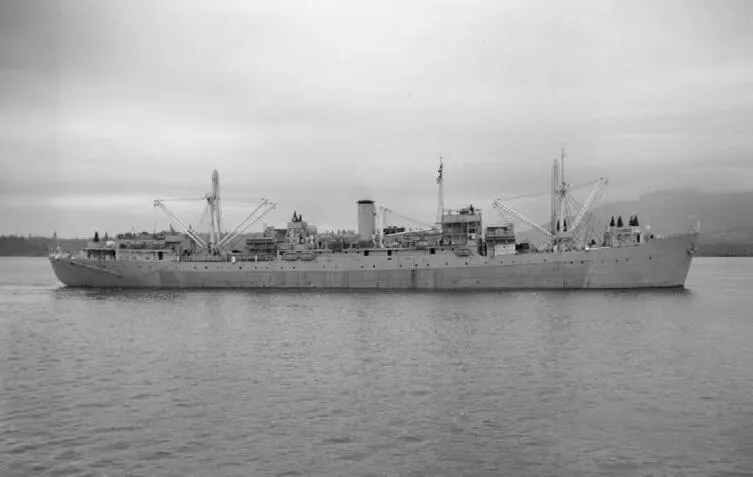
The Beachy Head-class repair ship was a class of 21 depot, maintenance and repair ships built for the Royal Navy during the final years of the Second World War. Every hull was constructed in Canada, most of them by the Burrard Dry Dock Company in Vancouver, British Columbia, making the class one of the largest single groups of auxiliary warships the Royal Navy ever ordered from a foreign yard.1 The ships belong to the wider repair and salvage ships category, vessels whose job was never to fight but to keep everything else afloat, patched, and re-armed close to the fighting front.
- mercantile hull kept unit cost and build time low
- full machine and electrical workshops close to the fighting fleet
- large crew of specialists (engineers, armourers, medical staff)
- hulls proved adaptable to postwar roles decades after WWII
- only 11 knots top speed, unable to keep pace with a fast task force
- light 20 mm-only self-defence armament
- most ships commissioned too late to see real wartime repair work
- design tied to a specific 1943-44 shipbuilding window, not repeated
The programme grew out of a hard lesson from the early Pacific war. When British and Commonwealth forces lost their forward naval bases in Southeast Asia and the Far East in 1941 and 1942, the fleet lost the dockyards, workshops, and spare-parts stores that kept destroyers and smaller escorts running. The Admiralty answered by ordering a series of floating repair yards built to standard mercantile hull lines, adapting the same rugged Fort-type cargo-ship hulls used for Canadian-built freighters (the Canadian equivalent of the American Liberty and Victory ship programmes) rather than designing a bespoke warship hull from scratch.2 Every ship in the class took its name from a British headland, a naming convention shared with several other wartime auxiliary classes, and produced titles such as Beachy Head, Girdle Ness, Dungeness, and Flamborough Head.
Twenty of the 21 ships served under the White Ensign at some point, with the United Kingdom as the class's primary operator, though the class only reached the fleet in its final months. Only five ships (Fife Ness, Dodman Point, Dungeness, Spurn Point, and Penlee Point) supported home-waters escort groups before the war in Europe ended, while the remaining hulls were earmarked for the East Indies Fleet and the British Pacific Fleet.1 After the war several ships found second careers far from their original role. HMS Beachy Head itself spent three years on loan to the Royal Netherlands Navy as HNLMS Vulkaan, and two sister ships were later sold outright to Canada and recommissioned into the Royal Canadian Navy.3,4 The class never fought a naval action of its own. Its value lay entirely in keeping other, more famous ships in the fight, and in outliving its original wartime purpose by decades in a handful of individual cases.
{{photo-req side=right q="Burrard Dry Dock Vancouver shipyard World War II" caption="Burrard Dry Dock in Vancouver, where the majority of the Beachy Head-class hulls were built" alt="Wartime shipyard at Burrard Dry Dock, Vancouver, British Columbia"}}
A Beachy Head-class repair ship displaced roughly 8,580 long tons (about 8,720 t) standard, rising to a full-load figure near 11,270 long tons (about 11,450 t) once workshops, spares, cranes, and fuel were embarked.2 The database's own full-load displacement figure of 8,717 t in fact matches the class's standard, not full-load, tonnage, and should be corrected to reflect the roughly 11,450 t figure once fully stored (see DATA REPORT). Overall length ran to 441 ft 6 in (134.6 m), with 425 ft (129.5 m) between perpendiculars, a beam of 57 ft (17.4 m), and a full-load draught around 20 ft 10 in (6.4 m).2
- Tam Yük Deplasmanı8.717,28 t
Propulsion was deliberately unambitious for a ship never meant to keep pace with a battle fleet. A single reciprocating triple-expansion steam engine, fed by two Foster Wheeler water-tube boilers, produced about 2,500 indicated horsepower through one shaft, giving a top speed of 11 knots, matching the database's own recorded figure.2 That was adequate for a depot ship meant to sit at anchor in a forward fleet base, not for one expected to sortie with cruisers or fast carriers.
- Azami Hız11 knot
Self-defence armament during the war consisted of sixteen single-mounted 20 mm Oerlikon cannon, distributed around the superstructure to cover air attack from multiple bearings, since a stationary depot ship anchored in a forward anchorage was a standing target for raiders.2 Complement ran to roughly 270 officers and ratings, a crew weighted heavily toward engineers, machinists, electricians, and medical staff rather than the gunners and lookouts that dominated a destroyer's manning list, since the ship's real output was welded steel and re-machined parts, not gunfire.2
{{photo-req side=left q="20mm Oerlikon gun mount Royal Navy WWII" caption="A single 20 mm Oerlikon mount of the type fitted around a Beachy Head-class ship's superstructure" alt="Royal Navy sailors manning a 20 mm Oerlikon anti-aircraft gun during the Second World War"}}
Below decks each hull carried machine shops, electrical repair bays, foundry equipment, and cold-storage and medical spaces sized to support an entire flotilla of escorts rather than the ship's own crew. That mercantile-derived hull, cheap and quick to build in a Canadian yard already turning out cargo ships by the dozen, is exactly what let the Admiralty order 21 of them inside about a year, at a moment when British yards were saturated building combatants.2
Orders for the Beachy Head-class repair ships were placed between 1943 and 1944, at the point in the war when the Admiralty could see the coming demand for a fleet train capable of sustaining a British battle fleet operating thousands of miles from any home dockyard.1 The lead ship, **HMS Beachy Head, was laid down on 8 June 1944 at Burrard Dry Dock in Vancouver, launched on 27 September 1944, and commissioned on 27 March 1945, a build cycle of under ten months from keel to commissioning that reflects how straightforward the mercantile hull design was to construct.3 Her first commanding officer was Lieutenant Commander Roger Geoffrey Buckley, who handed over to Acting Captain Hugh Valentine King** in September 1945.3
Because nearly the entire class was ordered and built in the war's final eighteen months, most ships commissioned between March and October 1945, well after the Second World War in Europe had ended and only weeks or months before Japan's surrender.1 That timing meant the ships arrived too late for the kind of sustained battle-damage repair work the Admiralty had originally planned around, but it did not make them useless. Sister ship **HMS Penlee Point (laid down 7 December 1944, launched 29 March 1945, commissioned 5 September 1945) was intended as a landing-craft repair ship for the planned invasion of Japan, and when that invasion never happened she instead spent years as an accommodation ship at Rosyth Dockyard** in Scotland.5
{{photo-req side=right q="Trincomalee naval base Ceylon World War II fleet" caption="Trincomalee harbour, Ceylon, the East Indies Fleet base several Beachy Head-class ships supported" alt="Warships and depot vessels anchored at the wartime Trincomalee naval base"}}
Eleven of the class were earmarked for service further east, supporting the East Indies Fleet, based at Trincomalee on the island then known as Ceylon, and the British Pacific Fleet's fleet train, the network of repair ships, tankers, and store carriers that let the fleet operate for weeks at sea without returning to a fixed dockyard.6 Only five hulls, Fife Ness, Dodman Point, Dungeness, Spurn Point, and Penlee Point, remained in home waters, supporting escort groups defending the final Atlantic and North Sea convoys of the war.1
Postwar, the class scattered into very different careers. **HMS Beachy Head was loaned to the Royal Netherlands Navy in 1947 and recommissioned as HNLMS Vulkaan, serving under the Dutch flag until she returned to Royal Navy control around 1950.4 In 1953 she and sister ship HMS Flamborough Head were sold outright to Canada, refitted, and recommissioned into the Royal Canadian Navy in January 1959 as HMCS Cape Scott and HMCS *Cape Breton*** respectively, the two hulls that gave the class its longest active careers of all.8,9
{{photo-req side=left q="HMCS Cape Scott repair ship Halifax" caption="HMCS Cape Scott, the former HMS Beachy Head, in Royal Canadian Navy service at Halifax" alt="A Cape-class maintenance ship of the Royal Canadian Navy alongside at Halifax"}}
The Beachy Head-class repair ships served in the World War II fleet-train role rather than in direct combat, but several individual hulls were assigned specifically to support the Western Pacific campaign against Japan in 1944 and 1945, keeping British Pacific Fleet destroyers, frigates, and smaller escorts armed and running while the fleet operated far from any fixed base.6 Other units supported the Southeast Asian theatre of World War II from the East Indies Fleet's Trincomalee base, servicing ships engaged against Japanese forces in Burma, Malaya, and the surrounding waters.6 None of the class is recorded as having fired on an enemy vessel or aircraft in earnest, their sixteen 20 mm Oerlikons never having to do more than deter an air raid on a crowded anchorage.
{{photo-req side=right q="British Pacific Fleet fleet train tankers repair ships 1945" caption="Ships of the British Pacific Fleet's fleet train, the support flotilla the Beachy Head class was built to reinforce" alt="Royal Navy fleet train vessels replenishing warships at sea in 1945"}}
In home waters, the five ships that reached the fleet before Germany's surrender supported convoy escort groups hunting the last U-boats operating around the British Isles, a far smaller and less dramatic role than the Pacific deployment but one that still mattered to the destroyers and corvettes that depended on their workshops for running repairs between patrols.
The class was not subdivided into formal sub-variants at build, all 21 hulls shared essentially the same mercantile-derived design, but several individual ships underwent conversions dramatic enough to function as de facto variants. The most significant was **HMS *Girdle Ness*** (the renamed Penlee Point), taken in hand at Devonport Dockyard from 1953 and recommissioned in July 1956 as the Royal Navy's first guided-missile trials ship.5 Her entire original superstructure was removed and the forward hull gutted to fit a triple Seaslug missile launcher and its associated magazines, radar (Type 901, Type 960, Type 982, and Type 983 sets), and telemetry gear, turning a wartime repair hull into a floating test rig for Britain's first operational surface-to-air missile.5 Over her trials career at RAE Aberporth and later from Malta, Girdle Ness fired 209 Seaslug missiles, training the first generation of Royal Navy missile operators before the ship reverted to an accommodation role in 1962 and was finally scrapped at Faslane from 1970.5
{{photo-req side=left q="HMS Girdle Ness guided missile trials ship Seaslug launcher" caption="HMS Girdle Ness after her 1956 conversion, with the triple Seaslug launcher fitted where her original superstructure once stood" alt="HMS Girdle Ness, a converted Beachy Head-class repair ship, fitted with a Seaslug missile launcher"}}
A second distinct postwar path was the Cape-class maintenance ship conversion undertaken for the Royal Canadian Navy. Cape Scott and Cape Breton were extensively refitted before their 1959 recommissioning, and both went on to outlive nearly every other member of the class, Cape Scott serving into the 1970s and Cape Breton surviving long enough to be deliberately sunk off Nanaimo, British Columbia, as an artificial reef in October 2001, well over half a century after her keel was laid as a wartime British repair ship.9


The United Kingdom's Royal Navy was the class's builder and primary operator, commissioning all 21 hulls between 1945 and the early postwar years, though the fleet drew the class down steadily through the 1950s and 1960s as purpose-built successors like the Vulcan-class repair ship entered service.1 Canada's Royal Canadian Navy became a formal operator in 1953 when it purchased Beachy Head and Flamborough Head outright, recommissioning them in January 1959 as Cape Scott and Cape Breton and operating them into the 1970s, by far the longest in-service careers any hulls of the class achieved.8,9 The Royal Netherlands Navy also operated a single ship, Beachy Head herself, on loan as HNLMS Vulkaan from 1947 until roughly 1950, a short but genuine period of Dutch naval service that the database's current operator list does not yet capture (see DATA REPORT).4
The Beachy Head class's closest institutional relative was its own successor, the Vulcan-class repair ship, which the Royal Navy designed specifically to replace the aging wartime hulls once it became clear a mercantile-derived 1944 design could not indefinitely support a modern postwar fleet. Where the Beachy Head ships were adapted cargo hulls built for wartime speed of production, the Vulcan class was purpose-built from the keel up as a repair ship, with a materially higher overall score in the database (63 versus 37) reflecting decades of design improvement rather than any single dramatic capability gap. The comparison illustrates a common pattern in naval procurement. An emergency wartime class gets the fleet through the crisis it was ordered for, then gets replaced wholesale once peacetime budgets allow a dedicated design.
Against contemporaries built by other navies, the American Achelous-class repair ship is the nearest wartime equivalent, an American depot and repair ship built to a broadly similar concept in the same period. Both classes existed to solve the same fleet-train problem, keeping escorts and smaller combatants running far from a fixed dockyard, and both leaned on mercantile-style hulls rather than dedicated warship construction to get large numbers of units to sea quickly.
| Beachy Head class | Vulcan class | |
|---|---|---|
| Displacement (full load) | ~11,450 t | higher, purpose-built hull |
| Top speed | 11 kn | higher |
| Hull origin | Fort-type mercantile cargo hull | purpose-built repair ship |
| Units built | 21 | fewer, purpose-built successors |
| Database overall score | 37 | 63 |
The Vulcan class's higher score is a design-generation gap, not a story of the Beachy Head ships being poorly built for their intended purpose. For the specific job the Admiralty needed solved in 1943 and 1944 (mass-produce enough floating workshops to support a fleet with no forward base) the mercantile hull approach the Beachy Head class took was, if anything, the correct trade, favouring speed and quantity of production over sophistication.

How many Beachy Head-class repair ships were built? Twenty-one, all constructed in Canada, the large majority by the Burrard Dry Dock Company in Vancouver, between 1943 and 1945.1
Is the Beachy Head-class repair ship still in service anywhere? No. The last hulls left active service by the 1970s, HMCS Cape Breton remaining nominally in reserve the longest before being sunk as an artificial reef in 2001, and HMS Girdle Ness, converted to a missile trials ship, was scrapped in 1970.5,9
What was the Beachy Head-class repair ship's top speed and range? Top speed was 11 knots from a single triple-expansion steam engine producing about 2,500 indicated horsepower, a deliberately modest figure for a ship meant to operate from a fixed anchorage rather than keep pace with a battle fleet.2
What happened to HMS Beachy Head itself? She served on loan to the Royal Netherlands Navy as HNLMS Vulkaan from 1947 to around 1950, then was sold to Canada in 1953 and recommissioned as HMCS Cape Scott in 1959, serving into the 1970s.3,4,8
Which Beachy Head-class ship became a guided-missile trials ship? HMS Girdle Ness, originally commissioned as HMS Penlee Point in 1945, was converted between 1953 and 1956 into the Royal Navy's first Seaslug guided-missile trials ship.5
- "Beachy Head-class repair ship", Wikipedia — en.wikipedia.org ↩
- "Beachy Head-class repair ship", Grokipedia — grokipedia.com ↩
- "HMS Beachy Head", Battleships-Cruisers Info Website — battleships-cruisers.co.uk ↩
- "HMS Beachy Head (F 02) of the Royal Navy", uboat.net — uboat.net ↩
- "HMS Girdle Ness (A387)", HandWiki (Wikipedia mirror) — handwiki.org) ↩
- "East Indies Fleet War Diary 1945", Naval-History.net — naval-history.net ↩
- "Beachy Head class Repair Ships", uboat.net — uboat.net ↩
- "HMCS Cape Scott", Royal Canadian Navy — canada.ca ↩
- "The Last of a Great Fleet of Ships Part 2: HMCS Cape Breton", The Searchers — warsearcher.com ↩