


Data Quality87%
MASS(Military Archive Scoring System)
ⓘ Regardless of era, the same scoring system applies to all units in the cruisers category.
01 / Overview
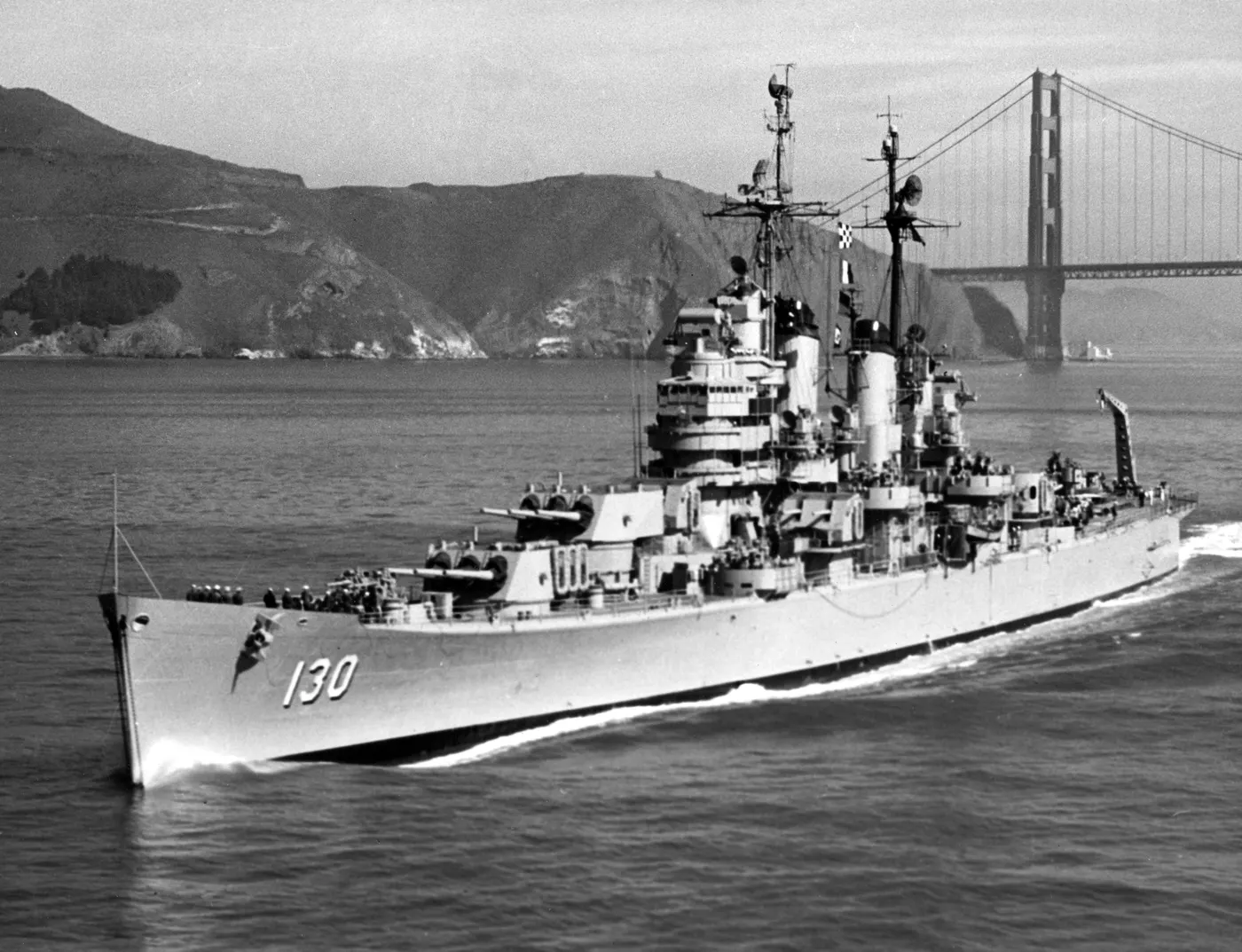
Baltimore-class cruiser
Category
Country
Prime contractor
Production
1942–1945
Quantity
14
Unit Price (current)
$40.0M
Operators
Conflicts
💰 PERFORMANCE / PRICE ASSESSMENT Methodology ↗
CRUISERS · WORLD WAR II
10
PERFORMANCE/PRICE
87
UNIT COST (2025 USD)
$40.0M
Inflation: +%0
ⓘ Performance/Price and MASS score are computed across all units in the cruisers category, regardless of era.
02 / Specs & Design
◎Identification8MOD.8
- Hull ClassificationCA
- Ship Typeheavy cruiser
- Builder / ShipyardBethlehem Steel Corporation, Fore River Shipyard, New York Shipbuilding Corporation, Philadelphia Naval Shipyard
- Laid Down1941
- Launched1942
- Commissioned1943
- Ships in Class14
- In ServiceYes
◈Displacement3MOD.3
- Light Displacement13,600 t
- Standard Displacement13,600 t
- Full Load Displacement17,000 t
▣Dimensions4MOD.4
- Length (overall)205 m
- Length (waterline)202 m
- Beam21.6 m
- Draft8.2 m
◇Complement2MOD.2
- Total Complement1,146
- Officers61
◆Propulsion7MOD.7
- PropulsionSteam Turbine
- Arrangement (CODAG/COGAG…)4 screws; 4 steam turbine sets
- Number of Engines4
- Shaft Power89,484 kW
- Shafts / Screws4
- Top Speed33 kn
- Nuclear-PoweredNo
▤Gun Armament4MOD.4
- Main Gun3 × triple 8-inch/55-caliber guns
- Main Gun Calibre203 mm
- Main Gun Count9
- Secondary Guns6 × twin 5-inch/38-caliber guns
⬢Missile Armament3MOD.3
▲Underwater Warfare4MOD.4
- Torpedo Tubes0
- ASW CapabilityYes
- Hull-Mounted SonarNo
- Towed Array SonarNo
◎Aviation5MOD.5
- Embarked Helicopters0
- HangarNo
- Flight DeckYes
- Fixed-Wing Aircraft0
- UAV CapabilityNo
◈Sensors & Combat Systems6MOD.6
- Air-Search RadarSK-2, SP, AN/SPS-6, AN/SPS-8A, AN/SPS-12, AN/SPS-37, AN/SPS-43
- Surface / Fire-Control RadarAN/SPS-10
- Phased-Array RadarNo
- Combat SystemMk34 GFCS, Mk37 GFCS, Mark 56 Gun Fire Control System
- Aegis / EquivalentNo
- Electronic WarfareYes
▣Survivability5MOD.5
- CBRN CitadelYes
- DegaussingYes
- Hull Materialsteel
- Stealth ShapingNo
- Automated Damage ControlYes
◇Cost1MOD.1
- Unit Cost40 USD
◆Fleet Status8MOD.8
- Completed14
- Active0
- Under Construction0
- Planned14
- Cancelled5
- Lost0
- Retired14
- Preserved0
▤Armour3MOD.3
- ArmourBelt: 4-6 in, Deck: 2.5 in, Turrets: 1.5-8 in, Barbettes: 6.3 in, Conning tower: 6.5 in, Bulkheads: 6 in
- Belt Armour152 mm
- Deck Armour64 mm
03 / History
SERVICE LIFESPANStill in Service
- 1939First deployment: World War II
- 1942Production started
- 1943Entered service
- 1945Production ended
84
years in service
3
years in production
14
units produced
1
countries operating
ⓘ The producing country still actively operates it.
04 / Conflicts
BALTIMORE-CLASS CRUISER · CONFLICTS SERVED IN0% win
Total Conflicts
1
Victories
0
Ongoing
0
Losses
0
ⓘ Shown only from conflicts recorded in our database.

06 / MASS Score
CRUISERS RANKING Cruisers · World War II


MASS RANKINGSMASS ↗
35CRUISERS10WORLD WAR II · CRUISERS1125UNITED STATES · ALL WEAPONS5PRICE · CRUISERS220PRICE · ALL WEAPONS6PERFORMANCE/PRICE · CRUISERS
ⓘ Rankings are within theCruiserscategory.
📖 TERMS ON THIS PAGE8terms
Anti-Submarine Warfare. Capability to detect, track, and engage submarines.
Automated Damage Control is a shipboard system that detects, assesses, and mitigates combat damage on aircraft carriers using sensors and software to enhance response speed and reduce crew workload.
A defensive system on fleet aircraft carriers designed to detect, protect against, and mitigate chemical, biological, radiological, and nuclear threats.
A technique to reduce a ship's magnetic signature by neutralizing its internal magnetic field, minimizing vulnerability to magnetic mines or detection.
Military action involving the use of electromagnetic spectrum to disrupt, deceive, or destroy enemy electronic systems.
The upper deck of an aircraft carrier, equipped for aircraft takeoff, landing, and maintenance operations.
Cruise missiles designed to strike land targets from naval platforms, typically launched from ships or submarines.
A mechanical device that converts steam pressure into rotational energy, used to drive shipboard generators or propulsion systems.
These terms are listed automatically because they appear on this page.full encyclopedia →
📚 Sources