

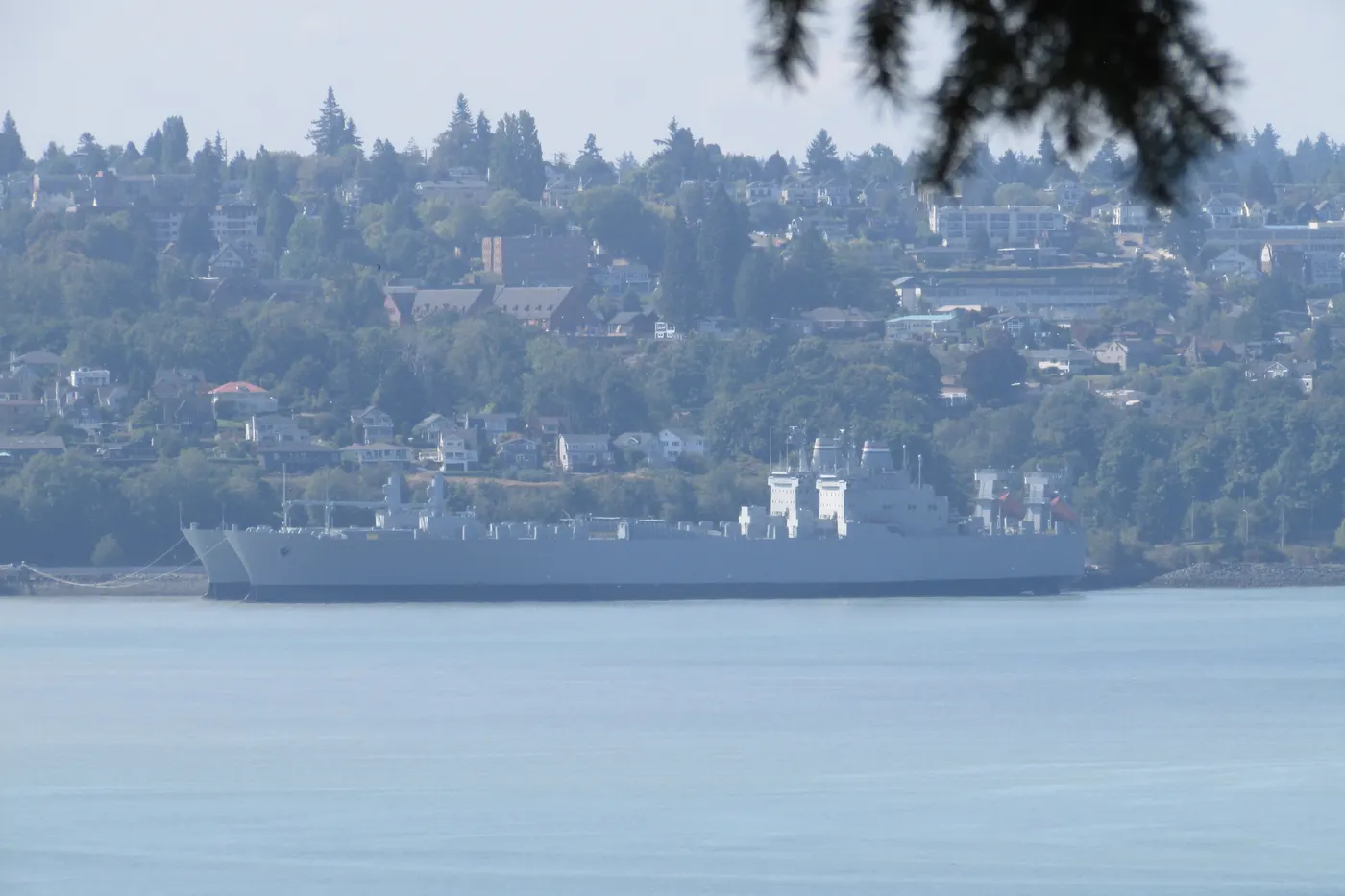

The Bob Hope-class vehicle cargo ship is a class of seven roll-on/roll-off cargo vessels built for the United States Navy's Military Sealift Command to move an Army heavy brigade's worth of tanks, trucks and armored vehicles across an ocean in a single sailing. Officially designated Large, Medium-Speed Roll-on/Roll-off ships, or LMSR, the class was built at Avondale Shipyard in Louisiana between 1993 and 2003 in direct response to the sealift shortfalls exposed during the 1990 to 1991 Gulf War, when chartered commercial ships took weeks longer than planned to reach the theater1. The lead ship, USNS Bob Hope (T-AKR 300), was delivered on 18 November 1998 and gave the class its name, honoring entertainer Bob Hope, who made 57 USO tours for American troops between 1941 and 19912.
- Carries up to 1,000 vehicles per hull
- Roll-on/roll-off loading needs no port cranes
- Large sustained cargo capacity for a brigade-scale lift
- Reduced Operating Status keeps crewing costs low between surges
- Sustained speed of only 20 knots, far slower than dedicated fast sealift ships
- No armament or self-defense systems of its own
- Ships now 20 to 28 years old with rising maintenance costs
- Full activation from layup still takes several days, not hours
{{photo-req side=right q="USNS Bob Hope T-AKR-300 ship underway" caption="USNS Bob Hope, lead ship of the class, underway with cargo loaded for a Military Sealift Command mission." alt="USNS Bob Hope roll-on/roll-off cargo ship underway at sea"}}
Each Bob Hope-class ship displaces roughly 62,000 tons fully loaded and offers 318,000 square feet of enclosed cargo space plus another 70,000 square feet of open deck cargo area, enough to carry more than 900 wheeled and tracked vehicles on a single voyage1. The ships are not warships. They carry no weapons, sail under Military Sealift Command civilian control with a crew of about 30 merchant mariners, and depend on Navy or allied escorts whenever they operate in contested waters. That tradeoff, huge capacity bought at the cost of self-defense and top speed, defines the entire class and the broader transport and cargo ships category it belongs to.
Six of the class's seven hulls (Fisher, Seay, Mendonca, Pililaau, Brittin and Benavidez) carry the names of individual people rather than places, a deliberate MSC naming pattern that continued across sister ships in the Watson-class vehicle cargo ship program. USNS Seay, USNS Mendonca, USNS Pililaau and USNS Brittin are each named for a Medal of Honor recipient from the Korean or Vietnam wars, while USNS Fisher honors Zachary and Elizabeth Fisher, the philanthropists behind the military family housing charity that still bears their name3. USNS Benavidez, the final ship delivered, was built by Northrop Grumman Ship Systems in New Orleans rather than Avondale directly, after Avondale's yard was absorbed into the Northrop Grumman shipbuilding group during construction of the class4.
The Bob Hope-class vehicle cargo ship measures 289.1 meters (951 feet 5 inches) in length with a beam of 32.3 meters (106 feet) and a draft of 11 meters, dimensions that put it among the largest roll-on/roll-off ships ever built for military use1. Light displacement runs about 35,500 tons, rising to roughly 62,000 tons at full combat load1. Four Colt-Pielstick 10PC4.2 V diesel engines drive two shafts fitted with controllable-pitch propellers, together producing about 47.89 megawatts (roughly 64,000 shaft horsepower), enough for a maximum speed near 24 knots and a sustained transit speed of 20 knots1.
{{photo-req side=left q="M1 Abrams tank driving up ro-ro ship stern ramp" caption="A tracked vehicle drives up a roll-on/roll-off ship's stern ramp, the same loading method used on every Bob Hope-class hull." alt="Military vehicle being driven up the stern ramp of a roll-on-roll-off cargo ship"}}
Loading uses a stern slewing ramp plus side-access ramps so vehicles can drive directly on and off without dockside cranes, along with two twin cranes rated at 55 tons each for lift-on, lift-off cargo that cannot be driven aboard1. That is the practical meaning of ro-ro design at this scale, an entire armored task force can be driven into the hull at one port and driven straight out at another, with the ship's own ramps doing the work a commercial container terminal normally provides. Each ship berths about 30 civilian mariners who operate the vessel under an MSC charter, plus space for up to 50 additional military personnel who ride along to maintain the embarked equipment during the voyage1.
Most of the fleet is kept in Reduced Operating Status (ROS-4), a maintenance posture with a skeleton crew that MSC can bring to full readiness within about five days during a turbo activation drill, rather than being sailed continuously6. That layup-and-surge model is the tradeoff for the class's low peacetime operating cost, the ships are cheap to maintain between crises but are not postured for an instant, no-notice departure the way a forward-deployed prepositioning ship is.
Congress and the Navy drew a hard lesson from Operation Desert Shield in 1990, when chartered commercial ro-ro ships needed on the order of three weeks longer than planned to deliver the US Army's heavy armor to Saudi Arabia, a delay that shaped how quickly a mechanized force could actually reach a fight1. The Pentagon responded with the LMSR program, funded through the National Defense Sealift Fund and split across two shipyards, Avondale Shipyard in Louisiana for what became the Bob Hope class and National Steel and Shipbuilding Company in San Diego for the larger, gas-turbine powered Watson-class vehicle cargo ship1.
{{photo-req side=left q="Avondale Shipyard Louisiana ship construction 1990s" caption="Avondale Shipyard near New Orleans, where six of the seven Bob Hope-class hulls were built." alt="Avondale Shipyard shipbuilding facility on the Mississippi River"}}
Avondale was awarded the lead-ship contract on 2 September 1993, laid the keel for USNS Bob Hope on 29 May 1995, launched her on 27 March 1997 and delivered her to the Navy on 18 November 1998, entering service the same day as the first purpose-built LMSR in the fleet7. The remaining six hulls followed through 2003, closing out a program that had originally been expected to move faster, the Government Accountability Office flagged repeated schedule slips against the original delivery targets during the mid-1990s8. Bob Hope himself died in July 2003, shortly after the final ship of his namesake class entered service, and MSC noted at the time that the ship would continue carrying his name and his decades of USO service into its own service history2.
{{photo-req side=right q="Bob Hope entertaining troops USO tour" caption="Bob Hope performing for American service members on a USO tour, the decades of work that earned him the honor of a Military Sealift Command ship named for him." alt="Entertainer Bob Hope performing for military personnel during a USO show"}}
Each of the seven hulls kept working the same brigade-lift mission for two more decades after the class finished construction, cycling between Reduced Operating Status layup and activation for exercises, hurricane relief and periodic Iraq and Afghanistan rotations rather than sitting idle. By the early 2020s, though, the oldest hulls in the class had passed 20 years of service life, and the Navy began the process of retiring the earliest ships first rather than running the whole class to a uniform retirement date.
USNS Bob Hope was inactivated and struck from the Naval Vessel Register on 19 December 2022, becoming the first ship of the class to leave active MSC service. She was transferred to the Maritime Administration's Ready Reserve Force, lost the USNS prefix in favor of MV, and was berthed in Portland, Oregon as part of the National Defense Reserve Fleet, available for reactivation rather than tasked for routine missions9.
The Bob Hope class saw its heaviest use during the buildup to and execution of the 2003 invasion of Iraq, when six of the seven ships carried the bulk of the US Army's heavy armor into the theater1. USNS Bob Hope alone spent 81 days in the Arabian Gulf across the opening months of 2003, moving more than 38,900 tons of combat equipment on three separate missions in support of the 101st Airborne Division and the 3rd Infantry Division, including roughly 90 M1A1 Abrams main battle tanks, 70 M2 Bradley fighting vehicles and 40 M113 armored personnel carriers on those runs alone10.
{{photo-req side=left q="Persian Gulf Arabian Gulf map Kuwait Iraq shipping route" caption="The Persian Gulf shipping route Bob Hope-class ships used to reach Kuwaiti ports supporting the 2003 Iraq invasion." alt="Map of the Persian Gulf and Arabian Gulf showing Kuwait and Iraq"}}
Military Sealift Command as a whole, not just the Bob Hope class, delivered more than 90 percent of the military cargo used in the opening phase of Operation Iraqi Freedom, moving over 21 million square feet of equipment and supplies between January and April 2003 alone13. The Bob Hope-class ships were the newest and largest single contributor to that total, precisely the scenario the LMSR program had been designed around a decade earlier.
{{photo-req side=right q="Military Sealift Command LMSR ship Kuwait Mina Ash-Shuaibah port 2003" caption="A Bob Hope-class LMSR moored at the port of Mina Ash-Shuaibah, Kuwait, during troop and equipment rotations for the Iraq War." alt="Large roll-on-roll-off cargo ship docked at a Kuwaiti port during the Iraq War"}}
Other hulls in the class repeated the same mission profile through the following years as US forces rotated in and out of Iraq during the broader Iraq War. USNS Benavidez, delivered in September 2003, carried more than 230,000 square feet of combat equipment and supplies for the 1st Cavalry Division on an early deployment run, with a port call in Souda Bay, Crete, en route11. The class's design purpose, moving an entire mechanized brigade's rolling stock in one lift rather than piecemeal by air or in small commercial charters, was validated directly by that 2003 surge, even as the same operation exposed how much the fleet still depended on chartered commercial tonnage to fill out demand beyond the LMSR force itself.
Kuwaiti ports stayed the class's main working destination for years afterward, as Bob Hope-class ships continued rotating equipment and unit gear in and out of theater through the later Iraq War troop surges, long after the initial 2003 invasion had ended1.
The Bob Hope class does not carry internal variant designations in the way a weapon system might. The meaningful variation across the seven hulls is the shift in builder for the final ship, USNS Benavidez, which was completed at Northrop Grumman Ship Systems' New Orleans yard after that company absorbed Avondale's shipbuilding operations, rather than any change in hull form, propulsion or cargo layout4. All seven ships share the same length, beam, propulsion arrangement and cargo capacity, unlike the parallel Watson-class vehicle cargo ship program, which used a different hull design and gas-turbine propulsion built by a separate shipyard entirely.
The United States Navy, through Military Sealift Command, is the sole operator of every Bob Hope-class vehicle cargo ship. None of the seven hulls has ever been sold, chartered out, or transferred to another country's navy. Day-to-day operation is contracted to private ship management companies working under MSC oversight, with civilian mariners crewing the vessels rather than uniformed Navy sailors, the standard MSC model applied across its entire sealift and prepositioning fleet1.
The closer point of comparison for the Bob Hope class is its own sister program, the Watson-class vehicle cargo ship, built at the same time to the same LMSR requirement but by a different yard with a different propulsion plant. Where the Bob Hope class uses four Colt-Pielstick diesel engines for a sustained 20 knots, the Watson class uses two LM2500 gas turbines for roughly the same top speed but a noticeably larger hull and greater cargo capacity, reflected in the Watson class's higher overall score1. The practical difference for a planner is smaller than it looks on paper, both classes exist to solve the identical problem of moving a heavy brigade's rolling stock in one lift, and the Navy has always operated them as a single interchangeable LMSR pool rather than assigning them to different missions.
A more instructive contrast is against the older Algol-class fast sealift ship, the Cold War era SL-7 container ships the Navy converted for military ro-ro use in the early 1980s. The Algol class can sustain over 33 knots, nearly nine knots faster than a Bob Hope-class ship's 24-knot maximum, because the SL-7 hulls were originally built as high-speed commercial container liners rather than purpose-built cargo carriers12. That speed comes at a steep cost in fuel burn and in cargo flexibility, the older ships were never designed around the same ro-ro deck layout and carry proportionally less vehicle cargo per hull. The tradeoff is a clean illustration of what the LMSR program was actually optimizing for, the Bob Hope class sacrifices raw transit speed for far greater sustained cargo volume and lower operating cost per ton delivered, a bet that paid off directly in the 2003 Iraq buildup where total tonnage delivered mattered more than how fast any single ship could cross an ocean.
What is the Bob Hope-class vehicle cargo ship used for? It is a US Navy roll-on/roll-off ship that carries Army tanks, trucks and other heavy vehicles across an ocean for Military Sealift Command, the core mission behind every ship in the class since USNS Bob Hope entered service in 19981.
How many Bob Hope-class ships were built? Seven, USNS Bob Hope, USNS Fisher, USNS Seay, USNS Mendonca, USNS Pililaau, USNS Brittin and USNS Benavidez, built at Avondale Shipyard and its Northrop Grumman successor yard between 1993 and 20031,4.
Is the Bob Hope class still in service? Most of the class remains in Military Sealift Command's Reduced Operating Status sealift fleet as of the mid-2020s, but the lead ship, USNS Bob Hope, was struck from Navy service in December 2022 and transferred to the Maritime Administration's Ready Reserve Force9.
How fast is a Bob Hope-class LMSR ship? It has a maximum speed of about 24 knots and a sustained cruising speed of 20 knots, slower than the older Algol-class fast sealift ships it works alongside but with far greater sustained cargo capacity1,12.
How much cargo can the Bob Hope class carry? Each ship offers 318,000 square feet of enclosed cargo space and 70,000 square feet of open deck cargo space, enough for roughly 900 to 1,000 wheeled and tracked vehicles in a single lift1.
- "Bob Hope Class Roll-On Roll-Off Vehicle Cargo Ships", Naval Technology — naval-technology.com ↩
- "USNS Bob Hope carries on despite loss of namesake", Military Sealift Command — msc.navy.mil ↩
- "USNS Fisher (T-AKR 301)", NavySite.de — navysite.de ↩
- "MV Roy P. Benavidez", Wikipedia — en.wikipedia.org ↩
- "Algol-class vehicle cargo ship", Wikipedia — en.wikipedia.org ↩
- "Sealift, Surge Sealift Ships and Ready Reserve Ships Turbo Activate", Military Sealift Command — msc.navy.mil ↩
- "MV Bob Hope", Wikipedia — en.wikipedia.org ↩
- "Strategic Mobility, Late Deliveries of Large, Medium Speed Roll-On/Roll-Off Ships", US Government Accountability Office — govinfo.gov ↩
- "Naval Vessel Historical Evaluation, Final Determination, USNS Bob Hope (T-AKR-300)", Naval Sea Systems Command — navsea.navy.mil%20Naval%20Historical%20Evaluation%20Final.pdf) ↩
- "TAKR-300 USNS Bob Hope", GlobalSecurity.org — globalsecurity.org ↩
- "The Military Sealift Command (MSC) Bob Hope Class LMSR USNS Benavidez (T-AKR 306)", PICRYL Public Domain Archive — picryl.com ↩
- "T-AKR 287 Algol SL-7 Type Fast Sealift Ships", GlobalSecurity.org — globalsecurity.org ↩
- "Sealift for Operation Iraqi Freedom is No Small Thing", Military Sealift Command — msc.navy.mil ↩