

A Maneuverable Re-Entry Vehicle (MaRV) is the part of a ballistic missile that carries the warhead and can steer itself after the booster burns out, adjusting its flight path during the final seconds or minutes of descent instead of simply falling along a fixed arc. A simple ballistic re-entry vehicle follows a predictable parabolic path once boost phase ends, and that predictability is exactly what a missile-defense radar relies on to compute where the incoming object will be. A MaRV breaks that assumption. Small control fins, side thrusters, or an actively steered aerodynamic shape let it correct toward the aim point while making its flight path harder to forecast.
The capability serves two purposes often conflated. One is plain accuracy, correcting for wind, spin, and mid-course drift so the warhead lands closer to its target, which matters enormously for a conventional strike where a miss of a hundred meters can mean an empty field rather than a destroyed target. The other is survivability against interception. An interceptor computing a fixed solution against an unpredictable, steering target faces a much harder problem than tracking a coasting warhead on a known parabola. Terminal guidance, the sensors and steering logic that decide how to correct the vehicle mid-flight, supplies the commands. The MaRV itself is the physical airframe capable of acting on those commands specifically during re-entry, separate from any course corrections made earlier, in the boost or midcourse phase.
01Pershing II and the First Operational MaRV
The first operationally deployed MaRV belonged to the Pershing II, a United States medium-range missile stationed in Germany starting in December 1983.1 Its re-entry vehicle used a system called RADAG, short for radar area-correlation guidance, which scanned the ground below during the terminal dive and matched the returns against a stored map of the target area, correcting course in real time.2
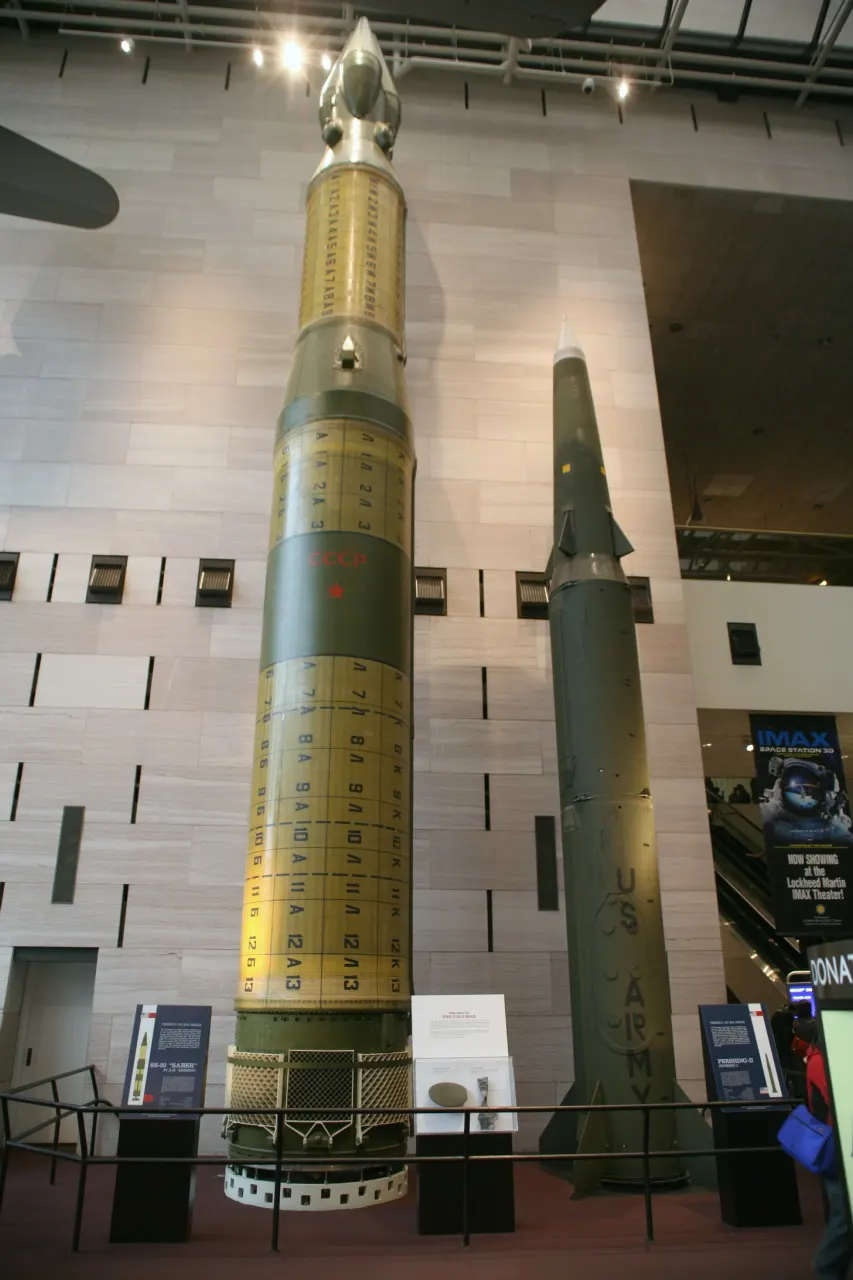
Combined with inertial guidance, RADAG reportedly pushed the Pershing II's circular error probable down to roughly 30 meters, a dramatic jump from the kilometer-scale errors typical of a purely ballistic re-entry vehicle of that generation.2 Stationing the system in Europe became one of the defining arms-control disputes of the late Cold War.
That dispute fed directly into the 1987 Intermediate-Range Nuclear Forces Treaty, under which Washington withdrew the Pershing II only a few years after deployment, though the MaRV concept it pioneered spread far beyond it.
01Fins, Thrusters, and Terminal Radar Locks
Mechanically, a MaRV steers by manipulating its own aerodynamics or by firing small thrusters, much like a glider making corrections rather than a rocket under constant power. The Pakistani Shaheen-II illustrates the approach well. Its re-entry vehicle carries four moving delta control fins along with small side-thrust motors, used to orient the vehicle after booster separation and fly evasive corrections during the terminal phase, reducing its estimated circular error probable to a few hundred meters.3
China's DF-16, a shorter-range People's Republic of China system fielded from 2015, pairs its maneuvering variants with a radar or optical terminal seeker, reportedly tightening accuracy to a single-digit-meter circular error probable.4 Turkey's Cenk, developed by ROKETSAN and first shown publicly in 2023, reportedly carries a single-stage MaRV warhead with four stabilizing fins, meant to sharpen terminal accuracy and complicate any interceptor's targeting solution.5
02From Cold War Deterrent to Carrier-Killer
The most consequential modern use of the maneuverable re-entry vehicle is anti-ship targeting. China's DF-21D is the world's first operational anti-ship ballistic missile, pairing a MaRV with an active radar seeker so the warhead can locate and steer toward a moving ship at sea rather than a fixed coordinate, a task a simple ballistic re-entry vehicle cannot perform at all.6
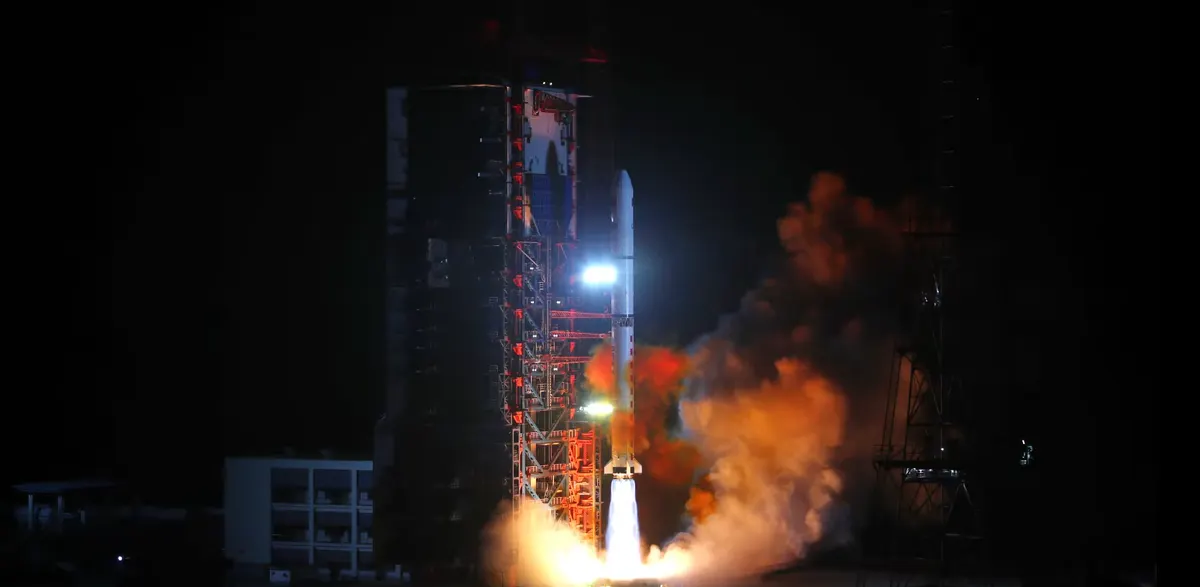
India followed a similar path with the Agni-P, developed by the Defence Research and Development Organisation as the first Indian missile fielded with a maneuverable re-entry vehicle, meant to raise accuracy and complicate an adversary's intercept planning.7
Iran has pursued the same goal with the Kheibar Shekan and the Haj Qasem, both credited with maneuverable, tri-conic re-entry vehicles reportedly capable of terminal speeds in the Mach 2 to Mach 3 range, well beyond what a coasting ballistic warhead could sustain that late in flight.8 Across these programs the underlying trade stays the same. A steerable re-entry vehicle costs more and demands a working terminal sensor, in exchange for accuracy and survivability a fixed ballistic path cannot match.
01Notes and Sources
- "MGM-31B Pershing II", Missile Threat, CSIS — missilethreat.csis.org ↩
- "Maneuverable reentry vehicle", Wikipedia — en.wikipedia.org ↩
- "Shaheen-II", Wikipedia — en.wikipedia.org ↩
- "Dong Feng-16 (CSS-11)", Missile Threat, CSIS — missilethreat.csis.org ↩
- "Turkey - Cenk MRBM", GlobalSecurity.org — globalsecurity.org ↩
- "DF-21 (CSS-5)", Missile Threat, CSIS — missilethreat.csis.org ↩
- "New Indian Missile Moves Closer to Deployment", Arms Control Association — armscontrol.org ↩
- "Table of Iran's Missile Arsenal", Iran Watch — iranwatch.org ↩


