

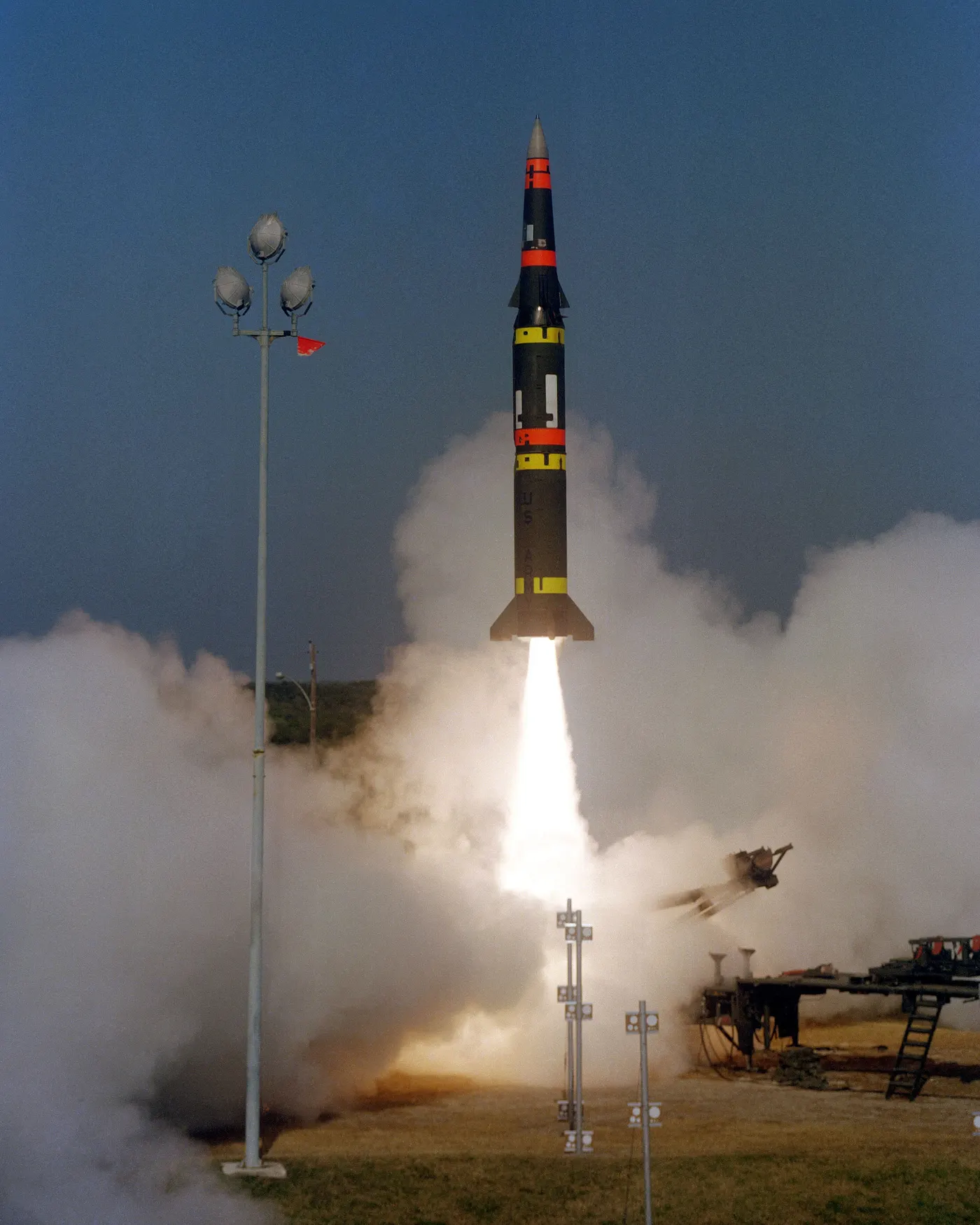

The Pershing II Weapon System is a United States road-mobile medium-range ballistic missile built by Martin Marietta as the replacement for the Army's earlier Pershing 1a. It entered service in 1983 and was withdrawn only eight years later, in 1991, eliminated under an arms control treaty rather than retired for any operational shortcoming. Its defining feature was a terminal guidance radar that let its single W85 thermonuclear warhead land within roughly 30 meters of its aim point, a striking figure for a Cold War ballistic missile and the reason the Pershing II unsettled Soviet planners far more than its modest 1,770 km range would suggest.
- Radar terminal guidance gave roughly 30 m CEP, unusually precise for a 1980s ballistic missile
- Road-mobile TEL basing improved survivability against a first strike
- Two-stage solid-fuel motor gave fast, short-notice launch readiness
- Variable-yield W85 warhead (5 to 80 kt) let commanders scale the strike
- Range of only 1,770 km forced forward basing in West Germany, exposing crews near the inter-German border
- Single warhead, no MIRV, unlike the three-warhead RSD-10 Pioneer it was built to counter
- Politically explosive, provoking Europe's largest peace movement since 1945
- Program life cut short after only eight years by the INF Treaty
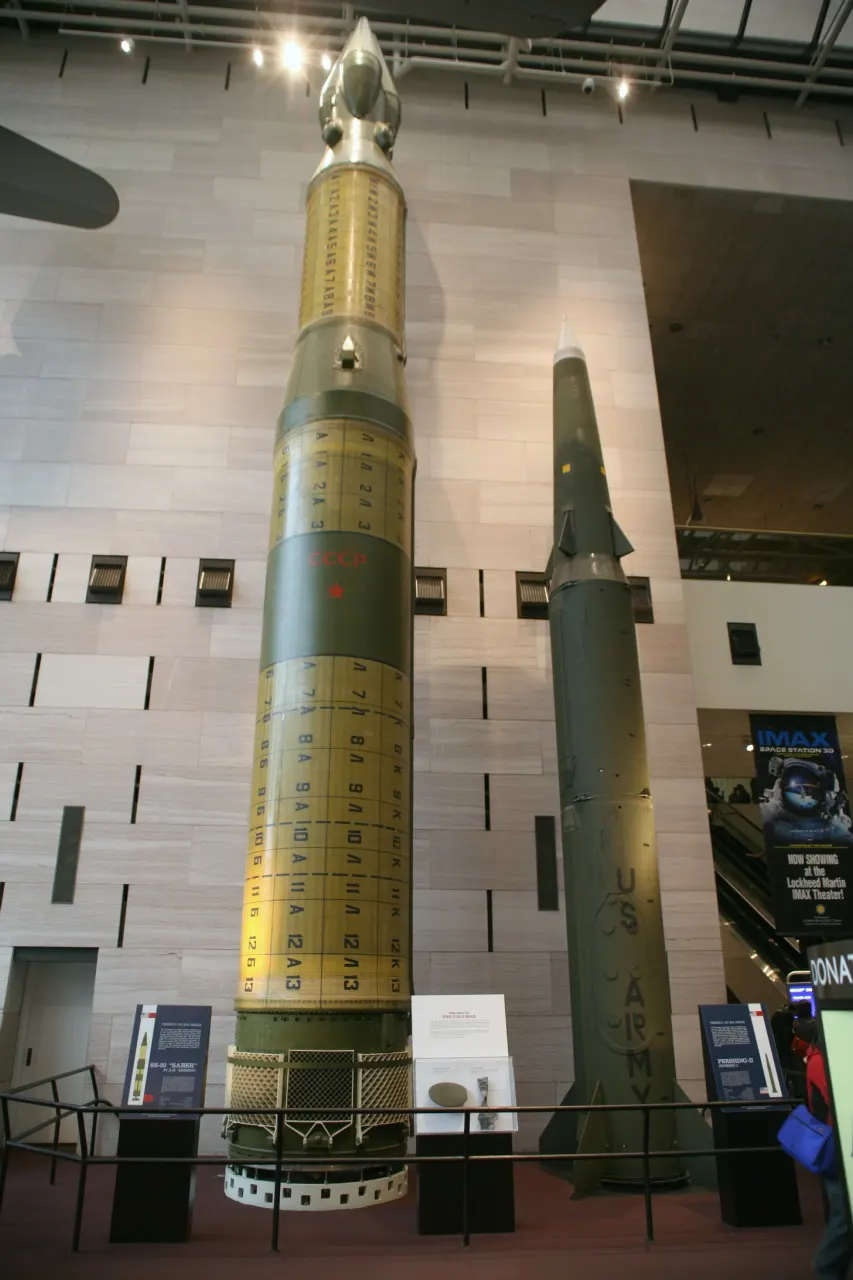
The Pershing II Weapon System was the American half of the Euromissile Crisis, NATO's response to the Soviet Union's deployment of the mobile rsd-10-pioneer (known in the West as the SS-20) against Western Europe. Deploying 108 Pershing II launchers and 464 BGM-109G Gryphon cruise missiles to NATO member states was the modernization half of the 1979 NATO Double-Track Decision, with negotiated Soviet missile reductions offered as the alternative.1,2 The missiles arrived in Germany in late 1983 and immediately became the focal point of the largest peace protests Western Europe had seen since the Second World War. Four years later the same missile that had triggered the crisis became the reason it ended, when the 1987 Intermediate-Range Nuclear Forces (INF) Treaty eliminated the Pershing II and the RSD-10 Pioneer as entire weapon classes, the first time two nuclear powers agreed to destroy a whole category of missiles under mutual on-site verification.3
Unlike its predecessor, the Pershing II was never placed under any form of shared West German custody. Pershing 1a launchers had operated under a NATO dual-key arrangement, with West German Air Force crews maintaining physical custody of the missiles while US officers retained the nuclear release authority. The Pershing II Weapon System reversed that arrangement entirely. Every launcher, warhead and crew member belonged to the US Army's 56th Field Artillery Brigade, and no German soldier ever had a hand on the system.1 That exclusivity became one more point of friction in a decade already strained by the missile's presence on German soil.
The Radar Area Correlation Terminal Guidance System and Its Accuracy Claim
What separated the Pershing II Weapon System from almost every other ballistic missile fielded in the 1970s and 1980s was its guidance package. A Singer-Kearfott inertial navigation unit flew the missile through boost and midcourse, the conventional approach used on the Pershing 1a and most contemporary systems. During reentry, a Goodyear Aerospace active-radar unit in the nose took over, scanning the terrain below and comparing the resulting radar image against a digital map stored in the missile's guidance computer before launch. Small fins on the maneuverable reentry vehicle steered the warhead until the live radar picture matched the stored map, correcting the final few kilometers of flight far more precisely than inertial guidance alone ever could.4,5 The result, according to the Army and multiple postwar technical assessments, was a circular error probable (CEP) of about 30 meters (100 feet), a leap over the several-hundred-meter CEP typical of contemporary terminal guidance-free ballistic missiles including the Pershing 1a it replaced.4,6
- Missile ClassMedium-range ballistic missile
- Service Entry Year1983
- DesignerMartin Marietta
- Length10.607 m
- Diameter1.016 m
- Launch Weight7.462 kg
- In ServiceNo
That precision fed a genuine controversy that outlived the missile itself. Soviet military leaders, and much of the Western press, argued that a CEP tight enough to matter against a point target implied the Pershing II Weapon System was built to destroy hardened Soviet command bunkers in a first strike, a decapitation weapon aimed at Moscow's leadership itself.7 The record is more complicated. The Army had developed a companion W86 earth-penetrating warhead specifically for hardened targets, but cancelled it in September 1980 when the Pershing II's mission was redefined toward soft, area-type targets at greater range rather than buried command posts, and only the area-effect W85 warhead ever reached production.8 Whether the missile's radar terminal guidance was really precise enough, and its warhead powerful enough, to guarantee a bunker kill remains disputed among Cold War analysts to this day, and the cancellation of the earth-penetrator variant undercuts the simplest version of the decapitation narrative even as Soviet planners never fully accepted it.
- Propulsion Typesolid propellant
- Number of Stages2
- Fuel Typesolid
- Solid-FuelYes
- Cold-LaunchNo
- CanisterizedNo
Two-Stage Solid Propellant and the Depressed-Trajectory Flight Profile
The missile itself measured 10.6 meters long and 1.016 meters in diameter, with a launch weight of 7,462 kg.4,6 Its two-stage solid-fuel rocket motors, built by Hercules Inc., used Kevlar composite casings with aluminum attachment rings, a lightweight combination that helped keep the whole road-mobile system within the load limits of its transporter erector launcher (TEL).1 The Pershing II Weapon System's solid-fuel motors also gave it a short-notice launch capability that liquid-fueled predecessors lacked, letting crews fire on a compressed timeline once ordered.
- Maximum Range1,770 km
- Re-Entry Speed (Mach)8 Mach
- Depressed-Trajectory CapableYes
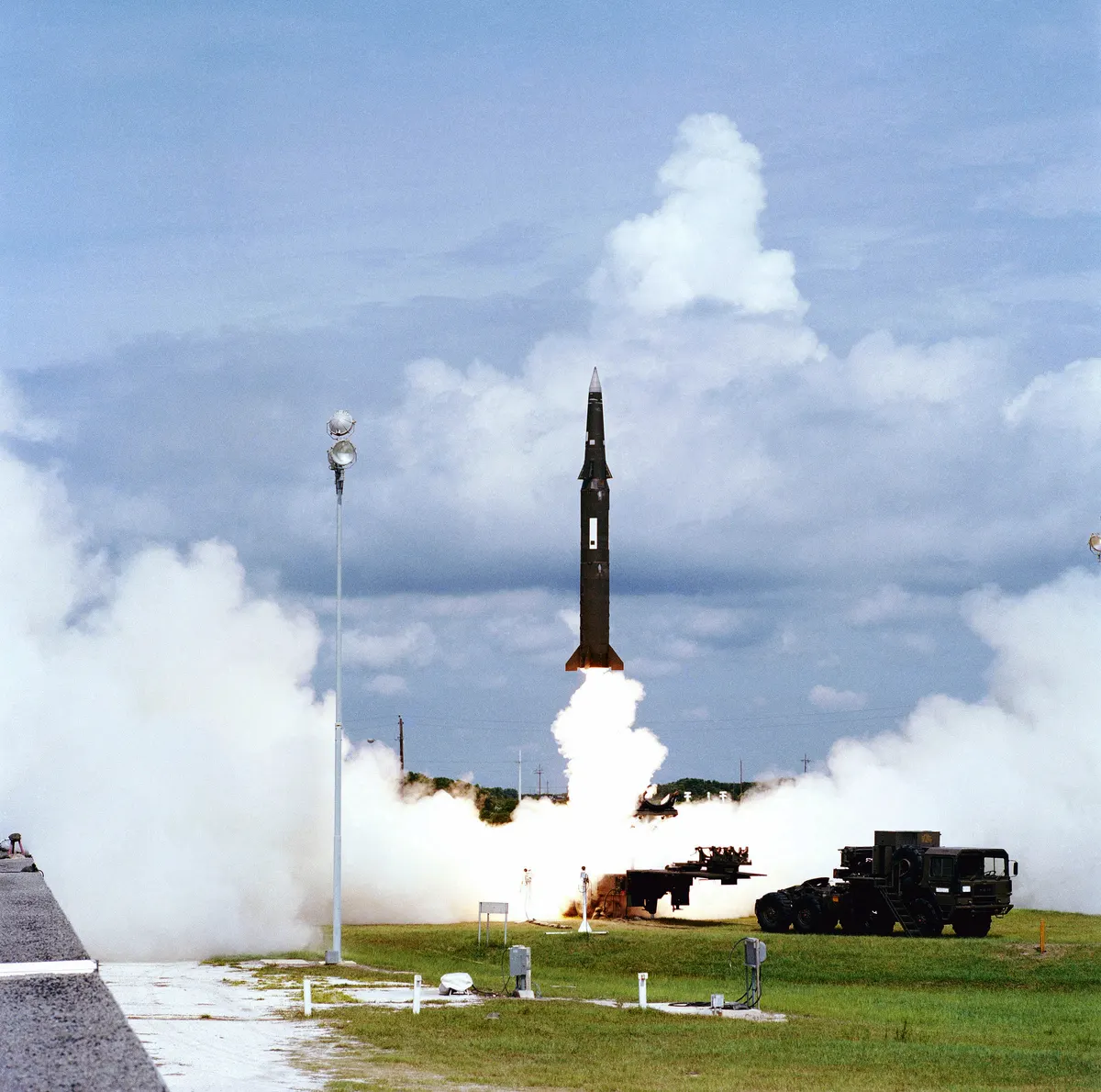
Flight profile mattered as much as raw specifications. The Pershing II Weapon System flew a depressed trajectory rather than the more efficient minimum-energy arc used by longer-range strategic missiles, reentering at speeds above Mach 8.9 That shorter, flatter path cut flight time to targets in the western Soviet Union to somewhere between eight and ten minutes, a figure Soviet General Secretary Yuri Andropov reportedly put closer to six.7,10
- Circular Error Probable (CEP)30.48 m
- Guidance TypeActive Radar
- Terminal GuidanceYes
- Maneuverable Re-Entry Vehicle (MaRV)Yes
- Penetration Aids / DecoysYes
For comparison, an intercontinental ballistic missile launched from the continental United States needed roughly 30 minutes to reach the same targets. The Pershing II Weapon System's short flight time from forward bases in Germany, not its warhead yield or its CEP alone, was what made Soviet planners treat it as a fundamentally different kind of threat.
- Warhead TypeW85 nuclear warhead
- NuclearYes
- ThermonuclearYes
- Yield (per warhead)80
- MIRVNo
- Warhead / RV Count1
- Conventional-CapableNo
- Basing Moderoad-mobile
- Silo-BasedNo
- Road-Mobile (TEL)Yes
- Rail-MobileNo
- Submarine-LaunchedNo
- Total Production276
- Operators1
- First Test1977
From the Pershing 1a to a New Generation of Accuracy
The US Army began development of what became the Pershing II Weapon System in the early 1970s as a straightforward accuracy and range upgrade to the existing MGM-31 Pershing 1a, whose inertial-only guidance left it with a CEP measured in hundreds of meters. Martin Marietta won the development contract in 1975, and early sub-scale flight tests began in 1977.4,11 The program might have remained a routine modernization effort had NATO's strategic calculus not shifted sharply at the end of the decade.
That shift came from the Soviet Union's own missile program. Beginning in 1976, the Soviet military fielded the mobile rsd-10-pioneer, a longer-ranged, MIRV-capable missile that could strike any NATO capital in Western Europe from deep inside Soviet territory, entirely outside the reach of the SALT strategic arms talks that governed only intercontinental systems.12 NATO foreign and defense ministers responded on 12 December 1979 with the Double-Track Decision, agreeing to modernize NATO's own intermediate-range forces by fielding 108 Pershing II launchers and 464 BGM-109G Gryphon ground-launched cruise missiles unless negotiations produced reciprocal Soviet reductions by the end of 1983.2
Diplomacy ran alongside deployment throughout the early 1980s. President Ronald Reagan proposed the zero option in November 1981, offering to cancel Pershing II and cruise missile deployment entirely in exchange for the Soviet Union dismantling its SS-4, SS-5 and RSD-10 Pioneer force.2 Moscow rejected it, viewed at the time as a one-sided proposal given NATO had not yet deployed anything to trade away. A closer call came the following year, when Nitze and Kvitsinsky's back-channel proposal, capping cruise missile numbers and cancelling Pershing II deployment altogether, was relayed to both capitals and rejected by each.13 With diplomacy stalled, deployment went ahead on schedule.
Deployment to West Germany and the Largest Peace Protests Since 1945
The first Pershing II launchers arrived in Germany in late November 1983. Initial Operational Status was declared on 15 December 1983, when A Battery of the 1st Battalion, 41st Field Artillery Regiment went on alert at the missile storage area outside Mutlangen.1 Deployment continued through 1985 across three battalion sites, Mutlangen, Neu-Ulm and Neckarsulm, eventually fielding the full complement of 108 launchers under the 56th Field Artillery Brigade.1
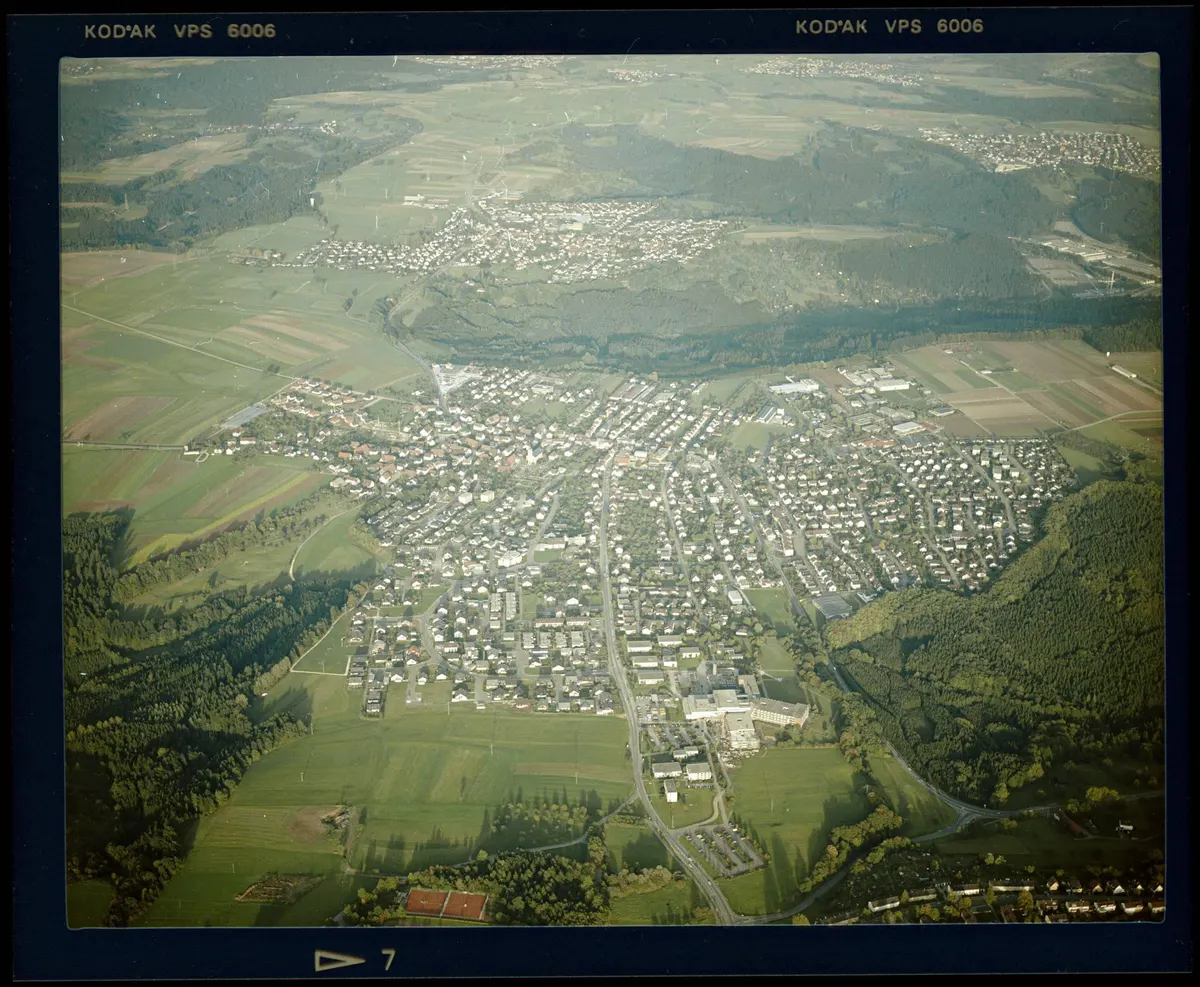
The reaction inside Germany was immediate and enormous. The Krefeld Appeal against the Double-Track Decision gathered roughly five million signatures by 1983.1 Bonn saw 300,000 demonstrators in October 1981 and as many as 500,000 in October 1983, when protesters also formed a human chain stretching from US Army headquarters in Stuttgart to the Pershing II battalion gates at Wiley Barracks in Neu-Ulm.1,14 A permanent protest camp took root outside the Mutlangen missile storage area from Easter 1983 until the INF Treaty was signed four years later, making it the single most visible symbol of West German opposition to the deployment.1 Activists challenged the deployment in West Germany's Federal Constitutional Court on the grounds that it violated the Basic Law, and lost, while the Plowshares movement carried out repeated direct actions against Pershing II infrastructure, from cutting fences at Schwäbisch Gmünd in December 1983 to damaging equipment inside Martin Marietta's own Orlando plant in April 1984.1
Deployment carried real operational risk as well as political cost. A launcher and its tractor rolled off an icy road into a snowbank near Mutlangen during a September 1984 field exercise, requiring six hours to recover.1 Worse followed on 11 January 1985 at Camp Redleg near Heilbronn, when a static charge that had built up in a Kevlar rocket motor casing during cold, dry weather discharged as the motor was being removed from its container, igniting the propellant and killing three soldiers. The accident triggered a moratorium on Pershing II missile handling that lasted through most of 1986 while the Army rewrote its procedures.1
The 1983 War Scare, the Zero Option and the Road to 1987
Soviet leadership reacted to the Pershing II Weapon System's arrival with alarm bordering on panic. General Secretary Yuri Andropov, a former KGB chief, viewed the deployment through the lens of a possible NATO decapitation strike and mistrusted Western assurances that the missiles could not reach Moscow.7 At a Warsaw Pact meeting that October, Soviet Defense Minister Dmitri Ustinov reportedly described the Pershing II as a means for a first strike, a decapitation strike in his own words.7 That climate of suspicion peaked barely two weeks after the first launchers reached Mutlangen, when NATO's Able Archer 83 command post exercise in November 1983 was misread by parts of the Soviet military as possible cover for a real attack, one of the tensest moments of the entire Cold War and a scare directly amplified by the missile's newly operational presence on West German soil.15 The Soviet delegation walked out of the Geneva arms talks that same month.2
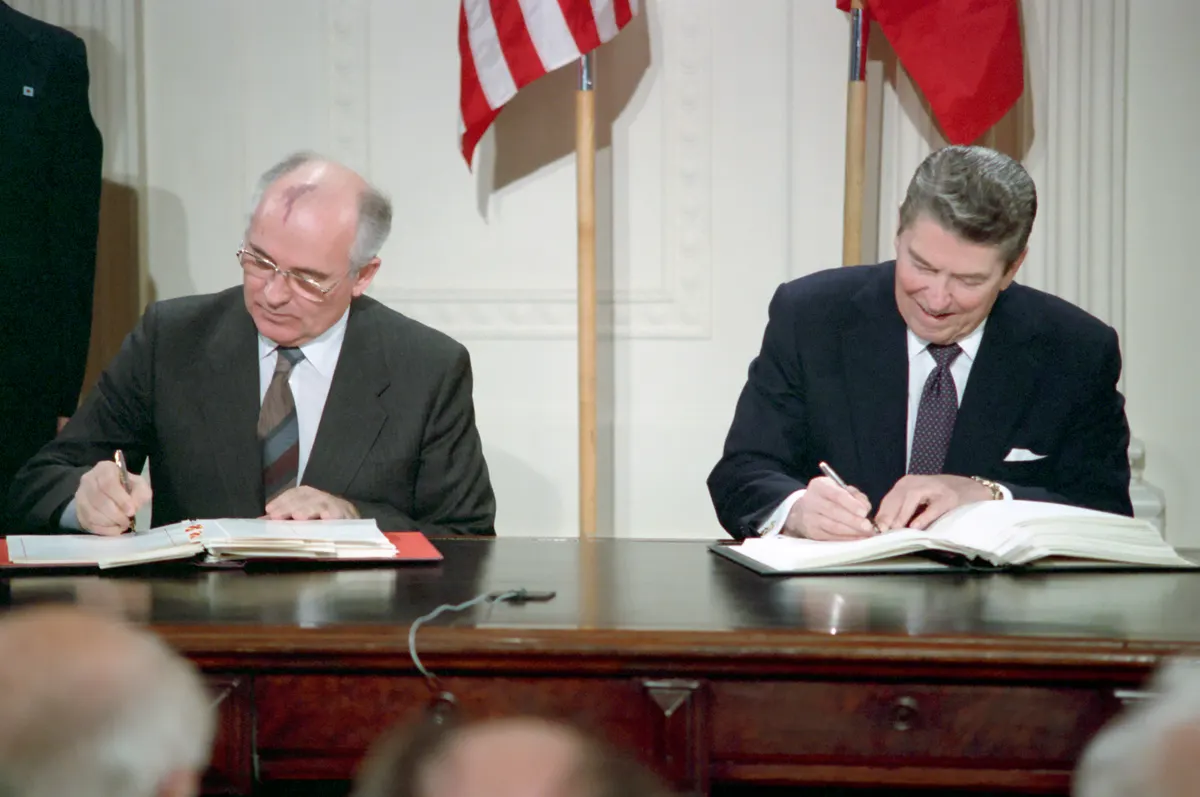
Negotiations resumed once Mikhail Gorbachev took power in Moscow in 1985, and the diplomatic climate improved sharply over the following two years. President Reagan and General Secretary Gorbachev signed the Intermediate-Range Nuclear Forces Treaty in Washington on 8 December 1987, eliminating the entire class of ground-launched missiles with ranges between 500 and 5,500 km, both the Pershing II Weapon System and the rsd-10-pioneer among them.3
The signing photograph, Reagan and Gorbachev shaking hands over the treaty text, became one of the defining images of the late Cold War, a striking reversal from the confrontational rhetoric that had surrounded the Pershing II Weapon System's arrival in Germany barely four years earlier.
Withdrawal and Elimination Under the INF Treaty
The treaty entered force on 1 June 1988 and set a three-year deadline for elimination. Withdrawal from Germany began that October, and the US Army completed destruction of its Pershing II inventory by 27 May 1991, alongside its remaining Pershing 1a stock and BGM-109G Gryphon cruise missiles.16 Of the 276 Pershing II missiles Martin Marietta had built, 234 remained subject to the treaty's elimination requirement by the time it was signed, the rest having already been expended in testing.4,16 Most missile stages were destroyed by static-firing the motor to burn off the propellant and then crushing the airframe, carried out primarily at the Longhorn Army Ammunition Plant in Texas and at Pueblo Depot Activity in Colorado, with Soviet inspectors from the newly created On-Site Inspection Agency physically present to witness the process.16 That mutual verification regime, unprecedented for its intrusiveness at the time, became the model for later arms-control agreements between Washington and Moscow.
The Pershing II Weapon System's cultural shadow outlasted its eight years of service. West German band Nena's 1983 hit 99 Luftballons grew out of guitarist Carlo Karges watching balloons released at a 1982 Rolling Stones concert in West Berlin drift toward the Wall and wondering what would happen if Soviet radar operators mistook them for an incoming attack, a fear inseparable from the Pershing II's presence on German soil that same year.17,18 The song topped West German charts in 1983 and reached the top five in the United States the following year in its English adaptation, carrying the anxiety of the Euromissile Crisis to an audience that had never heard of Mutlangen.
The Pershing II Weapon System never fired a shot in anger. Its combat role was entirely deterrent, a fixture of NATO's nuclear posture during the final, tensest phase of the Cold War rather than a weapon used in any shooting war.1 Its most consequential episode was diplomatic and psychological rather than kinetic, centered on the Able Archer 83 command post exercise in November 1983, held barely two weeks after the first Pershing II launchers reached operational status at Mutlangen.15 Soviet military intelligence, already primed by years of warnings from Andropov's leadership about a possible NATO first strike, interpreted parts of the exercise as unusually realistic and briefly moved toward heightened alert of its own nuclear forces, a moment historians now regard as one of the closest brushes with accidental nuclear war of the entire Cold War.15

That the alarm was triggered by an exercise rather than an actual attack, and defused within days once Soviet intelligence concluded no strike was underway, does not diminish how directly the Pershing II Weapon System's presence shaped the episode. NATO planners had not anticipated that a routine annual exercise could interact so dangerously with genuine Soviet fear of the missile parked less than ten minutes' flight time from targets in the western Soviet Union.
Historians still debate exactly how close the war scare came to triggering a Soviet preemptive response, since much of the relevant Soviet documentation remains only partially declassified. The consensus among Western intelligence retrospectives, though, is that the danger was real rather than manufactured after the fact.15
The Pershing II Weapon System reached production in essentially one configuration. All 276 missiles Martin Marietta built carried the same W85 variable-yield warhead, the same Goodyear Aerospace radar terminal guidance package, and the same two-stage Hercules solid-fuel motor.4,8 A parallel W86 earth-penetrating warhead was developed alongside the W85 specifically to defeat hardened, buried targets, but the Army cancelled it in September 1980 once the missile's targeting mission shifted toward softer, longer-range targets, leaving the area-effect W85 as the only warhead ever fielded operationally.8

A number of inert Pershing II trainers, identical in dimensions and weight to operational rounds but without live warheads or propellant, were built for crew handling drills and now sit in museum collections including the Smithsonian's National Air and Space Museum.6
The missile's direct predecessor, the Pershing 1a, remained in West German Air Force service under the older NATO dual-key arrangement even after the Pershing II Weapon System took over the Army's own nuclear alert mission. Both systems were ultimately eliminated together under the INF Treaty.16

The United States Army was the Pershing II Weapon System's only operator. Every launcher and warhead belonged to the 56th Field Artillery Brigade (redesignated 56th Field Artillery Command in 1986), organized into three firing battalions, the 1st Battalion/41st Field Artillery, 4th Battalion/41st Field Artillery, and 3rd Battalion/84th Field Artillery, all garrisoned in Germany but under exclusive US custody and control throughout the deployment.1 Unlike the Pershing 1a's dual-key arrangement, no other NATO member ever held launch authority, physical custody, or a production license for the system.
The Pershing II Weapon System was never exported, never licensed for foreign production, and never offered for sale, a deliberate choice given its role as a purely NATO deterrent asset rather than a general-purpose export missile. Its operational history therefore begins and ends with the same single operator across its full eight years of active service, from Initial Operational Status in December 1983 to the completion of treaty-mandated elimination in May 1991.1,16
The clearest way to understand the Pershing II Weapon System is through the trade-off it made against the missile it was built to counter, the Soviet rsd-10-pioneer. Soviet designers built the RSD-10 Pioneer for range and payload, a 7,500 km reach and up to three 150 kt MIRV warheads, all launched from deep inside Soviet territory where NATO strike aircraft and shorter-range missiles could not touch it.12 Martin Marietta built the Pershing II Weapon System for precision instead, a single warhead delivered to within about 30 meters of its aim point, but only 1,770 km from the launcher, a range gap that forced NATO to base the entire force forward in West Germany, within direct reach of Soviet retaliation and squarely in the path of any Warsaw Pact ground offensive.4,12
| Spec | Pershing II Weapon System | RSD-10 Pioneer |
|---|---|---|
| Max range | 1,770 km | up to 7,500 km |
| CEP | ~30 m | ~150-450 m |
| Warhead(s) | 1, up to 80 kt | up to 3 MIRV, 150 kt each |
| Basing | Road-mobile TEL, West Germany | Road-mobile TEL, Soviet territory |
| Guidance | Inertial + radar terminal | Inertial only |
That asymmetry is exactly why the Pershing II Weapon System read as so provocative to Soviet planners despite carrying a single warhead against the RSD-10 Pioneer's three. A missile that has to sit close to the front line to reach its targets, but can hit those targets with enough precision to threaten hardened facilities rather than just area targets, looks like a first-strike weapon even when its range is objectively shorter than its rival's. The RSD-10 Pioneer, by contrast, never needed comparable accuracy, its MIRV payload and sheer numbers were built to guarantee destruction of softer NATO targets across the whole of Western Europe from well outside the reach of any NATO retaliatory strike short of a full ICBM exchange.12 Both missiles vanished from their respective arsenals within the same three-year window after 1987, the RSD-10 Pioneer's greater range and payload counting for nothing once both were banned outright by the same treaty.
Set against its own predecessor rather than its Soviet rival, the improvement is just as stark. The Pershing 1a it replaced relied on inertial guidance alone and carried a CEP measured in the hundreds of meters, useful only against large area targets. The Pershing II Weapon System's radar terminal guidance cut that error down by roughly an order of magnitude, the single biggest capability jump in the whole Pershing missile line and the reason the newer missile drew so much more diplomatic and public attention than the older one it quietly retired.


Is the Pershing II missile still in service today? No. The Pershing II Weapon System was withdrawn from West Germany starting in October 1988 and the US Army completed elimination of its entire inventory by 27 May 1991 under the terms of the INF Treaty.16
How accurate was the Pershing II missile? Its radar area correlation terminal guidance gave it a circular error probable of roughly 30 meters (100 feet), unusually precise for a ballistic missile of its era and a major improvement over the several-hundred-meter accuracy of its Pershing 1a predecessor.4,6
What replaced the Pershing II after it was eliminated? Nothing directly, for more than three decades. The INF Treaty banned the entire class of ground-launched missiles with ranges between 500 and 5,500 km for both the United States and the Soviet Union's successor states. Only after the US withdrew from the treaty in August 2019 did the Army begin fielding intermediate-range successors again, including the Typhon Mid-Range Capability system and the Dark Eagle hypersonic weapon.19,20
Why was the Pershing II missile so controversial? Its short flight time from West Germany, roughly eight to ten minutes to targets in the western Soviet Union, combined with its unusually tight CEP, convinced Soviet leadership it was intended as a decapitation weapon against Moscow's command structure, a fear amplified by Soviet intelligence overestimating its range at up to 2,500 km.7,9
How many Pershing II missiles were built, and how many were destroyed? Martin Marietta built 276 Pershing II missiles in total. Of those, 234 remained in the active inventory subject to the INF Treaty's elimination requirement, all destroyed by static motor burn and crushing by May 1991.4,16
What did the Pershing II missile cost? Congressional Budget Office estimates from 1983 put the unit cost at roughly $4.2 million per missile, with total program research, development, testing and procurement costs reaching roughly $2.45 billion for 247 missiles according to Government Accountability Office figures.21
- "Pershing II", Wikipedia — en.wikipedia.org ↩
- "NATO Double-Track Decision", Wikipedia — en.wikipedia.org ↩
- "Intermediate-Range Nuclear Forces Treaty", Wikipedia — en.wikipedia.org ↩
- "Pershing 2", Missile Threat (CSIS) — missilethreat.csis.org ↩
- "Introduction to the Scene Matching Missile Guidance Systems", DTIC — apps.dtic.mil ↩
- "Pershing II", National Air and Space Museum — airandspace.si.edu ↩
- "Iskander, Pershing II and Missile Defences: History Repeating", RUSI — rusi.org ↩
- "W86", Wikipedia — en.wikipedia.org ↩
- "Pershing 2", United States Nuclear Forces (FAS) — nuke.fas.org ↩
- "The Soviet Side of the 1983 War Scare", National Security Archive — nsarchive.gwu.edu ↩
- "Pershing II 'Destroys Itself' in 1st Full Test", The Washington Post — washingtonpost.com ↩
- "RSD-10 Pioneer", Wikipedia — en.wikipedia.org ↩
- "Paul Nitze and A Walk in the Woods, A Failed Attempt at Arms Control", Association for Diplomatic Studies and Training — adst.org ↩
- "More Than a Million Protest Missiles in Western Europe", The Washington Post — washingtonpost.com ↩
- "Able Archer 83, What Were the Soviets Thinking?", Survival (Taylor and Francis) — tandfonline.com ↩
- "pershing", US Army Redstone Historical Information — history.redstone.army.mil ↩
- "99 Luftballons", Wikipedia — en.wikipedia.org ↩
- "99 Luftballons and the Grim Fairy Tales of '80s West Germany", Longreads — longreads.com ↩
- "U.S. Withdrawal from the INF Treaty on August 2, 2019", US Department of State — 2017-2021.state.gov ↩
- "The Army's Typhon missile system is in Japan", Task and Purpose — taskandpurpose.com ↩
- "INF Treaty Pullout Could Be Boon for Missile Makers", National Defense Magazine — nationaldefensemagazine.org ↩