


On December 10, 2010, an Indian rocket lifted off from Wheeler Island on the Odisha coast under a designation that most people outside the missile-watching community have never heard, A2-P. The Defence Research and Development Organisation (DRDO), India's state missile design agency, called the project Agni-II Prime, and defense reporters at the time mostly wrote it as Agni-II+. The flight failed seconds after launch.1 What happened to the program afterward is one of the more genuinely tangled naming stories in the Indian ballistic missile family, and this article treats that tangle honestly rather than pretending the record is clean.
- Enlarged composite-cased solid motor gave real range growth over Agni-II
- Road-mobile canister-style basing improved survivability versus rail-fixed systems
- Indigenous ring laser gyro navigation was a genuine domestic technology milestone
- First flight (December 2010) failed outright, delaying validation by nearly a year
- Never operationally inducted or exported under the Agni-II Prime name itself
- Its identity is easy to confuse with the unrelated, much later Agni-P (Agni Prime) missile
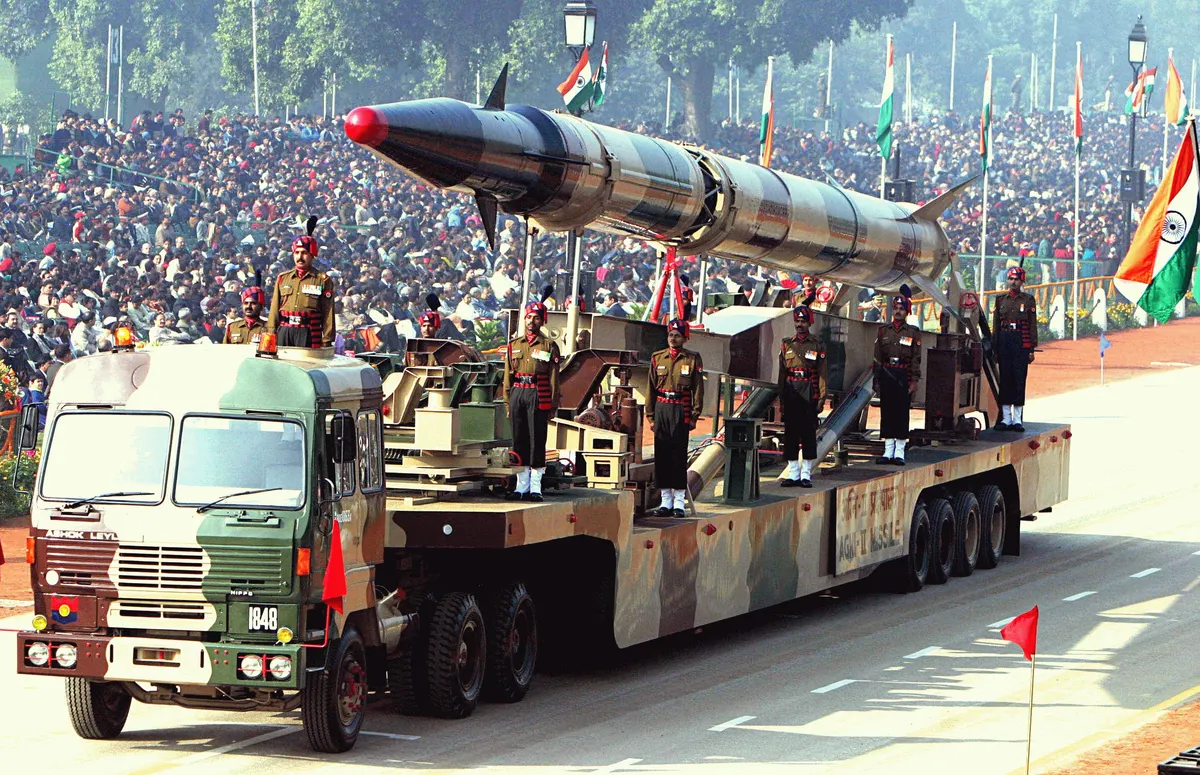
Agni-II Prime was DRDO's attempt to stretch the combat-proven Agni-II medium-range ballistic missile into something with meaningfully longer reach, using an enlarged, steel-cased first-stage motor, a lighter carbon-fiber second stage, and a new composite rocket motor casing meant to cut structural weight.2,3 It also carried a new indigenous ring laser gyroscope inertial navigation package and was fired from a road-mobile launcher rather than the rail-based system used by earlier Agni missiles.4 The 2010 test failed because of a stage-one control error immediately after lift-off, but DRDO's own statement afterward said several of the new technologies performed as intended even though the mission as a whole did not.4
What makes Agni-II Prime unusual as an archive entry is that it never flew again under that name. When DRDO returned to the same airframe on November 15, 2011, it launched from the same Wheeler Island range and reached roughly 3,000 kilometers downrange with a 900-kilometer apogee, and the missile was now called Agni-IV.1,3 Wikipedia's own Agni-IV article states plainly that Agni-IV was earlier known as Agni II Prime, and CSIS Missile Threat treats the December 2010 shot and the successful November 2011 shot as the same development line.1,3 In practical terms, most open-source missile literature now reads Agni-II Prime not as a separately fielded weapon but as the pre-induction name for what the public eventually came to know as Agni-IV.
Confusion around the name did not end in 2011. Since 2021 the Indian Army has tested and begun fielding a completely different, shorter, and lighter missile that DRDO calls Agni Prime, commonly abbreviated Agni-P.5 Agni-P is a roughly 10.5-meter, two-stage, canisterized missile with a declared range band of 1,000 to 2,000 kilometers, built to replace the original Agni-I and Agni-II in the field, not a follow-on to the 2010 test.5 The near-identical English names, Agni-II Prime from 2010 and Agni Prime from 2021, describe two unrelated programs a decade apart, and this archive keeps them as separate weapon entries for that reason. Readers searching for Agni-II Prime specifications or for Agni Prime range figures should check which decade of Indian missile testing they actually mean before comparing numbers.
India's Strategic Forces Command, the tri-service body that controls the country's nuclear-capable missile inventory, was the intended end user of the Agni-II Prime/Agni-IV line from the start, continuing the deterrence posture built around the base Agni-II and the longer-ranged Agni-III.2 The missile falls within the broader MRBM category this archive tracks, though its documented 3,000 to 4,000-kilometer intended range sits at or past the conventional 3,000-kilometer line separating medium-range from intermediate-range ballistic missiles, a genuine classification ambiguity rather than an error in either direction.
The Agni-II Prime that flew (and failed) on December 10, 2010 was reported at roughly 20 meters long with an enlarged first-stage diameter of about 1.2 meters, up from the base Agni-II's narrower first stage, and a launch weight in the neighborhood of 17,000 kilograms.3,2 The added bulk went almost entirely into the new composite-cased solid rocket motor, which DRDO fielded for the first time on this airframe specifically to cut structural weight while holding more propellant, the same design logic that let the eventual Agni-IV declare a 3,000 to 4,000 kilometer range against the original Agni-II's 2,000 to 3,500 kilometers.2,3 A payload figure of roughly 1,000 kilograms appears consistently across sourcing for both the Agni-II baseline and the Agni-II Prime/Agni-IV upgrade, suggesting the reentry vehicle and warhead bus itself changed less than the boost stages around it.2
- Missile Classmedium_range_ballistic_missile
- Designerdefence_research_and_development_organis
- Length20 m
- Diameter1.2 m
- Launch Weight17,000 kg
- In ServiceNo
Guidance combined an inertial navigation platform built around an Indian-made ring laser gyroscope with satellite positioning, the same broad inertial-GPS approach used across the Agni family, reportedly tightening accuracy toward a circular error probable under 100 meters by the time the design matured into operational Agni-IV testing.3 That gyroscope was one of three genuinely new technologies DRDO named in its post-failure statement, alongside the composite motor casing and the shift to road-mobile launch, and the agency's own language afterward, stating that the new technologies had already been proved even though the flight itself had not succeeded, is a useful reminder that a single failed test does not necessarily invalidate every subsystem riding on it.4
- Propulsion Typetwo_stage_solid_fueled_rocket
- Number of Stages2
- Fuel Typesolid_fuel
- Solid-FuelYes
Warhead options followed the same dual-capable pattern as the rest of the Agni series, conventional high-explosive, thermobaric, and strategic nuclear payloads, with the nuclear option assessed by outside analysts in roughly the same 150 to 200 kiloton band credited to the base Agni-II design.2,3 No open source confirms an independently verified yield specific to the Agni-II Prime configuration itself, since the one flight conducted under that name never reached the reentry phase where a warhead would have been exercised, and this article does not manufacture a number where the test record simply stops short.
- Minimum Range3,000 km
- Maximum Range4,000 km
- Apogee900 km
- Throw Weight1,000 kg
The table below lines up the reported Agni-II Prime/Agni-IV configuration against the Agni-II it was meant to replace in front-line units.
- Circular Error Probable (CEP)100 m
- Guidance TypeInertial / GPS
| Spec | Agni-II (baseline) | Agni-II Prime / Agni-IV |
|---|---|---|
| Length | 21 m | 20 m |
| First-stage diameter | 1.3 m | 1.2 m (steel, composite-assisted) |
| Launch weight | 16,000-17,000 kg | ~17,000 kg |
| Declared range | 2,000-3,500 km | 3,000-4,000 km |
| First flight | 1999 | 2010 (failed), 2011 (as Agni-IV, succeeded) |
The composite motor casing and ring laser gyro navigation package validated on the failed 2010 flight carried over almost unchanged into the production standard eventually inducted as Agni-IV, which is the clearest engineering throughline connecting the 2010 test to the missile the Indian public actually came to know a year later.
- Warhead Typenuclear_high_explosive_thermobaric
- NuclearYes
- MIRVNo
- Warhead / RV Count1
- Conventional-CapableYes
- Basing Moderoad_mobile
- Silo-BasedNo
- Road-Mobile (TEL)Yes
- Rail-MobileNo
- Submarine-LaunchedNo
- First Test2010
India's Agni missile program traces back to the 1980s Integrated Guided Missile Development Programme, but the specific lineage that produced Agni-II Prime starts with the operational Agni-II, first tested in 1999 and inducted into the Strategic Forces Command by the mid-2000s with a declared reach of roughly 2,000 to 3,500 kilometers.2 By the mid-2000s, DRDO's Agni design teams in Hyderabad were already working on a heavier-payload, longer-range derivative meant to close the capability gap between the Agni-II and the substantially larger Agni-III, and this derivative is the missile that eventually carried the Agni-II Prime and then Agni-IV names.1,2
The December 10, 2010 test at the Integrated Test Range on Wheeler Island was the program's first flight. DRDO's after-action statement described a trajectory deviation immediately after lift-off that caused mission failure, attributed to a stage-one control system fault, while noting that the composite rocket motor, the indigenous ring laser gyro navigation system, and the road-mobile launch concept had each demonstrated useful data regardless of the overall outcome.4
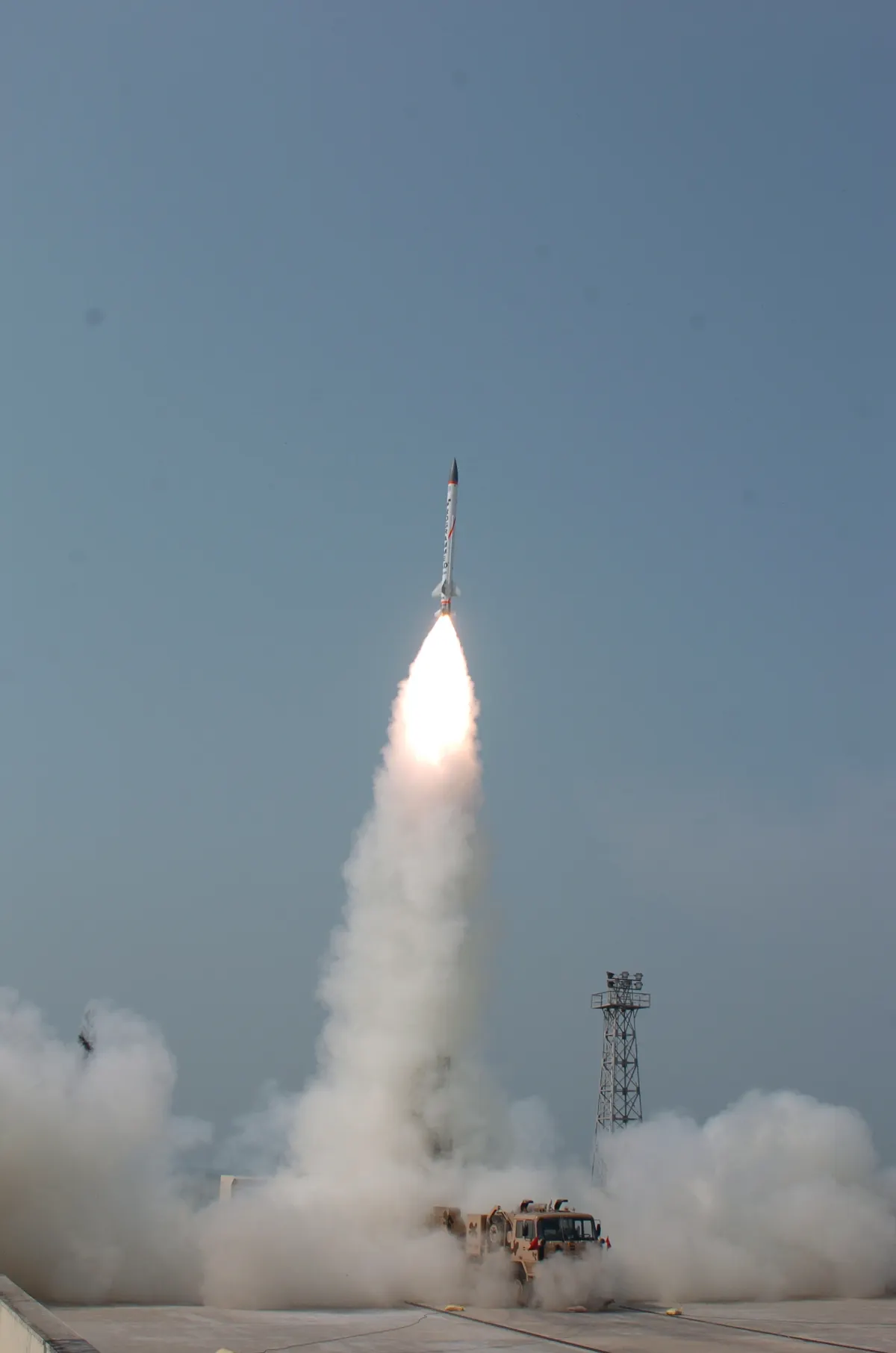
Indian defense press covered the failure under the Agni-II+ label DRDO itself was using informally at the time, and some contemporary reporting speculated the missile might eventually be designated Agni-IV once mature, a name that had also floated around a separate, unbuilt 5,000-kilometer-class concept discussed years earlier, adding to the naming confusion even among specialists following the program closely.1,5
DRDO returned to the same design on November 15, 2011, launching from Wheeler Island again, and this time the missile flew cleanly to roughly 3,000 kilometers with a 900-kilometer apogee.1,3 This is the flight that publicly settled the naming question, at least from DRDO's side, by carrying the Agni-IV designation rather than any further Agni-II Prime or Agni-II+ label.

A fuller-range test on September 19, 2012 reportedly reached the design's 4,000-kilometer mark with sub-100-meter accuracy, and further weapon-configuration and user trials followed in 2014, 2015, 2017, and 2018 under Strategic Forces Command control, culminating in the missile's operational induction.3 None of these later, successful flights are described in sourcing as Agni-II Prime tests, which is precisely why this archive treats Agni-II Prime as the closed, pre-induction chapter of the story and Agni-IV as its separate, successfully fielded continuation, linked here rather than merged into one record because the two names genuinely tracked two different phases of testing with two different outcomes.
The DRDO scientist most publicly associated with this generation of Agni testing was V. K. Saraswat, who served as the organisation's director general and the government's Scientific Advisor to the Defence Minister through the December 2010 failure and the subsequent 2011 recovery flight, and who spoke publicly at the time about treating the setback as a data point rather than a program-ending event.4
The broader strategic backdrop for this generation of Agni testing was India's push, through the 2000s and 2010s, to build a missile force capable of reaching hardened and mobile targets across both Pakistan and, at the longer end of the family, into China, without abandoning its declared no-first-use nuclear posture.6 Agni-II Prime's specific contribution to that push, a composite-motor, longer-range Agni-II derivative, mattered less for its own brief flight record than for the manufacturing and guidance techniques it handed off intact to the missile that replaced its name.
Analysts who track India's nuclear signaling have separately noted that better accuracy across the Agni family, the same ring laser gyro guidance lineage this program pioneered, has reopened debate over whether India's declared no-first-use posture is quietly shifting toward more precise, counterforce-capable options rather than pure retaliatory deterrence.6 That debate is centered mostly on the later Agni-P rather than on Agni-II Prime itself, but the guidance technology under discussion traces directly back to the package first flight-tested, and lost, on Agni-II Prime's single 2010 launch.
Because Agni-II Prime and Agni-IV describe the same physical design at two different stages of testing rather than a parent missile and a genuinely distinct derivative, this section is unusually short compared to most weapons in this archive, and that brevity is itself the honest answer rather than a gap in research. The only meaningful variant relationship worth recording is the naming transition itself, Agni-II Prime (2010, failed) becoming Agni-IV (2011 onward, successful and eventually inducted), documented directly by Wikipedia's Agni-IV article and treated as continuous by CSIS Missile Threat's separate Agni-II and Agni-IV entries.1,3
A second, unrelated naming collision deserves its own callout given how often it confuses casual readers. Agni-P, also called Agni Prime, is a wholly separate missile first tested in 2021, roughly half the length of Agni-II Prime at about 10.5 meters, built from the start as a canisterized, road-mobile replacement for the aging Agni-I and Agni-II rather than as a stretch of either.5 Agni-P shares a maneuverable reentry vehicle concept and some composite-casing manufacturing lessons with the Agni-IV/Agni-II Prime line, since DRDO's design bureaus reuse proven subsystems across programs, but it is not a later revision of Agni-II Prime and carries its own separate flight-test history starting more than a decade after the 2010 A2-P failure.5,6

No confirmed operator ever fielded a missile under the Agni-II Prime name specifically. The single flight test conducted under that designation, on December 10, 2010, ended in a launch failure, and by the time the design flew successfully in November 2011 it carried the Agni-IV name instead, meaning any operational induction that eventually followed is properly credited to Agni-IV rather than to Agni-II Prime as its own fielded system.1,4 India's DRDO retained sole ownership of the program throughout its testing, with the Strategic Forces Command of India slated as the eventual end user, consistent with the same command structure that operates the rest of the country's Agni family.2,3
No export customer, licensed production arrangement, or third-country interest in the Agni-II Prime configuration appears in open sourcing, unsurprising for a nuclear-capable strategic system that India has never offered abroad and that, in this specific naming history, never completed even its own domestic flight-test qualification before being folded into a successor designation.
Pakistan's answer to India's Agni-series buildup came from a different propulsion path entirely. The Ghauri-II, developed by Khan Research Laboratories and first assembled around 2000, uses two liquid-fuel stages derived from North Korean Nodong-1 technology to reach a declared 2,000-kilometer range, an approach that trades Agni-II Prime's faster solid-fuel readiness and composite-cased weight savings for the greater raw thrust liquid propellants can deliver from a simpler, older manufacturing base.7 Only two Ghauri-II flights are recorded, in 1999 and 2004, and Pakistan never assigned it a service designation for deployment, a test record thinner even than Agni-II Prime's own single, failed 2010 flight, which at least matured into the successfully inducted Agni-IV within a year.7
Shaheen-II is the more direct rival in engineering terms, since Pakistan built it, like Agni-II Prime, as a two-stage solid-fuel missile rather than a liquid-fuel design.8 Shaheen-II is shorter than Agni-II Prime's roughly 20-meter airframe at about 17.2 meters, heavier at launch (around 23,600 kilograms against Agni-II Prime's approximately 17,000), and declares a somewhat shorter 1,500 to 2,000-kilometer range against the 3,000 to 4,000 kilometers credited to the mature Agni-II Prime/Agni-IV configuration.8 Shaheen-II first flew in 2004 and reached operational status after a final training launch in 2014, giving Pakistan a fielded solid-fuel MRBM years before India's own composite-cased design cleared its testing under either the Agni-II Prime or Agni-IV name.8
| Spec | Agni-II Prime / Agni-IV | Shaheen-II | Ghauri-II |
|---|---|---|---|
| Propulsion | Two-stage solid, composite casing | Two-stage solid | Two-stage liquid |
| Length | ~20 m | 17.2 m | 18 m |
| Launch weight | ~17,000 kg | 23,600 kg | 1,800 kg |
| Declared range | 3,000-4,000 km | 1,500-2,000 km | 2,000 km |
| First flight | 2010 (failed) / 2011 (as Agni-IV) | 2004 | 1999 |
The MRBM category both nations compete in exists largely because of this exact regional rivalry, India pushing range and payload upward from the shorter Agni-I and Prithvi systems, Pakistan pushing its own Shaheen and Ghauri families to match, each side citing the other's tests to justify its own. Iran pursued a broadly similar solid-fuel leap with the Sejjil medium-range missile, and North Korea's canister-launched, solid-fuel Pukguksong-2 pursued the same cold-launch mobility concept Agni-II Prime's road-mobile basing was reaching toward, evidence that composite-cased, mobile solid-fuel MRBMs were a genuinely global engineering trend in the 2010s rather than a uniquely Indian one. Solid-fuel medium and intermediate-range missiles are not a new idea by any measure, France's silo-based S2 fielded a comparable solid motor concept for its own strategic deterrent as far back as the 1970s, decades before DRDO applied the same basic propellant logic to Agni-II Prime.


Is Agni-II Prime still in service today No missile is fielded under the Agni-II Prime name itself. The single flight tested under that designation, in December 2010, failed, and the design continued its testing and eventual induction under the Agni-IV name from November 2011 onward.1,4
What is the difference between Agni-II Prime and Agni-IV Open sourcing, including Wikipedia's own Agni-IV article, describes them as the same missile design at two stages, Agni-II Prime being DRDO's internal and press name for the pre-2011 configuration, Agni-IV being the name applied once the design flew successfully and moved toward operational service.1,3
Is Agni-II Prime the same missile as Agni Prime (Agni-P) No. Agni-P is a separate, shorter, lighter missile first tested from 2021 onward as a replacement for the Agni-I and Agni-II, roughly a decade after the 2010 Agni-II Prime test and unrelated to it beyond sharing design bureaus and some manufacturing techniques.5
What is the range of Agni-II Prime Sourcing consistently describes a 3,000 to 4,000-kilometer intended range for the mature Agni-II Prime/Agni-IV configuration, against 2,000 to 3,500 kilometers for the original Agni-II it was derived from.2,3
Who manufactures Agni-II Prime The Defence Research and Development Organisation designed it, with Bharat Dynamics Limited handling production integration for the Agni-IV configuration the design became.3
Why did the Agni-II Prime test fail in 2010 DRDO attributed the failure to a stage-one control system fault causing a trajectory deviation immediately after lift-off, while stating that the new composite motor casing, ring laser gyro navigation, and road-mobile launch concept it was also testing had each shown useful results independent of the overall mission failure.4
- "Agni-IV", Wikipedia — en.wikipedia.org/wiki/Agni-IV ↩
- "Agni-II", Wikipedia — en.wikipedia.org/wiki/Agni-II ↩
- "Agni-4", CSIS Missile Threat — missilethreat.csis.org/missile/agni-4/ ↩
- "Agni-II+ Missile Test Fails", Livefist Defence — livefistdefence.com/agni-ii-missile-test-fails/ ↩
- "Agni-P", Wikipedia — en.wikipedia.org/wiki/Agni-P ↩
- "India's Nuclear Doctrine, The Agni-P and the Stability-Instability Paradox", RUSI — rusi.org/explore-our-research/publications/commentary/indias-nuclear-doctrine-agni-p-and-stability-instability-paradox ↩
- "Ghauri-II", Wikipedia — en.wikipedia.org/wiki/Ghauri-II ↩
- "Shaheen-II", Wikipedia — en.wikipedia.org/wiki/Shaheen-II ↩