

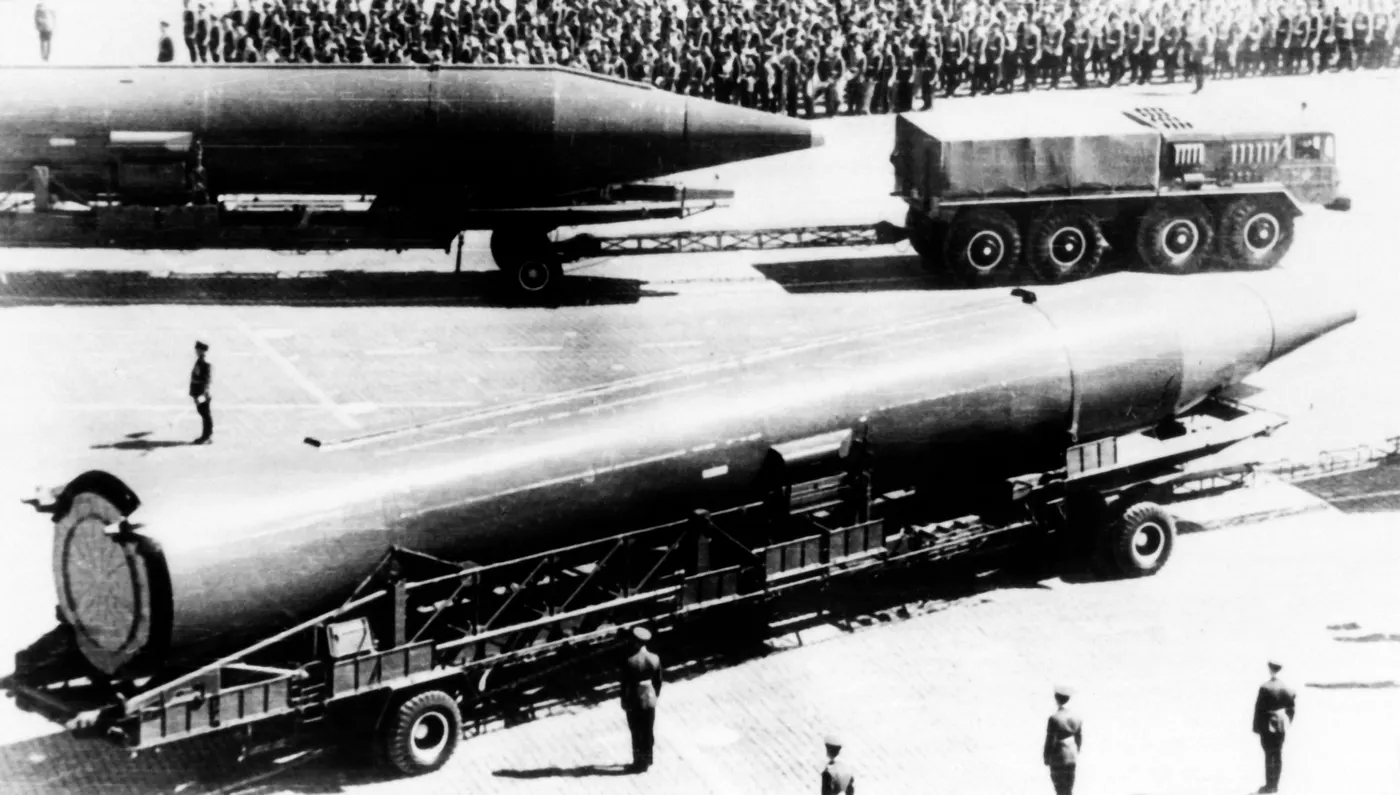

The R-14 Chusovaya, known in the West by its NATO reporting name SS-5 Skean and by the Soviet GRAU index 8K65, is a single-stage, liquid-fueled medium-range ballistic missile designed by Mikhail Yangel at his design bureau in Dnipropetrovsk and accepted into Soviet service on 24 April 1961.1 Its maximum range, calculated by Soviet engineers at roughly 4,500 kilometers against a US estimate closer to 3,700 kilometers, actually places it in the intermediate-range ballistic missile band under NATO's own classification scheme, well past the shorter R-12 Dvina it is most often mentioned alongside.2 The range gap between the two missiles mattered enormously in practice, especially during the one event that made both missiles famous outside specialist circles.
- Long reach for a single-stage, first-generation Soviet design
- Reached deep into the continental United States from Cuban launch sites
- Reusable airframe basis for the long-serving Kosmos-3M space launcher
- Proven inertial guidance platform, no dependence on ground radio correction
- Storable but still hypergolic propellant, hours of fueling before a soft-site launch
- Never deployed outside Soviet territory despite the Cuban plan
- Built in far smaller numbers than the R-12 it is usually compared to
- Superseded relatively quickly by the solid-fueled, road-mobile RSD-10 Pioneer
That event is the October 1962 Cuban Missile Crisis. The Soviet Union shipped R-12 Dvina missiles to Cuba first, and Soviet engineers began preparing two further sites, at Guanajay in the west and Remedios in central Cuba, for the longer-ranged R-14 Chusovaya.3 Neither Cuban R-14 site was finished when the crisis broke, and no R-14 missile or launcher ever actually reached the island, a genuinely important distinction from the R-12, some of which were assembled and close to launch-ready by the time American U-2 reconnaissance aircraft found them. The R-14 Chusovaya's role in the crisis is real but easy to overstate. Its warheads arrived in Cuba. Its missiles did not.
The missile entered Soviet service barely two years after the shorter R-12 Dvina, part of the same wave of first-generation Soviet ballistic missiles built to hold Western Europe and, eventually, more distant American targets at risk. Peak Soviet deployment came in the mid-to-late 1960s, and the type stayed in the nuclear order of battle for more than two decades before the solid-fueled RSD-10 Pioneer made it obsolete and, eventually, the Intermediate-Range Nuclear Forces (INF) Treaty eliminated it entirely. Is the R-14 Chusovaya still in service anywhere today? No, the last examples were destroyed under treaty verification in 1989, and no other country ever operated the type.
A Single-Stage Airframe Built Around the RD-216 Engine
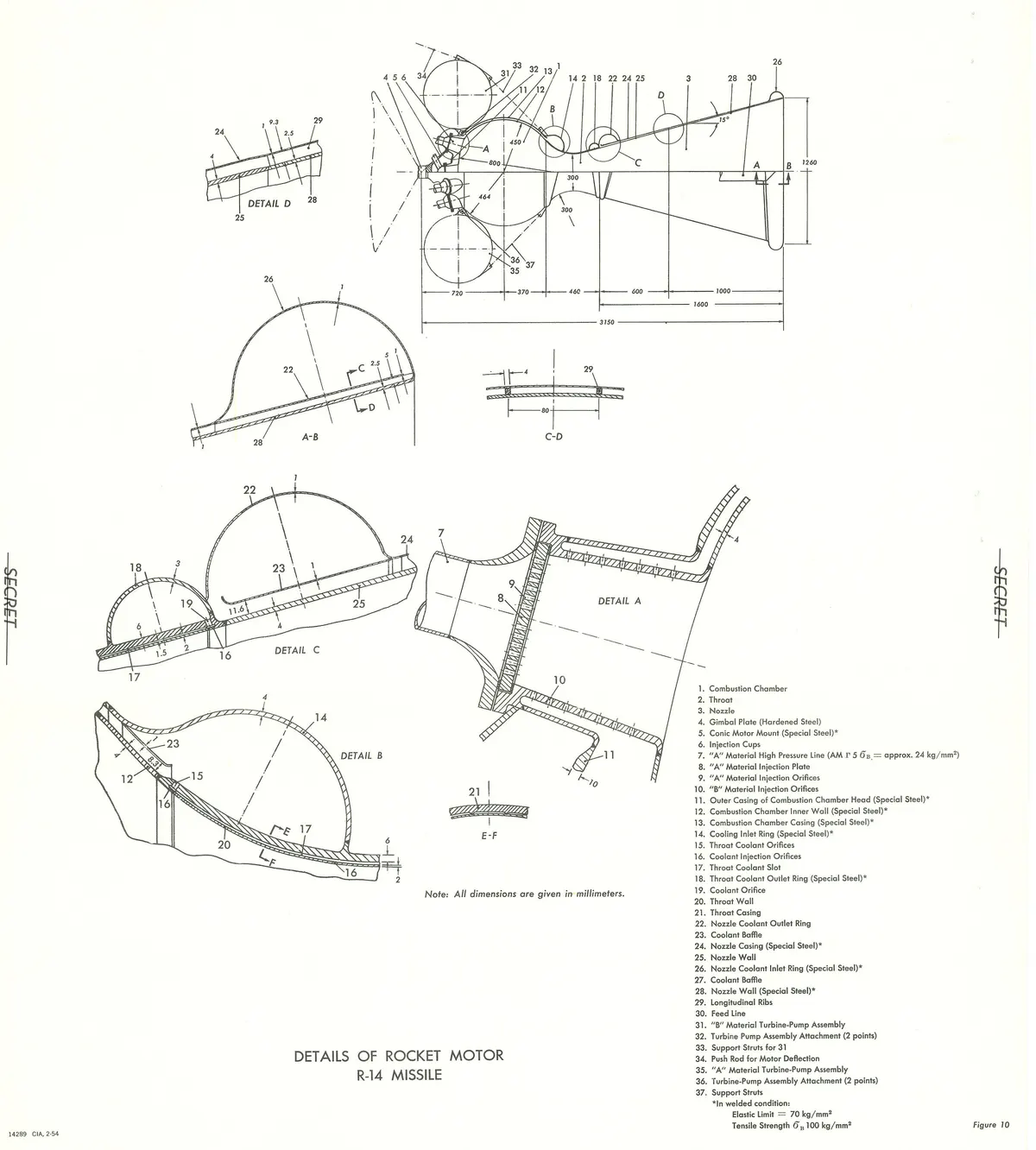
The R-14 Chusovaya measures 24.4 meters long and 2.4 meters in diameter, with a launch weight of about 86,300 kilograms, figures the current database record already reflects accurately.1 Power came from the RD-216, an engine built by Valentin Glushko's design bureau out of two paired RD-215 combustion chamber sets, delivering roughly 1,480 kilonewtons (about 151 tons) of thrust at sea level.4 The RD-216 burned a storable, hypergolic propellant combination, unsymmetrical dimethylhydrazine fuel paired with a nitric-acid and nitrogen-tetroxide oxidizer blend, which let the missile sit fueled for extended periods compared with the cryogenic liquid-oxygen missiles of the same generation, though it still fell well short of true instant readiness.4 The database's hydrazine/nitrogen tetroxide fuel-type entry is broadly consistent with this description.
- Missile ClassIntermediate-range ballistic missile
- Service Entry Year1961
- DesignerMikhail Yangel
- Length24.4 m
- Diameter2.4 m
- Launch Weight86,300 kg
- In ServiceNo
Inertial Guidance Without a Ground Radio Link
The R-14 Chusovaya used a fully inertial guidance platform, one of the first Soviet single-stage missiles to fly without any dependence on a ground radio correction signal during powered flight.2 Published circular error probable figures cluster between roughly 1.1 and 2.4 kilometers, and the database's current 2.4-kilometer value sits at the accurate, conservative end of that published range.1 The missile carried a single reentry vehicle rather than any multiple-warhead arrangement, with a throw weight in the 1,200 to 1,500-kilogram class, matching the database's 1,500-kilogram figure.2 Warhead options included a roughly 1-megaton thermonuclear device and a heavier 2 to 2.3-megaton version, the latter consistent with the database's recorded 2,000-kiloton yield.1
- Propulsion Typeliquid-propellant
- Number of Stages1
- Fuel TypeHydrazine/Nitrogen tetroxide
- Solid-FuelNo
Silo and Soft-Pad Basing, the R-14U Distinction
The base R-14 Chusovaya launched only from fixed, prepared surface pads, a soft basing arrangement with a reaction time of one to three hours under normal readiness, cut to three to five minutes on full alert.2 A parallel R-14U variant, authorized in May 1960, added compatibility with hardened underground silos roughly 30 meters deep, spaced at least 100 meters apart within each launch complex, giving the missile force a hardened option that cut reaction time to five to fifteen minutes under normal conditions.2 Describing the type as flatly road-mobile, as the database currently does, overstates matters. Field erector-launchers moved the missile between prepared, surveyed positions rather than allowing the shoot-and-scoot flexibility of a true transporter-erector-launcher, the kind the R-14's eventual replacement would introduce.
- Minimum Range3,700 km
- Maximum Range4,500 km
- Apogee500 km
- Throw Weight1,500 kg
Initial production ran at Factory 586 in Dnipropetrovsk (today's Pivdenmash) and at a second plant in Krasnoyarsk, but from 1962 onward the bulk of the missile's line production shifted to Aviation Factory 166 in Omsk, later reorganized as the Polyot Production Corporation, while RD-216 engine manufacturing stayed concentrated at the original Dnipropetrovsk plant.4 That production split explains why the two Soviet missiles most associated with the Cuban crisis, the R-12 Dvina and the R-14 Chusovaya, trace back to two different primary manufacturers rather than one.
- Circular Error Probable (CEP)2.4 m
- Guidance TypeInertial / GPS
- Terminal GuidanceNo
Published production figures for the R-14 Chusovaya are thin and inconsistent across secondary sources. Peak deployment of 97 launchers between 1965 and 1969 implies a total build run more likely in the low hundreds of missiles, well short of some far larger production totals occasionally quoted in compilations that appear to conflate the missile's GRAU index with an actual unit count.5
- Warhead Typethermonuclear
- NuclearYes
- ThermonuclearYes
- Yield (per warhead)2,000
- MIRVNo
- Warhead / RV Count1
- Conventional-CapableNo
- Basing Modesilo, pad
- Silo-BasedYes
- Road-Mobile (TEL)No
- Submarine-LaunchedNo
- Total Production8,000
- First Test1960
- Detonation Mechanism / FuzeAirburstBunkerbuster
- Explosive Filler Weight1,200 kg
- Explosive Filler TypeThermonuclear weapon
Origins at OKB-586, 1958 to 1961
Development of the R-14 Chusovaya began by formal directive on 2 July 1958, assigned to Mikhail Yangel's design bureau, OKB-586, in Dnipropetrovsk, with a preliminary design finished that December.1 Flight trials of the complete missile and its launch complex ran from Kapustin Yar between June 1960 and February 1961, and the R-14 Chusovaya was formally accepted into Soviet service on 24 April 1961, with the first operational missile division declared ready by the end of that year.1 The Soviet Union's first R-14 Chusovaya regiment stood up on 1 January 1962, positioned in Ukraine and, soon after, in Latvia.2
Once deployed, the R-14 Chusovaya's declared targets under Soviet planning included NATO's own intermediate-range missile bases, among them the American Thor missiles based in the United Kingdom, the Jupiter missiles stationed in Italy and Turkey, and the Polaris submarine base at Rota in Spain.1 The missile's added reach over the R-12 Dvina was precisely what let Soviet planners threaten these more distant NATO deployments from launch sites well inside Soviet territory, without needing to place the missile itself any closer to Western Europe.
An Unfinished Rocket's Second Career
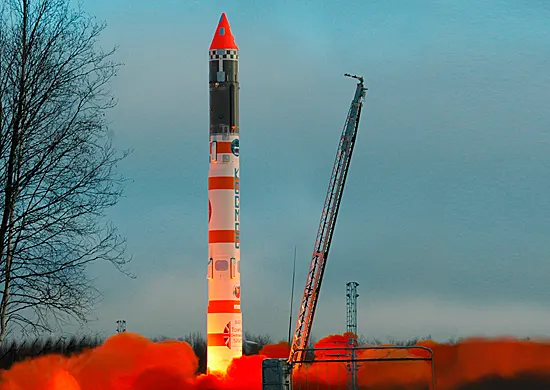
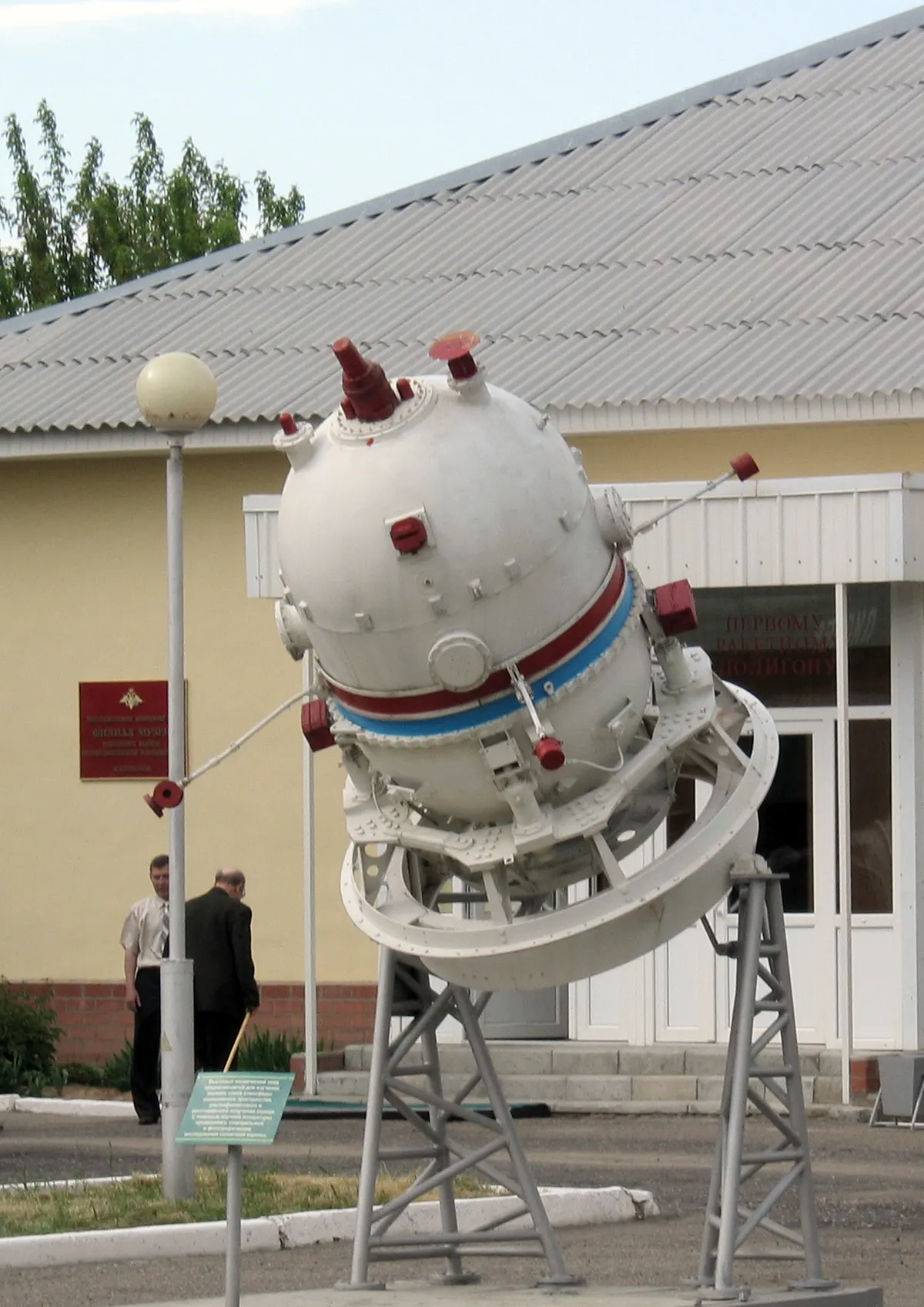
The R-14 Chusovaya's airframe outlived its career as a weapon by decades. Soviet engineers adapted the same first-stage structure, with a new upper stage, into the Kosmos-3 and later Kosmos-3M space launch vehicles, workhorse boosters that flew more than 420 orbital missions between the 1960s and their retirement in 2010.4 Very few Cold War ballistic missiles matched that combination, a short and largely uneventful career carrying nuclear warheads followed by an exceptionally long and productive one carrying satellites.
Replacement and Retirement Under the INF Treaty
Deployment of the R-14 Chusovaya peaked between 1965 and 1969, when roughly 97 launchers were in the Soviet inventory, and roughly 100 missiles remained operational as late as 1979.5 Retirement of the older soft, surface-pad sites began around 1969, with the hardened R-14U silo sites following from 1971, as the Soviet Union progressively replaced the type with the solid-fueled, road-mobile RSD-10 Pioneer between 1978 and 1983.2 The last operational R-14 Chusovaya missiles left service by 1984.1

Even after the type left active service, a handful of surviving R-14 Chusovaya missiles remained in storage until the 1987 INF Treaty, which banned all ground-launched missiles with ranges between 500 and 5,500 kilometers, a band the R-14 Chusovaya's roughly 4,500-kilometer reach fell squarely inside. The final six missiles were destroyed under treaty verification at the Lesnaya missile elimination facility on 9 August 1989, closing out the type more than a quarter-century after its Cuban deployment was cancelled.2
Because the R-14 Chusovaya's service and elimination were both complete before the Soviet Union's 1991 dissolution, no post-Soviet state ever inherited custody of the type, unlike several other Soviet-era weapons that ended up split among multiple successor governments.
Guanajay and Remedios, the Unfinished Cuban Deployment
The Cuban Missile Crisis is the R-14 Chusovaya's only brush with a real conflict, and it is a story about what did not arrive rather than what did. Soviet planners intended two regiments, roughly 32 missiles across 16 launchers, for Cuba, split between a site at Guanajay in western Cuba and a second at Remedios in the island's center, each designed to host eight launch positions.3,6 Construction equipment for both sites began arriving in mid-August 1962, with actual site work starting roughly two weeks later.6
American U-2 flights found the shorter-range R-12 Dvina sites near San Cristóbal first, on 14 October 1962, in photographs taken by Major Richard Heyser.7 Follow-up Strategic Air Command U-2 missions on 15 October then located the two R-14 Chusovaya sites at Guanajay.7 By the time the crisis became public, Guanajay's more advanced position was assessed as mid-to-late-stage construction, projected to be operational within roughly six weeks, while Remedios was earlier in its buildout and not expected to be ready before mid-to-late December 1962.6 Neither site had a single R-14 Chusovaya missile or launcher present. Analysts who briefed on the imagery were direct about it, when asked whether the missiles found in Cuba were ready to fire, the answer given was that none were, and reaching that point would take roughly two more weeks even for the more advanced R-12 positions.8
What did reach Cuba were the warheads. Twenty-four one-megaton nuclear warheads intended for the Guanajay and Remedios launchers arrived at the port of Mariel aboard the Soviet ship Indigirka on 4 October 1962, well before the crisis became public, alongside warheads for the R-12 force and several shorter-range systems.5,9 A dedicated nuclear-warhead storage bunker near Guanajay was itself under construction and, according to American intelligence at the time, could have become operational at roughly the same point as the adjacent launch site.6 Had the crisis run its course rather than ending in a negotiated withdrawal, the R-14 Chusovaya's much longer reach was the real strategic escalation waiting in the wings. Full deployment of both missile types to Cuba would have put nearly the entire continental United States within range, sparing only the Pacific Northwest corner of the country, a coverage gap the shorter R-12 Dvina alone could not have closed.10
The crisis ended on 28 October 1962, when the Soviet Union agreed to withdraw all offensive weapons systems from Cuba. All nuclear warheads present on the island, including the 24 destined for the never-completed R-14 Chusovaya sites, left aboard the ship Arkhangelsk, departing Mariel for the Soviet Union on 1 December 1962.9 No R-14 Chusovaya missile ever fired a shot, in Cuba or anywhere else, and the type's entire combat legacy rests on this single unfinished deployment.
- R-14 (8K65) is the base soft-pad version, accepted into service in 1961, launched from prepared surface positions with a one to three-hour normal reaction time.2
- R-14U (8K65U) is the silo-compatible universal version, authorized in May 1960 and accepted for service in June 1963, adding hardened underground basing and a faster reaction time on top of the same missile airframe.2
- Kosmos-3 / Kosmos-3M are civilian derivatives rather than weapons, two-stage orbital launch vehicles built around the R-14 Chusovaya's first-stage airframe, flown from the 1960s through 2010 and credited with more than 420 successful launches.4

The R-14 Chusovaya was operated exclusively by the Soviet Union. Deployed regiments were stationed across Ukraine, Latvia, Belarus, Kaliningrad, and further east into the Russian Far East and Kazakhstan, oriented primarily against NATO's intermediate-range missile bases in Western Europe.2 Peak deployment reached roughly 97 launchers between 1965 and 1969, and the type remained in the Soviet inventory into the early 1980s before the RSD-10 Pioneer took over its mission.5 No country other than the Soviet Union ever operated the R-14 Chusovaya, and the planned Cuban deployment, the only time the missile came close to leaving Soviet soil, was cancelled before a single R-14 Chusovaya airframe arrived on the island.3
The R-14 Chusovaya and the RSD-10 Pioneer that eventually replaced it represent two different eras of Soviet missile engineering separated by barely fifteen years. Where the R-14 Chusovaya needed hours of hypergolic fueling before a soft-site launch and, even in its silo form, still relied on a fixed underground position, the solid-fueled RSD-10 Pioneer could fire on short notice from a road-mobile transporter erector launcher that never needed to sit in one place long enough to be targeted first.11 That single change, going from a missile that had to be fueled to one that arrived ready to fire, was the real reason the R-14 Chusovaya's operational life ended in the early 1980s rather than because its range or throw weight had become inadequate.
| Missile | Max range | Propulsion | Basing |
|---|---|---|---|
| R-14 Chusovaya | ~4,500 km | Storable liquid | Silo / soft pad |
| R-12 Dvina | ~2,000-2,500 km | Storable liquid | Silo / soft pad |
| RSD-10 Pioneer | ~5,800 km | Solid | Road-mobile TEL |
| SPEC | R-14 Chusovaya | R-12 Dvina | RSD-10 Pioneer |
|---|---|---|---|
| Maximum Range | 4500 km | 2500 km | 5000 km |
| Propulsion Type | liquid-propellant | liquid-propellant rocket engine | solid-fuel rocket |
| Basing Mode | silo, pad | silo and road-mobile | Road-mobile TEL |
Set against the R-12 Dvina, the comparison is less about technology than about reach. Both missiles came out of Mikhail Yangel's design bureau within three years of each other, both used similar storable liquid propellant, and both were sent toward Cuba in 1962. The R-12 Dvina's roughly 2,000 to 2,500-kilometer range was enough to threaten Washington DC from Cuban soil, which was already a serious escalation.12 The R-14 Chusovaya's extra 2,000 kilometers of reach was the difference between threatening the US capital and threatening nearly the entire continental United States, which is exactly why American planners treated the incomplete Guanajay and Remedios sites as such a high priority target for intelligence collection even though neither one held a single missile yet. The R-12 Dvina also vastly outnumbered the R-14 Chusovaya in Soviet service, with more than 2,300 R-12 Dvina airframes built against a total R-14 Chusovaya production run more likely in the low hundreds, a gap that reflects the R-14 Chusovaya's narrower strategic role rather than any technical shortcoming.12


What is the R-14 Chusovaya missile? The R-14 Chusovaya, NATO reporting name SS-5 Skean, is a Soviet single-stage, liquid-fueled medium-range ballistic missile designed by Mikhail Yangel and accepted into service in 1961.1
How far could the R-14 Chusovaya SS-5 Skean reach? Soviet figures put the R-14 Chusovaya's maximum range at about 4,500 kilometers, with a more conservative American-era estimate closer to 3,700 kilometers, enough to place it in the intermediate-range ballistic missile class rather than the shorter medium-range band of its R-12 Dvina counterpart.1,2
Was the R-14 Chusovaya deployed to Cuba during the missile crisis? Twenty-four nuclear warheads for the R-14 Chusovaya reached Cuba in October 1962, but the missiles and launchers themselves never arrived. Both planned Cuban sites, at Guanajay and Remedios, were still under construction when the crisis ended.6,9
What is the difference between the R-12 Dvina and the R-14 Chusovaya? Both are Soviet, Yangel-designed, liquid-fueled missiles from the same era, but the R-14 Chusovaya's range of roughly 4,500 kilometers nearly doubles the R-12 Dvina's 2,000 to 2,500 kilometers, and far fewer R-14 Chusovaya missiles were ever built.12
Is the R-14 Chusovaya still in service? No. The Soviet Union withdrew the type from active service by 1984 and destroyed the last examples under the 1987 INF Treaty in August 1989.2
What replaced the R-14 Chusovaya missile? The solid-fueled, road-mobile RSD-10 Pioneer replaced the R-14 Chusovaya between 1978 and 1983, offering a much faster launch-readiness time without the hours of liquid-fuel preparation the older missile required.11
- "R-14 Chusovaya", Wikipedia — en.wikipedia.org ↩
- "R-14 / SS-5 SKEAN", Federation of American Scientists — nuke.fas.org ↩
- "R-14 / SS-5 SKEAN, Western Views", GlobalSecurity.org — globalsecurity.org ↩
- "R-14 | 8K65 | SS-5 | Skean", RussianSpaceWeb — russianspaceweb.com ↩
- "R-14 (SS-5 Skean) Russian Medium Range Ballistic Missile", The Military Standard — themilitarystandard.com ↩
- "Special National Intelligence Estimate on Cuba", Office of the Historian, US Department of State — history.state.gov ↩
- "Cuban Missile Crisis", National Air and Space Museum — airandspace.si.edu ↩
- "Briefing Board #91, IRBM Launch Site No. 1, Guanajay, Cuba, 23 October 1962", JFK Presidential Library — jfklibrary.org ↩
- "One Minute to Midnight, Part III, Tracing the Nuclear Warheads", National Security Archive — nsarchive2.gwu.edu ↩
- "Cuban Missile Crisis", Wikipedia — en.wikipedia.org ↩
- "RSD-10 Pioneer", Wikipedia — en.wikipedia.org ↩
- "R-12 Dvina", Wikipedia — en.wikipedia.org ↩