

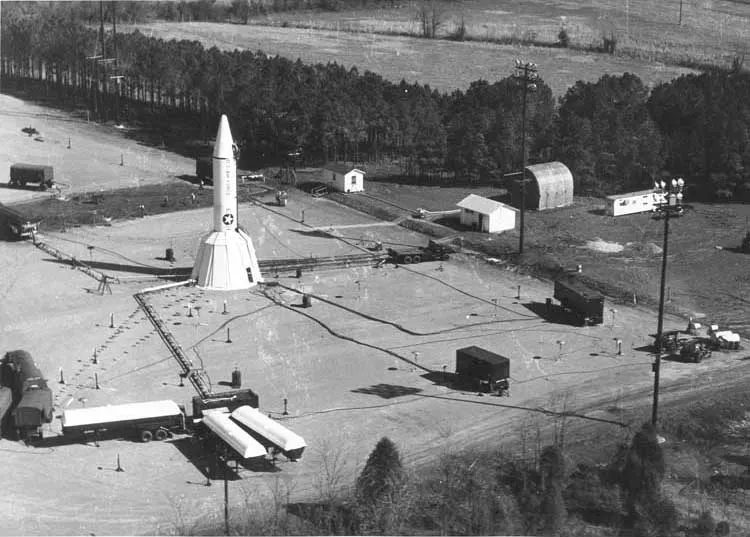

The PGM-19 Jupiter became the first operational medium-range ballistic missile in United States service, and within three years of reaching its bases in Italy and Turkey it was withdrawn as the secret price of ending the Cuban Missile Crisis.1 Deployed under a NATO nuclear-sharing arrangement to allied crews in Italy and Turkey in 1961, the Jupiter's presence 130 miles from the Soviet border, close enough to strike Moscow within about ten minutes of launch, was one of the grievances Soviet Premier Nikita Khrushchev cited when he moved missiles into Cuba in 1962.9 When the crisis reached its most dangerous point in late October that year, Robert Kennedy quietly told the Soviet ambassador that the Jupiters would come out of Turkey regardless, so long as nobody said so in public. They were gone by April 1963.9
- First US MRBM to reach operational squadron service
- Proven 150,000-lbf Rocketdyne LR79 engine, reliable once matured
- 1.45-megaton W49 warhead, among the largest ever fielded on an MRBM
- Extended NATO's nuclear reach over the Soviet Union years before ICBMs matured
- Above-ground, soft launch emplacements, vulnerable to a first strike
- 15 to 30 minutes of liquid-oxygen fueling and chilling before launch
- Politically toxic host-nation presence, ultimately traded away in 1963
- Obsolete against Soviet air defenses almost as soon as it was fully deployed
Structurally the PGM-19 Jupiter was a single-stage, liquid-fueled missile burning RP-1 kerosene and liquid oxygen through a single Rocketdyne LR79 engine, carrying a 1.45-megaton thermonuclear W49 warhead to a range of roughly 2,400 kilometers (1,500 miles).1,3 It descended directly from the PGM-11 Redstone, scaled up by Wernher von Braun's team at the Army Ballistic Missile Agency (ABMA) at Redstone Arsenal, and it was built in series by the Chrysler Corporation at a dedicated missile plant in Warren, Michigan.2,5
Despite its short operational life, the PGM-19 Jupiter is a genuine hinge point in Cold War history. It is also a case study in how a missile's real-world classification can drift from the modern range bands used to sort weapons today. USAF and NATO planners of the era routinely called Jupiter and its Air Force rival, the PGM-17 Thor, intermediate-range ballistic missiles, and both are still commonly labeled IRBM in period documents, even though a Jupiter's roughly 2,400-kilometer range sits squarely inside the modern MRBM band used to classify this missile here. Chrysler built approximately 100 Jupiter airframes between 1956 and 1961, of which 45 were deployed operationally, 30 in Italy and 15 in Turkey, and the type never saw combat.1,5 It was retired from NATO service by 1963, well before Chrysler's production run had even reached a decade old, replaced by Polaris-armed submarines and the intercontinental Minuteman force.
The Rocketdyne LR79 Engine and RP-1/LOX Propellant
The PGM-19 Jupiter's single Rocketdyne LR79-NA engine (factory designation S-3D) produced roughly 150,000 pounds-force (667 kilonewtons) of thrust burning RP-1 kerosene against a liquid-oxygen oxidizer, the same general propellant combination used across most of the first generation of American ballistic missiles.4 Chrysler's engineers spent the missile's early flight-test years chasing turbopump reliability problems in this engine family, and a February 1957 static test very nearly ended the whole program when a liquid-oxygen pump explosion threatened to rupture a propellant tank. Test foreman Paul Kennedy's quick shutdown avoided disaster, and the root cause traced back to a pump lubricant that reacted badly with liquid oxygen.2 RP-1 could be stored loaded in the missile's tanks indefinitely, but the cryogenic liquid oxygen boiled off steadily, so a Jupiter on alert required continuous chilling and periodic topping-off, with a full fueling-to-launch sequence of roughly 15 to 30 minutes even after the process was streamlined.3,10
- Missile ClassMRBM
- Service Entry Year1959
- DesignerUS Army / Chrysler
- Length18.288 m
- Diameter2.667 m
- Launch Weight49,895 kg
- In ServiceYes
A Short, Squat Airframe Built for a Submarine That Never Came
The Jupiter's stubby proportions, 18.3 meters long and 2.67 meters in diameter, a wider and shorter shape than its Air Force rival Thor, are a fossil of a design requirement that disappeared early in the program.1,3 When the Army and Navy briefly ran Jupiter as a joint program in 1955 and 1956, the missile had to be short enough to strike below a submarine's deck, which is why ABMA's original 92-foot proposal was cut down first to 58 feet and then settled at the production length of 60 feet even after the Navy walked away from the whole arrangement in December 1956 to pursue the solid-fueled Polaris instead.2 The wide, squat body that resulted stuck with Jupiter for the rest of its service life even though no Jupiter ever flew from a submarine. Fully fueled, a Jupiter weighed close to 49,900 kilograms (108,800 pounds) at liftoff.1
- Propulsion Typesingle-stage
- Number of Stages1
- Fuel TypeRP-1 / LOX
- Solid-FuelNo
- Cold-LaunchNo
- CanisterizedNo
Early Jupiter flights also exposed a propellant sloshing problem, where fuel movement inside the tanks during flight destabilized the missile's control system and caused at least one in-flight breakup. ABMA engineers solved it with an unusually improvised test rig, mounting scale propellant tanks on a railroad flatcar and shaking them to validate truncated-cone baffles for the RP-1 tank and accordion-style baffles for the liquid-oxygen tank before the fix went into the production airframe.2 The finished missile carried a throw weight of roughly 1,814 kilograms to its maximum range, all of it committed to a single reentry vehicle rather than any multiple-warhead arrangement, since the MIRV concept did not yet exist for an operational missile of Jupiter's generation.
- Minimum Range1,500 km
- Maximum Range2,414 km
- Apogee611 km
- Re-Entry Speed (Mach)15 Mach
- Throw Weight1,814 kg
- Depressed-Trajectory CapableNo
ST-90 Radio-Inertial Guidance and a Mile-Wide Miss
Jupiter's guidance combined an onboard ST-90 inertial platform with ground-based radio corrections sent to the missile during its powered boost phase, a hybrid arrangement typical of first-generation American ballistic missiles before fully self-contained inertial systems matured.1 Guidance accuracy improved steadily across the flight-test program. The July 1958 test flight AM-6B, the first to combine a production-standard nose cone with the ST-90 system, landed only about 1.5 nautical miles from its aim point, a sharp jump in precision over earlier launches.1 In service, the missile's circular error probable is generally put at roughly 1.5 to 1.8 kilometers, wide enough that Jupiter was effective against area targets like cities and troop concentrations but not against hardened military targets.3 This is not a claim that Jupiter carried anything resembling modern satellite-aided navigation. It reflects a 1950s-era radio-inertial system whose glossary classification in this database, inertial-GPS, is a leaf-wide labeling shorthand rather than a literal statement that a Jupiter used satellite positioning decades before GPS existed.
- Circular Error Probable (CEP)1,852 m
- Guidance TypeInertial / GPS
- Terminal GuidanceNo
- Maneuverable Re-Entry Vehicle (MaRV)No
- Penetration Aids / DecoysNo
The 1.45-Megaton W49 Warhead and a Goodyear Reentry Vehicle
The operational PGM-19 Jupiter carried a single W49 thermonuclear warhead, with a yield generally cited at 1.44 to 1.45 megatons, one of the largest warheads ever mounted on a medium-range missile.1,3 The warhead rode inside an ablative-technology reentry vehicle built by Goodyear Aerospace, which shed material by design as it heated during reentry to protect the warhead package, then separated from the spent missile body on explosive bolts before continuing to the target on its own.1 A related warhead, the W38, is sometimes wrongly associated with Jupiter. The W38 was drawn up in a March 1956 planning study that considered fitting a common warhead family across the Titan, Thor, and Jupiter programs, but the W38 that actually entered service in 1961 armed only the Atlas and Titan I ICBM forces, never the Jupiter.6 Jupiter's own program stayed on the W49 throughout its operational life.
- Warhead TypeW49
- NuclearYes
- ThermonuclearYes
- Yield (per warhead)1,450
- MIRVNo
- Warhead / RV Count1
- Conventional-CapableNo
- Basing Moderoad-mobile launcher
- Silo-BasedNo
- Road-Mobile (TEL)Yes
- Rail-MobileNo
- Submarine-LaunchedNo
- Total Production110
- Operators3
- First Test1957
- Detonation Mechanism / Fuzeairburst/impact
- Explosive Filler Type{{unbulleted list
From the Redstone to a 1,500-Mile Missile
Wernher von Braun's ABMA team began studying a scaled-up Redstone in 1954, and by September 1955 von Braun personally briefed Secretary of Defense Charles E. Wilson, arguing that a missile reaching 1,500 nautical miles was, in his words, a logical extension of the Redstone program.2 That December, the Army and Navy jointly announced a program to build both land- and submarine-launched versions of the missile, and by April 1956 the Army's branch of the effort had been named Jupiter, with the Air Force's competing design named Thor.1 Admiral Arleigh Burke initially championed Navy involvement, but doubts about handling cryogenic propellant at sea, combined with 1956 studies showing a solid-fueled missile could reach comparable range, pushed the Navy out of Jupiter entirely in favor of what became Polaris.1
An Army-Air Force Turf War Decides Who Flies Jupiter
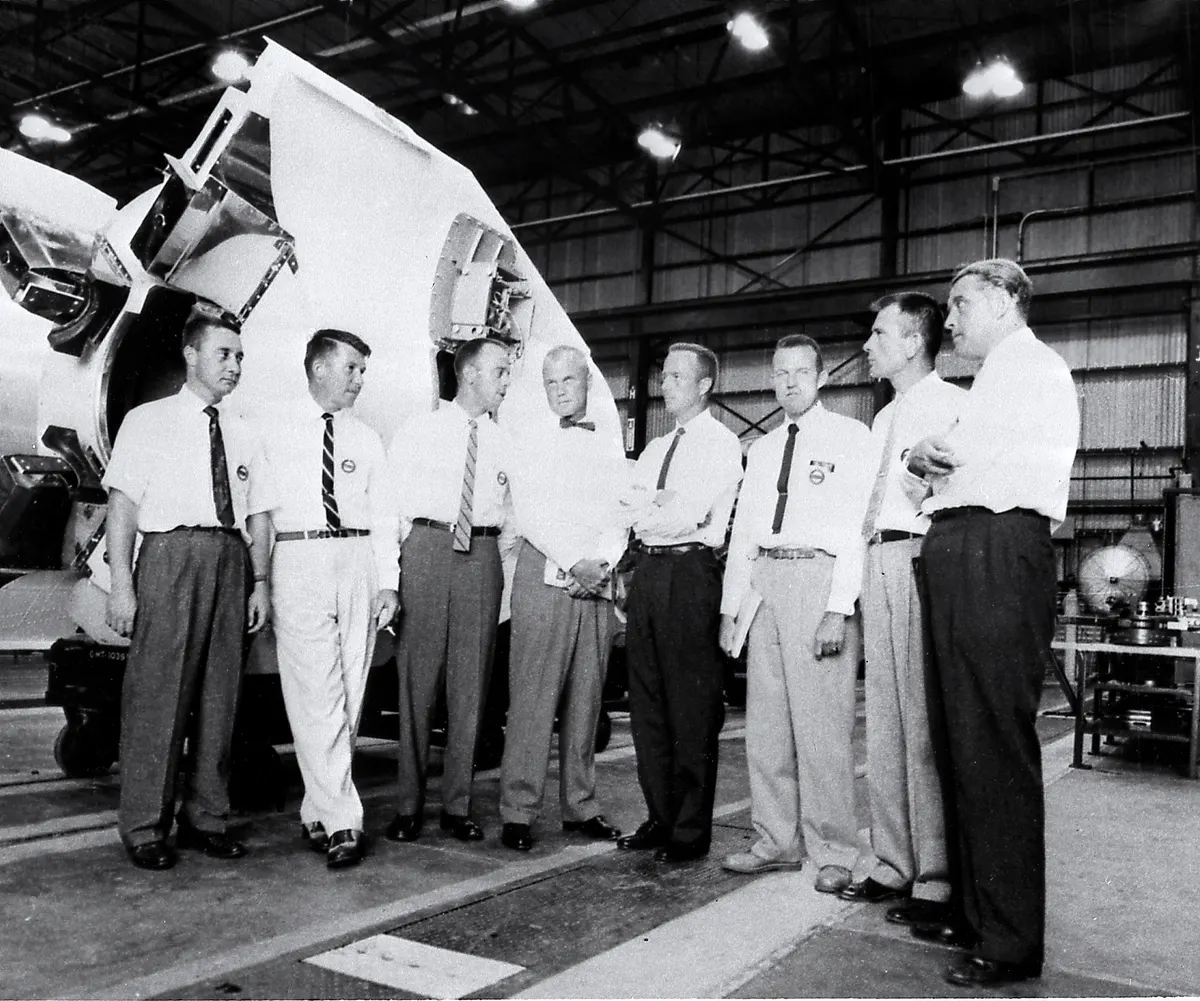
Jupiter's existence as an Army missile threatened the Air Force's claim to sole ownership of strategic nuclear delivery, and the resulting interservice fight was fierce enough that, by one contemporary account, practically every Army missile program was under attack in the press through 1955 and 1956.1 Secretary Wilson approved both the Army's Jupiter and the Air Force's Thor programs in November 1955, but a follow-on Roles and Missions directive issued November 28, 1956 gave the Air Force sole control of any missile with a range beyond 200 miles. Jupiter, despite being an Army-designed and Army-built system, became an Air Force weapon the instant that memo was signed.1 The Sputnik launch in October 1957 briefly reopened the question, when the shock of a Soviet satellite in orbit pushed President Eisenhower to accelerate both American IRBM programs rather than cancel either.2 Jupiter beat Thor into the field anyway, becoming the first successful American missile in its class four months before Thor's own first successful flight, even after control had already passed to the service that had fought hardest against it.1
Chrysler Production and a Rocky Flight-Test Campaign
Chrysler Corporation served as prime contractor for production Jupiters, building them at its Michigan Ordnance Missile Plant near Warren after ABMA hand-built the earliest test articles itself.5 The flight-test program that followed was punishing. The first launch, AM-1A on March 1, 1957, failed when the missile's own turbopump exhaust was ingested back into the airframe, and the second attempt broke up in flight from propellant sloshing.2 AM-1 finally succeeded on May 31, 1957, traveling 1,247 nautical miles, but turbopump failures halted testing again that November and December for nearly five months.1 Jupiter was declared operational on January 15, 1958, technically ahead of the missile's guidance and reliability problems being fully resolved, a sequencing that reflected Cold War political pressure at least as much as engineering readiness.1
Jupiter's flight-test program also carried live cargo. On December 13, 1958, AM-13 carried a squirrel monkey named Gordo on a suborbital hop, and telemetry confirmed the animal survived the roughly 10g acceleration, eight minutes of weightlessness, and 40g reentry deceleration, though a parachute failure meant Gordo did not survive recovery.1 The better-remembered flight came on May 28, 1959, when AM-18 carried a rhesus monkey named Able and a squirrel monkey named Baker roughly 1,500 miles downrange to a 300-mile altitude. Both primates survived 38g of acceleration and nine minutes of weightlessness, becoming the first living creatures recovered alive after a spaceflight of that scale, though Able died days later from an unrelated reaction to anesthesia during a medical procedure. Baker lived on display until 1984.1,2
Deployment to Italy, Gioia del Colle and the 36th Aerobrigata
Operational Jupiter squadrons went to two NATO host nations. In Italy, two squadrons totaling 30 missiles were emplaced across 10 sites arranged in a rough triangle around Gioia del Colle Air Base, under the command of the Italian Air Force's 36th Strategic Interdiction Air Brigade (36ª Aerobrigata Interdizione Strategica), with American personnel retaining custody of the nuclear warheads even though Italian crews operated the missiles day to day.1 The first three-missile Italian launch position went on operational alert in July 1960, and both Italian squadrons reached full operational status by June 20, 1961.10 The deployment was not free of accidents. Between October 1961 and August 1962, lightning struck Italian Jupiter sites on four occasions, and twice the strikes activated thermal batteries and partially armed warheads by injecting boost gas into the weapon, incidents serious enough that the Air Force subsequently installed protective lightning-tower arrays at every site.1 In 1962, a Bulgarian reconnaissance aircraft reportedly crashed near one of the Italian Jupiter sites after overflying it, an early sign of the surveillance interest the missiles attracted from the other side of the Iron Curtain.1
Deployment to Turkey, İzmir, Çiğli Air Base, and a Belated Handover
Turkey received a single squadron of 15 missiles across five sites near İzmir, commanded out of Çiğli Air Base, with United States Air Force personnel running day-to-day operations for most of the deployment.1 The Turkish squadron reached full operational status in November 1961, later than its Italian counterparts, and the first flight of three missiles was not formally transferred to Turkish Air Force (Türk Hava Kuvvetleri) control until late October 1962, with the United States still retaining sole authority to arm the nuclear warheads even after the handover.1,10 That transfer date fell in the same week the Cuban Missile Crisis reached its peak, an overlap that was coincidental in scheduling but symbolically loaded given what the Turkish Jupiters were about to be traded for. The basing plan for both countries followed a standard three-by-five layout inherited from the American home squadrons, five dispersed outlying positions per squadron, each holding three missiles, three launchers, and a single launch-control trailer, with every missile in a squadron required to be able to fire within 15 minutes of an execution order.2
The Missiles That Started the Crisis
Soviet Premier Nikita Khrushchev treated the Jupiter squadron in Turkey as a personal affront, close enough to Soviet territory to strike Moscow in roughly ten minutes of flight time, and he reportedly described the Turkish missiles as a bone stuck in his throat.9 That grievance is widely credited as one of the direct motivations behind the Soviet decision in 1962 to secretly station its own R-12 Dvina medium-range missiles in Cuba, an act that, once discovered by American U-2 reconnaissance flights in October 1962, triggered the Cuban Missile Crisis itself.9 For thirteen days the two superpowers stood closer to open nuclear war than at any other point in the Cold War, with President John F. Kennedy's Executive Committee of the National Security Council (ExComm) weighing options that ranged from a naval blockade to direct air strikes on the Cuban missile sites.13
The Secret Trade That Ended It
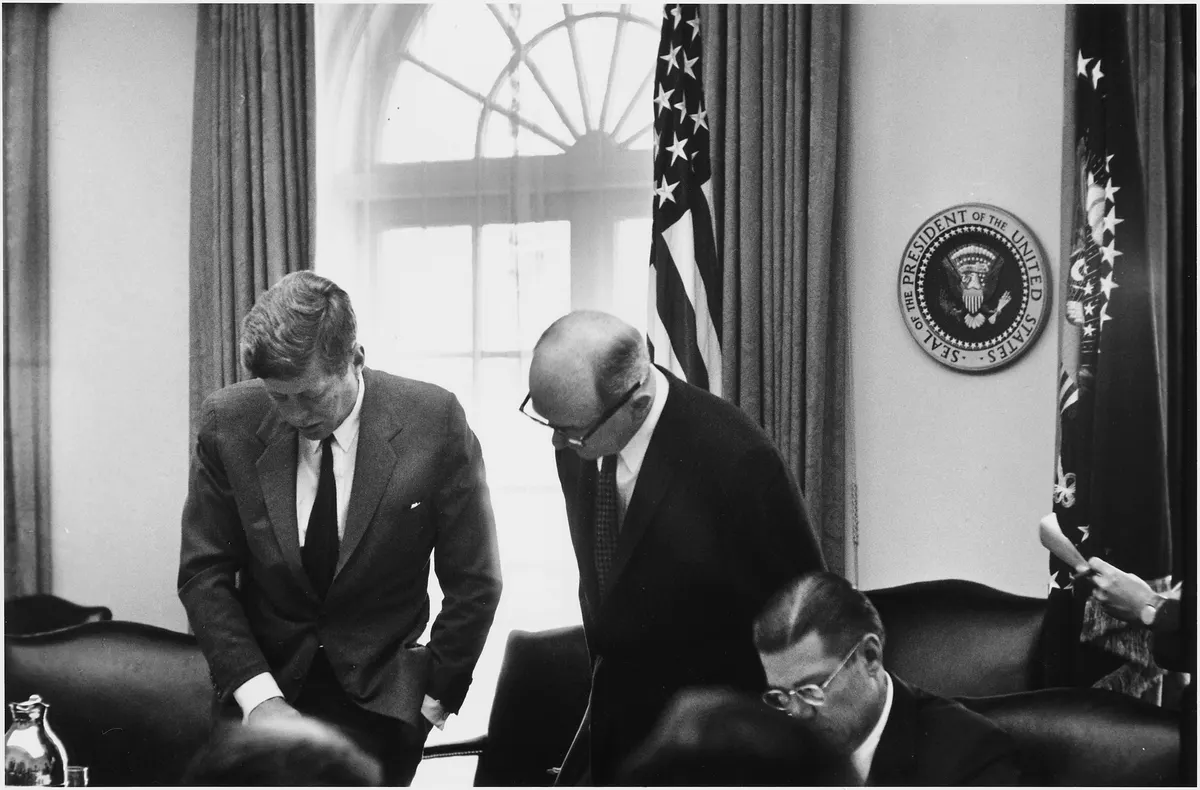
On October 27, 1962, the crisis's most dangerous day, Khrushchev sent Kennedy a message demanding that any resolution include the removal of the Jupiter missiles from Turkey. Attorney General Robert Kennedy met secretly that evening with Soviet Ambassador Anatoly Dobrynin and told him that the United States had already been planning to withdraw the obsolete Jupiters regardless, and that it would do so soon, but that this could never be acknowledged as part of any public deal.9,11 President Kennedy is reported to have referred to the missiles dismissively during internal ExComm discussions as those frigging missiles, reflecting how little military value the White House itself placed on a system it was nonetheless reluctant to be seen trading away under public pressure.11 Only nine American officials knew the actual terms of the arrangement at the time, among them the president, his brother, National Security Adviser McGeorge Bundy, and Secretary of State Dean Rusk, and the deal stayed classified until it was first publicly acknowledged at a Moscow conference in January 1989.8
Withdrawal, April 1963
Publicly announcing the Jupiter withdrawal risked convincing NATO allies that Washington would trade away their security to manage a crisis involving neither of them, so the process moved through quiet diplomacy instead. Secretary of Defense Robert McNamara met Italian and Turkish defense ministers at a NATO gathering in Paris in mid-December 1962 to begin the conversation, and by January 1963 Kennedy had approved letters to both governments proposing Polaris submarines as a replacement deterrent.7 Italy's government agreed relatively quickly, with the Italian Council of Ministers approving withdrawal by January 24, 1963, but Turkey's agreement came more slowly and only in principle at first.7 Both governments suspected a secret US-Soviet bargain lay behind the sudden interest in replacing their Jupiters, and Secretary Rusk spent the following weeks publicly denying any connection to Congress even as diplomats worked the actual timeline behind closed doors.8 The last operational Jupiter missiles came out of Turkey and Italy by April 1963, closing out barely two years of front-line NATO service.9
- SM-78 / PGM-19A is a designation history rather than a distinct hardware variant. The Jupiter was originally carried as SM-78 under the Air Force's early strategic-missile numbering system before the Pentagon's 1963 tri-service redesignation scheme renamed it PGM-19A, the designation this database and most modern references use.5
- Juno II was a four-stage orbital launch vehicle built on the Jupiter's first stage, adding solid-fuel upper stages to put small satellites into orbit. It flew ten times between December 1958 and May 1961, four of them successful, launching Pioneer 3, Pioneer 4, and the Explorer 7, 8, and 11 satellites.1 Juno II should not be confused with Jupiter-C or Juno I, the vehicle that put America's first satellite, Explorer 1, into orbit in 1958. Those were built on a stretched PGM-11 Redstone airframe, sharing the Jupiter name informally but not its actual first-stage hardware.
- Jupiter's manufacturing tooling had one further legacy. The Saturn I rocket's first stage used a central Jupiter-diameter fuel tank surrounded by eight smaller Redstone-diameter tanks clustered around it, a design choice driven partly by reusing existing Jupiter and Redstone production tooling rather than building new tank dies from scratch.1


The United States Air Force activated three Strategic Missile Squadrons, the 864th, 865th, and 866th, to train Jupiter crews stateside at Huntsville, Alabama, though none of the training squadrons ever deployed operationally themselves.1 Overseas, Italy's Air Force operated 30 missiles across two squadrons under the 36th Strategic Interdiction Air Brigade at Gioia del Colle from 1961 to 1963, and Turkey's Air Force nominally took control of one 15-missile squadron near İzmir from October 1962 until the type's withdrawal in April 1963, with American personnel retaining physical custody of the nuclear warheads throughout both deployments.1,10 No other country ever operated the Jupiter, and none of the three operators retained it in any reserve or training role after 1963.
Jupiter and the Air Force's own PGM-17 Thor were born from the same 1955 Army-Navy dual program and grew up as bureaucratic rivals rather than technical opposites, which makes their comparison less about performance and more about the fight over who got to fly which missile. Thor reached a broadly similar range, about 2,400 kilometers, but did so from a taller, narrower airframe, 20 meters long and 2.4 meters wide against Jupiter's shorter, 18.3-meter, 2.67-meter-wide body, since Thor never carried Jupiter's abandoned submarine-launch requirement.12 Thor also deployed to a single, different NATO host, going to Royal Air Force squadrons in Britain under the codename Project Emily rather than to Italy or Turkey, and reached operational status on a broadly similar timeline to Jupiter despite losing the initial race to the pad.12
| Spec | PGM-19 Jupiter | PGM-17 Thor |
|---|---|---|
| Length / diameter | 18.3 m / 2.67 m | 20.0 m / 2.4 m |
| Range | ~2,400 km | ~2,400 km |
| CEP | ~1.5-1.8 km | ~0.97 km |
| Host nation | Italy, Turkey | United Kingdom |
| Missiles fielded | 45 | ~60 |
| SPEC | PGM-19 Jupiter | R-12 Dvina |
|---|---|---|
| Maximum Range | 2414 km | 2500 km |
| Yield (per warhead) | 1450 kt | 2300 kt |
| Launch Weight | 49895 kg | 41700 kg |
Jupiter's more historically significant rival was never Thor at all but the Soviet R-12 Dvina it indirectly provoked into Cuba. The R-12, known to NATO as the SS-4 Sandal, entered Soviet service the same year as Jupiter, 1959, and carried a broadly comparable thermonuclear payload to a similar 2,500-kilometer range, designed by Mikhail Yangel's OKB-586 bureau rather than by an ABMA-Chrysler partnership.14 The Soviet Union built the R-12 in far greater numbers, over 2,300 airframes against Jupiter's roughly 100, reflecting a doctrine built around mass rather than the smaller, more expensive NATO deployment model. The two missiles never fought each other directly. Instead, one country's fielding of a Jupiter squadron in Turkey helped motivate the other's attempt to field an R-12 squadron in Cuba, and the resulting crisis ended with both missile types withdrawn from their respective forward bases within months of each other.
Is the PGM-19 Jupiter still in service anywhere today? No, it has not been in service since April 1963, and no museum-preserved example remains flight-capable. What replaced it in NATO's nuclear posture was not another land-based MRBM but sea-based Polaris submarines and, eventually, the Minuteman ICBM force, both of which solved Jupiter's core vulnerability of sitting exposed on a fixed, above-ground pad.


What happened to the Jupiter missiles in Turkey? They were withdrawn by April 1963 as part of a secret understanding reached during the Cuban Missile Crisis, in which the United States privately agreed to remove its Jupiter missiles from Turkey (and Italy) in exchange for the Soviet Union withdrawing its own missiles from Cuba, without either side publicly linking the two actions at the time.9
Was the PGM-19 Jupiter really traded away to end the Cuban Missile Crisis? Yes, though the trade was never announced. Robert Kennedy privately told Soviet Ambassador Anatoly Dobrynin on October 27, 1962 that the Jupiters would come out of Turkey soon regardless, and the missiles were gone within six months, but Washington and Moscow both denied any direct linkage in public for decades.9,8
What was the PGM-19 Jupiter's range and how accurate was it? The Jupiter reached roughly 2,400 kilometers (1,500 miles) with a circular error probable generally cited around 1.5 to 1.8 kilometers, precise enough for city-sized targets but not for hardened military sites.1,3
How fast could a Jupiter missile be launched once on alert? Squadrons were required to be able to fire within 15 minutes of an execution order, though a full cold start with liquid-oxygen fueling and chilling could take closer to 15 to 30 minutes depending on the missile's prior alert state.2,3
What is the difference between the PGM-19 Jupiter and the PGM-17 Thor missile? Both came out of the same 1955 dual Army-Navy MRBM program and reached similar range, but Jupiter was Army-designed and built by Chrysler with a shorter, wider airframe left over from an abandoned submarine-launch requirement, while Thor was an Air Force design built by Douglas and deployed to Britain rather than Italy and Turkey.1,12
Who manufactured the PGM-19 Jupiter and what powered it? Chrysler Corporation built production Jupiters at its Michigan Ordnance Missile Plant, based on a design from Wernher von Braun's Army Ballistic Missile Agency, using a single Rocketdyne LR79 engine burning RP-1 kerosene and liquid oxygen.2,5
- "PGM-19 Jupiter", Wikipedia — en.wikipedia.org ↩
- "Jupiter", U.S. Army Redstone Arsenal Historical Information — history.redstone.army.mil ↩
- "SM-78 Jupiter", CSIS Missile Threat — missilethreat.csis.org ↩
- "Rocketdyne LR79", National Museum of the United States Air Force — nationalmuseum.af.mil ↩
- "Chrysler SM-78/PGM-19A Jupiter Intermediate Range Ballistic Missile", National Museum of the United States Air Force — nationalmuseum.af.mil ↩
- "W38 (nuclear warhead)", Wikipedia — en.wikipedia.org) ↩
- "The Jupiter Missiles and the Endgame of the Cuban Missile Crisis: Sealing the Deal with Italy and Turkey", Wilson Center — wilsoncenter.org ↩
- "The Jupiter Missiles and the Endgame of the Cuban Missile Crisis: A Matter of Great Secrecy", Wilson Center — wilsoncenter.org ↩
- "The Jupiter Missiles and the Endgame of the Cuban Missile Crisis, 60 Years Ago", National Security Archive — nsarchive.gwu.edu ↩
- "Nuclear Weapons and Turkey Since 1959", National Security Archive — nsarchive.gwu.edu ↩
- "Those Frigging Missiles", GlobalSecurity.org — globalsecurity.org ↩
- "PGM-17 Thor", Wikipedia — en.wikipedia.org ↩
- "Cuban Missile Crisis", Wikipedia — en.wikipedia.org ↩
- "R-12 Dvina", Wikipedia — en.wikipedia.org ↩