

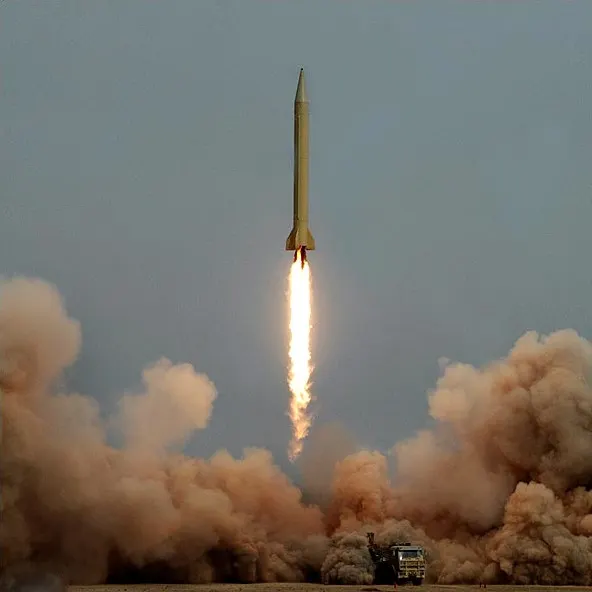

The Shahab-3 is Iran's first operational medium-range ballistic missile, and it remains the technical starting point for nearly every liquid-fuel missile Iran has fielded since. Iran declared the Shahab-3 operational on 7 July 2003, after a decade of work that began with the acquisition of North Korean No-Dong hardware in the mid-1990s.1 Iran's Islamic Revolutionary Guard Corps has fielded it as a road-mobile, single-stage, liquid propellant missile with a stated range band of 1,000 to 2,000 km, depending on the payload carried.2 As one of the earliest entries in Iran's medium-range ballistic missile inventory, the Shahab-3 (whose Persian name means Meteor) gave Tehran, for the first time, the ability to strike Israel and every US base in the Persian Gulf region from Iranian soil.1
- Combat-proven, mass-produced airframe
- Simple, well-understood single-stage liquid engine
- Basis for Iran's entire liquid-fuel missile family
- Road-mobile, hard to track pre-launch
- Poor accuracy (2,500 m CEP) versus modern standards
- Long, visible liquid-fuel launch preparation
- Superseded operationally by Ghadr and Emad variants
- Nuclear-capable design heritage draws international scrutiny
The missile's importance is less about its own performance, which was always modest by Scud-family standards, and more about what it enabled afterward. The airframe, engine and production infrastructure the Shahid Hemmat Industrial Group built for the Shahab-3 became the shared technical basis for the Ghadr-110, the Emad missile, and even the solid-fuel Sejjil program that eventually replaced it. Later members of that broader Iranian missile family, including Khorramshahr, Ashoura, Dezful, Haj Qasem and Kheibar Shekan, all trace their propulsion and airframe engineering back to lessons learned on this single program.
Iran has never officially confirmed how many Shahab-3 missiles or launchers it still holds, but Western intelligence assessed fewer than 50 launchers in active service as of 2017, a number that has likely fallen further as production shifted to the more accurate Ghadr-110 and Emad missile.1 The missile is no longer in production in its original form, though its derivatives are.2 Anyone searching for Shahab-3 specifications, its range in kilometers, or how the missile compares with the Ghadr and Emad is really asking about one connected weapon family that started here.
A Single-Stage, Nodong-Derived Airframe
The Shahab-3 is built around a single-stage, liquid-propellant rocket motor burning unsymmetrical dimethylhydrazine (UDMH) and nitrogen tetroxide, the same hypergolic propellant combination used on the Scud family and the North Korean No-Dong.1 Independent specification surveys converge on a missile roughly 16 to 16.6 meters long and about 1.25 meters in diameter, with a launch weight close to 17,400 to 18,300 kg.1 Those figures matter because Iran's own database entry for this weapon lists a shorter 13.5 m airframe, a much heavier 35,000 kg launch weight and two propulsion stages, numbers that do not match any credible open-source technical survey of the Shahab-3 and appear to describe a different missile entirely. The single-stage, ~16.5 m, ~17,400 kg figures from CSIS Missile Threat and allied specification databases are the ones treated as authoritative in this article.1
- Missile ClassStrategic MRBM
- Service Entry Year2003
- Length16.5 m
- Diameter1.2 m
- Launch Weight17,850 kg
- In ServiceYes
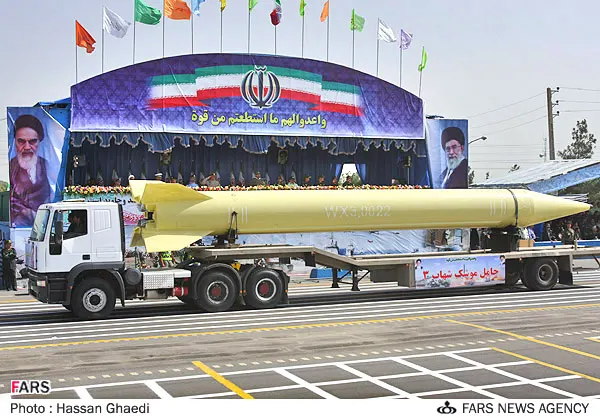
At burnout the missile reaches roughly Mach 7 (about 2.4 km per second) at an altitude of 10 to 30 km, and it flies to a peak altitude near 400 km before re-entry.2 Guidance is a basic inertial navigation system inherited from the No-Dong and, further back, the Scud, giving the baseline Shahab-3 a circular error probable of roughly 2,500 meters, poor enough that it is only militarily useful against large, fixed area targets like air bases or cities rather than point targets.1 Later Shahab-3B airframes added a redesigned, cone-on-cylinder triconic (baby bottle) reentry vehicle that improved reentry stability, cut warhead mass and modestly extended range, work that fed directly into the far more accurate strap-down guidance package used on the Ghadr-110.2
- Propulsion TypeLiquid propellant rocket
- Number of Stages1
- Fuel TypeLiquid
- Solid-FuelNo
- Cold-LaunchNo
- CanisterizedNo
Warhead Options From Unitary High Explosive to Cluster Submunitions
The Shahab-3 was designed to carry either a single 1,200 kg conventional high-explosive warhead or, in the improved variants, a payload of five cluster-munition submunitions of about 280 kg each.2 Iran displayed the cluster-munition configuration publicly in 2006, claiming an unusually large 1,400-bomblet count that most Western analysts treated as inflated propaganda rather than a credible operational figure.2 Because the missile's guidance is imprecise, its conventional role has always leaned toward area bombardment of airfields, ports and cities rather than precision strikes, a role later missiles in the family were specifically built to fix.
- Minimum Range1,000 km
- Maximum Range2,000 km
- Apogee400 km
- Re-Entry Speed (Mach)7 Mach
- Depressed-Trajectory CapableNo
The missile is conventional-capable in every fielded configuration known to have actually been used, and no confirmed nuclear test or nuclear warhead integration has ever been documented for the Shahab-3 itself.
- Circular Error Probable (CEP)2,500 m
- Guidance TypeInertial / GPS
- Terminal GuidanceNo
- Maneuverable Re-Entry Vehicle (MaRV)No
- Penetration Aids / DecoysNo
- Warhead TypeConventional high‑explosive
- NuclearNo
- ThermonuclearNo
- MIRVNo
- Warhead / RV Count1
- Conventional-CapableYes
- Basing Moderoad‑mobile
- Silo-BasedNo
- Road-Mobile (TEL)Yes
- Rail-MobileNo
- Submarine-LaunchedNo
- Operators1
- First Test1998
- Detonation Mechanism / Fuzeimpact
- Explosive Filler Weight1,200 kg
- Explosive Filler Typehigh explosive
From the No-Dong Purchase to a Domestic Production Line
Iran's ballistic missile effort predates the Shahab-3 by more than a decade, rooted in the War of the Cities Scud exchanges with Iraq in the 1980s. But the Shahab-3 itself began with a specific transaction. In the early 1990s Iran, alongside Pakistan, reportedly agreed with North Korea to purchase No-Dong missiles and associated production technology, and at least one No-Dong test flight in 1993 was witnessed by Iranian and Pakistani observers.1 International pressure eventually forced North Korea to scale back the deal, but Tehran had already obtained enough hardware and technical documentation to start its own program. Russian engineers reportedly began training their Iranian counterparts in October 1997, and Iran conducted early engine ground tests that same year using components believed to have come directly from North Korea.2
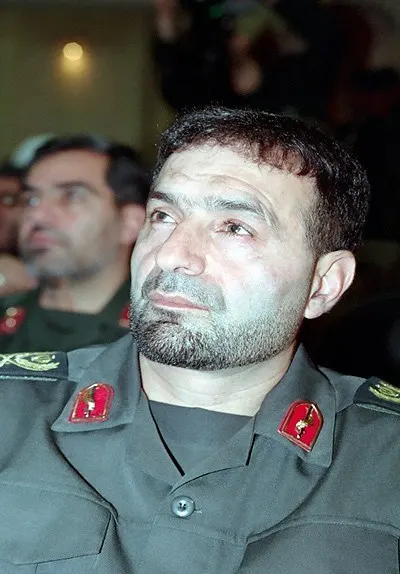
The program was run by the Shahid Hemmat Industrial Group, a subordinate unit of Iran's Aerospace Industries Organization that still designs and builds every major Iranian liquid-fuel missile today.5 The chief architect of the effort was Hassan Tehrani Moghaddam, an IRGC Aerospace Force officer later remembered inside Iran as the father of its missile program. Moghaddam is credited with taking the Scud-C derived No-Dong technology and turning it into the Shahab-3, and later guiding the Ghadr and solid-fuel Sejjil programs that followed it.3
A Difficult Flight-Test Record Before the 2003 Declaration
The first Shahab-3 flight test, in July 1998, ended with the missile exploding in mid-air, and it remains unclear whether that failure was intentional self-destruction or an outright malfunction.2 A second test in July 2000 succeeded using a North Korean-supplied engine, but a third attempt that September failed again shortly after launch. Iran's then-Defense Minister Ali Shamkhani announced a successful test in May 2002 that he said had improved the missile's power and accuracy, and another test followed in July 2002.2 The ninth and final test, conducted a few weeks before the missile's public declaration, succeeded in July 2003 and reportedly exceeded 1,300 km of range.1
Iran declared the Shahab-3 part of its operational arsenal on 7 July 2003, and Supreme Leader Ali Khamenei publicly unveiled the missile on 20 July that year, formally announcing series production.1 From that point the design kept evolving. In August 2004 Iran modified the warhead section, replacing the original conical nose cone with the smaller triconic shape that came to define the later 3B variant, and further flight tests followed in September 2004.2 A May 2005 test reportedly involved a new solid-fuel upper stage design, work that fed forward into the entirely separate solid-fuel Sejjil missile rather than the liquid-fuel Shahab-3 line itself.2
Public Exercises, a Doctored Photograph, and a Fatal Explosion
Iran folded the Shahab-3 into larger show-of-force exercises through the 2000s. Four missiles were reportedly test-launched in February 2006, and that November the Great Prophet II exercise combined Shahab-2 and Shahab-3 launches in a single, publicized drill.2 The Great Prophet III exercise on 8 July 2008 fired a non-upgraded Shahab-3 alongside Fateh-110 and Zelzal missiles, and Iranian state media released a photograph appearing to show four missiles lifting off simultaneously.
Analysts, including Mark Fitzpatrick of the International Institute for Strategic Studies, concluded Iran doctored the photo specifically to cover up an in-flight failure rather than to exaggerate an otherwise successful test.4 The episode became a recurring reference point for how skeptically outside observers treat Iranian missile-test claims.
The program's chief designer did not survive to see how far the family he started would eventually spread. Hassan Tehrani Moghaddam was killed on 12 November 2011 in an explosion at the Bid Kaneh IRGC missile base west of Tehran, along with sixteen other IRGC personnel. Iranian officials described the blast as an accident during the movement of munitions, while several foreign outlets speculated about sabotage.3
The Nuclear-Range Controversy Around the 2015 Nuclear Deal
The Shahab-3's role in Iran's broader missile arsenal made it a recurring point of friction during and after the 2015 nuclear deal negotiations. UN Security Council Resolution 2231, which endorsed the JCPOA, called on Iran in a non-binding annex not to undertake activity related to ballistic missiles designed to be capable of delivering nuclear weapons, a category into which most assessments of the Shahab-3's original design placed it, for a period of eight years that expired in October 2023.6 That language was never legally enforceable, and Iran continued testing and fielding Shahab-3 derivatives throughout the restriction period, arguing its missiles were conventional weapons never intended to carry a nuclear payload.6 The dispute over whether the Shahab-3 and its successors counted as nuclear-capable systems, rather than a dispute over any specific range threshold, remained one of the more persistent disagreements between Iran and Western governments through the JCPOA period.
Operation True Promise Attacks on Israel, 2024 to 2025
Iran's first acknowledged use of Shahab-3-family missiles in direct combat against Israel came on the night of 13 to 14 April 2024, in Operation True Promise I, when Iran fired a mixed salvo of drones, cruise missiles and ballistic missiles at Israeli targets in retaliation for an Israeli strike on its consulate compound in Damascus. Reporting at the time identified Emad and Ghadr variants of the Shahab-3 among the ballistic missiles launched, with most intercepted by a United States, Israeli, British and Jordanian air-defense coalition before reaching their targets.8 Some of the missiles used carried cluster warheads, a configuration analysts linked directly back to the submunition payload originally developed for the Shahab-3.10
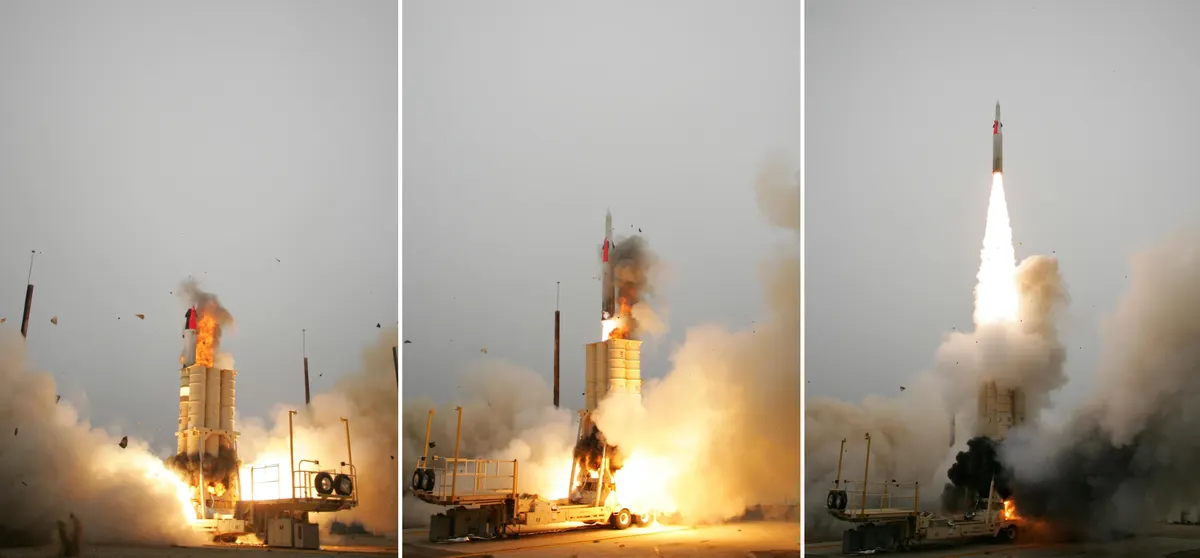
On 1 October 2024, in Operation True Promise II, Iran fired roughly 200 ballistic missiles at Israel in retaliation for the killing of Hezbollah leader Hassan Nasrallah and other regional assassinations. Reporting again described the liquid-fueled Shahab-3 among the missile types used, alongside the newer solid-fuel Fattah-1 and Kheibar Shekan.9 Israeli officials said roughly 99 percent of the incoming missiles were destroyed, with only minor damage recorded at Nevatim Air Base.
The conflict escalated sharply in June 2025. Israel opened the Twelve-Day War on 13 June with a surprise strike on Iranian nuclear and missile infrastructure, and Iran retaliated under the codename Operation True Promise III, launching more than 550 ballistic missiles and over 1,000 drones at Israel over the following eleven days.11 Israeli and allied air defenses intercepted roughly 90 percent of the incoming fire, but missiles that penetrated the defense screen killed more than 28 Israeli civilians before a US and Qatar-mediated ceasefire took effect on 24 June 2025.11 Fighting resumed on a larger scale less than a year later. From 28 February to 17 June 2026, the United States and Israel fought the 2026 Iran war, opening with a strike campaign Washington called Operation Epic Fury, and Iran again answered with missile and drone attacks against Israel, Gulf states and US bases in the region. Iranian officials and open-source trackers confirmed Shahab-3 missiles, with a stated range beyond 1,900 km in some reporting, were among the systems fired during that campaign, alongside the newer Emad and Sejjil types.12,13
Shahab-3A, 3B, 3C and 3D
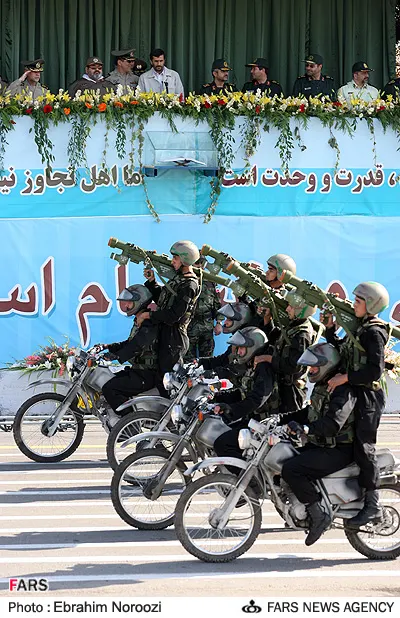
Iran fielded several improved sub-variants under the Shahab-3 name before shifting to entirely new missile designations for later derivatives. The Shahab-3A extended range to roughly 1,300 to 1,500 km but was reportedly out of production by 2008.2 The Shahab-3B introduced the redesigned triconic reentry vehicle, a switch from steel to aluminum airframe construction to save weight, a lengthened fuselage for more propellant, and improved terminal guidance with rocket-nozzle steering.2 Iran also referenced Shahab-3C and 3D designations for further indigenous refinements to precision and navigation, with a claimed annual production capacity of roughly 70 units by 2008.2
The Ghadr, Emad and Sejjil as Direct Technical Descendants
Every major liquid-fuel Iranian missile fielded after 2007 traces its airframe and engine work back to the Shahab-3 program. The Ghadr-110 reached operational status around 2007, keeping the Shahab-3's basic airframe and engine but adding a strap-down inertial guidance package that cut CEP from roughly 2,500 meters to around 300 meters, alongside a stretched fuel tank that pushed range out to 1,600 to 1,950 km.7 The Emad missile, first tested on 11 October 2015, went a step further with a maneuverable, guided reentry vehicle, becoming Iran's first missile marketed as capable of striking a target rather than an area.7 The solid-fuel Sejjil took a different propulsion path entirely, but its program grew directly out of solid-motor work first tested under the Shahab-3 effort in 2005, and it shares the same Shahid Hemmat institutional base rather than any Shahab-3 hardware.2
Further down that same technical line sit newer Iranian missiles including Khorramshahr, Ashoura, Dezful, Haj Qasem and Kheibar Shekan, all products of the same institutional and engineering base the Shahab-3 program built between 1997 and 2003.

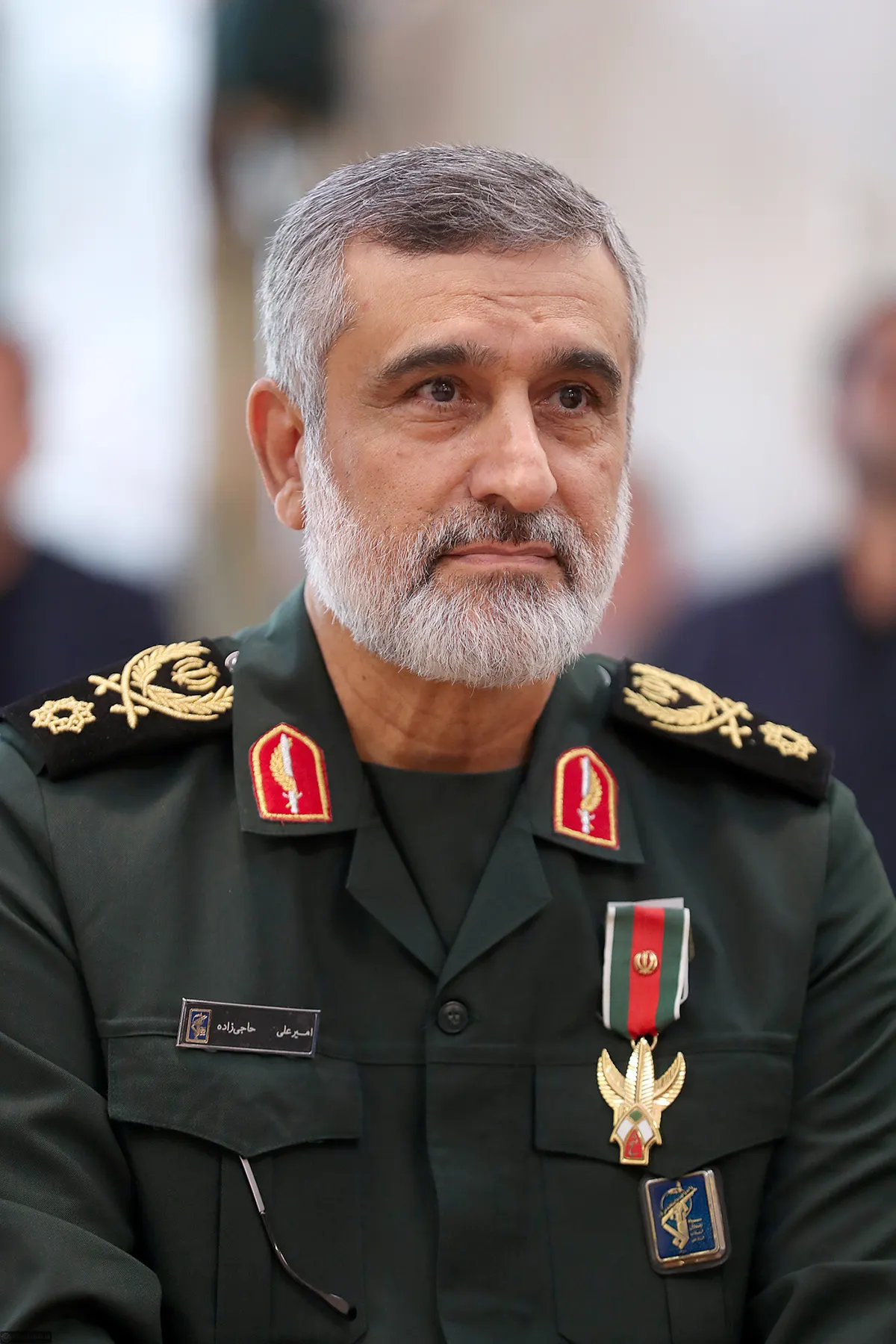
The Shahab-3 has had exactly one operator since its 2003 declaration, Iran, and within Iran it has always belonged to the Aerospace Force of the Islamic Revolutionary Guard Corps rather than the regular Artesh army.1 That force has been commanded since 2009 by Brigadier General Amir Ali Hajizadeh, who has overseen the transition from Shahab-3 to its more accurate Ghadr and Emad successors and been a public face of Iran's missile strikes on Israel in 2024 and 2025.
No other country has operated the Shahab-3 itself. Iran has shared missile technology derived from the program with regional partners at various points, but no confirmed export sale or foreign operator of the Shahab-3 airframe has ever been documented, unlike the wider proliferation of the earlier Scud-B/C designs it descended from.
Shahab-3 vs Hwasong-7 (No-Dong), the North Korean Parent Design
The clearest comparison for the Shahab-3 is its own technical source, North Korea's Hwasong-7 (widely known in the West as the No-Dong or Rodong). The two missiles share an airframe concept, a single-stage liquid engine and roughly the same 1,000 to 1,500 km range class, because Iran built the Shahab-3 directly from acquired No-Dong technology in the 1990s.1 Where the programs diverged afterward is production scale and export policy. North Korea treated the Hwasong-7 primarily as an export product, selling variants to Pakistan (as the Ghauri) and Libya, while Iran kept the Shahab-3 for domestic use and instead exported the engineering knowledge onward into its own Ghadr and Emad programs rather than the missile itself.
| Spec | Shahab-3 | Hwasong-7 (No-Dong) |
|---|---|---|
| Stages | Single-stage | Single-stage |
| Propellant | Liquid (UDMH/N2O4) | Liquid (TM-185/AK-27I) |
| Range | 1,000-2,000 km | 900-1,500 km |
| Guidance CEP | ~2,500 m | ~190 m (later variants) |
Shahab-3 vs Ghadr-110, Its Own Successor
The more instructive comparison for understanding why Iran moved past the Shahab-3 is against its direct successor, the Ghadr-110. Both missiles share essentially the same airframe and engine, but the Ghadr-110's strap-down guidance package cut its CEP to roughly 300 meters against the baseline Shahab-3's 2,500 meters, an eightfold accuracy improvement that turned an area-bombardment weapon into something closer to a precision-strike system.7 That gap explains why Iranian and open-source reporting on the 2024 to 2026 strikes against Israel increasingly names Ghadr and Emad rather than the original Shahab-3 as the missiles actually launched, even when press shorthand still calls the whole family Shahab-3-class missiles.


Is the Shahab-3 still in service? Yes, though Iran has shifted the bulk of its liquid-fuel missile production to the more accurate Ghadr-110 and Emad missile. Western intelligence estimated fewer than 50 Shahab-3 launchers were still operationally deployed as of 2017, and the type is not believed to be in active production.1
What is the range of the Shahab-3 missile? Most specification surveys put the Shahab-3's range between 1,000 and 2,000 km depending on payload weight, with a commonly cited baseline figure near 1,300 km for a full 1,000 kg warhead.1,2
What missile is the Shahab-3 based on? The Shahab-3 was developed from North Korea's No-Dong (Hwasong-7) missile, technology and hardware Iran acquired in the mid-1990s and adapted into domestic production.1
How accurate is the Shahab-3? The baseline Shahab-3 has a circular error probable of roughly 2,500 meters using basic inertial guidance, considerably less accurate than the Ghadr-110 and Emad missile that followed it.1
What is the difference between the Shahab-3, Ghadr and Emad missiles? The Ghadr and Emad share the Shahab-3's core airframe and engine but add improved guidance, a redesigned reentry vehicle and, in Emad's case, a maneuverable warhead, cutting the family's targeting error from roughly 2,500 meters down to around 300 meters or less.7
How much does a Shahab-3 missile cost? No confirmed unit price has ever been published for the Shahab-3, and Iran has never disclosed program costs for any of its ballistic missile families.
- "Shahab-3", Missile Threat, CSIS Missile Defense Project — missilethreat.csis.org ↩
- "Shahab-3", Wikipedia — en.wikipedia.org ↩
- "Hassan Tehrani Moghaddam", Wikipedia — en.wikipedia.org ↩
- "Iran-released photos of missile test were doctored", France 24 — france24.com ↩
- "Shahid Hemmat Industrial Group (SHIG)", Iran Watch — iranwatch.org ↩
- "United Nations Security Council Resolution 2231", Wikipedia — en.wikipedia.org ↩
- "Emad, Ghadr (Shahab-3 Variants)", Missile Threat, CSIS Missile Defense Project — missilethreat.csis.org ↩
- "Iran fired Emad and Ghadr variants of Shahab-3 missiles at Israel, reports", The Week — theweek.in ↩
- "Iran used hypersonic Fattah and ballistic Shahab-3 missiles to target Israel, what these are capable of", ThePrint — theprint.in ↩
- "Iran Just Used Ballistic Missiles With Cluster Warheads To Strike Israel", The War Zone — twz.com ↩
- "Twelve-Day War", Wikipedia — en.wikipedia.org ↩
- "2026 Iran war", Wikipedia — en.wikipedia.org ↩
- "US-Israel Strikes on Iran Enter Second Week as Spillover Mounts", Quwa — quwa.org ↩