

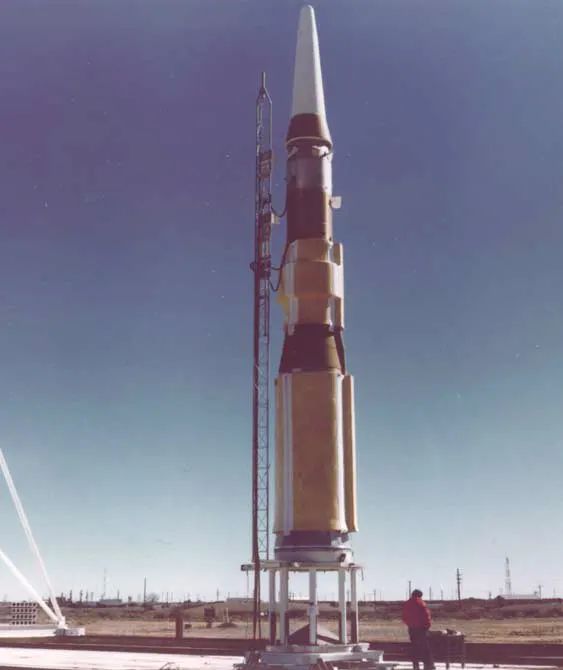

Hera is not a weapon in the ordinary sense. It is a target, a ballistic vehicle built for the express purpose of being shot down. The United States Army awarded the Theater Missile Defense Targets contract for the program to Coleman Aerospace of Orlando, Florida in 1992, and every Hera airframe since has been assembled from decommissioned rocket stages that once sat in Minuteman II silos.1 Once launched, it flies a trajectory shaped to look like an incoming Scud-class or medium-range threat, giving American missile-defense systems something real to intercept during development testing.
- built from cheap, already-paid-for surplus ICBM motors
- combat-representative Scud/MRBM flight profile for realistic testing
- flexible trajectory shaping across multiple threat classes
- decades of flight history feeding THAAD, PAC-3 and Aegis test data
- finite supply of retired Minuteman II stages limits total production
- 2009 quality-control failure triggered a purchase suspension
- disputed under Russia's now-defunct INF Treaty reading
- cannot simulate genuinely maneuvering or [MIRV](/en/glossary/mirv)-equipped threats
That single fact separates Hera from almost everything else catalogued in this MRBM leaf. The other missiles here are built to strike something. Hera is built to be struck, and its entire design, from the recycled motors to the instrumented reentry vehicle riding on top, exists to make the vehicle behave like a genuine MRBM or SRBM without ever being one. It carries no explosive payload and was never intended for operational use against a real adversary.
Hera's disputed status came from Russia, which argued the vehicle's range and guidance heritage sat uncomfortably close to the intermediate-range missiles the INF Treaty had already banned, a claim covered further in History below.
Hera's role sits inside the broader Missile Defense Agency targets and countermeasures program, which buys threat-representative vehicles the same way it buys interceptors.11 Coleman built 25 confirmed Hera vehicles under that original contract, with derivative airframes sharing the same motor family flying into the following decade.2,4 The vehicle first flew on April 24, 1995, from White Sands Missile Range, New Mexico, and has since supported test after test of the Terminal High Altitude Area Defense (THAAD) system, the Patriot PAC-3 interceptor, and joint engagements involving Aegis Ballistic Missile Defense.1,8
Because Hera answers the how does a missile defense target work question almost as directly as any target vehicle on record, it is worth being precise about what the Hera target missile actually is. It is not a Scud copy and not a repackaged Pershing missile. It is a purpose-built test article that borrows hardware from three unrelated Cold War programs, a Minuteman II ICBM, a Pershing II guidance section, and a custom Coleman Aerospace airframe, and stitches them into a single reusable target design.1,2
Recycled Minuteman II Motors Doing a Second Career
Hera is a two-stage, 11.9 meter long vehicle with a first-stage diameter of 1.32 meters and a launch weight of roughly 11,300 kilograms.1,3 Neither stage was built for Hera originally. The first stage is an Aerojet SR19-AJ-1 solid rocket motor, producing about 268 kN of thrust, that served as the second stage of the LGM-30 Minuteman before Cold War arms reductions retired hundreds of Minuteman II airframes.1,4 The second stage is a Hercules Inc. M57A1 motor, roughly 156 kN of thrust, pulled from the same missile's third stage.1,4 Coleman Aerospace paired the two solid-fuel motors with a new motor adapter, a new aft skirt, and modified Minuteman interstage hardware, then added an instrumented reentry vehicle on top to record how the flight actually performed.2
- Missile Classtarget_missile
- Service Entry Year1995
- DesignerColeman Aerospace
- Length11.9 m
- Diameter1.32 m
- Launch Weight11,300 kg
- In ServiceYes
A Pershing II Guidance Section Steering an ICBM Stack
What actually points Hera at its intended impact point did not come from Minuteman II at all. Coleman Aerospace built Hera's guidance and control module around the guidance heritage of the Pershing II weapon system, the medium-range missile the United States eliminated under the 1987 INF Treaty.2 The production Hera uses a combined inertial-gps navigation package, an approach that was realistic for a system entering service in the mid-1990s once GPS constellations were mature enough for tactical use.1 Space Vector Corporation supported Coleman as a guidance and integration subcontractor on the original 1992 contract.2
- Propulsion Typesolid_fuel
- Number of Stages2
- Fuel Typesolid
- Solid-FuelYes
- Cold-LaunchNo
- CanisterizedNo
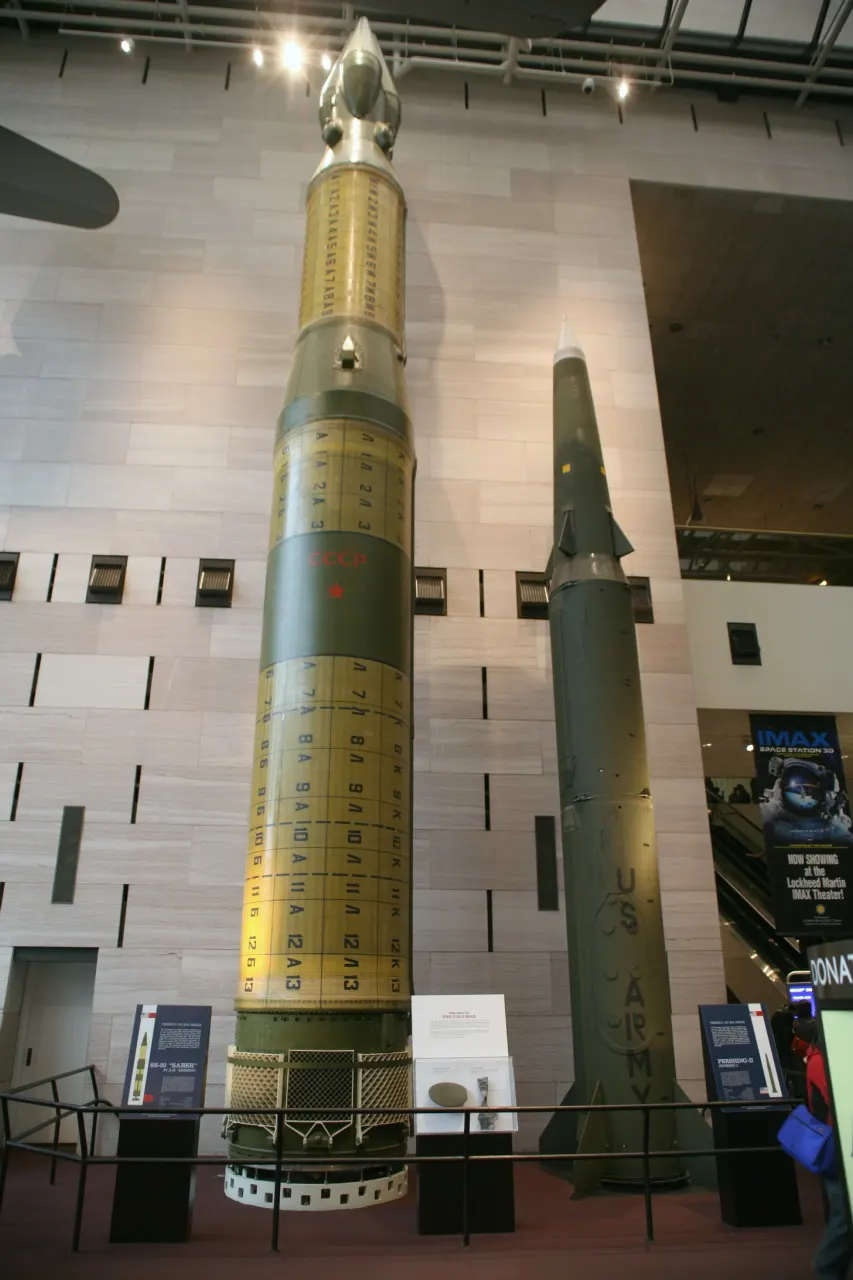
It is worth being explicit about what this guidance section is not built to do. Hera's inertial-gps guidance flies the vehicle to a defined point in space so a defending radar and interceptor have something predictable to engage. It has no terminal guidance of its own and makes no attempt to defeat or evade the system under test. Precision here means repeatability for the test range, not accuracy against a target, since Hera itself is the object meant to be hit.
- Maximum Range1,100 km
- Apogee300 km
Launch Sites and Flight Profile
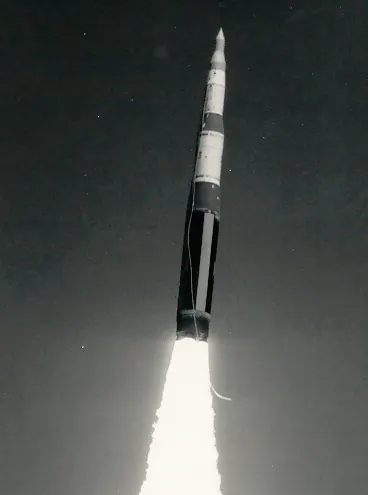
Hera launches from fixed pads rather than a mobile launcher, most often Launch Complex 96 at Fort Wingate, New Mexico, or Launch Complex 94 at White Sands Missile Range, with the vehicle flying a corridor across the Datil Mountains toward the White Sands impact area.16 Published figures put its maximum range near 1,100 kilometers and its apogee near 300 kilometers, though individual test flights are deliberately flown shorter and lower to match whatever threat class a given intercept test is validating against.1
- Guidance TypeInertial / GPS
- Terminal GuidanceNo
- Basing Modefixed launch pad
- Silo-BasedNo
- Road-Mobile (TEL)No
- Rail-MobileNo
- Submarine-LaunchedNo
- Total Production25
The Theater Missile Defense Targets contract that created Hera came from the U.S. Army Space and Strategic Defense Command (later Space and Missile Defense Command) in 1992, awarded to Coleman Aerospace with Space Vector Corporation and Aerotherm as subcontractors.2 Coleman's engineers spent three years converting surplus Minuteman II stages into a testable target vehicle before the first flight left White Sands on April 24, 1995.1,3
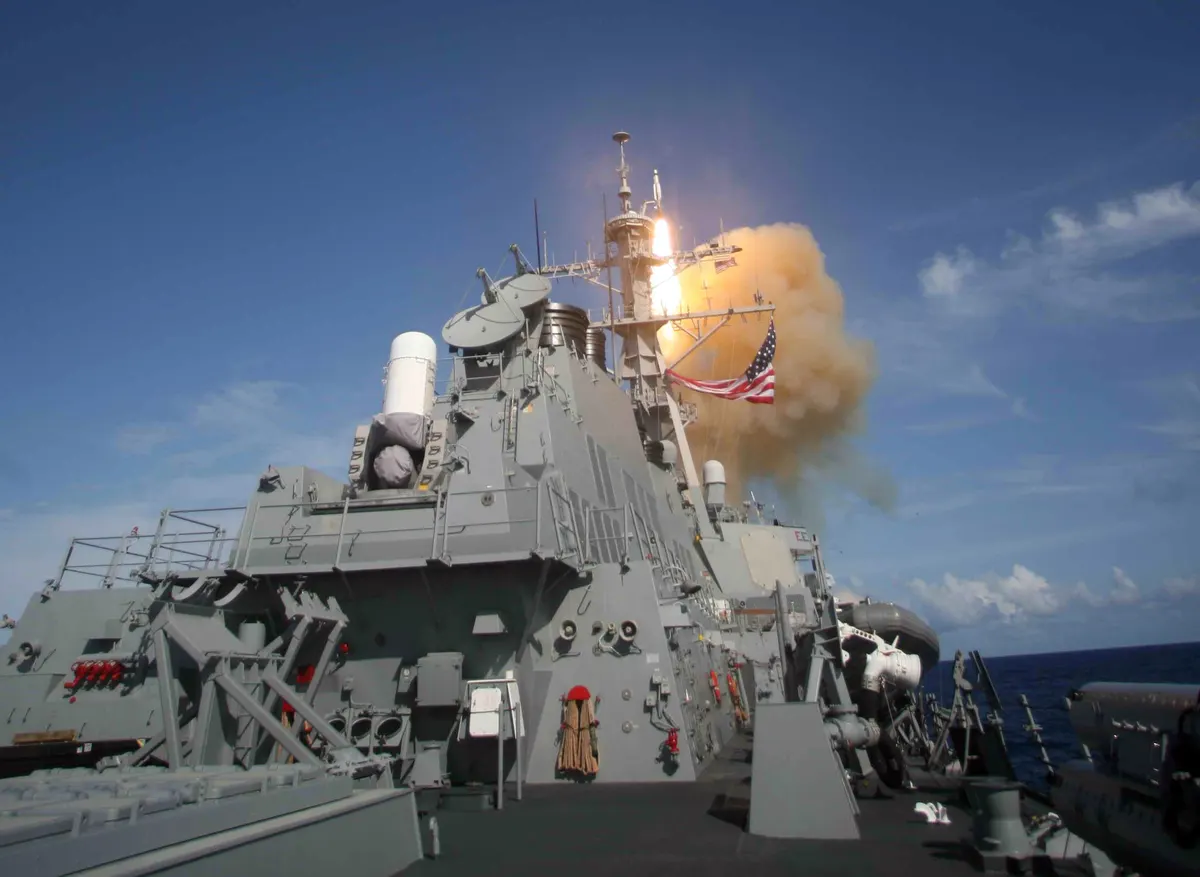
The vehicle's most consequential decade came next, as the U.S. tried to get THAAD and Patriot PAC-3 working at all. Patriot's PAC-3 variant scored a hit-to-kill intercept in March 1999, and THAAD followed with its own first successful intercept on June 10, 1999, at White Sands, ending a string of earlier failures.7 That success came only after a rough stretch. On March 29, 1999, a THAAD interceptor overshot its target entirely and self-destructed within roughly 30 meters of the Hera vehicle it was chasing, the program's ninth consecutive miss and one that cost Lockheed Martin a $15 million contractual penalty.9 June and August 1999 turned that record around, with both intercepts flown against Hera targets.8
The redesigned, production-representative THAAD interceptor had its own debut against Hera on July 12, 2006, in test FTT-03, described by the program as the first intercept using an operational interceptor rather than a validation prototype.8 Not every flight went cleanly. A September 2006 THAAD test had to be scrubbed in mid-flight after the Hera target itself ran into trouble before the interceptor could even launch.8 The worse failure came on December 11, 2009, during THAAD test FTT-11, when an air-launched Hera vehicle dropped from a C-17 over the Pacific failed to ignite its motor and fell into the ocean, an onboard computer fault rather than an interceptor problem.10,11 Missile Defense Agency director Lieutenant General Patrick O'Reilly criticized L-3 Coleman Aerospace's quality control publicly, and the agency suspended new Hera purchases in March 2010 until corrective action satisfied both MDA and the Air Force in May 2011.11
Hera's most complex mission came on September 10, 2013, in Flight Test Operational-01 (FTO-01), an integrated engagement in which a THAAD interceptor destroyed one medium-range target while a second THAAD round fired in salvo alongside an Aegis SM-3 Block IA interceptor against a separate medium-range target, the Aegis round scoring the kill.12 The test showed THAAD and Aegis Ballistic Missile Defense could be cued against the same layered raid using target vehicles drawn from the same Minuteman II-derived motor family that built the original Hera.12 The two FTO-01 targets were logged under the family designations eMRBM and eMRBM-T1 rather than the Hera name itself, a reminder that Hera strictly refers to Coleman's original 1990s configuration even though the press and the public routinely use it as shorthand for the whole SR19/M57A1 target family.5

Ownership of the Hera program changed hands more than once. L-3 Communications acquired Coleman Research (Coleman Aerospace's parent) in 2001, and L-3 Coleman Aerospace kept building targets through the 2000s.13 In October 2013 the Pentagon awarded L-3 Coleman a $74 million contract to keep supplying medium-range targets, beating out competing bids from Orbital Sciences Corporation and Lockheed Martin Space Systems.1 Aerojet Rocketdyne bought the Coleman Aerospace business from L3 Technologies in 2017 for roughly $15 million, folding target-vehicle production into its own rocket motor line, the same company that had built one of Hera's two stages decades earlier.13,14

Coleman built several derivatives on the same SR19-AJ-1/M57A1 motor pairing rather than a fresh Hera model for every mission profile. SRALT (Short-Range Air-Launched Target), also called Hera-SRALT, strips the design to a single SR19-AJ-1 stage dropped by parachute from a C-130 or C-17 for shorter-range engagements, and flew in August 2004 to provide a target for an Arrow-2 interceptor test conducted jointly with Israel.6 LRALT (Long-Range Air-Launched Target) goes the other way, stacking two SR19-AJ-1 motors under an Orbus-1A upper stage for longer-range profiles, and flew its first operational mission in September 2005 supporting a Cobra Dane radar evaluation.6
A separate but related point of confusion involves the actual builder. Orbital Sciences Corporation never built Hera. Orbital instead developed Juno, a sibling target vehicle sharing the identical SR19-AJ-1/M57A1 motor stack for a different mission, carrying radar-calibration and other instrumented payloads rather than the ballistic-target reentry vehicle Coleman fitted to Hera.4 Boeing built a third sibling, the PLV, using the same recycled Minuteman II stages to loft prototype ground-based interceptors during early GMD development.4 The three programs shared a parts bin, not a design team, and Orbital's later corporate successors, Orbital ATK and eventually Northrop Grumman, inherited the Juno line rather than any Hera production role.

Hera has only ever had one operator, the United States, through the Missile Defense Agency and the Army test ranges that host its launches.1 It has never been exported, sold, or fielded operationally by any other country, and its only meaningful international dimension is cooperative testing, most visibly the August 2004 SRALT flight that supported an Israeli Arrow-2 intercept attempt at a US range under the two countries' long-running missile-defense partnership.6 That flight does not make Hera an Israeli asset. Israel supplied the interceptor being tested. The target vehicle, its launch, and its range support all remained under US control.
Hera and the Pershing II share more design DNA than a passing mention would suggest. Coleman built Hera's guidance and control module directly around Pershing II's guidance heritage, and both systems came out of the same US Army missile-development programs of the 1970s and 1980s.2 Where they differ is purpose. Pershing II was a nuclear-capable, road-mobile medium-range missile eliminated under the INF Treaty specifically because it could threaten Warsaw Pact command centers. Hera carries an inert, instrumented reentry vehicle and exists solely to be intercepted. The INF Treaty that ended Pershing II's career is the same treaty Russia later invoked against Hera, arguing its range and its Pershing-derived guidance made it uncomfortably similar to what the treaty had just banned.15
A more useful role comparison sits with a real adversary missile such as Shahab-3, the Iranian medium-range missile whose flight profile Hera-family targets are built to approximate in THAAD and PAC-3 testing. Shahab-3 is a liquid-fuel, single-stage weapon meant to deliver a real warhead over roughly 1,300 kilometers. Hera is a two-stage, solid-fuel vehicle built from recycled ICBM stages that flies a similar Scud-descended trajectory shape without ever carrying a warhead at all. The comparison is not about which missile is more capable. It is about why the two exist. Shahab-3 exists to threaten a target. Hera exists to teach American radars and interceptors what a missile like Shahab-3 looks like in flight, long before either country's engineers meet in an actual conflict.
| Parameter | Hera | Pershing II |
|---|---|---|
| Stages | 2 (recycled Minuteman II motors)1 | 22 |
| Range | ~1,100 km1 | ~1,770 km (historical, treaty-eliminated) |
| Guidance | Inertial-GPS1 | Inertial with radar area-correlation |
| Warhead | None (instrumented reentry vehicle)2 | Nuclear (W85), eliminated under INF |
| Role | Missile-defense test target | Nuclear-capable strike weapon (retired) |


What is the Hera target missile used for? Hera provides a realistic, Scud-class or medium-range ballistic trajectory for testing American missile-defense interceptors, chiefly THAAD and Patriot PAC-3, and occasionally in joint engagements with Aegis Ballistic Missile Defense.1,12
Is the Hera missile still in service? Coleman-built and derivative Hera airframes continued flying into the mid-2010s under Aerojet Rocketdyne's Coleman Aerospace unit, though the finite stock of retired Minuteman II motors limits how many more can ever be built.13,4
Does the Hera missile carry a warhead? No. Hera carries an instrumented, unarmed reentry vehicle designed to record flight data, not a nuclear or conventional payload, which is the central difference between Hera and every offensive medium-range ballistic missile it is used to test against.2
What missile stages does the Hera target missile use? Its first stage is an Aerojet SR19-AJ-1 motor and its second stage a Hercules M57A1 motor, both originally built as the second and third stages of the LGM-30 Minuteman II ICBM before Coleman Aerospace converted them into a target vehicle.1,4
Who manufactures the Hera target missile? Coleman Aerospace developed Hera under a 1992 Army contract, then continued production first as L-3 Coleman Aerospace after 2001 and, since 2017, as a unit of Aerojet Rocketdyne.2,13,14
- "Hera (rocket)", Wikipedia — en.wikipedia.org) ↩
- "Coleman Hera / Lockheed Martin PLV", Designation Systems — designation-systems.net ↩
- "Hera", Astronautix — astronautix.com ↩
- "SR-19 M-57A1", Gunter's Space Page — space.skyrocket.de ↩
- "SR-19 Family", Gunter's Space Page — space.skyrocket.de ↩
- "Coleman SRALT/LRALT", Designation Systems — designation-systems.net ↩
- "THAAD Achieves First Intercept", Arms Control Association — armscontrol.org ↩
- "Terminal High Altitude Area Defense", Wikipedia — en.wikipedia.org ↩
- "THAAD defense system logs ninth failure", EE Times — eetimes.com ↩
- "Failed Target Launch Halts THAAD Missile Defense Test", SpaceNews — spacenews.com ↩
- "Hera target missile failure may delay upcoming PAC-3, THAAD tests", Inside Defense — insidedefense.com ↩
- "THAAD And Aegis BMD Successfully Engage Multiple Targets During Integrated Ballistic Missile Defense System Test", Lockheed Martin — news.lockheedmartin.com ↩
- "Aerojet Rocketdyne buying target-missile maker Coleman Aerospace", SpaceNews — spacenews.com ↩
- "Aerojet Rocketdyne acquires L-3's Coleman, boosting launch portfolio", Defense News — defensenews.com ↩
- "How have Moscow and Washington violated the agreement? What's so dangerous about intermediate-range missiles?", Meduza — meduza.io ↩
- "Launch Facilities", White Sands Missile Range (US Army) — wsmr.army.mil ↩