


The Jericho II is a two-stage, solid-fuel medium-range ballistic missile developed by Israel and built by Israel Aerospace Industries through its MLM missile division. No Israeli government has ever confirmed what the Jericho II actually carries. That single fact shapes almost everything written about it. Foreign intelligence assessments, arms-control researchers and successive editions of Jane's have treated the missile as the backbone of Israel's undeclared nuclear deterrent since the late 1980s, while Israeli officials have said, at most, that the country will not be the first to introduce nuclear weapons into the Middle East.1,2
- Solid-fuel motor, fast to prepare and launch compared to liquid-fueled contemporaries
- Silo, cave and road-mobile basing spreads the force against a first strike
- Shared airframe with the Shavit space launcher gives it a legitimate civilian cover story
- Reach covers Iran and the wider Middle East without staging through third countries
- Basic specifications (length, weight, exact range) still disputed across open sources
- No confirmed combat launch to validate real-world accuracy or reliability
- Guidance and terminal accuracy details remain unverified estimates, not measured data
- Small declared inventory compared to major-power MRBM/IRBM forces
Development grew directly out of a failed 1975 arms request. Israel asked the United States for the Pershing II class missile then entering American service and was turned down as part of the Sinai withdrawal negotiations with Egypt.2 Unable to buy an off-the-shelf medium-range ballistic missile from Washington, Israel built its own, drawing on a decade of earlier French rocket work and, briefly, a joint program with Iran that collapsed after the 1979 revolution.1,2 The result reached flight test in 1987 and is generally dated to operational service in 1989, though this is a subject of real disagreement among analysts, not just a rounding difference.3
The Jericho II sits inside Israel's wider deterrent architecture alongside Dolphin-class submarines carrying the Popeye cruise missile and a nuclear-capable strike aircraft leg built around the F-15 Eagle and F-16 Fighting Falcon, the classic three-leg triad structure applied to a state that will not officially admit it has a nuclear weapon to deliver in the first place.6 It is also one of the more unusual medium-range ballistic missiles in the world for a second reason. Its first two stages form the basis of the Shavit satellite launcher, so a rocket motor developed for a weapon has also carried Israeli reconnaissance satellites into orbit, a dual-use relationship the state has been considerably more willing to discuss than the missile's warhead.1,2
Because Israel has never released official figures, nearly every number attached to the Jericho II, including its length, diameter and launch weight, varies from one respected source to the next. That is not sloppy reporting. It is what a genuinely opaque nuclear-adjacent program looks like from the outside, and it is worth stating plainly rather than picking one figure and presenting it as settled fact.
A Missile Whose Own Length Is Disputed Across Sources
The Center for Strategic and International Studies Missile Threat project lists the Jericho II at 15.0 meters long and 1.35 meters in diameter, with a launch weight around 22,000 kg.1 Wikipedia's missile-by-missile breakdown instead gives 14.0 meters, 1.56 meters and 26,000 kg.2 Neither figure comes from an Israeli government release. Both are analyst reconstructions built from test-flight tracking, satellite imagery and comparison with the related Shavit launcher, and the roughly one-meter, several-thousand-kilogram spread between them is a reasonable illustration of how little hard data actually exists in the open literature. The CSIS figures are treated as the primary reference point below, with the Wikipedia range flagged as a credible alternative rather than presented as confirmed.
- Missile ClassMedium-range ballistic missile
- Service Entry Year1989
- DesignerIsrael Aerospace Industries (MLM missile division)
- Length15 m
- Diameter1.35 m
- Launch Weight22,000 kg
- In ServiceYes
What is more consistently reported is the missile's architecture. The Jericho II is a two-stage, solid-propellant design with a separating reentry vehicle, replacing the storable liquid propellant used in the earlier Jericho (Jericho I).1,2 Solid fuel means the missile can sit ready to launch on comparatively short notice rather than requiring hours of fueling before a strike, a meaningful advantage for a deterrent force that is meant to survive a surprise attack and still respond. The switch to a solid-fuel motor also gave Israeli engineers propulsion technology directly transferable to the Shavit space launcher, which uses essentially the same first two stages with a third stage and payload shroud added on top.1
- Propulsion Typesolid-propellant
- Number of Stages2
- Fuel TypeSolid composite propellant
- Solid-FuelYes
Payload figures are reported at up to 1,500 kg of high explosive, or, per foreign assessments, a nuclear warhead. Israel Aerospace Industries has never published a payload figure of its own, so every number in this paragraph is an outside reconstruction rather than a factory specification.1,6
- Maximum Range1,500 km
- Throw Weight1,500 kg
Range estimates cluster around 1,500 km, enough to reach targets across Iran, Iraq and the wider region from launch sites inside Israel, with some sources citing extended-range variants out to roughly 3,500 km.1 Some estimates put warhead yield as high as a reported megaton, though most arms-control analysts treat the higher figures as speculative upper bounds rather than confirmed values, closer in spirit to Cold War-era single-source claims than to measured data.
- Guidance TypeInertial / GPS
- Terminal GuidanceYes
Guidance, Terminal Accuracy and the Reported Radar Upgrade
Publicly available sources describe the Jericho II as using an inertial guidance platform, the same basic approach used by virtually every ballistic missile of its generation, reportedly supplemented by an active radar homing terminal seeker for improved accuracy, similar in concept to the terminal guidance fitted to the American Pershing II.2
- Warhead TypeHigh explosive or nuclear warhead (undeclared, foreign-assessed)
- NuclearYes
- ThermonuclearNo
- MIRVNo
- Warhead / RV Count1
- Conventional-CapableYes
No independent source has published a confirmed CEP (circular error probable) figure for the Jericho II, and none is invented here in place of one. The predecessor Jericho I is credited with a CEP around 1,000 meters, and the Jericho II is described in general terms as more accurate, but a specific number for the newer missile simply is not in the open literature with any confidence.2
- Basing ModeUnderground silo/cave, rail-car and road-mobile TEL
- Silo-BasedYes
- Road-Mobile (TEL)Yes
- Rail-MobileYes
- Submarine-LaunchedNo
Silo, Cave and Road-Mobile Basing at Sdot Micha
The Jericho II's basing is reported as unusually flexible for its era, combining silo launch, road-mobile transporter-erector-launchers, and even a rail-car basing option according to some analyses, spreading the force across multiple launch methods rather than concentrating it in one vulnerable configuration.2,3 The primary declared location, to the extent Israel declares anything about it, is Sdot Micha Airbase near the town of Zekharia, southwest of Tel Aviv, a facility whose existence Israel neither confirms nor denies in the way it treats most other military installations.4
- Total Production90
- Operators1
- First Test1987
Analysis of satellite imagery has identified roughly two dozen hardened cave entrances cut into the limestone hills around the base, described as capable of sheltering missile launchers behind blast doors, with an estimated capacity in the range of dozens of launchers across the northern and southern sections of the site.5

As many as 90 Jericho II missiles are estimated to be based in this area, though as with every other figure in this section, that number is an outside estimate rather than an Israeli disclosure.3 The logic behind spreading launchers across caves, silos and road-mobile vehicles is straightforward even without an official explanation. A deterrent force that can be destroyed in a single strike is not much of a deterrent, and dispersal is the standard answer to that problem across every nuclear-armed state that has faced it.
From a French Rocket to a Missile Israel Had to Build Alone
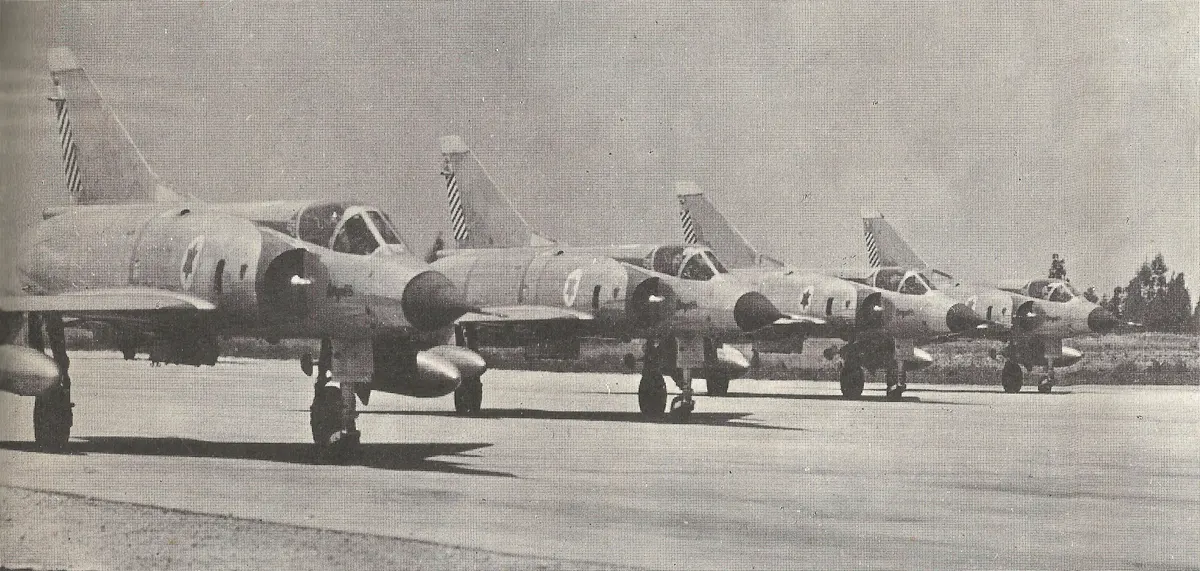
Israel's ballistic missile program did not start with the Jericho II, or even with the first Jericho. It started with a French design. Dassault Aviation began supplying Israel with missile technology in the early 1960s, and the two countries tested a design known as the MD-620 in 1965 as the technical root of what became the Jericho I.2 That relationship ended abruptly. France imposed an arms embargo on Israel in January 1968, after the Six-Day War, cutting off further cooperation, though a dozen MD-620 missiles had already been delivered.2 Israel was left holding a partially developed missile and no supplier willing to finish the job, which pushed the program toward full domestic development under Israel Aerospace Industries.
The Jericho II itself began as a direct response to a second rejection, this time by the United States rather than France. In 1975, during negotiations over the Sinai withdrawal that eventually produced the Egypt-Israel peace process, Israel asked to buy the American Pershing II medium-range ballistic missile as part of a broader military assistance package. Washington said no.2 Development of an indigenous replacement, eventually designated YA-3 and known publicly as Jericho II, formally began in 1977.1,2
The Iranian Interlude and the South African Partnership
For a short window in the late 1970s, the new missile program had an unlikely second sponsor. Multiple sources describe evidence of a joint Israeli-Iranian missile effort in this period, before the two countries' relationship collapsed entirely after the 1979 Iranian revolution replaced the Shah's government with the Islamic Republic that Israel now treats as its principal strategic threat.1,2 The irony is not subtle. A missile partly shaped by early cooperation with Tehran would spend the following four decades being sized, in large part, against the ballistic missile forces Tehran itself went on to build.
South Africa filled a very different role in the same period. Under the apartheid government, South Africa and Israel developed a close, mutually useful relationship through the 1970s and 1980s. South Africa provided uranium and remote test facilities. Israel provided rocket propulsion and guidance technology in return, including the ten-metric-ton solid motor design used in the Jericho II.9 South African engineers used that technology to build the RSA-3 space launch vehicle, based on the Shavit design, and conducted flight tests from the Overberg Test Range near Bredasdorp, known to Western intelligence by the codename Arniston.9
Tests from Overberg are reported in July 1989 and again in November 1990, with the July 1989 flight said to have covered roughly 1,400 km over the Indian Ocean, before the program was cancelled after South Africa's transition away from apartheid rule and its accession to the Missile Technology Control Regime in 1995.9
The same period of Israeli-South African cooperation is inseparable from one of the more contested episodes in nuclear history. On 22 September 1979, an American Vela surveillance satellite recorded a double flash of light over the South Atlantic, a signature strongly associated with a low-yield atmospheric nuclear detonation. The event, now generally referred to as the Vela incident, is widely believed by historians and former US officials, though never formally confirmed by either government, to have been a joint Israeli-South African nuclear test.11 It is included here because it illustrates the depth of the two countries' unacknowledged strategic cooperation in the exact years the Jericho II was moving from paper to flight hardware. It was not a Jericho missile test itself.
Test Flights Over the Mediterranean and a Contested Operational Date
Western intelligence first identified a Jericho II flight test in May 1987, when a missile flew roughly 850 km into the Mediterranean.3 A second test followed in September 1988, close in time to Israel's first Ofeq reconnaissance satellite launch on the related Shavit booster.3 A further test in September 1989 covered approximately 1,300 km, also into the Mediterranean.3 Some analyses point to additional, longer-range test firings conducted from South African territory in this same window, consistent with the Overberg cooperation described above.3
Most open sources, including CSIS Missile Threat, date the Jericho II's entry into operational service to 1989, immediately following that year's test flight.1,3 That is not universally accepted.
Researcher Seth Carus, drawing on an Israeli source, has argued the actual decision to declare the Jericho II operationally deployed came only after 1994, several years after the 1991 Gulf War Scud attacks on Israel had ended and a ceasefire and disarmament regime were already in place against Iraq.3 The year 1989 is treated here as the primary reference date, consistent with the majority of published sources, while a credible minority view places real operational readiness closer to the mid-1990s. That gap of several years is a genuine, unresolved disagreement in the public record.
Amimut, the Doctrine That Refuses to Say the Word
None of the history above answers the single question most readers actually want answered, whether Israel has nuclear-armed Jericho II missiles ready to fire. Officially, Israel will not say. This is not an accidental gap in the record. It is a deliberate, decades-old policy scholars call amimut, commonly translated as nuclear opacity or nuclear ambiguity.6 Historian Avner Cohen, whose published academic work is the standard reference on the subject, distinguishes an earlier period of simple ambiguity from the more calculated stance adopted once it became clear, around 1969, that Israel possessed the weapons in question.6

That policy rests on a specific piece of diplomatic language from 1968. Ambassador Rabin told the US State Department that Israel's understanding of introducing nuclear weapons meant testing them, deploying them openly, or declaring them publicly, and that simple possession fell outside that definition.6 Everything about how the Jericho II is discussed in public, including the near-total absence of official Israeli figures used throughout this article, flows from that single interpretive move made more than half a century ago.
Analysts working from foreign assessments generally credit Israel with somewhere between 25 and 100 Jericho-family missiles across all three generations assigned a plausible nuclear role, alongside the submarine and aircraft legs of the same undeclared force.6,8,12 Under amimut, Israel neither confirms nor denies possessing nuclear weapons while maintaining the separate public position that it will not be the first state to introduce them into the Middle East.6,7
There is no confirmed record of a Jericho II missile ever being launched in combat, against any target, by any country. That single sentence is worth stating directly rather than working around, because deterrent weapons succeed by not being used, and by most accounts the Jericho II has spent nearly four decades doing exactly that.
The missile's strategic logic was shaped by conflicts it never fired a shot in. The 1973 Yom Kippur War, fought before the Jericho II itself existed, is the war most historians point to as the moment Israeli planners concluded that a survivable, longer-range strategic missile force was a necessity rather than a luxury, feeding directly into the frustrated 1975 Pershing II request that started the Jericho II program in the first place.2 The 1991 Gulf War, during which Iraq fired 39 Scud missiles at Israeli cities, is the conflict most often cited as validating the entire premise of an Israeli ballistic missile deterrent, even though the Jericho II itself was never employed and Israel's public response was restricted to civil defense and reliance on the American-supplied Patriot batteries deployed to intercept incoming Scuds.3
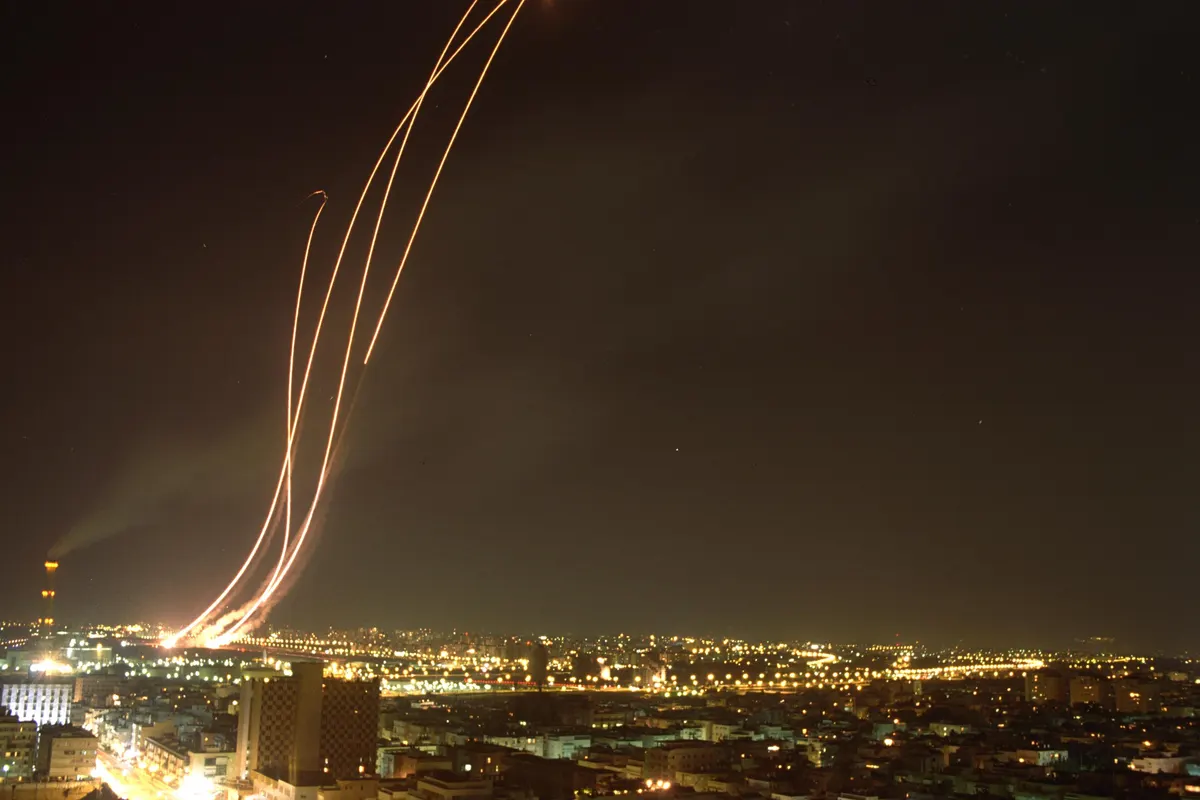
More recent conflicts have tested the missile's role differently, by testing the secrecy around it rather than the hardware itself. During the June 2025 Twelve-Day War and the wider 2026 Iran war that followed, Israel and Iran exchanged direct ballistic missile fire for the first time in either country's history, with Iran launching several hundred ballistic missiles at Israeli territory across both conflicts.14,15 Israel's own response in both wars relied overwhelmingly on air power rather than any confirmed Jericho launch, and no credible source has reported an Israeli ballistic missile strike on Iran using the Jericho family during either round of fighting.10
What analysts have noted instead is a quieter erosion of the secrecy surrounding the program itself, as a sustained war fought explicitly over nuclear capability pushed Israeli strategic infrastructure, including facilities historically kept out of public discussion, into ordinary wartime reporting.13 The legal shell of amimut survived both conflicts. Its diplomatic usefulness, several analysts argue, did not survive entirely intact.13
Jericho IIA and IIB Range Variants
Open sources describe two broad Jericho II sub-variants, an original roughly 800 km version and an extended-range Jericho IIB reaching approximately 1,500 km, achieved primarily through a lighter payload and improved propellant rather than a fundamentally different airframe.1,3 Precise, sourced differences between the two beyond range are thin in the public record, which is consistent with the program's overall opacity rather than a gap specific to this section.
Shavit, the Satellite Launcher Built on the Same Motor
The Shavit family is the Jericho II's most consequential variant, even though Israel presents it as a wholly separate, civilian space program rather than a missile derivative. Shavit uses the Jericho II's first two solid-fuel stages, adds a third stage and a payload shroud, and has launched Israel's Ofeq reconnaissance satellites since 1988.1,2 The relationship works in both directions analytically. Because a Shavit launch is a public, trackable event while a Jericho II test is not, outside analysts have used measured Shavit performance data, including work by physicist Steve Fetter and analysts at Lawrence Livermore National Laboratory, to reconstruct plausible Jericho II range and payload figures that Israel itself has never released.3 A satellite launcher, in other words, has become the main public window into a missile the state won't discuss directly.
RSA-3, the South African Licensed Derivative
South Africa's RSA-3 program, described above in the History section, stands as the clearest confirmed instance of Jericho II-derived technology being built and flight-tested by a second country, even though it flew as a satellite launcher rather than a weapon and the entire program was cancelled before it produced an operational South African missile force.9

Israel is the only confirmed operator of the Jericho II, and by the nature of the program, that is essentially the extent of what can be stated with confidence. No export sale, transfer, or foreign operator of the Jericho II itself has ever been confirmed. The closest analog, South Africa's RSA-3, was a licensed derivative used for satellite launches, not a transfer of the missile itself to a second country's military.9 Estimates of Israel's own Jericho-family inventory, spanning Jericho I, II and III together, run from roughly 25 to 100 missiles assigned a plausible nuclear delivery role, with the Jericho II specifically credited with as many as 90 airframes based around Sdot Micha.3,8
Jericho II vs the Pershing II Israel Was Never Allowed to Buy
The most revealing comparison for the Jericho II is not a rival Israel had to out-design. It is the missile Israel wanted to purchase directly and was refused. The American Pershing II entered US Army service in 1983, six years after Israel's own request for it was turned down as part of the 1975 Sinai negotiations, and the two missiles ended up more alike than their separate origins would suggest, both two-stage, solid-fueled systems reportedly incorporating active radar terminal guidance for improved accuracy over a purely inertial flight path.2 Where they differ is scale and role. The Pershing II was built as a NATO theater weapon, deployed in West Germany against Warsaw Pact targets and withdrawn entirely under the 1987 Intermediate-Range Nuclear Forces Treaty once Washington and Moscow negotiated the whole missile class out of existence.2 The Jericho II answers to no such treaty. Israel is not a signatory to the INF framework, and the missile remains a live, if undeclared, part of its arsenal decades after its American near-counterpart was dismantled down to the last airframe.
| Spec | Jericho II | Pershing II |
|---|---|---|
| Stages / propellant | 2, solid | 2, solid |
| Length | ~14-15 m (disputed)1,2 | 10.6 m1 |
| Range | ~1,500 km1 | 1,770 km1 |
| Terminal guidance | Reported active radar2 | Confirmed active radar1 |
| Status | In service (undeclared role) | Retired 1991 under the INF Treaty |
Jericho II vs Shahab-3, the Threat It Was Built to Outrange
If the Pershing II comparison explains where the Jericho II came from, Shahab-3 explains what it has spent most of its service life pointed at. Iran's Shahab-3 is a liquid-fueled, road-mobile medium-range ballistic missile that entered service in 2003, roughly matching the Jericho II's own reported 1,500 km range but trading the Israeli missile's solid-fuel readiness for a larger, heavier liquid-propellant airframe that takes longer to prepare for launch.1 The two missiles have never faced each other in the sense of exchanging fire. Iran has fired Shahab-family and related missiles at Israel repeatedly during the 2025 Twelve-Day War and the 2026 Iran war, while no confirmed Jericho II launch against Iran exists in the public record.14,15 The comparison that matters is not battlefield performance but strategic posture. Shahab-3 is a declared, openly test-flown missile whose specifications Iran itself has publicized for deterrent value. The Jericho II is the reverse case entirely, a missile whose greatest deterrent asset, by design, is that nobody outside a small circle in Israel can say with certainty what it actually carries.


Does the Jericho II carry a nuclear warhead?
No government has ever confirmed this. Foreign intelligence assessments and independent arms-control researchers widely treat the Jericho II as Israel's primary land-based nuclear delivery system, with an inventory of roughly 25 to 100 missiles across the whole Jericho family assigned a plausible nuclear role, but Israel's official policy of amimut means the state itself will neither confirm nor deny it.6,8
What is the Jericho II missile's range?
Most sources place the Jericho II's range at approximately 1,500 km, sufficient to reach Iran and most of the wider Middle East from launch sites inside Israel, with some analyses citing extended-range variants reaching roughly 3,500 km.1 No official Israeli range figure has ever been published.
Who manufactures the Jericho II missile?
Israel Aerospace Industries, through its MLM missile division, is credited as the Jericho II's developer and manufacturer, continuing a program that began with French Dassault Aviation cooperation in the 1960s before shifting to entirely domestic development after the 1977 program restart.1,2
Is the Jericho II still in service?
Yes, based on all available open-source assessment, though Israel does not publish force-status updates for the program. Some projections have suggested a gradual drawdown as the longer-range Jericho III matures, but no confirmed retirement date for the Jericho II exists in public reporting.1,12
How is the Jericho II different from the Jericho I and Jericho III?
The Jericho II is a two-stage, longer-range successor to the single-stage Jericho I, itself derived from 1960s French technology, and a predecessor to the longer-range Jericho III, which is reported to reach intercontinental distances of roughly 4,800 to 6,500 km. Each generation trades a shorter, less capable missile for a longer-ranged, less confirmed one, consistent with the program's overall move away from any independently verifiable detail as capability has grown.1,16,17
Has the Jericho II ever been used in combat?
No. There is no confirmed record of a Jericho II combat launch by Israel against any target. The missile's role has been strategic deterrence rather than battlefield use, including through the 1991 Gulf War, the 2025 Twelve-Day War and the 2026 Iran war, three conflicts that shaped or tested the surrounding secrecy without any confirmed Jericho launch.3,13
- "Jericho 2", Missile Threat, CSIS — missilethreat.csis.org ↩
- "Jericho (missile)", Wikipedia — en.wikipedia.org) ↩
- "Jericho 2", Israel Special Weapons, Federation of American Scientists — nuke.fas.org ↩
- "Sdot Micha Airbase", Wikipedia — en.wikipedia.org ↩
- "Beit Zachariah / Zekharyeh / Sedot Mikha", GlobalSecurity.org — globalsecurity.org ↩
- "Israel and nuclear weapons", Wikipedia — en.wikipedia.org ↩
- "Wrestling With Nuclear Opacity", Arms Control Association — armscontrol.org ↩
- "Israel", Nuclear Threat Initiative — nti.org ↩
- "Missile Programs, South Africa", Federation of American Scientists — nuke.fas.org ↩
- "Could Israel Use Conventionally-Armed Jericho Ballistic Missiles To Strike Iran?", The War Zone — twz.com ↩
- "Vela incident", Wikipedia — en.wikipedia.org ↩
- "What is the Jericho missile? Israel's doomsday nuclear option", Newsweek — newsweek.com ↩
- "The Iran War Is Eroding Israel's Nuclear Ambiguity", Foreign Policy — foreignpolicy.com ↩
- "Twelve-Day War", Wikipedia — en.wikipedia.org ↩
- "2026 Iran war", Wikipedia — en.wikipedia.org ↩
- "Jericho 3", Missile Threat, CSIS — missilethreat.csis.org ↩
- "Jericho 1", Missile Threat, CSIS — missilethreat.csis.org ↩