

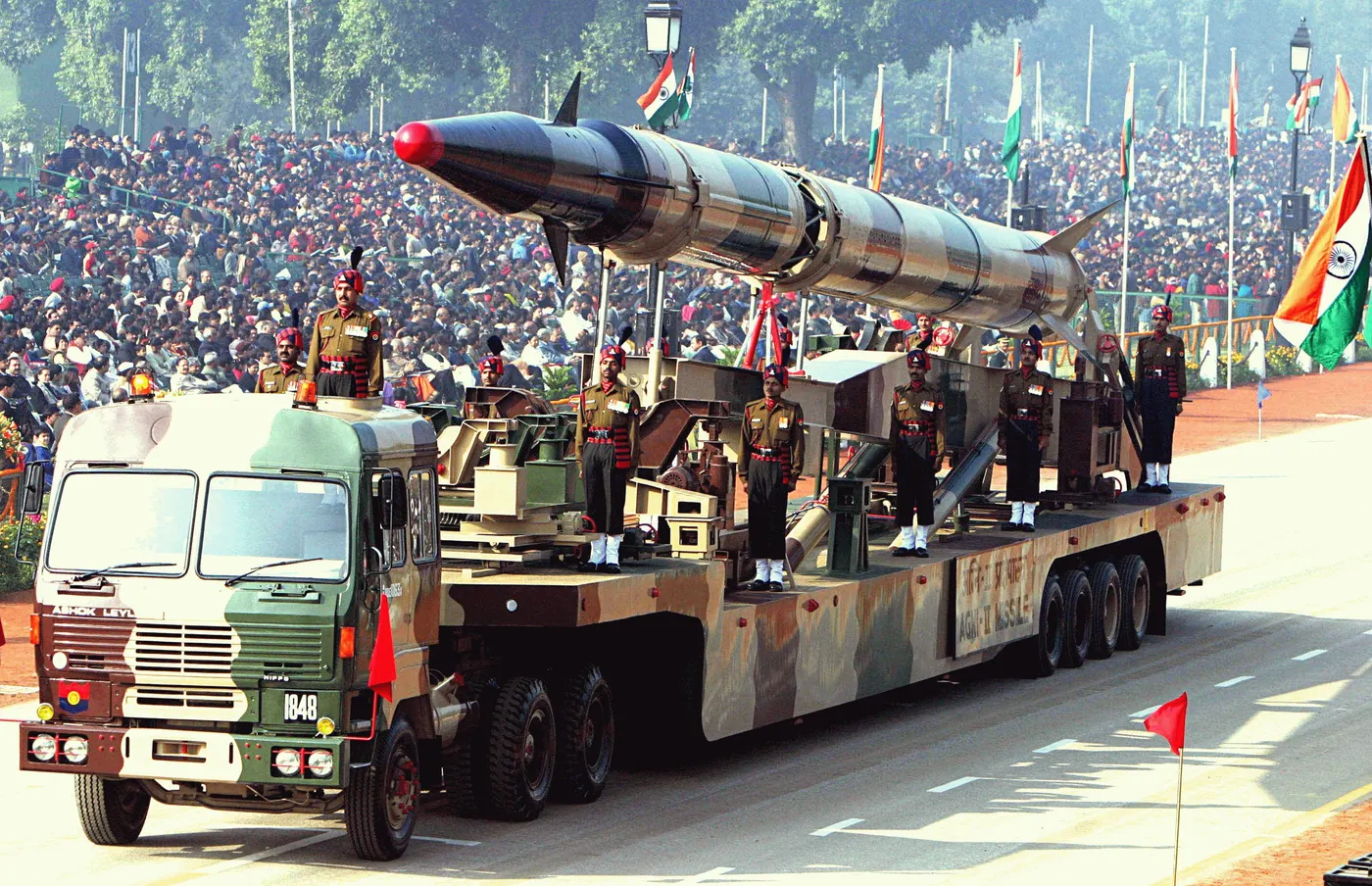

The Agni-II is an Indian two-stage, solid-fuel medium-range ballistic missile first flight-tested on 11 April 1999 from Wheeler Island off the Odisha coast.1 Built by the Defence Research and Development Organisation (DRDO) and integrated by Bharat Dynamics Limited, the Agni-II gave India's Strategic Forces Command its first missile with the reach to strike targets across all of Pakistan and into southern and southeastern China, closing a capability gap that the earlier, shorter-ranged Agni-I could not fill.2,1 Unlike most road-only mobile missiles of its generation, the Agni-II was cleared to fire from both wheeled transporter-erector-launchers and specialized rail cars from the very start of its test program, an unusual dual-basing arrangement that would not become common in India's missile force again until the newer Agni-P two decades later.1,3
- Solid-fuel propulsion, quick to prepare and fire
- Road-mobile and rail-mobile basing, hard to target preemptively
- Reach covers all of Pakistan and much of southern China
- Carbon-carbon composite re-entry vehicle survives high-speed re-entry heating
- Not canisterized, longer exposure time versus later Agni-III/Agni-P
- Reported accuracy (30-40 m CEP) trails the newest Agni variants
- Two consecutive user-trial failures in 2009 delayed full operational certification
- Small fleet, roughly a dozen missiles built across the whole production run
How does the Agni-II missile work, and why does India still keep an aging design like this in service alongside newer Agni-P and Agni-III missiles? The short answer is that the Agni-II was never fully retired even after more capable successors arrived, because it still fills a specific medium-range slot in the Strategic Forces Command's order of battle that those newer systems have only partly absorbed.4 The missile carries a single warhead, either a nuclear payload reported at 150 to 200 kilotons or a conventional high-explosive alternative, out to a commonly cited operational range of 2,000 to 3,500 kilometers depending on the payload carried.1,5 Indian officials have described the Agni-II ballistic missile as operationally ready with a nuclear warhead since shortly after its first test, a statement that outran the missile's actual reliability record by roughly a decade.6
Reported unit costs for the Agni-II missile run around ₹25 to 35 crore, roughly $2.6 to $3.7 million, and only about a dozen missiles are believed to have been built across the program's entire run, a small fleet even by the standards of other Indian strategic systems.4 That scarcity is partly a legacy of the missile's own rocky test record. Two consecutive user trials failed in 2009 before the missile was finally certified from a production-lot round in 2010, and only after several further successful trials through 2014 did the Agni-II settle into the reliable, low-profile deterrent role it occupies today.7
The Two-Stage Solid-Fuel Motor and Post-Boost Vehicle
The Agni-II missile stands roughly 20 meters tall (some sources give 21 meters) with a diameter of about 1 meter and a launch weight commonly cited at 16,000 to 17,000 kilograms, figures that vary slightly across CSIS Missile Threat, Wikipedia, and other open sources because India has never published an authoritative specification sheet.1,9 Both rocket stages burn solid propellant, a deliberate choice over the liquid-fueled missiles India had relied on earlier, because solid motors do not require the lengthy, hazardous fueling sequence that liquid-fueled systems like Pakistan's rival Ghauri family need before launch.1 A Post-Boost Vehicle is integrated directly into the missile's re-entry vehicle rather than built as a separate bus stage, a compact design also used on the later, shorter-ranged Agni-P.9
- Missile Classmedium_range_ballistic_missile
- Designerdefence_research_and_development_organisation
- Length20 m
- Diameter1 m
- Launch Weight17,000 kg
- In ServiceYes
Development work on the two-stage motor and the wider missile began in July 1997 at DRDO's Advanced Systems Laboratory, working alongside several other DRDO facilities before the missile's first flight less than two years later.1 That short timeline reused test infrastructure and re-entry technology already proven on the earlier Agni-I demonstrator, letting DRDO move to flight testing far faster than a fully clean-sheet program would have allowed.
- Propulsion Typetwo_stage_solid_fueled_rocket
- Number of Stages2
- Fuel Typesolid_fuel
- Solid-FuelYes
- CanisterizedNo
Guidance, Re-Entry, and the Circular Error Probable Debate
The Agni-II uses an inertial navigation system reportedly supplemented by GPS aiding for mid-course correction, described in some sources as a ring-laser-gyro inertial platform combined with multi-constellation satellite navigation.9 Reported circular error probable (CEP) figures range from 30 to 40 meters, respectable for a missile of this generation but a clear step behind India's newest inertial-gps guided systems.1,9 Some accounts describe a later terminal guidance upgrade using radar scene matching, evolving toward active radar homing on later-production missiles, though independent confirmation of that specific upgrade is thin and it should be treated cautiously rather than as a confirmed baseline feature.9
- Minimum Range2,000 km
- Maximum Range3,500 km
- Throw Weight1,000 kg
The re-entry vehicle itself is built from a carbon-carbon composite material chosen specifically for its light weight and its ability to survive the intense thermal stress of atmospheric re-entry at several kilometers per second.2 Reported maximum speed for the re-entry vehicle runs near 3.5 kilometers per second, roughly Mach 11, at a flight ceiling in the low hundreds of kilometers.9 The Agni-II carries a single re-entry vehicle rather than multiple independently targetable warheads, so it has no MIRV capability, unlike some contemporary Russian and Chinese systems in the same broad missile class.1 India's disclosed nuclear yield figures for the Agni-II, in the 150 to 200 kiloton range, are consistent with a boosted-fission design rather than a confirmed staged thermonuclear weapon, and no source reviewed here claims the Agni-II specifically carries a thermonuclear warhead.1
- Circular Error Probable (CEP)40 m
- Guidance TypeInertial / GPS
Rail-Mobile and Road-Mobile Basing Before Canisters Arrived
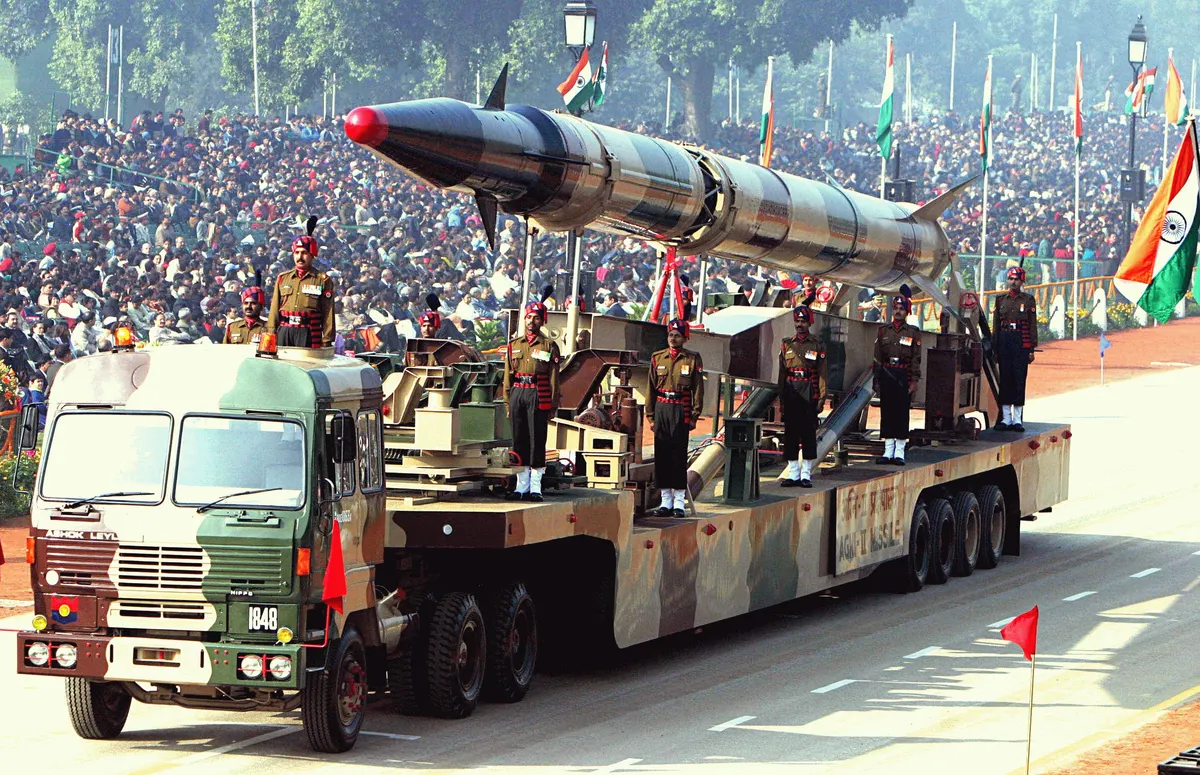
India's Agni-II normally rides on an Ashok Leyland or Tata Motors transporter-erector-launcher (TEL) for road-mobile deployment, but the missile's very first flight test in 1999 was launched from a rail-mobile launcher, a rarer basing arrangement that only a handful of nuclear states have ever fielded.1,8 That rail option gives the Strategic Forces Command an added layer of dispersal across India's rail network alongside conventional road convoys, complicating any attempt to track and preemptively target the missile's launch platforms.
- Warhead Typenuclear_high_explosive_thermobaric
- NuclearYes
- MIRVNo
- Warhead / RV Count1
- Conventional-CapableYes
Unlike the canisterized Agni-III and Agni-P missiles that followed it, the Agni-II is not stored inside a sealed launch canister. It sits in the open on its TEL or rail car during transport and erection, which means longer exposure time and a slower launch sequence than India's newer, fully canisterized systems.10,11 DRDO only introduced true canister-based Agni launches with the Agni-III program roughly a decade after the Agni-II's debut, and India's most recent canisterized rail-mobile tests, conducted with the shorter-ranged Agni-Prime in 2025, use a fundamentally different sealed-tube launch method than anything the Agni-II itself ever employed.8,10
- Basing Moderoad_mobile_rail_mobile
- Silo-BasedNo
- Road-Mobile (TEL)Yes
- Rail-MobileYes
- Submarine-LaunchedNo
That basing gap is one of the clearest technical dividing lines between the Agni-II and the newer missiles meant to eventually take over its medium-range role, even though both share the same broad solid-fuel, rail-and-road-mobile design approach that DRDO first proved out on the Agni-II two decades earlier.
- First Test1999
DRDO, the IGMDP, and the Road to a Two-Stage Agni
The Agni-II grew out of India's Integrated Guided Missile Development Programme (IGMDP), a state-run effort launched in the early 1980s under DRDO scientist APJ Abdul Kalam, who served as the programme's Project Director from 1983 to 1992 before later becoming India's president.12 The IGMDP originally conceived the Agni project as a technology demonstrator, proving re-entry vehicle survivability on a single-stage vehicle that first flew in 1989, years before any operational Agni missile existed.12 That demonstrator became the basis for the short-ranged Agni-I, and DRDO then stretched the concept into a genuine two-stage, longer-ranged system that emerged as the Agni-II.1
India had actually paused Agni flight testing for roughly five years, from 1994 to 1999, under sustained diplomatic pressure from the United States and other governments worried about a South Asian missile race.6 The Agni-II's 11 April 1999 test broke that pause decisively, and it followed India's May 1998 nuclear weapons tests at Pokhran by less than a year, tying the missile directly to India's newly declared nuclear-weapon status rather than to the earlier, more ambiguous Agni-I technology demonstrator.6
The 11 April 1999 Test and a Fast-Moving South Asian Missile Race
On 11 April 1999, the Agni-II flew roughly 1,400 kilometers downrange from Wheeler Island, a restrained test profile well short of the missile's full advertised range but enough to prove the design.6 Just days later, on 15 April 1999, DRDO chief APJ Abdul Kalam told reporters the missile was already operationally ready for deployment with a nuclear warhead, a bold claim that Indian officials would later have to walk back somewhat once quality-control problems surfaced a decade afterward.6
Pakistan answered almost immediately. Islamabad test-fired its own Ghauri-II missile on 14 April 1999, just three days after the Agni-II's debut, and followed with a Shaheen-I test on 15 April, an unmistakable test-for-test response pattern that alarmed Western governments watching the exchange.6,13 China's reaction was more divided. Civilian defense analysts in Beijing argued India's test posed no serious near-term threat given the years India would still need to fully weaponize its warheads, while hawkish military think tanks pushed for at least a moderate buildup of Chinese nuclear forces along the Indian border in response.14 The scholar Air Commodore Jasjit Singh summed up the deeper logic at the time by noting that India's nuclear posture had been driven essentially by the China factor since the early 1960s, with Pakistan treated by New Delhi as a secondary concern by comparison.14 A second Agni-II flight test followed in January 2001, again flown close to the missile's advertised range, further consolidating the design ahead of formal service entry.15
Quality Control Failures in 2009 and the Long Road to Certification
Kalam's 1999 claim of operational readiness proved premature. Two consecutive Strategic Forces Command user trials, on 19 May 2009 and again on 23 November 2009, failed when the missiles deviated from their planned flight paths and crashed into the sea, embarrassing failures traced to manufacturing quality-control problems in the production missiles rather than to any flaw in the underlying design.1 Those failures forced a pause for corrective work before DRDO and the Army were willing to certify another production-lot missile for service.
The fix worked. On 17 May 2010, a production-lot Agni-II user trial flown from Wheeler Island succeeded, covering the full flight profile in roughly 660 seconds before splashing down at its predesignated target, the first fully successful production-batch trial after the 2009 failures.1 Further successful Strategic Forces Command trials followed on 30 September 2011, 9 August 2012, 7 April 2013, and 9 November 2014, each one further validating the missile's reliability under real operational conditions rather than under controlled development testing.1 By the time of that later trial run, the Agni-II had effectively earned the operational status Kalam had claimed for it more than a decade earlier.
Induction into the Strategic Forces Command and the 335 Missile Group
India formed its tri-service Strategic Forces Command in January 2003 specifically to control the country's growing arsenal of nuclear-capable missiles, and the Agni-II entered SFC service not long afterward, generally dated to around 2004 even though its full operational certification did not really firm up until the successful trials of 2010 and beyond.2,1 Day-to-day custody of the missile fell to the 335 Missile Group of the Regiment of Artillery, based near Secunderabad, a location chosen in part for its proximity to Bharat Dynamics Limited's missile integration facilities.1 Roughly a dozen transporter-erector-launchers were built for the unit, though U.S. Air Force intelligence assessments as of 2017 estimated fewer than ten launchers were operationally deployed at any given time.1
The Agni-II operates within India's broader declared no-first-use nuclear doctrine, announced in 2003, meaning the missile is postured as a retaliatory weapon rather than a first-strike system, part of what analysts increasingly describe as an emerging Indian nuclear triad spanning land-based missiles like the Agni family, air-delivered weapons, and more recently sea-based systems aboard India's ballistic-missile submarines.2 Even as a modest, aging land-leg contributor to that broader posture, the Agni-II remains one of the longest-serving Agni-family missiles still formally listed in service.
DRDO briefly pursued an extended-capability successor called Agni-II Prime, testing a more advanced, lighter two-stage design once in 2010 with a reported range out to roughly 3,000 to 4,000 kilometers.16 That single flight test failed, and rather than continue development under the Agni-II Prime name, DRDO folded the effort into what became the separately designated Agni-IV, first tested successfully in November 2011 after an earlier failed December 2010 attempt.16 The Agni-II Prime is best understood as an intermediate development step bridging the capability gap between the Agni-II and the longer-ranged Agni-III, rather than as a direct production variant of the Agni-II carried into service under its own name.
Beyond that aborted extended-range effort, open-source reporting does not describe distinct hardware variants, block upgrades, or sub-models of the Agni-II comparable to the Mod 1/Mod 2 split seen on some other countries' medium-range missiles. India's own public statements have occasionally referenced incremental guidance and re-entry vehicle improvements across the production run, most notably the disputed terminal-guidance upgrade mentioned above, but no source reviewed here documents a formally separate variant designation carried by the missile itself.9 That relative continuity, one basic design fielded with only minor internal refinements across more than two decades, is itself a notable contrast with how quickly DRDO iterated through the later Agni-III, Agni-IV, and Agni-V programs.

India is the Agni-II's only operator, and the missile has never been exported, licensed for foreign production, or offered for sale abroad, consistent with India's general practice of keeping its longer-range strategic missiles entirely in domestic service.1 The Strategic Forces Command's 335 Missile Group at Secunderabad has operated the type since roughly 2004, with the small declared fleet of about a dozen missiles and their associated transporter-erector-launchers representing one of the more modest force postures among the world's operational medium-range nuclear missile fleets.1

That small fleet size reflects both the Agni-II's troubled early reliability record and India's broader doctrine of maintaining a minimum credible deterrent rather than a large numerically driven missile force. Newer Agni-P missiles, canisterized and quicker to deploy, are gradually expected to take over more of the medium-range mission that the Agni-II has quietly carried since the mid-2000s, though the Indian government has publicly denied any fixed timeline or formal decision to retire the Agni-I and Agni-II from service.17
Pakistan tested a nuclear-capable medium-range missile a full year before India's Agni-II ever flew, and that chronological head start shaped much of how the two countries' missile programs have been compared ever since. Pakistan's Ghauri-I, first tested on 6 April 1998, borrowed heavily from North Korean Nodong missile technology and burns liquid propellant, a fuel choice that requires a lengthy, hazardous pre-launch fueling procedure the Agni-II's solid-fuel design simply does not need.13 That single difference cascades through almost every other point of comparison between the two missiles. The Ghauri-I needs substantially more time between a launch order and an actual liftoff, while the solid-fueled Agni-II can be readied and fired far more quickly once its launch crew receives orders, a real operational edge in any crisis where warning time is short.13
Range tells a similar story. Pakistan's Ghauri-I is generally credited with a maximum range around 1,300 to 1,500 kilometers, reaching roughly 2,300 kilometers in later Ghauri-II testing with a reduced payload, well short of the Agni-II's commonly cited 2,000 to 3,500 kilometer envelope.13 India's own open-source press regularly frames the Agni-II as more accurate and technically more mature than Pakistan's Ghauri and Shaheen missile families, though independent verification of exact accuracy figures for either side's arsenal remains limited, and both countries' own official statements should be read with that caveat in mind.13
| Spec | Agni-II | Ghauri-I |
|---|---|---|
| Propellant | Solid, two-stage | Liquid, single-stage |
| Max range | ~3,500 km | ~1,300-1,500 km |
| Basing | Road and rail mobile | Road mobile |
| First test | 11 April 1999 | 6 April 1998 |
The two missiles have never fought each other and neither has ever been fired at a real target, but their near-simultaneous test histories in April 1999 made them the clearest symbol of the broader India-Pakistan missile competition of that era. Against China, the comparison runs differently. The Agni-II's reach into Tibet and parts of southeastern China puts it in the same rough performance class as shorter-legged elements of China's own DF-21 family, though China's far larger and more diverse missile force, spanning everything from theater-range systems up to intercontinental weapons, means the Agni-II functions as only a partial counter to Chinese capabilities rather than a like-for-like rival the way it is against Pakistan's Ghauri-I.14


What is the range of the Agni-II missile? Open sources most commonly cite an operational range of 2,000 to 3,500 kilometers depending on payload weight, with a 1,000-kilogram warhead generally associated with figures toward the lower end of that range.1,5
Is the Agni-II still in service? Yes. The Agni-II remains formally in service with India's Strategic Forces Command, operated by the 335 Missile Group near Secunderabad, though it is a small, aging fleet that newer Agni-P missiles are gradually expected to supplement or eventually replace.1,17
What is the difference between the Agni-II and the Agni-III? The Agni-III is a longer-ranged successor, generally credited with roughly 3,500 to 5,000 kilometers of range, and it introduced canisterized launch to the Agni family, a sealed-tube storage and launch method the Agni-II never used.10
How accurate is the Agni-II missile? Reported circular error probable figures range from about 30 to 40 meters, based on an inertial navigation system reportedly supplemented by GPS aiding, though India has never published an official accuracy figure.1,9
Who manufactures the Agni-II missile? The Defence Research and Development Organisation designed the Agni-II, with Bharat Dynamics Limited handling production integration, consistent with how DRDO develops most of India's Agni-family missiles.2
What is the Agni-II missile's unit cost? Reported figures put the unit cost around ₹25 to 35 crore, roughly $2.6 million to $3.7 million, though only about a dozen missiles are believed to have been built across the entire production run.4
- "Agni-II", Wikipedia — en.wikipedia.org) ↩
- "Agni Missile Series: India's Strategic Ballistic Missile Family from Agni-I to Agni-V and MIRV", Anantam IAS — anantamias.com ↩
- "Agni-P", Wikipedia — en.wikipedia.org ↩
- "Agni-II", Missile Threat, CSIS — missilethreat.csis.org ↩
- "Agni Missile, History, Types, Range, Significance, UPSC Notes", Vajiram and Ravi — vajiramandravi.com ↩
- "India, Pakistan Test New Missiles; U.S. Urges Restraint", Arms Control Association — armscontrol.org ↩
- "Agni-II | Military Wiki", Fandom — military-history.fandom.com ↩
- "India Just Launched A Ballistic Missile From A Train", The War Zone — twz.com ↩
- "Agni-II", Grokipedia — grokipedia.com ↩
- "Agni-V Canister Launch, Facts and Implications", Modern Diplomacy — moderndiplomacy.eu ↩
- "India Successfully Launches Agni-Prime Missile from Rail-Based Mobile Launcher", Overt Defense — overtdefense.com ↩
- "Integrated Guided Missile Development Programme", Wikipedia — en.wikipedia.org ↩
- "India vs Pakistan Missiles, Full Comparison Of Range, Speed And Power", The Daily Jagran — thedailyjagran.com ↩
- "Indian Missile Deployments and the Reaction from China", Carnegie Endowment for International Peace — carnegieendowment.org ↩
- "India Tests Agni-2 Ballistic Missile", Arms Control Association — armscontrol.org ↩
- "Agni-IV", Wikipedia — en.wikipedia.org ↩
- "On track, India's rail-based Agni-Prime", IISS — iiss.org ↩