


The DF-21A (Dongfeng-21A, NATO reporting name CSS-5 Mod 2) is a two-stage, solid-fuel, road-mobile medium-range ballistic missile that entered service with China's Second Artillery Corps in 1996. It is an accuracy-upgraded development of the baseline DF-21, the first Chinese ballistic missile to combine solid-fuel propulsion with a road-mobile transporter-erector-launcher, replacing the liquid-fuel DF-3 and DF-4 intermediate-range ballistic missiles that needed hours of exposed fueling before launch.1 Where the original DF-21 was reported to have a wide, roughly 700 meter circular error probable, the DF-21A tightened that figure substantially, though independent Western estimates still disagree by a wide margin on exactly how much.
- Road-mobile, hard to target preemptively
- Solid fuel allows rapid 10-15 minute launch prep
- Improved accuracy over baseline DF-21
- Proven JL-1-derived propulsion, mature by 1996
- Real-world CEP is disputed across sources (50-400m)
- Superseded in the pure-nuclear role by DF-21B/C
- No confirmed foreign operator, no export revenue
- Airframe dimensions themselves are disputed in open sources
The missile's motor technology traces back to the JL-1 submarine-launched ballistic missile program, a rare case of a design moving from submarine to land rather than the more usual reverse path.2 Fielded by the People's Republic of China, the DF-21A gave the People's Liberation Army a quick-reaction, mobile nuclear strike option that was far harder for an adversary to locate and destroy than the fixed, silo-based systems it displaced. Launch preparation time is consistently cited at 10 to 15 minutes, a dramatic reduction from the hours required to fuel a DF-3.3
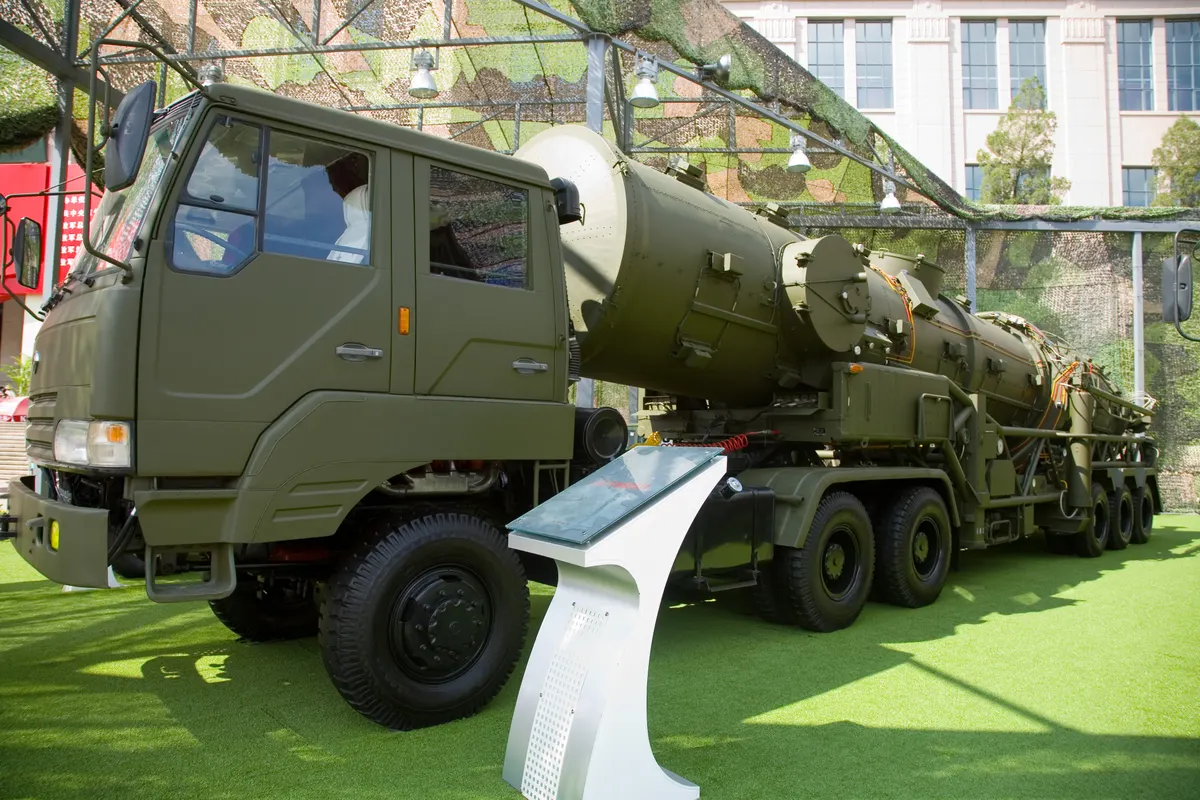
Chinese sources and Western analysts do not fully agree on the DF-21A's physical dimensions. CSIS's Missile Threat project describes a stretched 12.3 meter airframe with a modified nose section, while most other open-source assessments, including Wikipedia and the Federation of American Scientists, give the same 10.7 meter length, 1.4 meter diameter, and roughly 14,700 kilogram launch weight as the baseline DF-21.4 That disagreement matters for anyone researching DF-21A specifications, because it changes how the accuracy upgrade is explained. The majority view, that the airframe stayed essentially the same and only the guidance package improved, is treated as the safer baseline in this article.
The strategic case for the DF-21A was straightforward even before its exact accuracy could be pinned down. A road-mobile missile that could be erected and fired within 10 to 15 minutes was far harder for satellite or signals intelligence to catch in a vulnerable, fueling state than the liquid-fuel DF-3 and DF-4 it replaced, and mobility meant a strike planner could never be fully certain where a given launcher was at any moment. That survivability, not raw range or a single warhead's yield, is what let planners in Beijing treat the DF-21A as a credible retaliatory weapon rather than a first-strike asset that had to be used quickly or risk being destroyed on the ground.
A JL-1-Derived Two-Stage Solid Motor
The DF-21A retains the two-stage, solid-propellant architecture of the baseline DF-21, using solid-fuel charges based on a polybutadiene mixed-fuel formulation that traces directly to the JL-1 submarine-launched ballistic missile, first flown from a Type 031 (Golf-class) submarine on 12 October 1982.2 Directing the JL-1's solid-fuel technology onto land as a road-mobile missile was a deliberate decision credited to Chinese defense scientist Zhang Aiping, and it is why the DF-21 family shares its motor with China's submarine deterrent rather than with the older liquid-fuel DF-3 and DF-4 land missiles it replaced.5 Two stages give the DF-21A a straightforward burn profile compared with liquid-fuel missiles, and solid propellant means the airframe can sit fueled and ready on its transporter for long stretches without the corrosive handling risks of liquid oxidizers.
- Missile Classmrbm
- Service Entry Year1996
- Designerchangfeng_mechanics_and_electronics_technology_academy
- Length10.7 m
- Diameter1.4 m
- Launch Weight14,700 kg
- In ServiceYes
Range, Accuracy, and the CEP Dispute
Reported maximum range for the DF-21A clusters around 1,770 kilometers, with some assessments citing figures up to roughly 2,150 kilometers and a practical minimum near 500 kilometers.1 That range is enough to reach targets across northern India, Central Asia, the Russian Far East, and much of Southeast Asia from launch positions well inside Chinese territory, closing a coverage gap left as the slower DF-3 retired from service.
- Propulsion Typesolid_fuel_rocket
- Number of Stages2
- Fuel Typesolid
- Solid-FuelYes
- Cold-LaunchNo
That spread, anywhere from 50 meters to 400 meters depending on the source, is frequently cited in arms-control literature as a textbook example of how hard it is to pin down Chinese missile accuracy from open information alone, since none of the underlying figures come from disclosed Chinese test data.3 Guidance is inertial, driven by a digital computing complex, and some assessments credit the DF-21A upgrade with an added terminal guidance element beyond the baseline DF-21's pure inertial navigation, which is the most plausible explanation for the accuracy gain regardless of which CEP figure is closest to reality.
- Maximum Range1,770 km
Warhead and Payload
The DF-21A carries a single non-maneuvering reentry vehicle, distinguishing it from the maneuverable reentry vehicle later fitted to the DF-21B and DF-21D. Estimated nuclear yield runs from roughly 200 to 300 kilotons by FAS's numbers up to 250 to 500 kilotons in CSIS's assessment, with warhead section mass put at around 600 kilograms.5 Some sources mention a conventional high-explosive payload option for the DF-21A, but that role is far more firmly documented for the later, GPS-guided DF-21C. A conventional DF-21A payload remains unconfirmed rather than established.
- Circular Error Probable (CEP)200 m
- Terminal GuidanceYes
- Maneuverable Re-Entry Vehicle (MaRV)No
The HY4260S Road Train and Launch Sequence
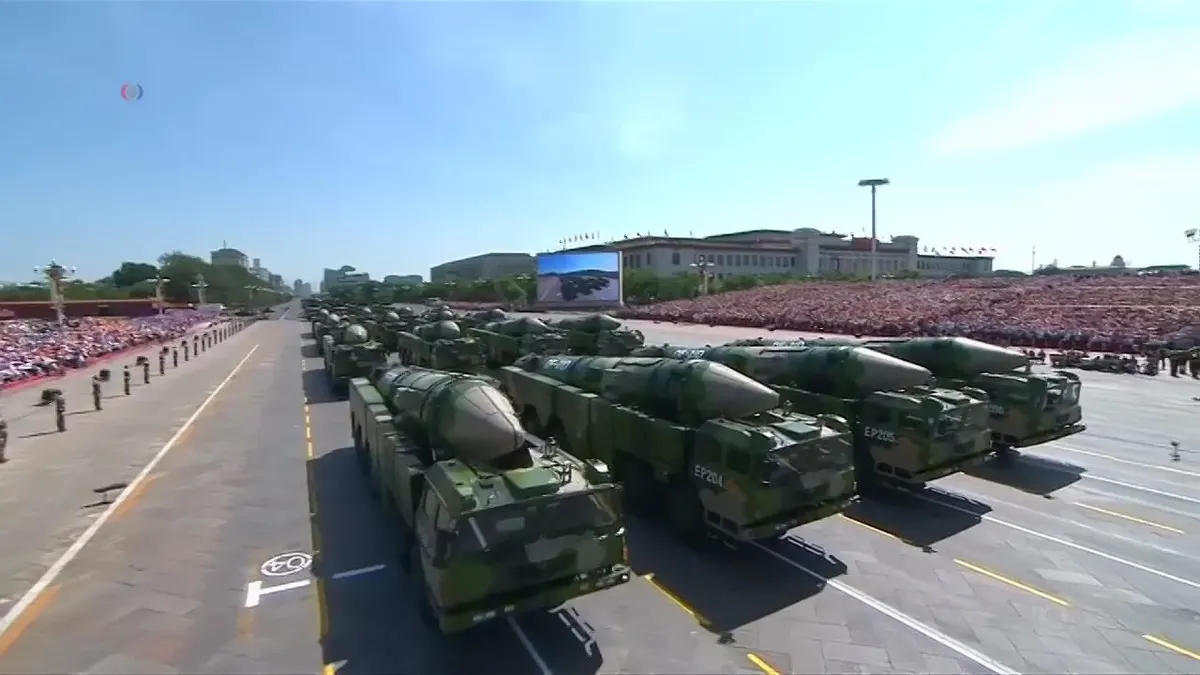
The DF-21A rides on a semi-trailer transporter erector launcher rather than a fully integrated wheeled vehicle. Specialist sources identify the trailer as an HY4260S road train rated for a 26.5 ton payload, towed by an HY-472 tractor unit with a V-12 diesel engine, while other assessments cite a broadly similar HY473 (Type 82) 6x6 tractor capable of about 64 kilometers per hour and powered by a 355 horsepower KHD F12L413F diesel.6 Whichever tractor variant a given unit operates, the erect-and-fire sequence consistently takes 10 to 15 minutes, the figure that made the DF-21A survivable in a way the silo-bound DF-4 never was. Chinese and Western writing on the missile alike treats that short reaction time, rather than any single spec on the sheet, as the DF-21A's defining engineering achievement.
- Warhead Typenuclear
- NuclearYes
- ThermonuclearYes
- Yield (per warhead)300
- MIRVNo
- Warhead / RV Count1
- Conventional-CapableNo
- Basing Modemobile_launcher
- Silo-BasedNo
- Road-Mobile (TEL)Yes
- Submarine-LaunchedNo
- Operators1
- Explosive Filler Weight600 kg
From the JL-1 Submarine Missile to a Land-Based Deterrent
Work on the technology behind the DF-21 traces to 1967, when China's JL-1 submarine-launched ballistic missile program began under the National Defense Science and Technology Commission, and formal development of a land-based derivative started around 1976 at the Second Aerospace Academy (later known through its successor, the Changfeng Mechanics and Electronics Technology Academy).5 The JL-1 achieved its first land-based test launch on 30 April 1982 and its first submarine launch that October, and DF-21 flight testing followed through the mid-1980s.2 The baseline DF-21 reached initial operational capability with the Second Artillery Corps around 1989 to 1991, giving China its first solid-fuel, road-mobile ballistic missile after decades of liquid-fuel, fixed-site systems.
The improved DF-21A became operational in 1996, replacing the original DF-21 as the mainstay nuclear-armed member of the family while its guidance and, per some assessments, terminal accuracy were upgraded.3 Brigades were historically based well inland, with older order-of-battle assessments placing units near Kunming, Chuxiong, Jianshui, and Tonghua, positions chosen to cover targets in Central Asia, the Russian Far East, and South Asia rather than the coastal, Taiwan-facing missions that later Dongfeng variants took on.7
Later Family Growth
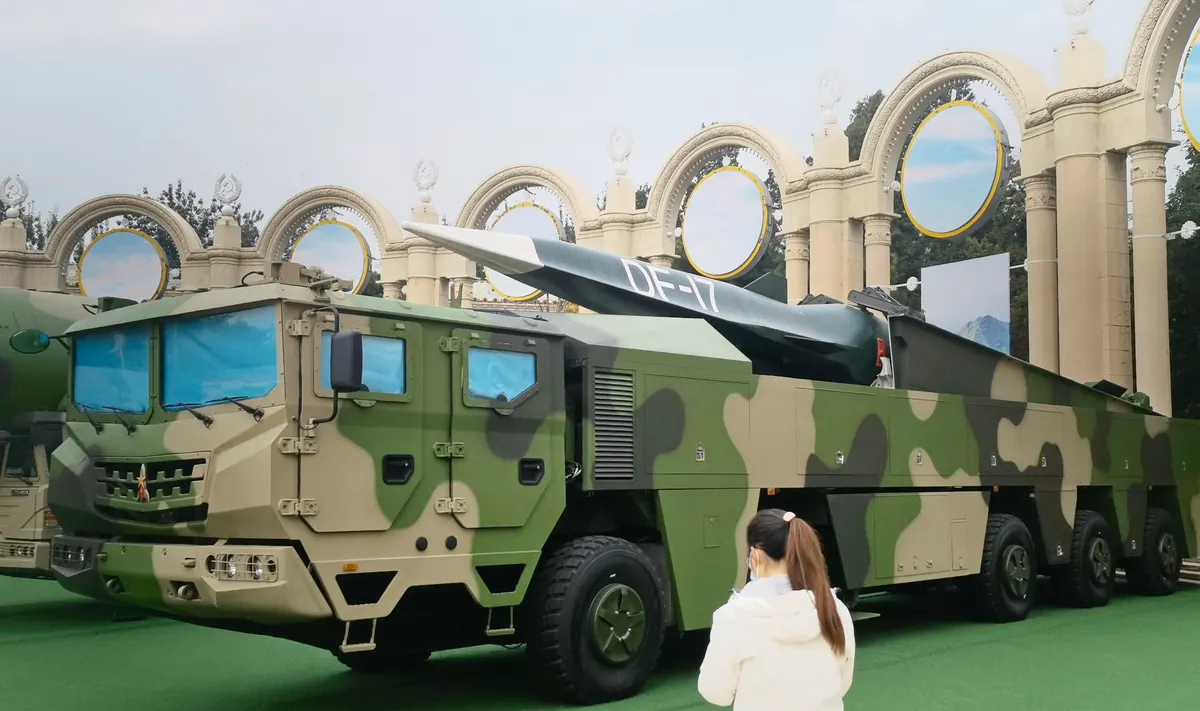
Development did not stop with the DF-21A. The DF-21C appeared publicly around 2006 with GPS-aided terminal guidance and a dual nuclear-conventional role, giving China a Dongfeng-21 variant that could hit a fixed target with far greater confidence than the DF-21A's disputed CEP figures ever allowed.4
The DF-21D anti-ship ballistic missile followed in the 2010s as the world's first operational weapon of its kind, built to engage moving carrier groups rather than fixed land targets, a mission neither the DF-21A nor the DF-21C was designed for.4 Together the DF-21C and DF-21D moved the wider DF-21 line toward conventional precision strike, a role the dedicated nuclear DF-21A itself was never built to fill.
Seen from the DF-21A's own vantage point, this later branching is really a story about specialization overtaking a generalist design. The DF-21A had to combine range, a survivable launcher, and enough accuracy to threaten a broad target set with a single nuclear warhead. Its successors instead split that job three ways, trading the DF-21A's nuclear versatility for sharper conventional accuracy in the DF-21C and a wholly new naval mission in the DF-21D.
The DF-21A has no confirmed history of combat use, and it is important not to conflate it with the missiles China actually fired during the 1995 to 1996 Third Taiwan Strait Crisis. Those launches, six missiles fired near Taiwan as a coercive signal during Taiwan's first direct presidential election, were DF-15 short-range ballistic missiles, not DF-21s.8 The crisis is nonetheless widely credited as a catalyst for the PLA's subsequent investment in more advanced area-denial systems, culminating years later in the DF-21D anti-ship variant.
The DF-21A's operational value lay instead in extending Chinese nuclear coverage westward and northward. Brigades oriented toward Central Asia, the Russian Far East, and northern India filled the gap left as the older DF-3 retired, at a time when China's declared No First Use nuclear doctrine framed the missile as a survivable second-strike asset rather than a first-strike weapon.7 The force that operated it, the Second Artillery Corps, was reorganized and renamed the PLA Rocket Force on 1 January 2016, a change that reflected the growing size and diversified mission set of China's land-based missile arsenal rather than any change specific to the DF-21A itself.9
More recent open-source tracking by the Bulletin of the Atomic Scientists estimates 10 to 20 DF-21-family brigades in total, with newer conventional-strike units concentrated in the Eastern and Southern Theater Commands facing Taiwan and Japan, while a legacy nuclear DF-21A and DF-21B presence is believed to persist further inland, oriented toward the same India and Central Asia coverage the missile was originally built for.10
The DF-21 family branched considerably from the original design.
- DF-21 (base) is the original nuclear MRBM, China's first solid-fuel road-mobile missile, with pure inertial guidance and a wide, roughly 700 meter CEP.
- DF-21A is the improved-accuracy nuclear MRBM covered in this article, entering service in 1996 with a tightened but disputed CEP variously reported between 50 and 400 meters.
- DF-21B is a further nuclear improvement reportedly introducing a maneuverable reentry vehicle-type upgrade and enhanced terminal guidance, with some thinly-sourced claims of a CEP as tight as 10 to 20 meters that should be treated with caution given how little open documentation exists for this specific variant.
- DF-21C is a dual nuclear-conventional MRBM revealed around 2006, adding GPS-aided terminal guidance for conventional precision strike with an estimated 30 to 40 meter CEP.
- DF-21D is the anti-ship ballistic missile variant, the first operational weapon of its kind anywhere, built to engage moving carrier groups at a range US assessments put near 1,450 to 1,550 kilometers, versus Chinese claims of up to 2,700 kilometers.1
| Variant | Role | Guidance | Approx. CEP |
|---|---|---|---|
| DF-21 (base) | Nuclear MRBM | Inertial | ~700 m |
| DF-21A | Nuclear MRBM | Inertial, improved | ~100-300 m (disputed 50-400 m) |
| DF-21C | Nuclear/conventional MRBM | Inertial + GPS terminal | ~30-40 m |

The DF-21A has only ever been confirmed in service with China, operated first by the PLA Second Artillery Corps from 1991 through 2015 and by its successor, the PLA Rocket Force, from 2016 onward. No foreign sale of the DF-21A itself has been confirmed.5
Saudi Arabia is the one country with a documented history of buying Chinese ballistic missiles, but the well-documented 1987 sale, publicly displayed in April 2014 at Hafr al-Batin, was of the older liquid-fuel DF-3, not the DF-21A.11 Separate reporting by the Arms Control Association has suggested Saudi Arabia more recently acquired newer, DF-21-class missiles from China as well, reportedly without being blocked by US intelligence agencies, but that claim remains uncorroborated by officials on either side and should be read as unconfirmed rather than as evidence the DF-21A itself was exported.12
That gap between a well-documented DF-3 sale and a thinly-sourced DF-21-class rumor is itself informative. China has historically been far more willing to export its older, liquid-fuel missiles once they had left frontline service than to sell a solid-fuel design still forming the backbone of its own regional deterrent, which is a large part of why the DF-21A has no confirmed operator besides China itself.
Both the DF-21A and the Soviet Union's RSD-10 Pioneer (NATO SS-20 Saber) solved the same problem at the same moment in the Cold War, moving national medium-range nuclear deterrence off vulnerable liquid-fuel silos and onto solid-fuel, road-mobile transporter erector launchers. Only one of the two missiles still exists. The RSD-10 Pioneer was eliminated entirely under the 1987 Intermediate-Range Nuclear Forces Treaty, with 654 missiles and 499 launchers destroyed by 1991, because the Soviet Union and the United States were both signatories.13 China never joined that treaty, so the DF-21 family, including the DF-21A, has remained in continuous service and development for three decades past the point its Soviet counterpart was scrapped.
The RSD-10 Pioneer was also a considerably larger missile, standing 16.5 meters tall with a 1.9 meter diameter and a 37.1 ton launch weight on its MAZ-547A/7916 launcher, dwarfing the DF-21A's roughly 10.7 meter, 14.7 ton airframe, and it could carry up to three MIRV warheads on some variants against the DF-21A's single reentry vehicle.13 The RSD-10 traded that bulk for intermediate range out to roughly 5,000 kilometers, well beyond the DF-21A's sub-2,200 kilometer envelope. That reflects a different regional geometry. Soviet planners needed to threaten all of Western Europe from launch sites deep inside the USSR, while Chinese planners needed shorter reach against neighbors along its western and northern borders.
Within its own family, the DF-21A's real point of comparison is the baseline DF-21 it replaced. Both share the same JL-1-derived two-stage solid motor and roughly the same physical envelope, so the entire case for the DF-21A designation rests on the accuracy improvement, whichever of the disputed CEP figures a reader takes as authoritative.


Is the DF-21A still in service? Some DF-21A units are believed to remain in China's inventory, though the missile has been substantially superseded in the pure-nuclear MRBM role by the more accurate DF-21B, and newer conventional-strike missions have shifted to the DF-21C and DF-21D.1
What is the range of the DF-21A missile? Open-source estimates put DF-21A range at roughly 1,770 kilometers, with some assessments citing a maximum near 2,150 kilometers and a practical minimum around 500 kilometers.1
How accurate is the DF-21A missile? Accuracy estimates vary widely, from an optimistic 50 meter circular error probable to a conservative 300 to 400 meters, with most open-source assessments converging somewhere between 100 and 300 meters.3
What is the difference between the DF-21A and the DF-21C? The DF-21A is a dedicated nuclear medium-range ballistic missile with inertial guidance, while the DF-21C, revealed around 2006, added GPS-aided terminal guidance and a dual nuclear-conventional role with a much tighter estimated CEP near 30 to 40 meters.4
Who manufactures the DF-21A missile? The DF-21 family was developed under China's state missile industry, with design work rooted in the Second Aerospace Academy and production associated with the Shanghai Academy of Spaceflight Technology under the China Aerospace Science and Technology Corporation.5
- "DF-21", Wikipedia — en.wikipedia.org ↩
- "JL-1", Wikipedia — en.wikipedia.org ↩
- "DF-21 (CSS-5)", CSIS Missile Threat — missilethreat.csis.org ↩
- "DF-21A / CSS-5 Mod 2 / DF-21B", ArmyRecognition — armyrecognition.com ↩
- "DF-21", FAS Nuclear Information Project — nuke.fas.org ↩
- "DF-21", Missilery.info — en.missilery.info ↩
- "China's Ballistic Missile Order of Battle", GlobalSecurity.org — globalsecurity.org ↩
- "Third Taiwan Strait Crisis", Wikipedia — en.wikipedia.org ↩
- "People's Liberation Army Rocket Force", Wikipedia — en.wikipedia.org ↩
- "Chinese Nuclear Weapons, 2025", Bulletin of the Atomic Scientists — thebulletin.org ↩
- "Saudi Arabia Displays Missiles", Arms Control Association — armscontrol.org ↩
- "Saudi Rattles Its Saber", NTI — nti.org ↩
- "RSD-10 Pioneer", Wikipedia — en.wikipedia.org ↩