

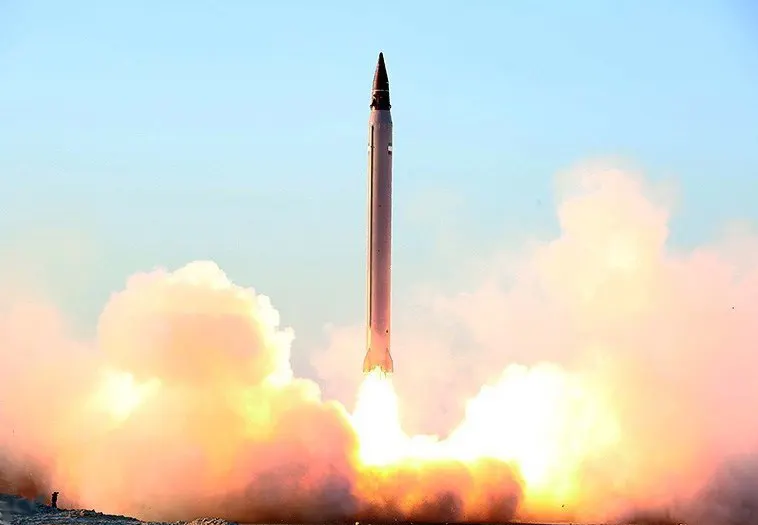

The Emad (Persian for Pillar) is a liquid-fuel medium-range ballistic missile built by Iran around a modified Shahab-3/Ghadr-110 airframe fitted with a new maneuverable reentry vehicle. Unveiled on 11 October 2015 by then-Defense Minister Hossein Dehghan, Emad was presented as Iran's first missile that could be guided and controlled all the way to the target, a claim that made it, at least on paper, the country's first genuinely precision-guided ballistic missile rather than an unguided artillery rocket scaled up to strategic range.1,2 The name draws from Emad ad-Din, a term meaning pillar of the faith, and the missile is still fielded exclusively by the Islamic Revolutionary Guard Corps (IRGC) Aerospace Force, the branch responsible for Iran's entire ballistic missile inventory.16
- maneuverable reentry vehicle improves accuracy over unguided Shahab-3
- shares TEL and basing infrastructure with existing Shahab-3/Ghadr-110 fleet
- combat-tested against a peer air-defense network (Israel)
- road-mobile, no new production line needed for the airframe
- liquid propellant means longer launch preparation than solid-fuel rivals
- real-world CEP measured far worse than Iran's claimed 50 m figure
- small inventory, high unit cost limits how often it can be fired
- never independently verified against a moving or hardened target
Emad specifications list a declared range of 1,700 km, a payload (throw weight) of 750 kg, and a body diameter of 1.25 m carried over almost unchanged from the Shahab-3 family.2,3 What changed was the nose. Where the Shahab-3's warhead simply fell along a ballistic arc, the Emad's reentry vehicle carries small fins and an internal guidance package that steers the warhead during its final descent, a maneuverable reentry vehicle in the same technical sense used by American and Russian precision-strike systems, and one the glossary here files under maneuverable reentry vehicle.1,4 Iran claims this cuts the Emad's circular error probable to as little as 50 meters, though independent analysis of its one confirmed combat use puts the real figure far higher, a gap covered in Conflicts below.
Despite a decade in service, the Emad missile remains a modest production item. Iran is not known to have exported it (unlike the older Shahab-3, which Syria and others acquired technology from), and estimates of the active inventory run to dozens rather than hundreds of missiles, a reflection of both a unit cost in the low millions of dollars and the limited domestic capacity to hand-finish precision reentry vehicles at scale.9 The missile remains road-mobile, launched from wheeled transporter-erector-launchers shared with the Shahab-3 and Ghadr-110 fleets and increasingly stored in Iran's hardened underground missile bases between drills.
Because Emad shares almost its entire airframe with the Shahab-3 and Ghadr-110, the real story of this missile is in the warhead, not the rocket. That distinction matters for how the missile actually performs, and for how it should be read against Iran's later, purpose-built precision systems like Kheibar Shekan and Haj Qasem.
A Single-Stage Missile Wearing a New Nose
Reporting sometimes describes the Emad as a two-stage design, but the weapon is built and analyzed as a single-stage, liquid-propellant missile. What Iran actually changed was the payload section. CSIS's Missile Threat project and GlobalSecurity.org both describe the Emad as a reentry vehicle fitted for placement atop an existing Shahab-3 or Ghadr rocket body, not a rebuilt or lengthened booster.2,3 The missile's overall length is reported at roughly 16 to 16.5 m (some Iranian broadcasts cite 15.5 m), with a launch mass in the range of 17 to 19 tons, numbers that track the Shahab-3 closely because the first stage genuinely is the Shahab-3's.2,13
- Missile ClassMedium Range Ballistic Missile
- Service Entry Year2015
- DesignerIran
- Diameter1.25 m
- In ServiceYes
That single-stage liquid engine burns the same UDMH/nitric-acid propellant combination Iran inherited from its original Shahab-3 program (itself derived from North Korea's No Dong missile), which is why Emad batteries still need a fueling sequence before launch, a real disadvantage against solid-fuel systems like Sejjil or Kheibar Shekan that can be launched from cold storage within minutes.
- Propulsion Typeliquid-fuel
- Number of Stages1
- Fuel Typeliquid fuel
- Solid-FuelNo
- Cold-LaunchNo
- CanisterizedNo
The Maneuverable Reentry Vehicle and Its Accuracy Claims
The actual innovation sits in the nose cone. Emad's redesigned reentry vehicle carries small tail fins and an internal navigation and control package, letting the warhead adjust its flight path during the final seconds of descent rather than falling ballistically like the Shahab-3's original warhead.1,4 Iran states this terminal steering, combined with inertial guidance and (on later variants) satellite-aided updates, delivers a circular error probable of around 50 meters, an order of magnitude tighter than the roughly 2,500 m CEP attributed to the baseline Shahab-3.2
- Maximum Range1,700 km
- Throw Weight750 kg
Emad's warhead carries a conventional high-explosive payload of up to 750 kg and detonates in an air-burst mode designed to maximize blast effect against area targets, though the same airframe and reentry geometry are understood by Western analysts to be adaptable to a chemical, biological, or nuclear payload, the basis for the nuclear-capable designation Western governments still apply to the whole Shahab-3 derivative family even though Iran has never declared a nuclear warhead program for it.7
- Circular Error Probable (CEP)500 m
- Guidance TypeInertial / GPS
- Terminal GuidanceYes
- Maneuverable Re-Entry Vehicle (MaRV)Yes
Road-Mobile Launch and Underground Basing
Like the rest of Iran's Shahab-3 derived fleet, the Emad missile launches from a wheeled road-mobile transporter-erector-launcher rather than a fixed silo, letting individual batteries disperse and hide between firings. A state television broadcast in October 2025 showed upgraded Emad and Qadr missiles stored on TELs inside a buried IRGC missile city beneath Tehran, with launch crews moving between covered galleries and pre-surveyed firing points, and new electronic countermeasures on the companion Qadr variant meant to jam early-warning radar and reduce the launch's electromagnetic signature.13
- Warhead Typeconventional
- NuclearNo
- ThermonuclearNo
- MIRVNo
- Warhead / RV Count1
- Conventional-CapableYes
- Basing Moderoad-mobile
- Silo-BasedNo
- Road-Mobile (TEL)Yes
- Rail-MobileNo
- Submarine-LaunchedNo
- Operators1
- First Test2015
- Detonation Mechanism / Fuzeair burst
Iran unveiled the Emad missile on 11 October 2015 in a ceremony presented by Defense Minister Hossein Dehghan, who described it as the first Iranian missile capable of being guided and controlled until impact.1,4 The reveal came only months after Iran signed the Joint Comprehensive Plan of Action (JCPOA) with world powers, and the timing immediately drew scrutiny under the missile-related language of UN Security Council Resolution 2231, the resolution that endorsed the nuclear deal and called on Iran to refrain from work on missiles designed to be capable of delivering nuclear weapons.7
A confidential UN Panel of Experts report subsequently found the Emad test to be a violation of the older Resolution 1929, and on 29 March 2016 the United States, United Kingdom, France, and Germany sent a joint letter to the UN Secretary-General accusing Iran of defying Resolution 2231 through a further round of missile tests.5,6 The dispute never resulted in formal sanctions specific to the Emad program. Resolution 2231's missile language calls on Iran to refrain from such launches but is worded as a request rather than a binding prohibition, and most nonproliferation specialists concluded Iran had defied the resolution's spirit without technically violating an enforceable clause, a genuine and still-cited legal ambiguity.5
Days after the missile itself was unveiled, IRGC Aerospace Force commander Brigadier General Amir Ali Hajizadeh presented Iran's first acknowledged underground missile base, describing a network of tunnels scattered across the country at depths of around 500 m, explicitly tying the Emad's debut to Iran's broader hardened-basing strategy for its missile force.13,17 Hajizadeh had led the IRGC Aerospace Force since 2009 and remained its commander through the Emad's entire service life until an Israeli strike killed him at the opening of the June 2025 Twelve-Day War.17
Testing continued quietly after 2015. In January 2021, during the Great Prophet 15 exercise, Iran claimed to have used an antiship variant of the Emad, alongside Ghadr and Sejjil missiles, to strike a floating target roughly 1,800 km away in the northern Indian Ocean.14 The US Navy, tracking the exercise from the region, confirmed two Iranian missiles splashed down but stated they posed no threat to nearby shipping or to the USS Nimitz carrier strike group operating in the area, a far more modest outcome than Iran's own account.14
By October 2025, state broadcasts showed a further-upgraded Emad alongside the Qadr missile deep inside an IRGC underground facility, with officials emphasizing survivability through dispersed launch cells rather than any single new performance claim.13 Through all of this, the Emad's role in Iran's arsenal stayed consistent. It remains a modest-accuracy, decades-old airframe upgraded just enough to hold specific fixed targets at risk, sitting below the newer solid-fuel Kheibar Shekan and Haj Qasem missiles in Iran's own stated preference for precision strikes.
The Emad missile's only confirmed combat use to date has been against Israel. In January 2024, Iran's missile strikes on targets in Iraq's Kurdistan Region and Syria's Idlib Governorate, launched in retaliation for the Kerman bombings, used Kheibar Shekan and Fateh-110/Fateh-313 missiles instead, a distinction worth stating plainly since the Emad is often lumped in with that strike in casual reporting.18
Emad's actual combat debut came on 13 to 14 April 2024, during Operation True Promise I, Iran's first direct missile and drone attack on Israeli territory, launched in retaliation for the 1 April 2024 Israeli strike on Iran's consulate building in Damascus.8 Alongside roughly 170 Shahed-136 drones, 30 cruise missiles, and around 120 ballistic missiles, Iranian sources named the Emad among the ballistic missiles fired, together with Ghadr, Dezful, and Kheibar Shekan types.9 Most of the roughly 300 total projectiles were intercepted by a coalition of Israeli, American, British, French, and Jordanian air defenses, but at least five ballistic missiles reached Nevatim Air Base in southern Israel, damaging a C-130 transport aircraft, an unused runway, and empty storage buildings while the base stayed operational.9,10
That Nevatim strike produced the clearest independent read yet on Emad's real accuracy. Analysts at the James Martin Center for Nonproliferation Studies compared known F-35I hangar locations against the missiles' impact points and calculated an average circular error probable of about 1.2 km, roughly twenty-four times worse than Iran's claimed 50 m figure.10 The finding does not necessarily mean the missile is that inaccurate under ideal conditions, since a wartime salvo against a defended target involves interception attempts, decoys, and jamming that a controlled test does not, but it is the best public evidence available and it undercuts a decade of Iranian claims about the Emad's precision.
Fourteen months later, Emad missiles returned to Israeli skies during the Twelve-Day War of June 2025, Iran's response to Israel's surprise 13 June opening strikes on Iranian nuclear and military sites.
Iranian state media described the Emad, alongside Ghadr and Kheibar Shekan missiles, as part of Operation True Promise III, the retaliatory missile campaign that fired more than 550 ballistic missiles and roughly 1,000 drones over twelve days and struck population centers in Haifa and Tel Aviv, killing at least 28 Israeli civilians over the course of the war.11,12 Iranian commentary again framed the Emad's maneuverable reentry vehicle as the reason some missiles evaded Israel's Arrow 3, David's Sling, and Iron Dome layers, though as with the 2024 strike, independent confirmation of which specific impacts came from Emad versus Ghadr or Kheibar Shekan warheads remains difficult from open-source imagery alone.11
Beyond those two documented campaigns, Western analyses of Iran's broader missile posture during the wider 2026 Iran war continue to list the Emad among the mid-weight ballistic systems, alongside Kheibar Shekan, Sejjil, and Ghadr, capable of damaging reinforced buildings and fuel infrastructure, though public reporting on that ongoing conflict has not isolated Emad-specific strikes the way analysts did for Nevatim in 2024.19 Across all three conflicts, the pattern is consistent. Emad missiles fly in mixed salvos alongside other Shahab-3 derivatives and newer solid-fuel types, and open-source analysts can rarely credit a specific building or crater to the Emad alone rather than to a Ghadr or Kheibar Shekan fired in the same barrage.
The baseline Emad unveiled in October 2015 remains the reference configuration, a Shahab-3/Ghadr-110 airframe topped with the maneuverable reentry vehicle and a declared 1,700 km range.1 Iran has since shown at least two named follow-ons.
Emad-3, unveiled during Quds Day observances on 29 April 2022 alongside the newer Kheibar Shekan, was presented as an improved version with unspecified guidance refinements, built by the same Aerospace Industries Organization program without a public breakdown of what changed from the original Emad.15
An antiship variant of the Emad appeared in Iran's January 2021 Great Prophet 15 exercise, claimed to have struck a floating target at extreme range in the northern Indian Ocean, though the US military's own account of that test described a far more modest result than Iran's, and no antiship Emad has been confirmed in an actual naval engagement since.14
Most recently, an unnamed upgraded Emad appeared in Iranian state media in October 2025, displayed inside an underground missile complex alongside an upgraded Qadr missile carrying new electronic countermeasures, though officials did not specify whether the Emad itself received comparable electronic warfare upgrades or only shared the basing footage.13

Iran remains the Emad missile's only confirmed operator, fielded exclusively by the IRGC Aerospace Force since its 2015 introduction.1,16 Unlike the older Shahab-3, whose underlying technology and, in some reporting, complete missiles reached Syria and other regional partners, there is no confirmed export or transfer of the Emad itself to any other state or non-state actor. The missile's status as a still-sanctioned, precision-relevant system under Resolution 2231's missile language makes any such transfer politically costly even where Iran has exported other missile types.
Emad and Kheibar Shekan represent two different answers to the same problem, hitting a fixed point target inside Israel's air defense envelope. Kheibar Shekan is a purpose-built solid-fuel design that can launch within minutes of an order, while Emad keeps the Shahab-3's decades-old liquid-fuel airframe and TEL infrastructure, adding accuracy only in the reentry vehicle rather than rebuilding the missile from the ground up. That tradeoff shows up directly in the numbers.
| Emad | Kheibar Shekan | |
|---|---|---|
| Propulsion | Liquid fuel2 | Solid fuel15 |
| Declared range | 1,700 km2 | ~1,450 km15 |
| Declared CEP | 50 to 500 m (claimed)2,11 | Reported comparable or tighter15 |
| Basing | Road-mobile TEL13 | Road-mobile TEL15 |
The practical difference matters most in a saturation strike. Iran's own targeting doctrine, visible in both the April 2024 and June 2025 attacks, mixed Emad with Kheibar Shekan, Ghadr, and Dezful missiles in the same salvo rather than choosing one system exclusively, using the older Emad to add volume against a defended target set while the newer Kheibar Shekan carried the higher-confidence precision role.9,11 Emad's real advantage over Kheibar Shekan is production scale, since Iran can build it from the existing Shahab-3/Ghadr fleet without standing up a new production line. The 2024 Nevatim data suggests actual battlefield accuracy is where that advantage runs out.


What is the range of Iran's Emad missile? Iran's Emad missile has a declared range of 1,700 km, enough to reach all of Israel and much of the Arabian Peninsula from launch sites inside Iranian territory.2,3
How accurate is the Emad missile? Iran claims a circular error probable of around 50 meters, but the only independent measurement, based on the April 2024 strike on Nevatim Air Base, found dispersion closer to 1.2 km, far worse than the advertised figure.10
Is the Emad missile nuclear capable? Iran states the Emad carries a conventional high-explosive warhead and denies any nuclear payload, but Western governments classify the broader Shahab-3 derivative family, Emad included, as nuclear-capable because the airframe and throw weight could physically accommodate a nuclear warhead.7
Is the Emad missile still in service? Yes. The Emad remains in active IRGC Aerospace Force service as of 2026, with an upgraded version shown in Iranian state media as recently as October 2025.13
What does Emad mean? Emad is Persian for Pillar, shortened from Emad ad-Din, a term meaning pillar of the faith.1
How much does an Emad missile cost? Public estimates vary widely, from roughly 500,000 to several million dollars per missile, reflecting Iran's small production runs and the added cost of the precision reentry vehicle over an unguided Shahab-3.9
- "Emad (missile)", Wikipedia — en.wikipedia.org) ↩
- "Emad, Ghadr (Shahab-3 Variants)", CSIS Missile Threat — missilethreat.csis.org ↩
- "Emad MRBM", GlobalSecurity.org — globalsecurity.org ↩
- "Could Tehran's EMAD Missile Outsmart Israel's Arrow 3?", Defense Update — defense-update.com ↩
- "Did Iran's Ballistic Missile Test Violate A U.N. Resolution?", NPR — npr.org ↩
- "Iran ignores UN ban, tests new ballistic missile", The Arab Weekly — thearabweekly.com ↩
- "United Nations Security Council Resolution 2231", Wikipedia — en.wikipedia.org ↩
- "April 2024 Iranian strikes on Israel", Wikipedia — en.wikipedia.org ↩
- "Which Of Iran's Missiles Made It Through Israel's Air Defense?", Iran International — iranintl.com ↩
- "Report calls into question accuracy of Iran's advanced Emad missile", The Times of Israel — timesofisrael.com ↩
- "Explainer, What are Emad, Ghadr, and Kheibar Shekan missiles Iran unleashed on Israel", Press TV — presstv.ir ↩
- "Twelve-Day War", Wikipedia — en.wikipedia.org ↩
- "Iran unveils upgraded Emad and Qadr ballistic missiles with electronic warfare in hidden tunnels", Army Recognition — armyrecognition.com ↩
- "Iran Tests Carrier-Killing Missile, Suicide Drones (and Other Insights from Exercise Great Prophet 15)", T-Intelligence — t-intell.com ↩
- "Iran showcases latest Kheiber-Shekan and Emad-3 ballistic missiles on Quds Day", Army Recognition — armyrecognition.com ↩
- "Islamic Revolutionary Guard Corps Aerospace Force", Wikipedia — en.wikipedia.org ↩
- "Amir Ali Hajizadeh", Wikipedia — en.wikipedia.org ↩
- "2024 Iranian missile strikes in Iraq and Syria", Wikipedia — en.wikipedia.org ↩
- "US-Iran War 2026, Operation Epic Fury and the Hormuz Crisis", Quwa — quwa.org ↩