

Terminal guidance is the capability that lets a ballistic missile correct its own aim during the closing seconds of flight, rather than relying only on the trajectory set at launch. A missile with it carries a seeker in the nose, radar, infrared, or optical, feeding a control system that nudges the warhead's path as the target comes into view. The DF-21D, developed by China's China Aerospace Science and Industry Corporation, shows why the capability matters most starkly, since it has to find and hit a moving warship rather than a fixed point on a map.3,4
A missile without this capability flies on inertial and satellite navigation guidance alone. Onboard gyroscopes and accelerometers, sometimes checked against GPS, compute position from launch and steer toward one pre-programmed impact point for the whole flight. That accumulates error across a ballistic arc running hundreds or thousands of kilometers, so even a calibrated inertial platform can land a warhead hundreds of meters off. An active terminal seeker corrects that drift in the last phase of flight, separating a mid-1950s-accuracy weapon from a modern precision-strike one, and is central to anti-ship ballistic missile concepts like the DF-21D.2
01Radar Area Correlation and the Pershing II Breakthrough
The first system to make terminal guidance work at scale was the United States' Pershing II, fielded in Europe in 1983 and built by Martin Marietta. Its maneuvering warhead carried a radar that scanned the ground below during descent and compared the live return against a stored map of the target area, a technique called radar area correlation guidance, or RADAG.1
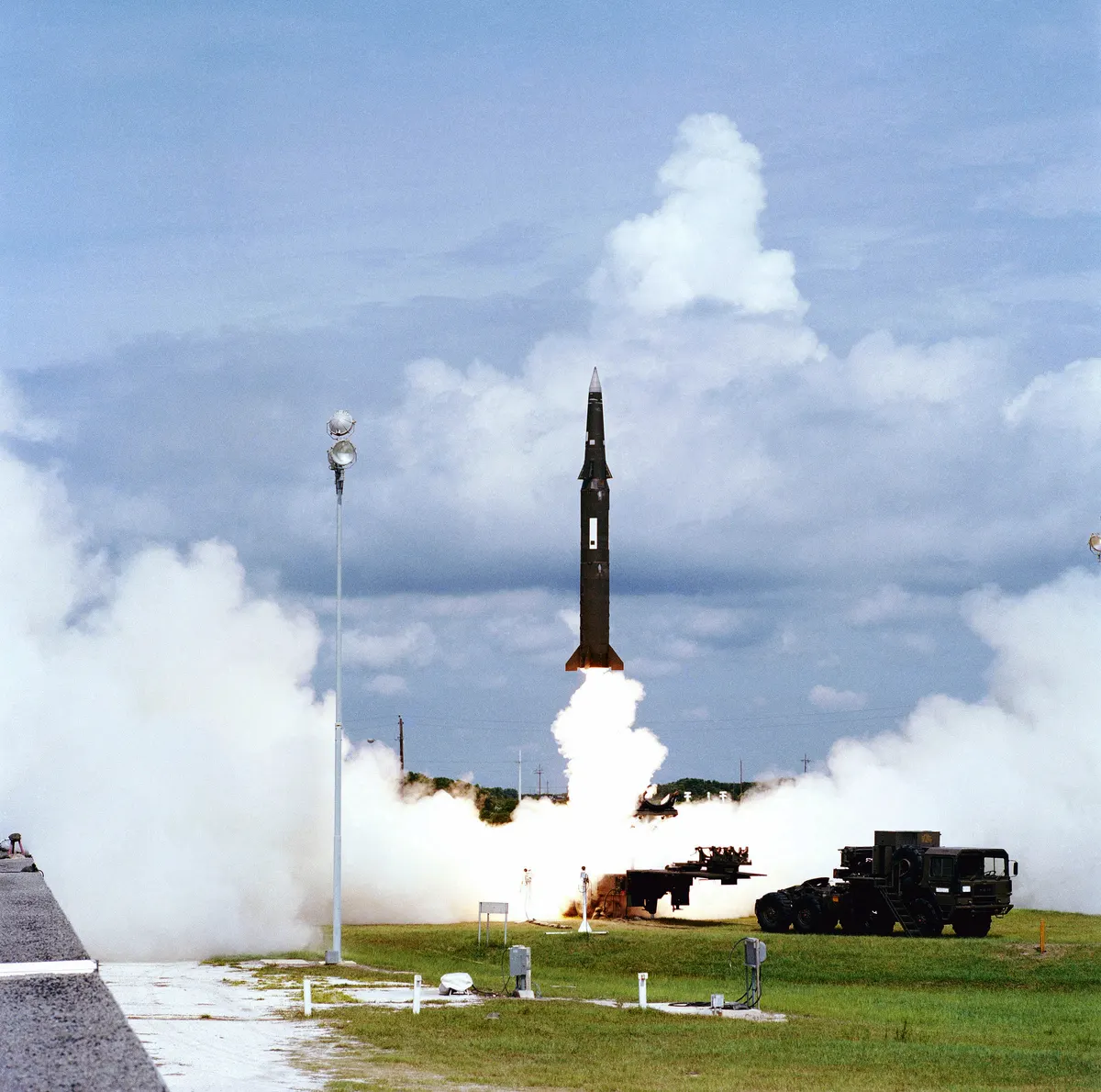
Matching the two images let the guidance computer measure the warhead's drift and correct the control fins accordingly, reportedly bringing circular error probable, the radius inside which half a weapon's shots land, down to around 30 meters.1,2 Inertial guidance alone could not approach that figure at Pershing II's roughly 1,800 kilometer range, which is why NATO planners treated the missile as a genuine threat to hardened command bunkers, and why it became a bargaining chip in the talks producing the 1987 Intermediate-Range Nuclear Forces Treaty.
If the primary radar guidance failed mid-flight, Pershing II still had inertial navigation to fall back on, at far lower accuracy, a redundancy pattern later terminal-guidance systems kept.1
01Radar, Infrared, and Optical Seekers in the Final Seconds
Modern terminal guidance systems replaced Pershing II's radar map-matching with a wider mix of sensor types, chosen for what the target looks like from above. An active radar seeker, similar in principle to RADAG but self-contained rather than tied to a pre-loaded map, can pick a warship out of sea clutter by its size and radar signature. An infrared seeker instead looks for a heat source, useful against a ship's engines and stacks.
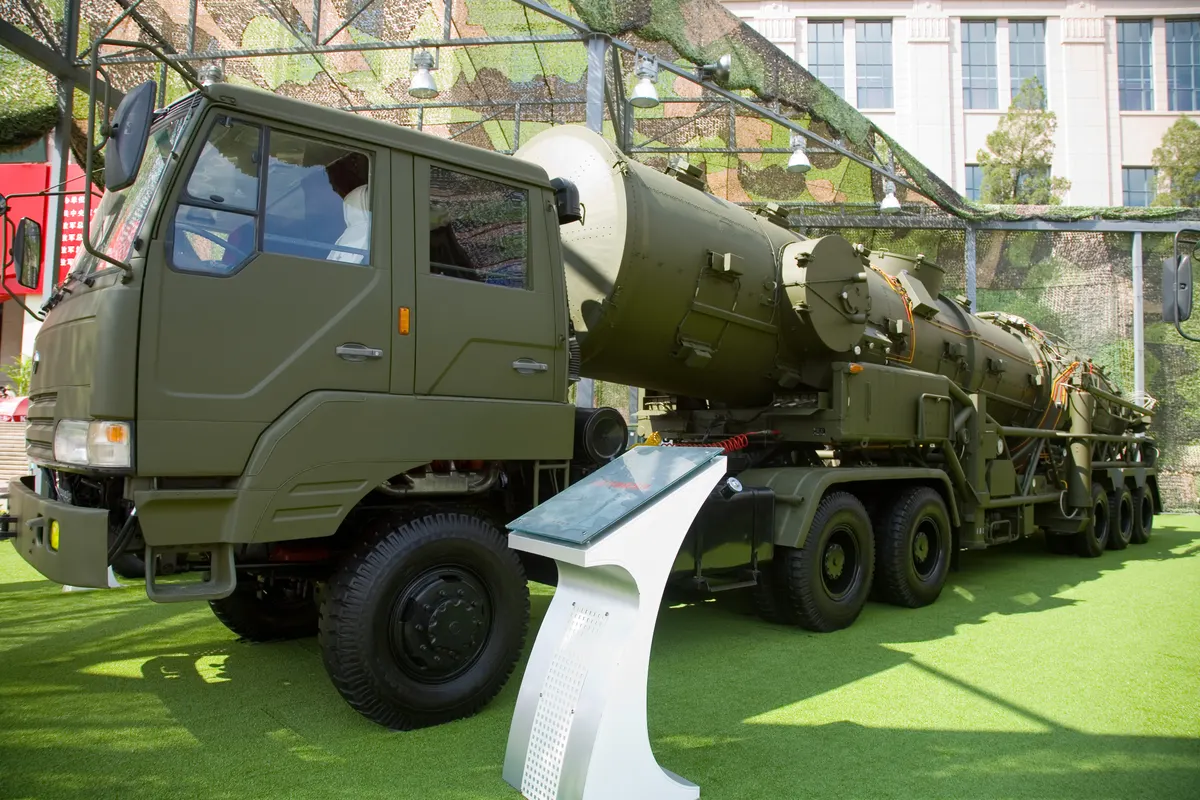
On the DF-21D, the seeker reportedly switches on only deep into the terminal dive, around Mach 2 and three to five kilometers above the sea, leaving seconds to find, lock onto, and correct toward a moving carrier group.3 A ship can travel kilometers between launch and arrival, so the seeker closes that gap almost entirely on its own, steering the maneuverable re-entry vehicle rather than simply confirming a fixed aim point is correct.5
China's earlier DF-21C and DF-21A variants added terminal guidance against static land targets first, an easier problem than a moving ship, before the DF-21D pushed the same seeker technology against a target at sea.
01From China's Regional Arsenal to Pakistan and Iran
Terminal guidance spread well beyond the missile that first proved it out. The DF-16, another China-built short-range system, paired a maneuverable warhead with terminal correction to strike fixed regional targets more precisely than a purely inertial missile of its range could.

Pakistan's Ababeel, first tested in 2017, folds a version of the same idea into a missile also carrying multiple independently targetable warheads, using terminal-phase correction to keep each payload's accuracy within a few hundred meters.6 Iran's Kheibar Shekan, unveiled in 2022, uses its maneuvering terminal phase for a dual purpose, tightening accuracy while also making the flight path harder for missile defense radars to predict.7
Israel's older Jericho II, developed during the Cold War, shows the capability reaches back well before the DF-21D generation, since credible open-source assessments describe it carrying terminal-phase correction alongside inertial navigation decades before China's anti-ship variant existed.8 Inertial navigation gets a warhead close. Terminal guidance closes the remaining gap.
01Notes and Sources
- "Pershing 2", Missile Threat, CSIS Missile Defense Project — missilethreat.csis.org ↩
- "Radar area guidance", Encyclopedia Britannica — britannica.com ↩
- "WU-14 Dong Feng-21D (DF21D) / CSS-5 Mod 5, Anti-Ship Ballistic Missile (ASBM)", GlobalSecurity.org — globalsecurity.org ↩
- "China Aerospace Science and Industry Corporation (CASIC)", GlobalSecurity.org — globalsecurity.org ↩
- "Dong Feng-21D (CSS-5)", Missile Defense Advocacy Alliance — missiledefenseadvocacy.org ↩
- "Ababeel", Missile Threat, CSIS Missile Defense Project — missilethreat.csis.org ↩
- "Khaibar Shekan MRBM", GlobalSecurity.org — globalsecurity.org ↩
- "Jericho (missile)", Wikipedia — en.wikipedia.org/wiki/Jericho_(missile)) ↩


