

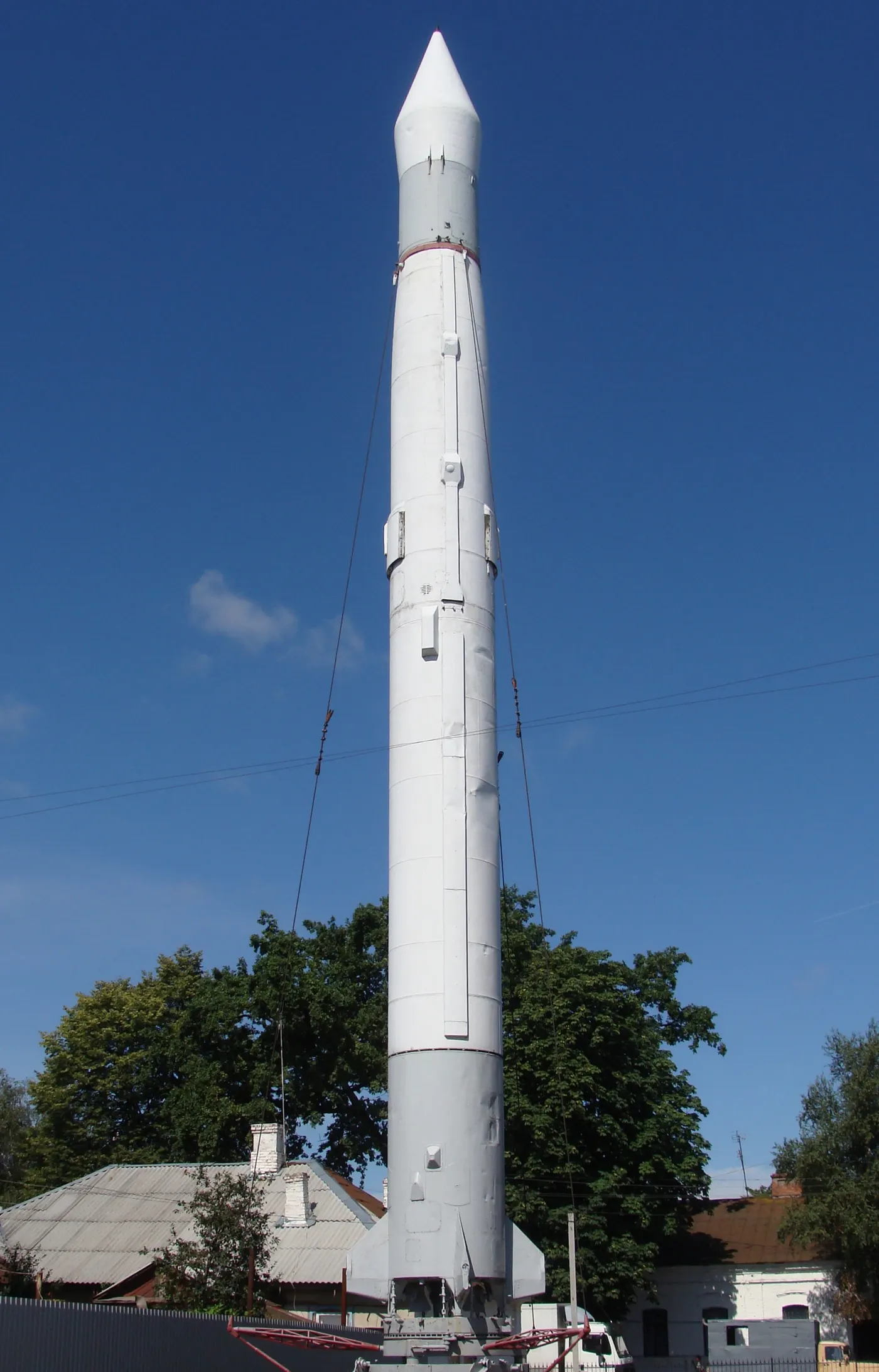

The R-5 Pobeda (Russian for Victory, GRAU index 8A62) was the Soviet Union's first true medium-range ballistic missile, fielded from 1955 as the direct successor to the shorter-ranged R-1 and R-2, both of which were themselves derived from the captured German V-2. Designed by Sergei Korolev's OKB-1 bureau, the R-5 Pobeda carried a conventional high-explosive warhead of roughly 1,000 kilograms out to 1,200 kilometers, more than double the range of the R-2 and over four times that of the R-1. It was the first Soviet missile design to break the 1,000-kilometer barrier, a threshold that at the time defined the line between a battlefield weapon and a strategic one.
- first Soviet missile past 1,000 km range
- separable warhead section (new for Soviet designs)
- integral welded tanks cut structural weight
- radio-corrected inertial guidance improved accuracy over R-1/R-2
- cryogenic liquid oxygen forced slow, exposed fueling
- fixed launch pad, not a true mobile system
- conventional warhead role quickly eclipsed by the nuclear R-5M
- retired after roughly a decade in service
A separate, nuclear-armed derivative, the R-5M, entered service the following year and is covered in its own article. The R-5 Pobeda described here is the original conventional-warhead system, and its short service life was largely overshadowed by that nuclear variant, but the R-5 Pobeda's own engineering record, the separable warhead section, the welded monocoque fuel tanks, the radio-corrected inertial guidance, set the pattern for every Soviet strategic missile that followed it, including the R-12 Dvina and ultimately the R-7 Semyorka that launched Sputnik.
Production of the R-5 Pobeda was modest. Only a handful of the purely conventional-warhead missiles appear to have reached operational units before the program pivoted almost entirely to the R-5M configuration, and even the R-5M's total run stopped at 48 deployed launchers. By 1967 the whole R-5 family had been withdrawn, replaced in Soviet Rocket Forces service by the longer-ranged, storable-propellant R-12 Dvina. Despite that brief operational window, the R-5 Pobeda's airframe kept working long after its combat role ended, flying on as the R-5A geophysical research rocket and the R-5RD testbed for R-7 Semyorka subsystems.
The RD-103 engine and ethanol/liquid-oxygen propulsion
The R-5 Pobeda was a single-stage, liquid-fueled missile powered by a single RD-103 engine, built by Valentin Glushko's design bureau (the forerunner of today's NPO Energomash) and rated at roughly 43.8 tonnes of sea-level thrust.1 The propellant combination, a mixture of 92 percent ethanol and water burned with liquid oxygen as the oxidizer, was the same broad family used on the R-1 and R-2 before it, tracing back to the German V-2's own alcohol-and-LOX system.2 Liquid oxygen cannot be stored indefinitely in a loaded airframe, so the R-5 Pobeda, like its predecessors, had to be fueled shortly before launch on an exposed pad, a limitation that later Soviet designs using storable hypergolic propellants were specifically built to remove.
- Missile ClassMedium Range Ballistic Missile
- Service Entry Year1955
- DesignerOKB-1
- Length20.75 m
- Diameter1.65 m
- Launch Weight28,900 kg
- In ServiceNo
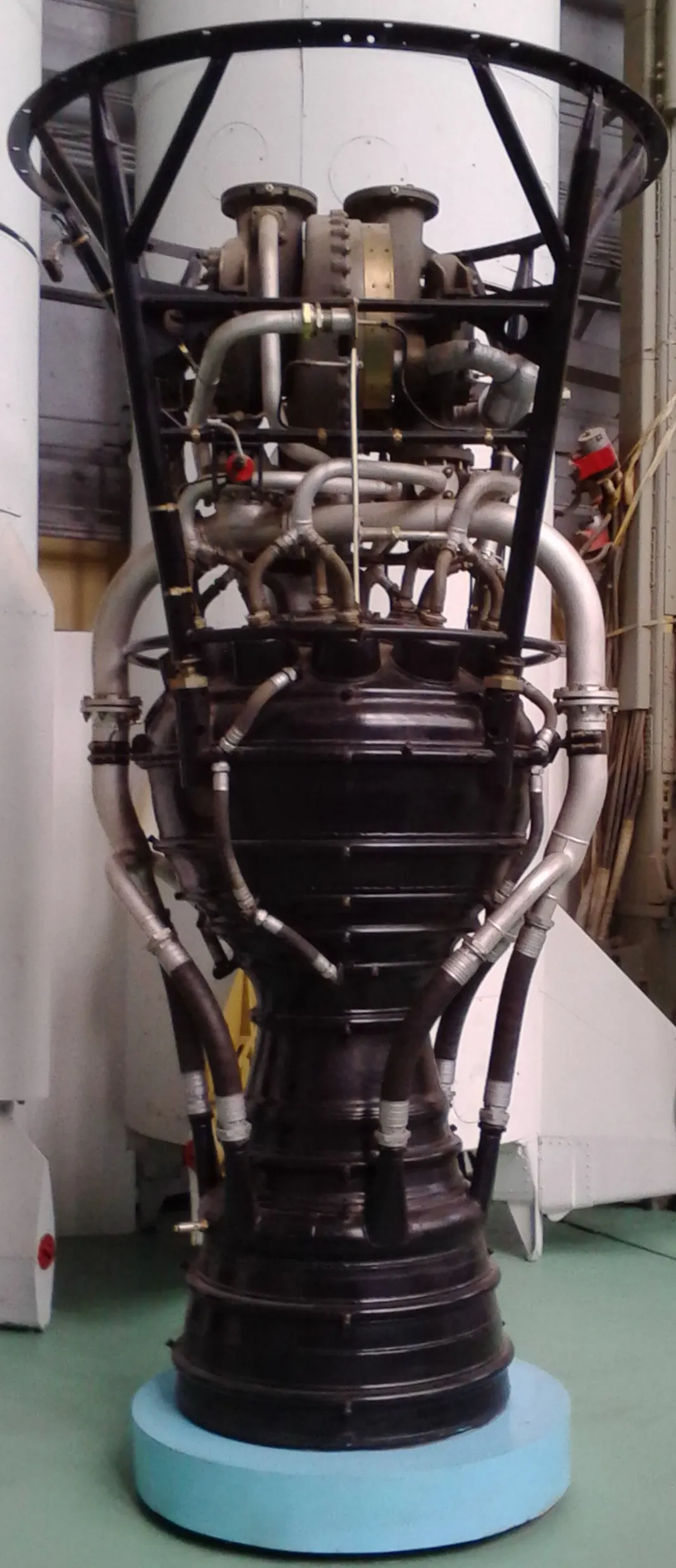
The R-5 Pobeda's fueled launch weight was about 28,900 kilograms, with a dry structural weight near 4,030 kilograms.3 Overall dimensions ran to a length of 20.75 meters and a diameter of 1.65 meters, the same external dimensions later carried over almost unchanged to the R-5M.1 Where the R-5 Pobeda departed sharply from the R-1 and R-2 was in its structure. Its fuel and oxidizer tanks were welded from light aluminum-magnesium alloy as monocoque shells, meaning the tank walls themselves carried the airframe's structural loads rather than sitting inside a separate load-bearing shell, a first for a Soviet missile and a significant weight saving over the R-2's construction.1 Aerodynamic rudders at the tail replaced the oversized fixed fins the R-1 and R-2 had inherited from the V-2, giving the R-5 Pobeda better control authority for a comparatively slimmer airframe.4
- Propulsion Typeliquid-propellant
- Number of Stages1
- Fuel Typeethanol/LOX
- Solid-FuelNo
The separable warhead and radio-inertial guidance
The R-5 Pobeda was the first Soviet missile built with a separable warhead section, a reentry vehicle that detached from the spent airframe near the top of the trajectory instead of reentering as one piece.4 This reduced the aerodynamic and structural loads the warhead itself had to survive, and it let engineers optimize the reentry shape independently of the rest of the missile, both of which fed directly into the accuracy gains over the R-1 and R-2. Guidance combined autonomous inertial navigation with a radio lateral-correction signal transmitted from the ground during powered flight, a hybrid scheme generally described as radio-inertial rather than the purely self-contained inertial guidance used on later Soviet missiles once gyroscope quality improved enough to drop the radio link.5 Longitudinal accelerometer integrators cut the engine at the calculated moment to control range, another refinement absent from the R-1 and R-2.1 The result was a stated accuracy of roughly 1.5 kilometers downrange and 1.25 kilometers cross-range, a real improvement on the earlier missiles even though it looks crude by later Cold War standards.3
- Minimum Range0 km
- Maximum Range1,200 km
- Throw Weight1,000 kg
Conventional warhead, contrasted with the nuclear R-5M
The R-5 Pobeda as originally specified carried a conventional high-explosive warhead of about 1,000 kilograms, launched to its full 1,200-kilometer range.1 It never received an operational nuclear tip of its own. That capability belonged entirely to the separate R-5M variant, whose airframe was reinforced to carry a heavier, roughly 1,350-kilogram nuclear payload and which underwent its own dedicated nuclear-capable flight test and warhead-integration program before entering service in 1956.6 Readers looking for the details of that nuclear test program, including the Soviet Union's first and only live nuclear-warhead test flown on an operational ballistic missile, should consult the R-5M article directly, since that event belongs to the R-5M's own history rather than to the conventional R-5 Pobeda covered here.
- Circular Error Probable (CEP)1,500 m
- Guidance TypeInertial / GPS
- Terminal GuidanceNo
- Warhead Typeconventional
- NuclearNo
- ThermonuclearNo
- Yield (per warhead)80
- MIRVNo
- Warhead / RV Count1
- Conventional-CapableYes
- Basing Moderoad-mobile
- Road-Mobile (TEL)Yes
- Submarine-LaunchedNo
- Operators1
- First Test1953
- Explosive Filler Typeconventional high-explosive, approx 1,000 kg
Sergei Korolev's OKB-1 bureau had, by the start of the 1950s, already taken the Soviet Union from a straight copy of the German V-2 (the R-1, adopted in 1950 with a 270-kilometer range) to a stretched, more capable derivative (the R-2, adopted in 1951 with roughly double the R-1's range and mass production running at Factory No. 586 in Dnepropetrovsk from mid-1953).7 In spring 1951, facing technical obstacles on the far more ambitious R-3 project, Korolev shifted his bureau's effort toward a nearer-term design that could reach much farther than the R-2 while reusing what OKB-1 had already learned.8 That design became the R-5 Pobeda.
Design work on the new missile ran through 1952, and flight testing opened at the Kapustin Yar range on March 15, 1953.8 The first two launches of an eight-missile trial series failed, but the third attempt, flown on April 2, 1953, succeeded, and a first full-range flight followed on April 19.8 The initial test series wrapped up on May 23, 1953, having demonstrated that the separable warhead and the new guidance scheme worked as designed.8
A second, longer confirmation-trial campaign ran from August 12, 1954 to February 7, 1955, after which the R-5 Pobeda was formally accepted into Soviet military service in 1955.1 Operational fielding of the purely conventional-warhead configuration, however, was brief and limited. Some accounts suggest only a small number of R-5 Pobeda missiles, or possibly none in significant numbers, actually reached front-line units before the program pivoted to the nuclear-armed R-5M configuration, which was approved for development on April 10, 1954 and entered service in its own right in 1956.6 From that point the R-5M effectively absorbed the R-5 Pobeda's operational role, and it is the R-5M's basing, not the conventional R-5 Pobeda's, that the bulk of later Cold War documentation on this missile family actually describes.
The R-5 Pobeda's front-line career, and that of the R-5M that superseded it, ended in 1967, when the whole family was withdrawn from Soviet Rocket Forces service and replaced by the R-12 Dvina, a design that traded the R-5's cryogenic liquid oxygen for storable propellants and offered a much faster reaction time.9
The R-5 Pobeda was never fired in anger. Its operational life fell within the tensest stretch of the early Cold War, a period that included the 1956 Suez Crisis and repeated confrontations over Berlin, but the missile's value in that standoff was purely as a stationed, latent capability rather than a weapon actually employed against a target.9 That distinction matters for how the R-5 Pobeda specifically is read historically. Because the conventional-warhead R-5 Pobeda was quickly overtaken in numbers and priority by the nuclear-armed R-5M, most of what actually deterred anyone during this period was the credible threat represented by the R-5M's warhead, not the conventional R-5 Pobeda's roughly 1,000-kilogram high-explosive payload, which offered comparatively little strategic leverage on its own by the standards of the mid-1950s.
The R-5M is the best known derivative, a reinforced, nuclear-capable version of the same airframe that entered service in 1956 and carried a substantially heavier warhead than the conventional R-5 Pobeda.6 It is covered in full in its own article, including its historic warhead-integration test program.
A separate scientific derivative, the R-5A, stripped the missile down for high-altitude geophysical research, carrying a recoverable instrument payload on a parachute rather than a warhead. Flights of this type reached altitudes as high as 473 kilometers by February 1958, well outside the atmosphere, giving Soviet scientists early data on cosmic radiation and the upper atmosphere using hardware derived directly from the R-5 Pobeda's airframe.1
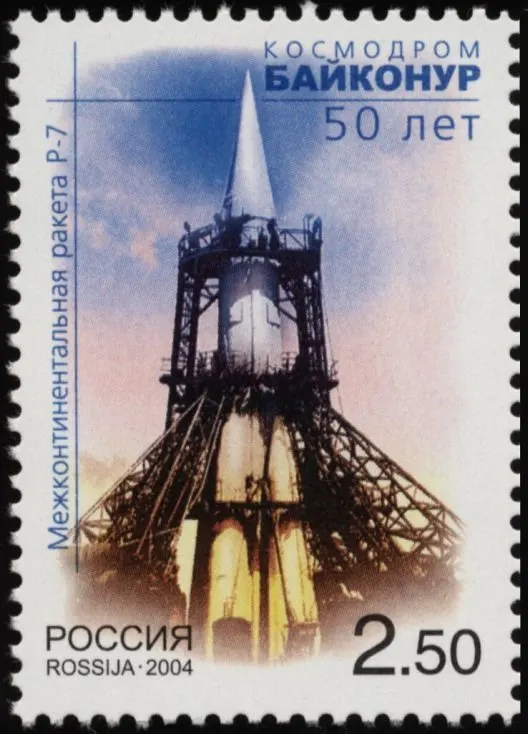
A third derivative, sometimes referred to as the R-5RD or M5RD, flew ten test missions between February and August 1956 specifically to validate subsystems destined for the far larger R-7 Semyorka intercontinental missile, the design that would go on to launch Sputnik and, later, Yuri Gagarin.10 Using the comparatively cheap, already-proven R-5 airframe as a flying testbed for R-7 hardware let OKB-1 de-risk parts of the far more ambitious ICBM program well before the R-7 itself was ready to fly, a pattern of incremental technology validation that Korolev's bureau repeated on several later Soviet space and missile programs.
Together, the R-5A and R-5RD flights meant the R-5 Pobeda's basic airframe stayed useful to Soviet engineers for years after its brief, largely overshadowed frontline career, a second life shared by remarkably few other missiles of its generation.

The R-5 Pobeda's only operator was the Soviet Union, fielded through what later became the Strategic Rocket Forces.1 Because the conventional-warhead configuration was fielded only briefly before the fleet transitioned to the nuclear R-5M standard, the deployment pattern most often described in Western intelligence assessments, ground units of four to six launchers organized as regiments or brigades, garrisoned near the western Soviet border with a smaller number in the Soviet Far East, applies primarily to the R-5M rather than to the original conventional R-5 Pobeda.6 Even so, both variants used identical ground support equipment. Missiles and their transporter-erector trucks were road-moved from storage to a prepared launch pad rather than fired directly from a moving vehicle, a basing style generally classed as road-mobile within this scheme even though the actual firing always happened from a fixed, pre-surveyed position, not from the transporter itself.6
By 1959, missile units equipped with this family had also been stationed inside East Germany, at Vogelsang, Zehdenick, and Furstenberg an der Havel, the first time Soviet nuclear-associated missile units had been based outside the USSR's own borders.6 That specific deployment, and the warhead capability behind it, is again a fact of the R-5M's operational history more than the conventional R-5 Pobeda's, and readers interested in it should look to the R-5M article directly.
No R-5 Pobeda or R-5M unit was ever exported to another Warsaw Pact country. Every operational unit remained under direct Soviet control throughout the missile family's roughly decade-long service life, from formal acceptance in 1955 to final withdrawal in 1967.
The R-5 Pobeda's most direct point of comparison is its own predecessor, the R-2, since the two shared the same OKB-1 design team and the same alcohol/liquid-oxygen propellant family, but differed sharply in what a decade's worth of missile engineering could add. Where the R-2 kept the R-1's, and by extension the V-2's, fixed warhead and oversized tail fins, the R-5 Pobeda's separable warhead and welded monocoque tankage let it more than double the R-2's range, from 600 kilometers to 1,200 kilometers, without a proportional increase in launch weight.7 The R-2's warhead stayed fixed to the airframe through reentry, while the R-5 Pobeda's detached, a structural change that mattered more for accuracy than for raw range.
Against its own successor, the R-12 Dvina, the comparison runs the other way. The R-12 Dvina replaced the R-5 Pobeda's, and the R-5M's, cryogenic liquid oxygen with storable nitric-acid propellants, cutting the multi-hour fueling delay that had defined every Soviet missile back to the V-2 down to a launch readiness measured in tens of minutes rather than hours.9 The R-12 Dvina also extended range to roughly 2,000 kilometers, nearly double the R-5 Pobeda's reach, while retaining a broadly similar road-transported basing pattern.
| R-5 Pobeda | R-12 Dvina | |
|---|---|---|
| Range | 1,200 km1 | ~2,000 km9 |
| Propellant | Ethanol/liquid oxygen2 | Storable (nitric acid/kerosene)9 |
| Warhead (this variant) | Conventional HE, ~1,000 kg1 | Nuclear9 |
| Service entry | 19551 | 19599 |
The practical upshot is that the R-5 Pobeda answered the basic question of how the Soviet Union could hit a target past 1,000 kilometers at all, while the R-12 Dvina answered the harder follow-up question of how to do that on a schedule fast enough to matter in an actual crisis. The R-5 Pobeda's real historical weight, in other words, sits less in what it did operationally, which was limited, and more in proving out the separable-warhead and monocoque-tank techniques that every later Soviet missile, the R-12 Dvina and the R-7 Semyorka included, then built on.


What is the R-5 Pobeda missile? The R-5 Pobeda was the Soviet Union's first medium-range ballistic missile, a single-stage, liquid-fueled design developed by Sergei Korolev's OKB-1 bureau and accepted into service in 1955 with a conventional high-explosive warhead.1
How far could the R-5 Pobeda missile travel? The R-5 Pobeda's design range was 1,200 kilometers, more than double the range of its immediate predecessor, the R-2.1
What is the difference between the R-5 Pobeda and the R-5M? The R-5 Pobeda was the original, conventional high-explosive-armed version. The R-5M was a separate, reinforced variant built specifically to carry a nuclear warhead, and it is the R-5M, not the conventional R-5 Pobeda, that carried out the Soviet Union's historic warhead-integration test program and went on to see the bulk of the family's operational deployment.6
Is the R-5 Pobeda missile still in service? No. The entire R-5 family, the conventional R-5 Pobeda and the nuclear R-5M alike, was withdrawn from Soviet service by 1967, replaced by the R-12 Dvina.9
What replaced the R-5 Pobeda missile? The R-12 Dvina, which used storable propellants for a far faster launch readiness time and extended range to roughly 2,000 kilometers, took over the R-5 family's role in Soviet Rocket Forces service from 1959 onward.9
- "R-5", Astronautix — astronautix.com ↩
- "R-1 (missile)", Wikipedia — en.wikipedia.org) ↩
- "R-5 Pobeda", Wikipedia — en.wikipedia.org ↩
- "R-5 (8A62)", RussianSpaceWeb — russianspaceweb.com ↩
- "R-5 / SS-3 Shyster", Federation of American Scientists — nuke.fas.org ↩
- "R-5M", Astronautix — astronautix.com ↩
- "R-2 (missile)", Wikipedia — en.wikipedia.org) ↩
- "R-7 Semyorka", Wikipedia — en.wikipedia.org ↩
- "R-12 Dvina", Wikipedia — en.wikipedia.org ↩
- "R-7", Astronautix — astronautix.com ↩