

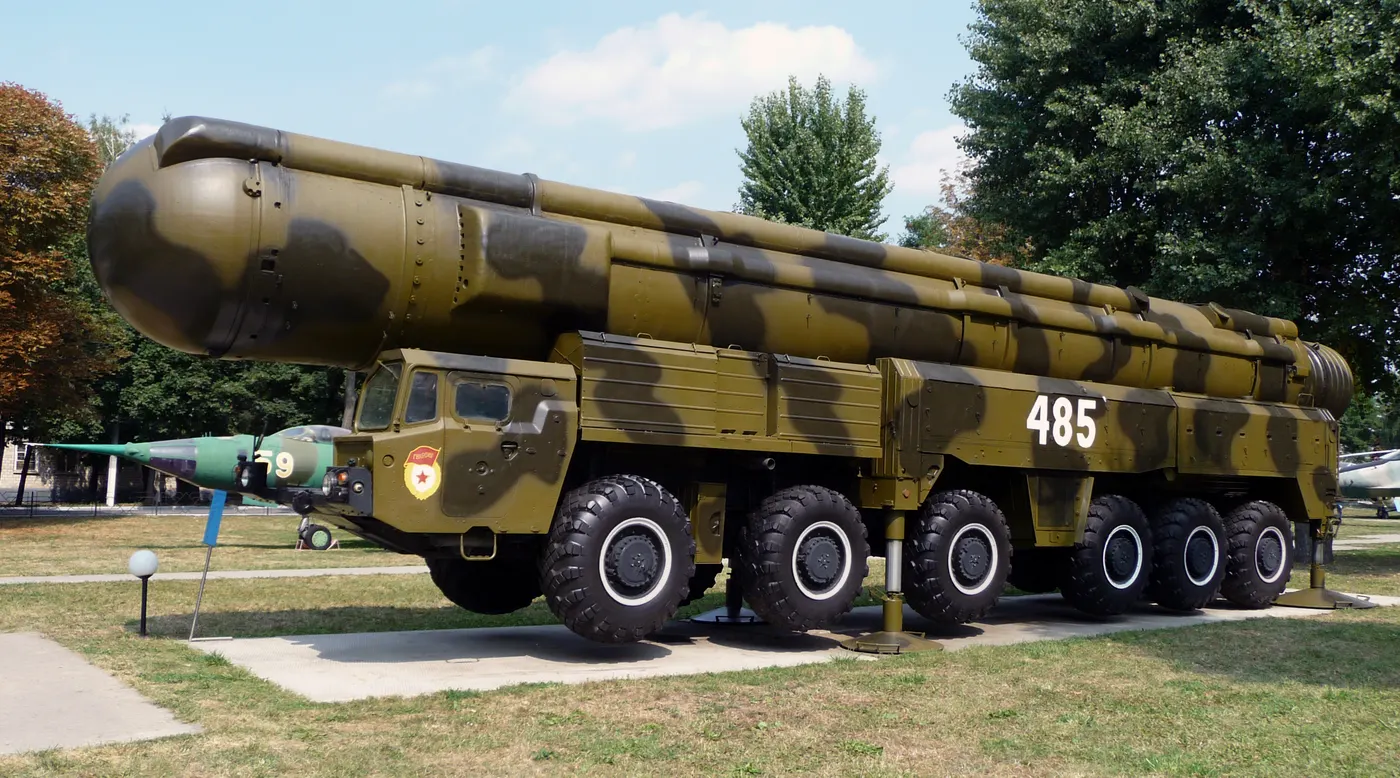

The RSD-10 Pioneer, known throughout the West by its NATO reporting name SS-20 Saber, was a Soviet road-mobile, solid-fuel ballistic missile that entered service on 11 March 1976.1 It was designed by Alexander Nadiradze at the Moscow Institute of Thermal Technology, the same design bureau that had just produced the troubled RT-21 Temp 2S ICBM, and it reused that program's first two rocket stages rather than starting propulsion development from scratch.2,1 The missile carried either a single 1-megaton warhead or, in its most widely deployed form, three independently targetable 150-kiloton MIRV warheads, launched from a wheeled transporter-erector-launcher that could disperse into forests and prepared field positions instead of sitting in a fixed silo.2
- Solid-fuel propulsion, launch-ready on short notice
- Road-mobile TEL basing, hard to target preemptively
- MIRV payload, three warheads per missile
- Long service radius covering all of Western Europe from deep Soviet territory
- Provoked the exact NATO counter-deployment it was meant to deter
- Never solved the *decoupling* problem it was built to exploit
- Extended-range Pioneer-3 variant abandoned under treaty pressure
- Entire fleet ultimately destroyed with none surviving in active service
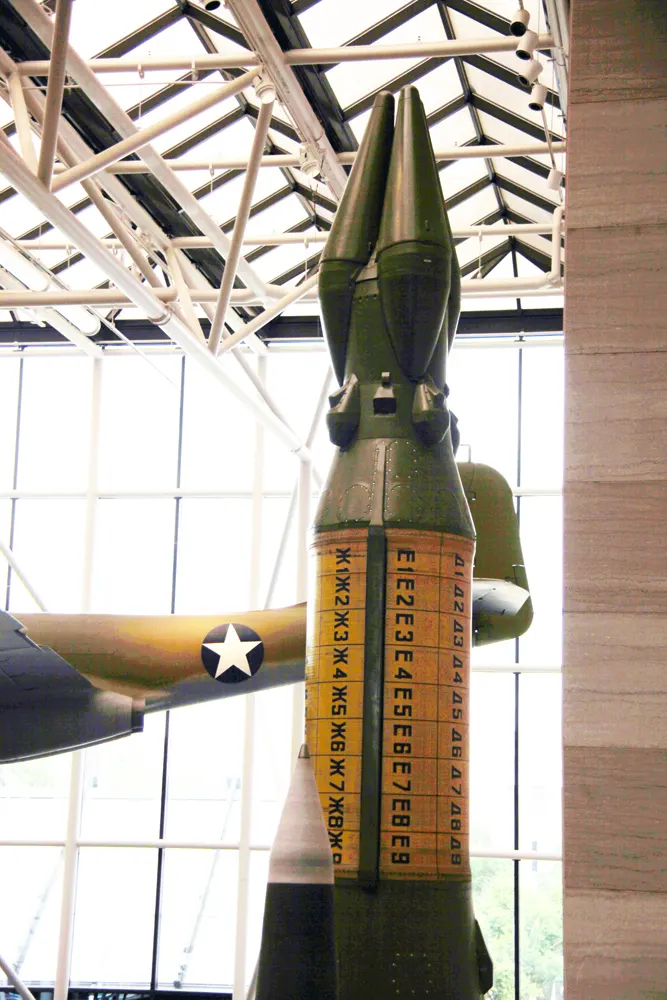
Classified in NATO terminology as an IRBM and grouped on this archive within the broader medium-range ballistic missile category, the RSD-10 Pioneer's real significance was political rather than purely technical. Its deployment starting in 1976 was the direct trigger for NATO's December 1979 Double-Track Decision, which paired arms-control negotiations with a threat to station United States Pershing II and ground-launched cruise missiles in Western Europe.3 That standoff, remembered as the Euromissile Crisis, dominated European security politics for most of a decade before ending in the 1987 Intermediate-Range Nuclear Forces (INF) Treaty, the first agreement to eliminate an entire class of nuclear weapons rather than merely cap it.4 Every RSD-10 Pioneer built was destroyed under that treaty by May 1991, and the type has been out of service ever since.1
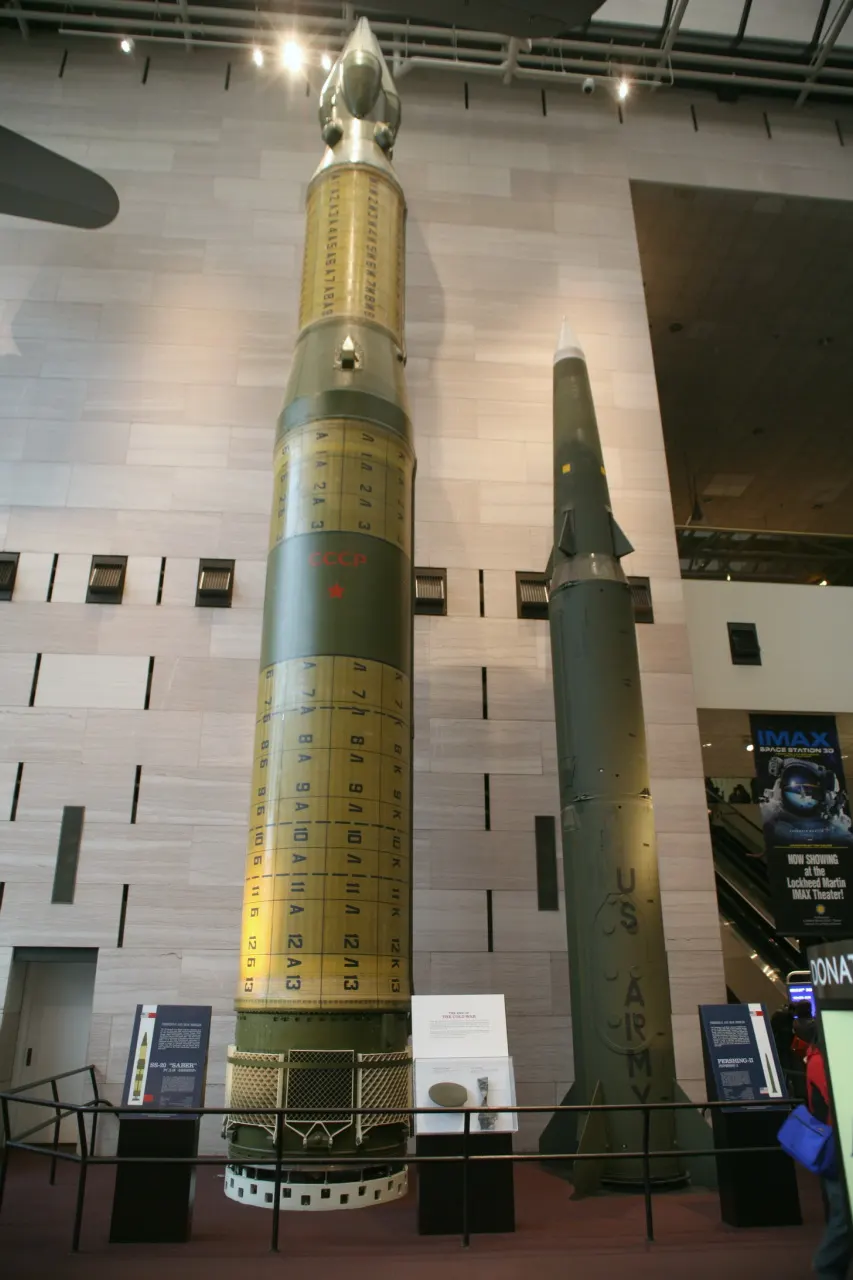
How does the RSD-10 Pioneer, or SS-20 Saber, actually compare with the American missile it provoked into existence? The short answer is that both missiles no longer exist, but the story of why they were built, and why they were the two systems arms controllers agreed to erase first, is one of the more consequential episodes of the Cold War. Is the SS-20 Saber still in service anywhere today? No single example remains operational, though a handful of inert missiles survive in museums as treaty-permitted exhibits.10
A Two-Stage Solid Motor Inherited From a Cancelled ICBM
The RSD-10 Pioneer was a two-stage missile measuring 16.5 meters long and 1.8 meters in diameter, with a launch weight of about 37,100 kilograms.2,1 Both rocket stages were solid-fueled, a deliberate break from the liquid-fueled Soviet missiles that preceded it, because solid propellant does not require the hours-long, hazardous fueling procedure liquid missiles need before launch.5 The two stages were adapted directly from the RT-21 Temp 2S, an intercontinental-range missile whose full three-stage version had been rejected for INF-class deployment, and the Moscow Institute of Thermal Technology simply repackaged the first two stages under a new warhead bus rather than restart propulsion development.2 This shortcut is the main reason the RSD-10 Pioneer moved from initial testing in September 1974 to operational deployment in barely eighteen months, a fast timeline even by Cold War standards.6
- Missile ClassIntermediate-range ballistic missile
- Service Entry Year1976
- DesignerAlexander Nadiradze (Moscow Institute of Thermal Technology)
- Length16.5 m
- Diameter1.8 m
- Launch Weight37,100 kg
- In ServiceNo
The MAZ-547 Launcher and Road-Mobile Basing
Rather than sit in a hardened silo, the missile rode on a MAZ-547A/MAZ-7916 six-axle transporter-erector-launcher (TEL) built by the Minsk Automobile Plant in the Belorussian SSR.5 Fully loaded, the vehicle stretched 19.3 meters and weighed more than 80 tons, yet it could still cross unimproved fords, climb 15-degree grades, and use a 21-meter turning radius to work Soviet road networks that were never built with an 80-ton vehicle in mind.5 Regiments typically fielded nine to twelve of these launchers, dispersed across garrison and pre-surveyed field positions specifically to defeat a first strike aimed at a small number of fixed sites, a survivability logic that stood in direct contrast to the silo-based R-12 and R-14 missiles the RSD-10 Pioneer was designed to replace.7 This approach to road-mobile basing became the template for later Soviet and post-Soviet mobile ICBMs, including the Topol family, and it is the single design decision that most defined how the RSD-10 Pioneer was employed operationally.
- Propulsion Typesolid-fuel rocket
- Number of Stages2
- Fuel Typesolid fuel
- Solid-FuelYes
- Cold-LaunchYes
- CanisterizedYes
At main garrison positions, launchers could shelter inside so-called Krona structures, metal garages with movable roof sections that let a missile launch without the TEL ever driving outside. A pyrotechnic charge threw the roof panels aside seconds before ignition.5 Multiple near-identical Krona shelters were often built along a regiment's dispersal routes purely as visual decoys, so that Western reconnaissance satellites could not easily tell which structure held a live missile on any given day.5
- Minimum Range600 km
- Maximum Range5,000 km
- Re-Entry Speed (Mach)21.6 Mach
Cold Launch and the MIRV Payload
The RSD-10 Pioneer used a cold launch method. The missile sat sealed inside an airtight transport-and-launch canister, and a gunpowder pressure accumulator ejected the entire round clear of the canister before the first-stage motor ignited at a safe height above the launcher.5 This is the same broad principle used on silo-based ICBM systems that need to protect their launch infrastructure from motor exhaust, adapted here to a wheeled vehicle instead of a silo.
- Circular Error Probable (CEP)450 m
- Guidance TypeInertial / GPS
- Penetration Aids / DecoysYes
Guidance was purely inertial navigation, with no satellite-aided terminal correction of any kind, appropriate to a missile designed years before any operational satellite guidance system existed for either side.2 Early production missiles (NATO Mod 1) carried a single 1-megaton warhead, but from 1980 the improved Pioneer UTTKh (Mod 2, sometimes catalogued as Mod 3 by NATO) carried a bus of three independently targetable 150-kiloton reentry vehicles, becoming the most widely deployed configuration.2,1 Reentry velocity reached roughly 7.4 kilometers per second, on the order of Mach 21.6, typical for a ballistic missile of this range class.1 Accuracy improved across the production run from an initial circular error probable near 550 meters down to roughly 450 meters on the UTTKh variant, a real but incremental gain rather than the very tight 150-meter figure sometimes quoted for the type.1,5
- Warhead Typenuclear
- NuclearYes
- ThermonuclearYes
- Yield (per warhead)1,000
- MIRVYes
- Warhead / RV Count3
- Basing ModeRoad-mobile TEL
- Silo-BasedNo
- Road-Mobile (TEL)Yes
- Total Production654
- Operators1
- First Test1974
- Explosive Filler Weight1,600 kg
- Explosive Filler Type1 x 1 Mt or 3 x 150 kt
From a Failed ICBM to a New Category of Threat
Development began in 1966 at the Moscow Institute of Thermal Technology, with the concept formally approved in 1968 and flight testing starting on 21 September 1974 at the Kapustin Yar missile range.1,6 The rising influence of defense industry chief Dmitriy Ustinov favored diversified, design-bureau-driven weapons programs over the General Staff's stated preferences, and the RSD-10 Pioneer is often cited as a product of that institutional shift as much as of any specific military requirement.1 The Soviet Union began fielding the missile near Petrikov in the Belorussian SSR (modern Belarus) in August 1976, only months after the March 1976 deployment order, and Strategic Rocket Forces units continued standing up new regiments through the early 1980s.6,1 By December 1980 the 835th Missile Regiment of the 32nd Missile Division, based at Smorgon in Grodno Oblast, had gone on alert duty with nine launchers, one of dozens of regiments eventually deployed across the Belorussian, Ukrainian, and Russian SFSR territories of the western Soviet Union.7 The 23rd Guards Rocket Division at Kansk in Krasnoyarsk Krai operated RSD-10 Pioneer regiments as well, illustrating how far east some units were based even though the missile's entire operational purpose was aimed at Western Europe.1
Western governments were slow to register just how destabilizing the new missile was. Because the 1972 and 1979 SALT agreements regulated only intercontinental-range systems, the RSD-10 Pioneer's roughly 5,000-kilometer range sat in a gap those treaties never closed, letting Soviet planners field a genuinely new capability without technically breaking any existing arms-control commitment.1,2 Once the scale of deployment became clear, however, the alarm in Western Europe was immediate. A single RSD-10 Pioneer regiment, with its three-warhead MIRV bus, could threaten every NATO capital from deep inside Soviet territory, while NATO's own intermediate-range nuclear forces in Europe were older, less accurate, and shorter-ranged.3 West European leaders, West Germany's Helmut Schmidt foremost among them, worried openly that the Soviet Union could use the RSD-10 Pioneer to strike Europe while depriving Washington of a matching intermediate-range deterrent, effectively decoupling American nuclear protection from its European allies.3
The Double-Track Decision and the Euromissile Crisis
On 12 December 1979, NATO foreign and defense ministers meeting in Brussels adopted the so-called Double-Track (or Dual-Track) Decision.3,8 One track pursued negotiations aimed at limiting or eliminating land-based intermediate-range missiles on both sides. The other track committed NATO to deploy 108 Pershing II ballistic missiles to Germany and 464 BGM-109G Gryphon ground-launched cruise missiles across Germany, Italy, Belgium, the Netherlands, and Britain if the talks failed to produce results by the end of 1983.3 The Pershing II in particular was chosen specifically because its flight time to Soviet targets, six to eight minutes, mirrored the kind of short-warning threat the RSD-10 Pioneer already posed to Western Europe, a deliberate tit-for-tat answer built into the weapon's own performance envelope rather than just its numbers.3
Negotiations opened in Geneva in 1981 and went nowhere for years. President Reagan's November 1981 zero option proposal called for the United States to cancel Pershing II and GLCM deployment entirely in exchange for the Soviet Union dismantling all of its SS-4, SS-5, and RSD-10 Pioneer missiles, a proposal Moscow rejected outright as one-sided.3 In July 1982, American negotiator Paul Nitze and his Soviet counterpart Yuli Kvitsinsky took a celebrated walk through the woods outside Geneva and sketched an informal compromise, capping American cruise missile deployment at 75 launchers while limiting Soviet intermediate missiles to 75 in Europe and 90 in Asia, and dropping Pershing II altogether.8 Both governments rejected the walk in the woods formula when it reached their capitals, and formal talks remained deadlocked.8
By late 1983 the Soviet Union was reportedly fielding a new RSD-10 Pioneer roughly once a week, and NATO proceeded with its own deployment on schedule despite large anti-nuclear demonstrations across Western Europe, including the long-running Women's Peace Camp outside RAF Greenham Common in Britain.3 When the first American Pershing II and GLCM units arrived in Germany in November 1983, Soviet negotiators walked out of the Geneva talks entirely, and for roughly a year and a half there were no active INF negotiations between the two superpowers.3
Gorbachev, the Reykjavik Opening, and the INF Treaty
The deadlock broke only after Mikhail Gorbachev became Soviet leader in March 1985 and began reassessing the entire military standoff in Europe, later reportedly describing the original RSD-10 Pioneer deployment as an unforgivable adventure.3 Negotiations resumed later that year and gained momentum at the October 1986 Reykjavik summit between Gorbachev and Reagan.
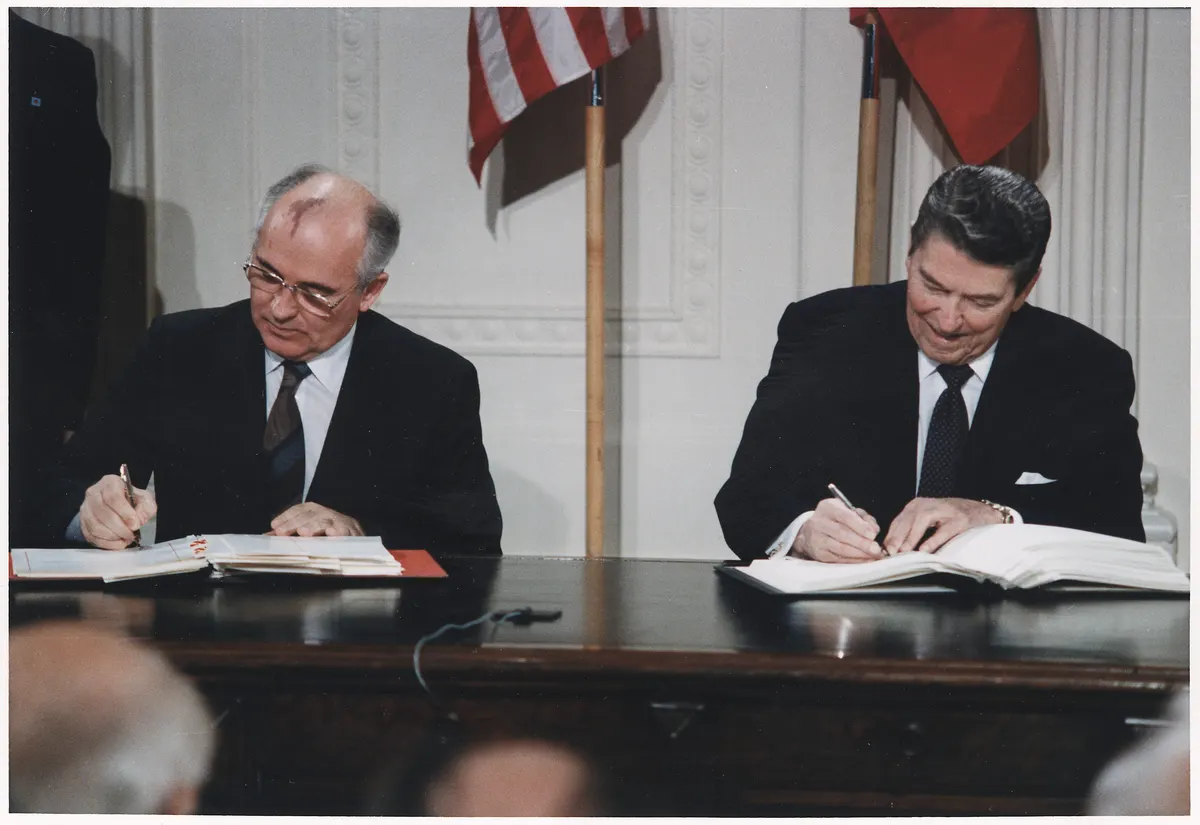
The talks finally produced the Intermediate-Range Nuclear Forces Treaty, signed by both leaders at the White House on 8 December 1987 and entered into force on 1 June 1988 after United States Senate ratification.4 The treaty eliminated 2,692 missiles across both countries by its 1 June 1991 deadline, 846 American systems (Pershing II, the older Pershing 1a, and BGM-109G GLCM) against 1,846 Soviet systems, principally the RSD-10 Pioneer alongside the older SS-4, SS-5, SS-12, and SS-23 types.4 It was the first arms-control treaty in history to abolish an entire class of weapon outright rather than simply cap the numbers each side could hold, and Reagan's own zero option, rejected as unrealistic when first floated in 1981, ended up as the treaty's actual outcome six years later.3
Verification was as significant as elimination. The INF Treaty established, for the first time in the Cold War, a regime of intrusive on-site inspections that let American teams watch Soviet crews destroy RSD-10 Pioneer missiles and Soviet teams watch American crews destroy Pershing II and GLCM hardware.9 The Soviet Union eliminated its first RSD-10 Pioneer missile and its launch canister at the Kapustin Yar test range on 22 July 1988, under American observation, and later switched to destroying whole missiles still inside their canisters with high explosives to speed the process along.9 A separate method used at the Chita and Kansk missile fields involved firing missiles without warheads on suborbital flights into unpopulated territory in the Soviet Far East, a form of destruction-by-launch rather than static demolition.9,1 The last of the 654 RSD-10 Pioneer missiles built was destroyed at Kapustin Yar on 12 May 1991, and the last of the associated 499 mobile launchers was eliminated at a dedicated facility at Sarny on 28 May 1991, closing out the program entirely inside the treaty's own deadline.1,9 On-site inspections under the treaty continued for another decade, running until 31 May 2001, before both sides shifted to remote monitoring.4 The treaty itself lasted until 2019, when the United States formally withdrew citing Russian development of the 9M729 cruise missile, a system Washington judged to be a direct-line violation of the same INF limits the RSD-10 Pioneer had once defined.4,3
The RSD-10 Pioneer was never fired in anger. Its entire operational history took place within the Cold War, specifically the tense years of superpower confrontation from 1979 to 1985 that the Euromissile Crisis came to define, followed by the treaty resolution phase from 1985 to 1991 during which every example of the missile was withdrawn and destroyed.3,9 Unlike a conventional weapon judged by combat performance, the RSD-10 Pioneer's real-world effect was strategic and political, reshaping NATO force posture, European public opinion, and superpower arms-control diplomacy without a single warhead ever leaving a launch canister in anger. Its deployment is nonetheless treated by historians as one of the defining military-political events of the Cold War's final decade, on par with any shooting conflict for its influence on alliance politics.3
Soviet designers fielded the RSD-10 Pioneer in three recognized configurations. The initial Mod 1 (GRAU index 15Zh45), deployed from 1976, carried a single 1-megaton warhead and used the less refined early guidance package.2 The Pioneer UTTKh, tested from August 1979 and deployed from December 1980 and generally tracked in Western sources as Mod 2 (occasionally listed as Mod 3), replaced the single warhead with a bus of three 150-kiloton MIRV reentry vehicles and improved circular error probable from roughly 550 meters down to around 450 meters, along with a modest increase in maximum range.1 A separate extended-range development, the Pioneer-3 (catalogued in the West as SS-X-28), was flight tested between 1985 and 1988 with a lightened single 50-kiloton warhead and a maximum range of roughly 7,400 kilometers, deliberately reaching past the INF Treaty's 500 to 5,500 kilometer definition of an intermediate-range system.9,11 Only about a dozen were built before the treaty's negotiators closed that loophole by banning the RSD-10 Pioneer and its variants outright, and the Pioneer-3 never left the test phase.11


The RSD-10 Pioneer had exactly one operator across its entire service life, the Soviet Union's Strategic Rocket Forces, deployed from bases across the Belorussian, Ukrainian, and Russian territories of the western USSR from 1976 until the last unit was withdrawn ahead of INF Treaty elimination deadlines in the late 1980s and 1991.1,7 No RSD-10 Pioneer was ever exported, licensed for foreign production, or transferred to a Warsaw Pact ally, unlike some earlier Soviet theater missiles that did see limited transfers, and its user base essentially collapsed at the same moment the Soviet Union itself did, with elimination completing in May 1991 just months before the USSR's dissolution.1
The INF Treaty is remembered largely as an agreement between two specific missiles, the RSD-10 Pioneer and the American Pershing II, even though it eliminated eight missile types in total. That shorthand exists because the two systems were built to answer each other directly rather than simply occupying the same broad category. The RSD-10 Pioneer optimized for payload flexibility and basing survivability, a 37-ton missile carrying up to three 150-kiloton warheads and hiding across a dispersed road network of Krona shelters and field positions. The Pershing II optimized for speed and precision on a much smaller airframe, using an active radar terminal guidance system to bring its circular error probable down to roughly 30 meters, a huge accuracy advantage bought at the cost of a single, much smaller warhead and a far shorter maximum range of about 1,770 kilometers against the RSD-10 Pioneer's roughly 5,000.1,12 Where the RSD-10 Pioneer threatened every NATO capital in Europe from launch sites deep inside Russia, the shorter-ranged Pershing II could only reach Warsaw Pact targets because it was based forward in Germany, a geographic dependence that made its deployment politically explosive in a way the RSD-10 Pioneer's own deployment on Soviet soil never had to contend with.
| Spec | RSD-10 Pioneer | Pershing II |
|---|---|---|
| Length | 16.5 m | 10.6 m |
| Launch weight | ~37,100 kg | ~7,462 kg |
| Max range | ~5,000 km | ~1,770 km |
| CEP | ~450 m (UTTKh) | ~30 m |
| Warheads | Up to 3 (MIRV) | 1 |
The two missiles never fought each other, and neither ever fired at a real target, but their pairing inside a single treaty is the closest thing the Cold War produced to a formal, mutually agreed verdict on which weapons had become too destabilizing to keep. Both the RSD-10 Pioneer and the Pershing II were fully eliminated by 1991, and no direct successor to either missile exists in NATO or Russian inventories today, since the INF Treaty barred exactly this category of ground-launched intermediate-range missile for both signatories until the United States withdrew in 2019.4


Is the RSD-10 Pioneer (SS-20 Saber) still in service? No. Every RSD-10 Pioneer built was destroyed under the 1987 INF Treaty, with the last missile eliminated at Kapustin Yar on 12 May 1991 and the last launcher destroyed on 28 May 1991. A small number of inert examples survive only as museum exhibits.1,9
What made the SS-20 Saber so alarming to NATO? Its combination of solid-fuel readiness, road-mobile basing, and a three-warhead MIRV payload let the Soviet Union threaten any NATO capital in Europe from deep inside Soviet territory, a capability that fell outside the range limits covered by existing SALT agreements when deployment began in 1976.1,2
How does the SS-20 Saber compare to the Pershing II? The RSD-10 Pioneer carried a heavier payload over a longer range from fixed Soviet territory, while the Pershing II traded payload and range for much higher terminal accuracy and forward basing in West Germany. Both were eliminated together under the INF Treaty.1,12
How many RSD-10 Pioneer / SS-20 missiles were built? 654 missiles and 499 transporter-erector-launchers were produced in total, with roughly 441 missiles deployed at peak strength around 1986 to 1987 across some 48 launch sites.1,9
Why was the SS-20 Saber's development linked to a cancelled ICBM? Its two rocket stages were adapted directly from the RT-21 Temp 2S, an intercontinental-range missile program the Soviet military had already judged unsuccessful, letting the RSD-10 Pioneer reach flight testing in 1974 and deployment in 1976 far faster than a clean-sheet design would have allowed.2,6
- "RSD-10 Pioneer", Wikipedia — en.wikipedia.org ↩
- "RSD-10 Pioneer (SS-20)", CSIS Missile Threat — missilethreat.csis.org ↩
- "The Euromissile Showdown", Air & Space Forces Magazine — airandspaceforces.com ↩
- "Intermediate-Range Nuclear Forces Treaty", Wikipedia — en.wikipedia.org ↩
- "Medium-range missile complex RSD-10 Pioneer (SS-20)", Missilery.info — en.missilery.info ↩
- "Pioneer / 15Zh45 / SS-20 / Saber", RussianSpaceWeb — russianspaceweb.com ↩
- "RT-21M / SS-20 SABER, Deployment", GlobalSecurity.org — globalsecurity.org ↩
- "Paul Nitze and A Walk in the Woods, A Failed Attempt at Arms Control", Association for Diplomatic Studies and Training — adst.org ↩
- "Chapter 6, INF Elimination Inspections", Federation of American Scientists — nuke.fas.org ↩
- "SS-20 Pioneer", National Air and Space Museum, Smithsonian Institution — airandspace.si.edu ↩
- "RT-21M / SS-20 SABER", Federation of American Scientists — nuke.fas.org ↩
- "Pershing II", Wikipedia — en.wikipedia.org ↩