

A thermonuclear warhead gets its explosive yield from staged fission and fusion reactions rather than fission alone. Engineers and arms-control writers also call the design a hydrogen bomb, since the fusion stage burns isotopes of hydrogen. A ballistic missile without this capability instead carries a pure fission, or atomic, warhead, and that approach runs into a hard ceiling. The largest pure fission device the United States ever tested, the 500-kiloton Ivy King shot of November 1952, sat close to the practical limit of what a single fissile core can release before the geometry needed to hold it together becomes unworkable.1 A staged thermonuclear secondary removes that ceiling almost entirely, which is why every missile design after the mid-1950s that needed either a very large yield or a genuinely lightweight warhead moved to a thermonuclear layout.
The term sits next to plain nuclear in most missile spec sheets, and the two get used loosely in casual writing. A nuclear warhead only has to mean fission-based. A thermonuclear one specifically adds a fusion-fueled second stage compressed by radiation from the fission primary, and that extra stage is what lets a missile carry vastly more destructive power per kilogram of warhead mass.
Missile designers care about this distinction for a very practical reason. A ballistic missile has a fixed payload budget set by its airframe, its guidance system, and the mass its motor can push through a full trajectory. A pure fission warhead heavy enough to reach a strategic-scale yield eats most of that budget on the warhead alone. A thermonuclear warhead of the same or larger yield can weigh a fraction as much, freeing mass for range, penetration aids, or additional warheads on the same booster.
01Teller, Ulam, and the 1951 Radiation-Implosion Breakthrough
The staged design traces to a specific moment. In January 1951, mathematician Stanislaw Ulam proposed compressing the fusion fuel before igniting it and placing that fuel in a separate stage outside the fission core, rather than mixed directly with it. Edward Teller then worked out that the X-ray and gamma radiation released by the fission primary could do the compressing, if the whole assembly sat inside a radiation-reflecting case.2 That combination, radiation implosion of a physically separate secondary, became known as the Teller-Ulam configuration, and every confirmed thermonuclear arsenal built since (American, Soviet, British, Chinese, and French) has used some variant of it.2
In plain terms, the fission primary detonates first and floods the interior of the warhead casing with radiation faster than the casing itself can expand. That radiation squeezes the fusion fuel, usually a lithium compound, in the secondary stage down to a density high enough to sustain fusion burning for the brief instant before the whole assembly flies apart. Almost none of a modern thermonuclear warhead's yield comes from the primary alone. The fusion secondary, and the additional fission it triggers in surrounding material, supplies most of the destructive output.
02From Ivy Mike to the First Deliverable Warheads
The first full test of the concept, the Ivy Mike shot of November 1, 1952, proved the physics worked at a scale of 10.4 megatons, but the device itself was never a weapon. It stood over six meters tall, weighed more than 60,000 kilograms with its cryogenic refrigeration equipment included, and could not fit in any aircraft of the era.3
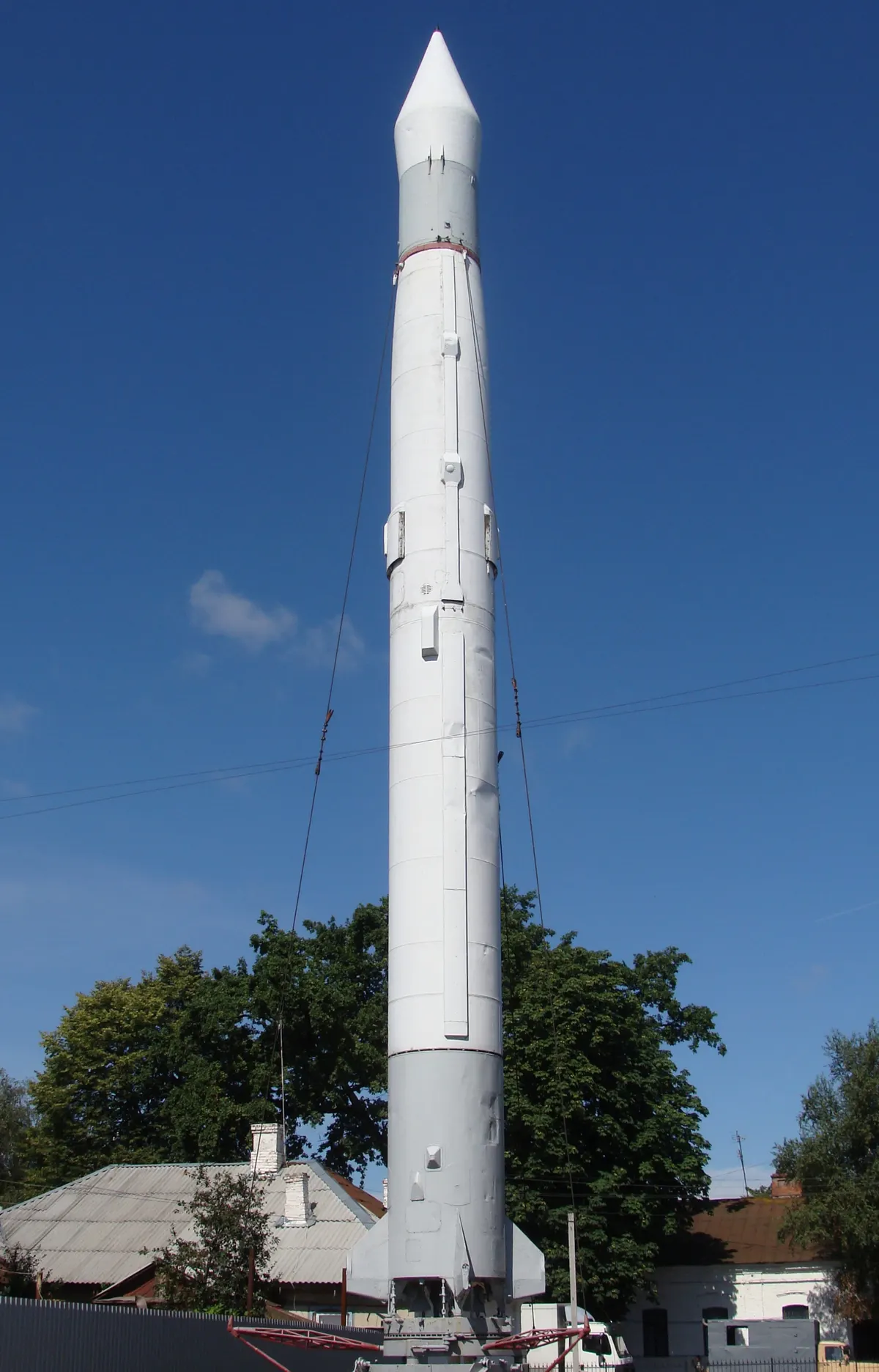
Turning that principle into something a bomber or missile could actually carry took another two years. The American Mark 17 became the first thermonuclear bomb to reach operational service in 1954, still a 19,000-kilogram weapon that needed a modified B-36 bomb bay, but a genuine step toward a deliverable warhead rather than a fixed test device.3 The R-5M followed on a missile airframe specifically, becoming the first Soviet missile ever assigned a warhead of this kind.
The R-5M entered service with the Strategic Rocket Forces on June 2, 1956, after a live warhead test earlier that year confirmed the pairing worked.4 Later Soviet medium-range missiles inherited the same basic pairing of a mobile launcher and a compact thermonuclear payload, among them the R-14 Chusovaya, fielded with a multi-megaton warhead specifically because its designers wanted a single missile capable of destroying a hardened target without needing pinpoint accuracy.
01Compact Secondaries and MIRV-Ready Missiles
A pure fission warhead of a given yield is heavy, because reaching that yield requires a correspondingly large fissile mass. A thermonuclear secondary produces far more energy per kilogram than a fission core of similar size, and that difference matters enormously once a missile has to carry its warhead through reentry rather than just detonate it on the ground.5 The lighter and smaller a warhead becomes for a given yield, the more of them (or the more accurate a single one) a missile's payload can carry, which is the direct engineering path that led to multiple independently targetable reentry vehicles, or MIRVs.
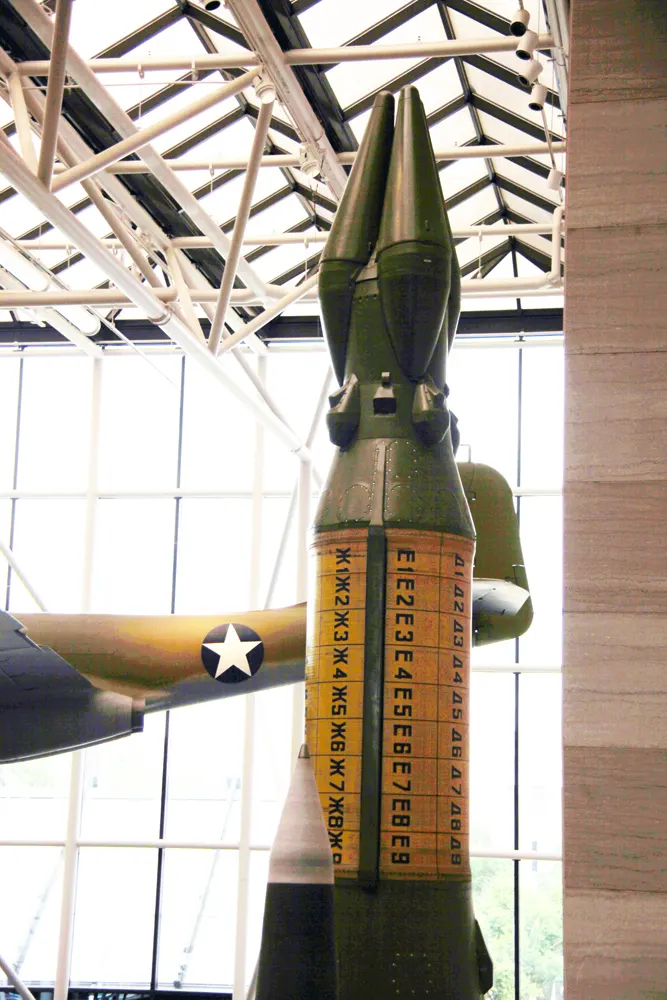
The RSD-10 Pioneer, known in NATO reporting as the SS-20, carried three independently targetable thermonuclear warheads on one road-mobile launcher, a payload arrangement that would have been physically impossible with fission-only warheads of equivalent yield.6 American missiles followed the same logic from the opposite side of the Cold War. The Pershing II fielded a single compact thermonuclear warhead built specifically for its reentry vehicle's tight size and weight limits, while the earlier PGM-19 Jupiter had already carried a lighter thermonuclear design a generation before it, in the early years when compact secondaries were still a new achievement rather than a routine one.
China's medium-range force shows the same pattern stretched over a longer timeline. The early DF-3 and the later DF-21A are both built around thermonuclear warheads, and China's move from fission-only test devices to a thermonuclear-armed missile force followed the same physical logic already worked out by the United States and the Soviet Union a decade earlier. Across every one of these missile families, a thermonuclear warhead is what let designers trade raw fissile mass for payload flexibility, and that tradeoff still shapes how modern medium-range and intermediate-range missile forces are built today.
01Notes and Sources
- "Ivy King", Wikipedia — en.wikipedia.org ↩
- "The Teller-Ulam Configuration", Britannica — britannica.com ↩
- "The First Hydrogen Bomb", Smithsonian Magazine — smithsonianmag.com ↩
- "R-5M", Astronautix — astronautix.com ↩
- "W88", Wikipedia — en.wikipedia.org ↩
- "Fact Sheet, Thermonuclear Weapons", Center for Arms Control and Non-Proliferation — armscontrolcenter.org ↩


