

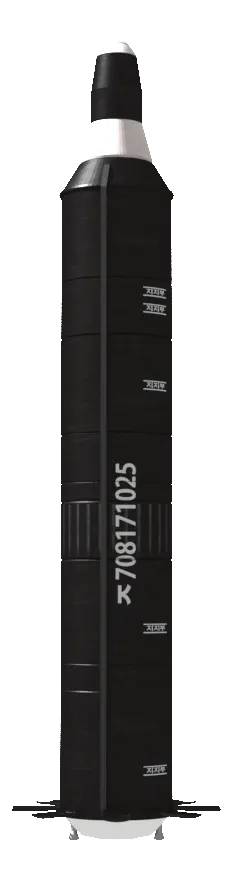

Hwasong-10, from the Korean Hwaseong, meaning Mars, and better known in the West by its US intelligence codename Musudan, is a North Korean road-mobile ballistic missile that spent most of its public life as a picture rather than a working weapon. It first appeared to the world on October 10, 2010, rolled through Kim Il Sung Square in Pyongyang during a parade marking the 65th anniversary of the ruling Workers' Party of Korea, and it did not fly a confirmed test flight until almost six years later1,2. When it finally did fly, in a concentrated 2016 test campaign, it failed catastrophically in most of its known attempts, making it one of the worst flight-test records of any missile North Korea has ever fielded in numbers.
- Extends North Korea's reach to Guam and US bases across Japan
- Road-mobile TEL basing is hard to preempt before launch
- Storable hypergolic propellants avoid the fueling delay of cryogenic fuels
- Design built on decades-old, well-understood Soviet SLBM engine technology
- One of the worst known flight-test records of any fielded ballistic missile
- Genuinely disputed whether the type was ever combat-ready
- Wide range of published dimensions before 2016 reflected pure guesswork
- Effectively abandoned in favor of newer designs after 2017
The US Department of Defense assigned the name Musudan after Musudan-ri, the coastal missile and satellite-launch site in Hwadae County, North Hamgyong Province, even though the missile itself is not primarily tested from that location3. North Korean state media refers to the type by its native designation, Hwasong-10, and Western trackers have also used BM-25, KN-07, Mirim, and Nodong-B, an alphabet-soup problem this leaf's other Hwasong-family articles run into repeatedly3,4. Publicly available imagery from the type's satellite-monitored deployment sites near Mirim airfield outside Pyongyang reportedly dates to as early as 2003, meaning the missile was apparently fielded for roughly thirteen years before anyone outside North Korea saw it actually fly2.
The core technical claim behind the Hwasong-10, that it adapts the Soviet R-27 submarine-launched ballistic missile's engine for a land-mobile North Korean missile, is itself disputed by specialist analysts, discussed in Specs and Design below. What is not disputed is the missile's role in North Korea's medium and intermediate-range arsenal, sitting between the shorter, Scud-derived Hwasong-7 and Hwasong-9 and the later road-mobile systems that eventually carried North Korea to a genuine intercontinental capability. Whether the MRBM classification even fits is itself an open question. Several trackers classify the type as a full IRBM given its estimated 2,500 to 4,000 km range, well beyond the rough 3,000 km line most trackers use to separate the two categories. There is no reliable public unit cost figure for the Hwasong-10, consistent with North Korea's general refusal to publish weapons pricing, and any search for the Hwasong-10 unit cost or Hwasong-10 price beyond that turns up only speculation.
An Engine Story Borrowed From a Soviet Submarine, Disputed by Specialists
The most repeated claim about the Hwasong-10 is that its engine is a North Korean-built variant of the Soviet 4D10 engine that powered the R-27 Zyb (NATO reporting name SS-N-6 Serb), a submarine-launched ballistic missile carried aboard Soviet Yankee-class ballistic missile submarines from the late 1960s onward1,3. The connection is generally traced to a 1992 contract between North Korea's Yon'gwang Trading Company and Russia's Makeyev Rocket Design Bureau in Miass, the design house responsible for the original R-274. The Musudan reportedly uses the same fuel combination as the R-27, unsymmetrical dimethylhydrazine (UDMH) burned with nitrogen tetroxide, hypergolic propellants that ignite on contact and can sit loaded in a missile's tanks for long stretches, unlike cryogenic fuels that demand fueling immediately before launch1.
- Missile ClassIntermediate-range ballistic missile
- Service Entry Year2016
- DesignerNorth Korea
- Length12 m
- Diameter1.5 m
- Launch Weight22,000 kg
- In ServiceYes
Not every specialist accepts that story at face value. Missile engineers Markus Schiller and Robert Schmucker, in a widely cited 2012 technical paper, argued that the public case for a direct R-27 connection rests on thinner evidence than commonly assumed. They found that the second stage of North Korea's Unha space-launch rocket, often cited as corroborating proof of captured SS-N-6 technology, could not plausibly be built from SS-N-6 hardware, and concluded that circumstantial links, such as Iran's Safir rocket also using SS-N-6-derived elements, do not actually establish that the Musudan itself is SS-N-6 technology rather than a separate, less capable North Korean design dressed up to look like one4. Schiller went further in later writing, floating what he called the bluff hypothesis, the idea that North Korea's parade missiles may be mockups built around obtained Soviet hardware whose actual service life had long since expired, intended mainly to project strategic leverage rather than field a genuine weapon5. Missile analyst Jeffrey Lewis has pushed back on that reading, pointing to multiple US intelligence community assessments between 2009 and 2013 that treated the Musudan as authentic, along with physical evidence from seized North Korean missile shipments that US agencies could compare directly against captured Scuds5. Neither side has settled the argument conclusively in public.
- Propulsion TypeLiquid-propellant rocket
- Number of Stages1
- Fuel TypeUDMH and nitrogen tetroxide
- Solid-FuelNo
- CanisterizedNo
Published dimensions for the Hwasong-10 swung wildly before its first confirmed flight. CSIS Missile Threat's own range of estimates ran from 12 to 19 m in length and 1.5 to 2.0 m in diameter, with launch weight estimated anywhere from 19,000 to 26,000 kg1. Once North Korea released clear video of the June 2016 tests, Schiller and Schmucker's technical review pinned the airframe closer to the low end of those ranges, and CSIS Missile Threat's baseline figures now list a length of roughly 12 m and a diameter of 1.5 m1,2. The missile is single-stage, carries a single warhead of an estimated 650 to 1,200 kg, and public sources describe conventional high-explosive, cluster, chemical, and potentially nuclear payload options, though no public source confirms an actual nuclear warhead has ever been mated to the type1. Guidance is purely inertial, with no confirmed terminal seeker, and CSIS estimates its circular error probable at roughly 1,600 m, an area-weapon level of accuracy against a fixed target like an airbase or port rather than anything approaching a precision strike1.
- Maximum Range4,000 km
A Wheeled MAZ-Based Launcher, Not a Silo
Like nearly every North Korean missile short of its newest intercontinental designs, the Hwasong-10 fires from a wheeled road-mobile transporter erector launcher rather than a fixed silo, believed to be built on a Soviet-derived MAZ-547 or MAZ-7917-type heavy chassis2,3. Road mobility lets North Korea disperse launchers and hide them in mountain tunnels between mobilization and launch, complicating any attempt to strike the force on the ground before it fires, the same basing logic used across the shorter Hwasong-7 and Hwasong-9. The missile is neither canisterized nor cold-launched, unlike some of North Korea's newer solid-fuel systems, and it is not rail-mobile or submarine-launched despite its underlying design starting life as exactly that, a submarine weapon.
- Circular Error Probable (CEP)1,600 m
- Guidance TypeInertial / GPS
- Terminal GuidanceNo
By 2020, US intelligence assessments reportedly still classified the Hwasong-10 as deployed, with fewer than 50 launchers fielded despite the type's dismal test record, a genuinely strange combination of a missile treated as operational on paper while remaining almost entirely unproven in practice1,2. North Korea has never disclosed actual production totals or unit numbers for the type, consistent with its general secrecy around missile inventories.
- Warhead Typehigh-explosive fragmentation, cluster, nuclear or chemical
- NuclearYes
- MIRVNo
- Warhead / RV Count1
- Conventional-CapableYes
- Basing Moderoad-mobile TEL
- Silo-BasedNo
- Road-Mobile (TEL)Yes
- Rail-MobileNo
- Submarine-LaunchedNo
- First Test2016
- Explosive Filler Type*Conventional *Possibly nuclear
Cold War Leftovers and a 1992 Recruitment Drive
The Hwasong-10's technical roots trace to the economic collapse that followed the Soviet Union's dissolution in 1991, when suddenly unemployed Soviet missile engineers became recruitable in a way that would have been unthinkable a few years earlier. North Korea moved quickly. On October 15, 1992, Russian Security Ministry officers intercepted 64 Russian missile specialists from Miass, home of the Makeyev bureau, along with their families, at Moscow's Sheremetyevo-2 airport as they prepared to board a flight bound for North Korea6. A second attempt on November 5, 1992, saw another 60 specialists stopped at the same airport, roughly 40 of them Makeyev missile engineers and the rest nuclear specialists6. The recruiter, a Russian national named Anatoliy Rubtsov posing as a Russian government official, was reportedly working for North Korea the whole time. Despite both interceptions, an estimated 17 to 20 missile specialists and 9 nuclear specialists are believed to have eventually reached North Korea via China regardless6. That episode, more than any single test flight, is the closest thing to a confirmed origin story for the technology North Korea would eventually present as the Hwasong-10.
A Missile Displayed for Six Years Before It Ever Flew
North Korea first showed the missile that would become known as the Musudan to Western audiences on October 10, 2010, during a parade marking the Workers' Party of Korea's 65th anniversary in Pyongyang, though some analysts believe earlier, unphotographed glimpses may have occurred as far back as 20072,3. Multiple independent technical reviewers, including Schiller and Schmucker, concluded the parade examples were very likely mockups, since no confirmed flight test of any kind had occurred and satellite imagery of suspected deployment sites near Mirim airfield reportedly went back to 20032,4. That combination, a missile apparently deployed for over a decade with zero confirmed flight tests, is unusual even by North Korean standards and fed directly into the bluff-hypothesis debate described in Specs and Design.
The 2016 Test Campaign That Finally Answered the Question, Badly
Whatever the Hwasong-10 actually was before 2016, North Korea settled part of the argument that year by finally flying it, repeatedly, and mostly unsuccessfully. The first confirmed test, on April 15, 2016, the birthday of North Korean founder Kim Il Sung, ended in a catastrophic failure at or shortly after launch near Wonsan7,8. A second attempt on April 28 failed just as badly, the resulting explosion destroying the transporter erector launcher along with the missile7,8. A third test on May 31 exploded on its launch pad, reportedly injuring nearby personnel7,8. By the end of May 2016, North Korea had attempted the Musudan four times without a single confirmed successful flight.
The turning point came on June 22, 2016 (June 21 by some Western dating conventions), when North Korea fired two more missiles from a site near Wonsan2,7. The first flew roughly 150 km before breaking apart in flight. The second reached an unusually high, lofted trajectory, traveling about 400 km in range while climbing past 1,000 km in apogee, a flight profile consistent with a missile capable of far greater range on a flatter, minimum-energy trajectory2,7. North Korean state media claimed complete success. Independent analysts were more cautious, treating the second flight as a genuine technical achievement while noting the first missile of the pair still failed7,9. Photographs released after the test showed a set of eight grid fins fitted around the missile's base, a stabilizing feature never seen on earlier Musudan mockups or on the original Soviet R-27, which analyst John Schilling at 38 North described as almost certainly a rushed, improvised fix by North Korean engineers who had guessed, correctly as it turned out, that their modifications to the missile had compromised its stability during early flight9.
North Korea did not stop there. Two further tests, on October 9 and October 19, 2016, launched from Kusong in the country's northwest and both failed catastrophically, though the missile type involved in those two launches was never fully confirmed7,8. Counting generously, North Korea's known 2016 Musudan tests ran to roughly eight attempts, with only the second June 22 flight counted as an unambiguous success, a failure rate matched by very few other missiles anywhere in the world that reached operational deployment on paper7,8.
Sidelined by Newer Designs
North Korea does not appear to have flight-tested the Hwasong-10 again after October 2016. The type was conspicuously absent from North Korea's February 2018 military parade, a notable omission given how heavily Pyongyang usually leans on parades to signal a program's continued relevance, and German missile analyst Norbert Brügge argued in late 2017 that the program had likely been quietly cancelled over unresolved engine problems2. The more likely explanation is that the Hwasong-10's technology, and its underlying lesson about the limits of adapted Soviet submarine hardware, fed directly into North Korea's next generation of missiles rather than simply vanishing. The Hwasong-12, first successfully tested in May 2017, uses a different and more powerful engine derived from the Soviet RD-250 family rather than the R-27's 4D10, evidence that North Korean engineers had by then moved past the Musudan's engine generation entirely10. That newer RD-250-derived propulsion also underpins the first stage of the Hwasong-14, North Korea's first missile with a genuine intercontinental range, tested two months later in July 2017. Whatever the Hwasong-10 actually contributed, whether hard engineering lessons, engine test data, or simply a costly demonstration of what not to repeat, its unreliable flight record marks a clear technological hinge point in North Korea's missile program, the last major system built around adapted Soviet SLBM propulsion before Pyongyang moved on to the RD-250-based engines that eventually powered a real intercontinental ballistic missile.
Iran's BM-25 and the Disputed Khorramshahr Connection
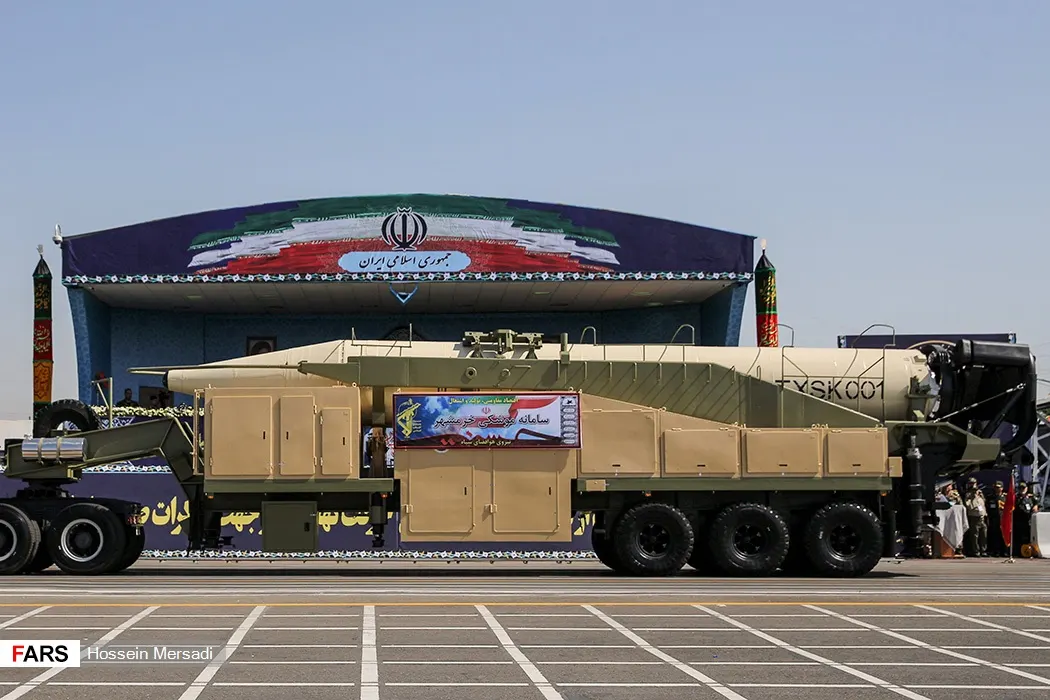
The clearest reported foreign offshoot of the Musudan involves Iran, though the details remain genuinely contested. A 2005 report from German intelligence sources, later summarized in a diplomatic cable made public through WikiLeaks, claimed Iran had purchased 18 to 19 missile kits under the BM-25 designation from North Korea, in semi-knocked-down or complete-knocked-down form11. US officials quoted around the cable's 2010 release were notably skeptical, with one senior intelligence official saying he was unaware of any sale of a complete missile, only probable kit transfers, and experts pointed out that Iran had never publicly displayed a Musudan-type missile despite years of opportunity to do so11. Years later, Iran unveiled a missile called Khorramshahr, first test-fired in January 2017 and publicly paraded in September 2017, widely assessed as a reworked, more compact derivative of the same Musudan-family design rather than a direct copy, adapted for Iran's own strategic requirements12,13.
Whether the Khorramshahr genuinely descends from hardware Iran physically received from North Korea, or simply reflects shared access to the same underlying Makeyev-derived engine data, remains an open question in public reporting. IRGC officials have described their missile as smaller and more tactically oriented than the Musudan it is compared against, consistent with either explanation13. No serial-production totals or confirmed unit counts exist for either the Iranian or North Korean side of this relationship.


North Korea, the Only Confirmed Operator of an Unreliable System
North Korea remains the sole confirmed operator of the Hwasong-10, fielding it on wheeled launchers alongside its shorter Scud-derived Hwasong-7 and Hwasong-9 missiles even after the program's disastrous 2016 test record1,2. Whether the roughly fewer-than-50 launchers reported deployed as of 2020 represent a genuinely combat-capable force, or a costly, mostly symbolic holdover kept fielded for deterrent optics after its intended replacement by newer designs, is not something open-source reporting can answer with confidence. No other country has been confirmed to operate the Hwasong-10 itself, as distinct from Iran's separately developed Khorramshahr derivative discussed above.
Hwasong-10 vs Soviet R-27, an Adapted Engine Without the Original's Track Record
The Soviet R-27 that supplied the Hwasong-10's presumed engine technology was itself a mature, extensively flight-tested system by the time it left Soviet service, deployed on submarines through the 1970s and 1980s with a service record numbering in the hundreds of flights. The Hwasong-10 inherited the engine concept and the storable hypergolic propellants but none of that flight history, adapting a proven submarine-launched design to a very different role, a land-mobile system exposed on a wheeled launcher rather than fired from a submerged missile tube. That difference in operating environment, rather than any single component, likely explains much of the stability problem North Korea's engineers scrambled to fix with improvised grid fins in June 2016. A missile designed around a submarine launch tube's constraints does not automatically behave the same way lofted off an open desert or mountain launch pad, and the Hwasong-10's test record suggests North Korean engineers learned that lesson the hard way rather than through careful ground testing.
Hwasong-10 vs Hwasong-12, Why North Korea Moved On
Where the Hwasong-10 struggled through a catastrophic 2016 test campaign built around 1960s-vintage Soviet SLBM engine technology, the Hwasong-12 that followed just months later used an entirely different, more powerful RD-250-derived engine and performed far more reliably in its own test program. The practical difference for North Korea was straightforward. A missile that fails catastrophically on the pad roughly seven times out of eight is not a credible deterrent no matter how many launchers carry it, while a missile that reliably reaches its intended range and altitude, even at short notice, actually delivers on the coercive threat North Korea's missile displays are meant to project. The Hwasong-12's success also confirmed something the Hwasong-10's failures had only implied, that North Korea's real path to a longer-range and eventually intercontinental capability ran through RD-250-family engines rather than through further refinement of adapted R-27 technology.
| SPEC | Hwasong-10 | Hwasong-9 | Hwasong-12 |
|---|---|---|---|
| Maximum Range | 4000 km | 1000 km | — |
| Propulsion Type | Liquid-propellant rocket | liquid_propellant | — |
| Road-Mobile (TEL) | ✓ | ✓ | — |
| Circular Error Probable (CEP) | 1600 m | 3000 m | — |


Is the Hwasong-10 still in service
North Korea's own status is genuinely disputed. US intelligence assessments as of 2020 reportedly still classified the type as deployed, with fewer than 50 launchers fielded, but it has not been observed in a major parade since before 2018, was not flight-tested again after October 2016, and its combat reliability was never properly demonstrated even during its own test campaign1,2.
What is the Hwasong-10's range
Public estimates put its maximum range at roughly 2,500 to 4,000 km, based mainly on the lofted trajectory of its one clearly successful June 2016 test rather than an operational demonstration on a normal flattened trajectory, which is a meaningfully different and less certain kind of evidence1,2.
Why did the Musudan fail so many test flights
No official North Korean explanation exists. Independent analysts point to the difficulty of adapting a submarine-launched missile engine to a very different land-mobile launch environment, and the improvised grid fins added for the June 2016 tests suggest North Korean engineers themselves identified an in-flight stability problem and attempted a rushed fix rather than a fully engineered solution9.
Is the Hwasong-10 the same missile as the Musudan or BM-25
Yes. Hwasong-10 is North Korea's own designation, while Musudan is the US intelligence community's codename and BM-25, KN-07, Mirim, and Nodong-B are other Western tracking labels that have been applied to the same missile over the years3,4.
How does the Hwasong-10 compare to Iran's Khorramshahr missile
Iran's Khorramshahr, first paraded in 2017, is widely assessed as a reworked derivative of the same underlying Musudan-family design, though genuine uncertainty remains over exactly what North Korea physically transferred to Iran versus what Iran developed independently using shared technical roots11,12,13.
- "BM-25 Musudan (Hwasong-10)", CSIS Missile Threat — missilethreat.csis.org ↩
- "Hwasong-10", Wikipedia — en.wikipedia.org ↩
- "No-dong-B / BM-25 Musudan", Army Recognition — armyrecognition.com ↩
- "Origins of the Musudan IRBM", Arms Control Wonk — armscontrolwonk.com ↩
- "Is the Musudan Real?", Arms Control Wonk — armscontrolwonk.com ↩
- "Chronology of North Korea's Missile Trade and Developments: 1992-1993", James Martin Center for Nonproliferation Studies — nonproliferation.org ↩
- "North Korea's Musudan Missile, A Performance Assessment", 38 North — 38north.org ↩
- "Why Do North Korea's Musudan Missile Tests Fail? Kim Jong Un's Country Had 7 Failures This Year", International Business Times — ibtimes.com ↩
- "A Partial Success for the Musudan, Addendum", 38 North — 38north.org ↩
- "A Quick Technical Analysis of the Hwasong-12", 38 North — 38north.org ↩
- "Experts Question North Korea-Iran Missile Link From WikiLeaks Document Release", The Washington Post — washingtonpost.com ↩
- "Khorramshahr (missile)", Wikipedia — en.wikipedia.org) ↩
- "Iran's Most Powerful Ballistic Missile Khorramshahr, How North Korea's Musudan Was Adapted for Middle Eastern Requirements", Military Watch Magazine — militarywatchmagazine.com ↩