

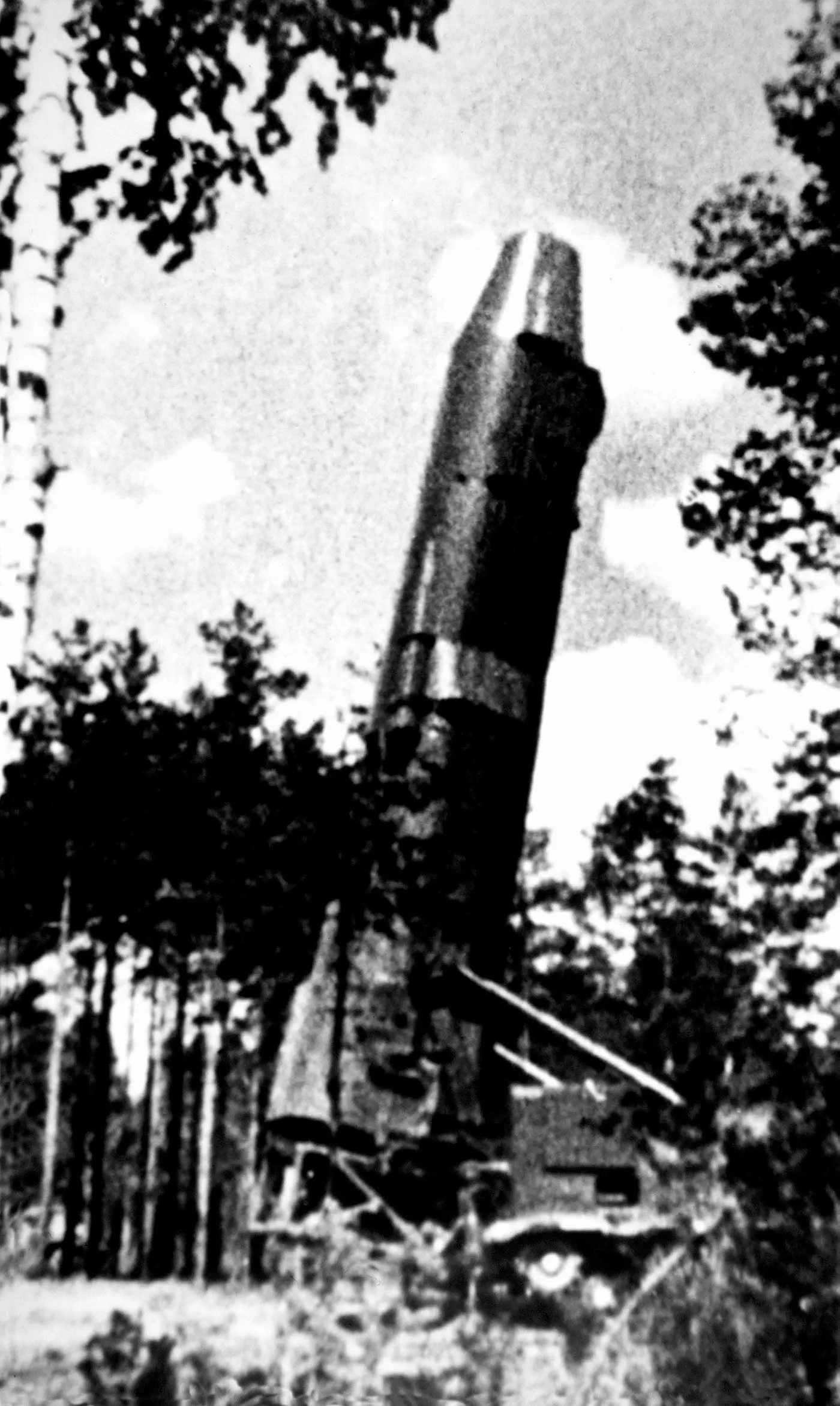

The RT-15 was a Soviet road-mobile, solid-fuel medium-range ballistic missile, carried in Soviet documents under the industrial index 8K96 and known to Western intelligence by the dual NATO reporting names SS-14 Scamp (applied first, to the tracked launcher) and SS-14 Scapegoat (applied later, to the containerized missile round itself).1,3 It never entered full combat service. The Soviet Union tested it through most of the 1960s, briefly fielded a handful of examples on trial status in Belarus around 1970, and quietly scrapped the whole program within two years, making the RT-15 one of the more obscure dead ends in early Soviet solid-fuel missile development.1,2
- Solid-fuel propulsion, no hours-long liquid fueling before launch
- Tracked, road-mobile launcher, harder to target than a fixed silo
- Reused proven RT-2 rocket stages instead of a clean-sheet motor
- Passed its own flight-test program well enough to be recommended for production
- Launch support electronics judged too bulky and fragile for real deployment
- Short overhaul interval and difficult chassis access in the field
- Guidance and control system never brought to a fully satisfactory state
- Cancelled after less than two years of even trial service
RT-15's story matters less for what it accomplished and more for what it revealed. The USSR spent the late 1950s and early 1960s racing to build a solid-fuel counterpart to its liquid-fuel missile force, and RT-15 was the first attempt to put that solid-fuel motor on a self-propelled chassis rather than a fixed pad.2 The attempt failed on its own terms, but the same basic idea, a truck- or tank-mounted missile that could disperse instead of sitting in one place, reappeared a decade later in the far more successful RSD-10 Pioneer. RT-15 was also meant, eventually, to stand alongside or replace liquid-fuel medium-range missiles like the R-12 Dvina, which is the missile that actually carried the Cuban Missile Crisis's warheads.1 The comparison sections below explain how those two related systems illuminate what RT-15 was trying and failing to do.
Two Solid Stages Recycled From the RT-2 ICBM Program
RT-15 measured 11.93 meters long and 1.49 meters in diameter, with a launch weight of 16,000 kilograms.1,2,5 It was a two-stage solid-fuel design, and both stages were derived directly from the RT-2 (SS-13 Savage) ICBM then under development at the same time, a shortcut that let RT-15 skip years of independent propulsion work.1 Stage one used the 15D27 motor, a four-nozzle unit rated around 42 tonnes of thrust, and stage two used the 15D28 (sometimes catalogued as 15D92), rated around 22 tonnes.5 Both burned a composite propellant designated PAL-17/7, developed by the Altai Research Institute of Chemical Technology from butyl rubber, ammonium perchlorate and powdered aluminum, the standard recipe family for Soviet solid rocket fuel of that era.5
- Missile Classmedium-range ballistic missile
- Service Entry Year1965
- DesignerPyotr Tyurin (TsKB-7 / Arsenal Design Bureau)
- Length11.93 m
- Diameter1.49 m
- Launch Weight16,000 kg
- In ServiceNo
The missile itself was engineered by Pyotr Tyurin's Arsenal Design Bureau (TsKB-7) in Leningrad, not by Sergei Korolev's OKB-1 as the program's origin story sometimes implies. Korolev chaired the overarching Council of Chief Designers that oversaw the entire family of missiles authorized by an April 1961 government decree, RT-1, RT-2 and RT-15 among them, but the detailed design of RT-15's airframe and control system belonged to Tyurin's team.1,2 A separate bureau, TsKB-34, designed the launch complex, and the Kirov Plant's own design office under Zh. Ya. Kotin produced the working drawings for the self-propelled launcher chassis.2 Three organizations, not one, built the actual hardware, and crediting the whole program to Korolev overstates his role, which was supervisory rather than hands-on.
- Propulsion Typesolid rocket
- Number of Stages2
- Fuel Typesolid
- Solid-FuelYes
- Cold-LaunchYes
- CanisterizedYes
The T-10 Chassis Launcher and a Silo Variant That Never Flew
RT-15's mobile complex, designated 15P696, mounted the missile on a modified T-10 heavy tank chassis internally called Object 815, launched directly from a sealed transport-launch container rather than an open pad.2,7 A unit fielded six of these launchers together with support vehicles. That container, designated 15Ya25 and built from fiberglass, is the basis for describing RT-15 as cold-launch capable, though the requirement to launch straight out of the container was only added in an August 1965 design revision, meaning the earliest test rounds fired from open positions instead.5 A parallel stationary version, 15P069, was meant to put the same missile in a fixed silo, but that variant was never completed and never flew, leaving RT-15 as a program that was dual-basing on paper only.
- Minimum Range2,000 km
- Maximum Range2,500 km
RT-15's designation as both road-mobile and silo-based in program records reflects this split, one basing mode that was actually built and tested, one that was cancelled before completion. There was never a rail-launched version of RT-15. Rail-mobile launch became a defining feature of much later Soviet missiles, the RT-23 Molodets among them, and has nothing to do with this program.
- Circular Error Probable (CEP)900 m
- Guidance TypeInertial
- Terminal GuidanceNo
- Maneuverable Re-Entry Vehicle (MaRV)No
- Penetration Aids / DecoysNo
Inertial Guidance, a Single Warhead and a Real Disagreement Over Yield
RT-15 flew on an autonomous, gyro-stabilized inertial guidance system, with no radio link, no radar correction and certainly no satellite-aided component of any kind.1,2,4 That is worth stating plainly because a purely inertial guidance package is exactly what an early-1960s Soviet missile should have, since satellite navigation would not exist in any form for another decade and a half. Accuracy came out to a circular error probable of roughly 900 meters according to Soviet-derived figures, a number Western intelligence broadly corroborated with its own wider estimate of 600 to 2,000 meters.1,4
- Warhead Typenuclear
- NuclearYes
- ThermonuclearYes
- Yield (per warhead)1,000
- MIRVNo
- Warhead / RV Count1
- Conventional-CapableNo
The missile carried a single, detachable monoblock nuclear warhead, no maneuvering reentry vehicle and no penetration aids of any kind.2 Its yield is where sources genuinely disagree rather than merely round differently. English Wikipedia, Russian Wikipedia and GlobalSecurity all cite a warhead in the 1-megaton class, while the specialist Russian missile-history site Missilery.info instead gives a 600-kiloton figure for the same detachable warhead.1,5,4 Payload mass is reported as roughly 500 to 535 kilograms across these sources. No source used the word thermonuclear specifically for this warhead, though a yield anywhere in the hundreds-of-kilotons-to-megaton range on a payload that light is difficult to achieve without a fission-fusion design, which is the basis for treating it as a thermonuclear weapon rather than settled fact from a named source.
- Basing Modemobile_and_silo_based
- Silo-BasedYes
- Road-Mobile (TEL)Yes
- Rail-MobileNo
- Submarine-LaunchedNo
- Operators1
- First Test1965
- Detonation Mechanism / Fuzenuclear detonation
- Explosive Filler Type1 Mt nuclear warhead
A 1961 Decree, Three Design Bureaus, and a Council Chaired by Korolev
The Council of Ministers issued the decree authorizing RT-15 alongside RT-1 and RT-2 on 4 April 1961, tasking multiple bureaus with a family of solid-fuel missiles meant to answer the Soviet military's growing interest in weapons that did not need hours of fueling before launch.1,2 TsKB-34 finished a preliminary design for the launch complex in 1962, and Tyurin's Arsenal Design Bureau carried the missile itself toward flight readiness. The original schedule called for tests to begin in the third quarter of 1963, but that date slipped because the solid propellant needed further refinement, a problem that dogged Soviet solid-fuel missile development generally through the early 1960s.1,2
Requirements were revised again in August 1965, this time mandating that the missile launch directly from its sealed container, and that same year the mobile launcher made its first public appearance at a Moscow military parade.1 Western analysts spotted the new tracked launcher independently around May 1965 and gave it the reporting name Scamp before they had identified what round it actually carried, only assigning the separate name Scapegoat to the containerized missile once they had a clearer picture in 1968.4 Flight testing itself is one of the few points where sources genuinely conflict. Wikipedia-derived figures describe roughly twenty launches between 1965 and 1970, three of them in the first year, while Missilery.info instead dates the first real launch to 4 December 1966 and the first fully successful flight to 9 February 1967, with state testing continuing through 1970.1,2 Western intelligence, working only from what it could observe rather than internal Soviet records, counted about ten test launches in 1969 and 1970 alone and clocked its last confirmed sighting in March 1970.4
Kapustin Yar Testing and a Missile the Ministry of Defense Refused
All of RT-15's flight testing took place at the Kapustin Yar range. By 1968, the missile had passed enough of its test program to be recommended for series production, a genuine technical success by the standard the Strategic Rocket Forces normally applied.2 The Ministry of Defense refused to accept it into general service anyway. Reasons cited across different sources vary, which likely reflects several real objections stacking up over the program's long life rather than any single fatal flaw. The launch support electronics were judged too bulky and fragile for field use. The vehicle's short 3,000 to 5,000-kilometer overhaul interval and difficult access to chassis components made routine maintenance a burden, and Tyurin's bureau reportedly never brought the missile's guidance and control system to a fully satisfactory state.1,2,6 A program that could hit its own test targets still lost on the practical questions of how many self-propelled chassis a real regiment would need and how reliably crews could maintain them.
The Belorussia Trial Deployment and a Program the West Barely Noticed
Despite the refusal, the 15P696 complex was accepted for limited trial or experimental operation in 1970, stationed with the 50th Independent Missile Battalion at Lesnaya, in the Belorussian SSR, with six launchers.1 It never went on full combat alert and was decommissioned by 1971 or 1972, only one or two years after arriving.1 Western estimates placed fewer than thirty examples ever deployed and, notably, believed they were stationed in Soviet Asia rather than Belorussia, an error that says as much about the limits of Cold War satellite reconnaissance as it does about RT-15 itself.4 The mismatch is a small but genuine reminder that even a program NATO tracked under its own reporting name could still be misread on where it actually sat.
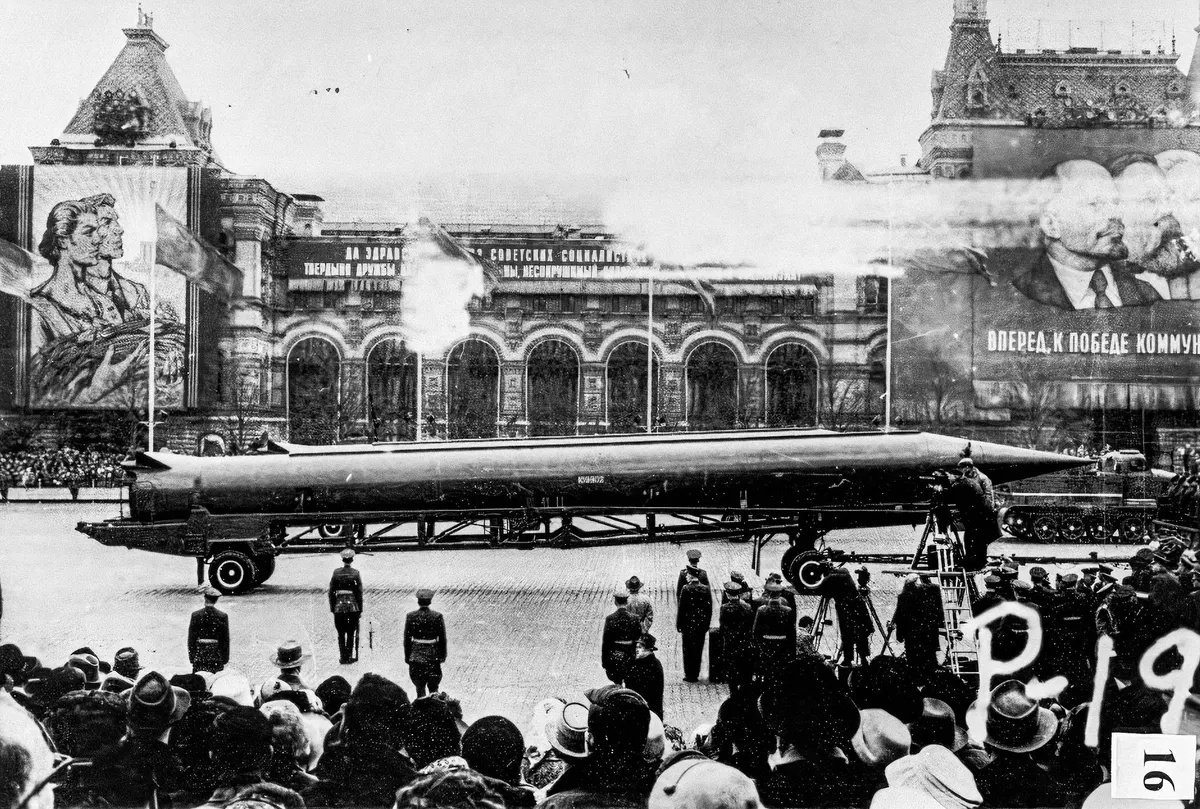
RT-15's entire operational life sat squarely inside the Cold War's missile-development race, alongside programs like the liquid-fuel R-12 Dvina it was intended to complement rather than any actual armed conflict.1 It never fired a shot, never faced an adversary, and never left Soviet territory. Its relevance is entirely to the internal history of how the Soviet Union tried, and on this first attempt failed, to put a strategic solid-fuel missile on a self-propelled launcher.
RT-15 produced two closely related official variants and one frequently confused unrelated missile. The mobile 15P696 complex, on the T-10-based Object 815 chassis, was the only version that actually reached flight testing and trial deployment.2 The stationary 15P069 silo variant was designed on paper but never completed, so RT-15 is correctly described as intended for both road-mobile and silo basing even though only the mobile half was ever real. A longer-range derivative, RT-25 (industrial index 8K97), reused RT-2 hardware in the same way RT-15 did but aimed for greater range, and it too was cancelled, as a separate program rather than a variant of RT-15 itself.2
The name RT-15 is also attached, confusingly, to a completely different missile. RT-15M (industrial index 4K22) was a submarine-launched derivative authorized under the same 1961 decree but designed separately by Viktor Makeyev's SKB-385 for the Project 667 Yankee-class ballistic missile submarine's D-7 launch system.8 It shared little beyond a name and a decree with the land-based RT-15, and it never left the design stage either, killed because the resulting missile came out roughly three times heavier than the competing liquid-fuel R-27 it was meant to replace.8
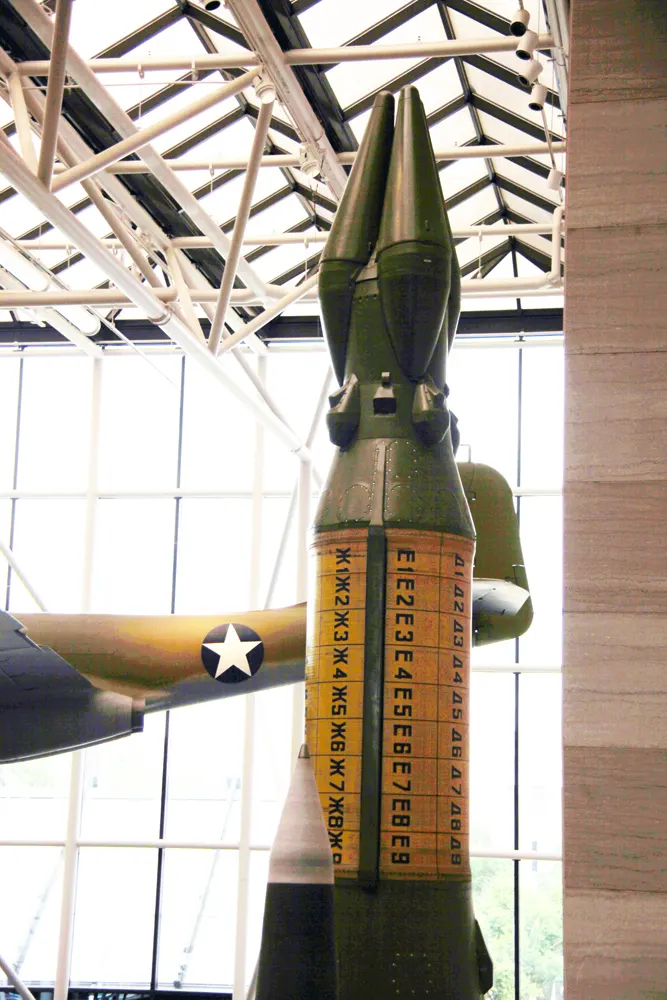
Whether RT-15 fed forward into later Soviet mobile missiles is a genuinely disputed point rather than a settled one. One account credits RT-15 directly with proving the general feasibility of mobile strategic systems, paving the way for the Moscow Institute of Thermal Technology's later work.6 The more commonly cited technical path in Western literature runs instead through a different program, RT-20P, whose engineering groundwork fed Alexander Nadiradze's RT-21 Temp 2S, the design that in turn became the direct ancestor of the RSD-10 Pioneer.9 The more defensible claim for RT-15 is narrower. It was an early, unsuccessful proof of concept for putting a strategic solid-fuel missile on a self-propelled chassis, and its specific failures, bulky launch electronics and poor field maintainability chief among them, are exactly the kind of problems later mobile-missile programs had to solve before Pioneer could succeed where RT-15 had not.

RT-15 had exactly one operator across its entire existence, the Soviet Union's Strategic Rocket Forces, and even that operator never accepted it for full combat service.1 The only unit to hold the missile was the 50th Independent Missile Battalion at Lesnaya in the Belorussian SSR, fielding six 15P696 launchers on trial status from 1970 until the complex was withdrawn around 1971 or 1972.1
No RT-15 was ever exported, licensed to a Warsaw Pact ally, or transferred outside Soviet control, unlike some other Soviet theater missiles of the same era that did see limited transfers to allied states. Its user base began and ended with a single trial battalion, and it never generated the kind of foreign operator history that gives some Cold War missiles a second life in export markets. There is no confirmed unit cost or production-run total for RT-15 beyond the six launchers built for the Lesnaya trial, which is itself a mark of how limited the program's real footprint was compared with missiles that reached genuine mass production.
RT-15 Against the RSD-10 Pioneer It Never Directly Fathered
The RSD-10 Pioneer is the missile RT-15 is most often mentioned alongside, because both were Soviet road-mobile, solid-fuel medium-range systems built by the Strategic Rocket Forces, yet the two could hardly have had more different outcomes. RT-15 struggled to reach even six launchers in trial service before its 1971 or 1972 cancellation. The RSD-10 Pioneer, built roughly a decade later by an entirely different design bureau under Nadiradze, went on to arm dozens of regiments and become the missile whose deployment triggered NATO's 1979 Double-Track Decision. The most honest way to describe the relationship is that RT-15 identified problems, bulky launch electronics, awkward chassis maintenance, an underdeveloped guidance and control system, that the RSD-10 Pioneer's designers had to solve rather than repeat. Whether that counts as RT-15 directly enabling Pioneer is genuinely contested in the sources, with only a single account making that direct claim and the more widely cited technical path in Western literature instead running through the separate RT-20P program.6,9
RT-15 Against the R-12 Dvina It Was Meant to Complement
RT-15's more immediate point of comparison inside its own era is the R-12 Dvina, the liquid-fuel medium-range missile that actually equipped Soviet regiments throughout the 1960s and carried the warheads secretly shipped to Cuba in 1962. Where the R-12 Dvina traded a hazardous, hours-long liquid fueling procedure for genuine numbers, hundreds of launchers built and fielded, RT-15 tried to buy the same forward-deployed readiness through solid fuel and mobility instead. It never got the chance to prove the trade was worth it. The R-12 Dvina remained in frontline Soviet service for almost three decades, into the era of the INF Treaty, while RT-15 lasted barely a year on trial status before being withdrawn.
| Spec | RT-15 | R-12 Dvina | RSD-10 Pioneer |
|---|---|---|---|
| Launch weight | 16,000 kg | ~41,700 kg | ~37,100 kg |
| Max range | 2,500 km | ~2,000-2,500 km | ~5,000 km |
| CEP | 900 m | ~1.5-5 km | ~450 m |
| Basing | Road-mobile / silo (unfinished) | Soft pad / silo | Road-mobile |
RT-15's specifications look almost identical to the R-12 Dvina's on range alone, yet the two missiles represent opposite bets on how to survive a first strike, dispersal on a tracked chassis versus overwhelming numbers of fixed launchers, and only one of those bets was actually placed at scale in the 1960s.


Was RT-15 ever deployed? Only on a limited trial basis. Six 15P696 launchers served with the 50th Independent Missile Battalion at Lesnaya in the Belorussian SSR from around 1970 until the program was withdrawn in 1971 or 1972. It was never accepted into full Soviet combat service.1
What was RT-15's NATO reporting name? Western intelligence used two related names for the same system, SS-14 Scamp for the tracked launcher and SS-14 Scapegoat for the containerized missile, having first spotted and named the launcher in 1965 before identifying the missile itself.4
Why was RT-15 cancelled? Sources cite several compounding reasons rather than one single failure, launch support electronics that were too bulky and fragile for field use, a short overhaul interval, difficult access to chassis components for maintenance, and a guidance and control system its designers never fully perfected.1,2,6
How does RT-15 compare to the RSD-10 Pioneer? Both were Soviet road-mobile, solid-fuel medium-range missiles, but RT-15 came a decade earlier, from a different design bureau, and failed where the later Pioneer succeeded, going on to arm dozens of regiments instead of six trial launchers.1,6
What was RT-15's warhead yield? Most sources cite a single monoblock nuclear warhead around 1 megaton, though the specialist site Missilery.info instead gives 600 kilotons for the same warhead, a genuine disagreement in the available sourcing rather than a rounding difference.1,5
- "RT-15", Wikipedia — en.wikipedia.org ↩
- "Mobile ground missile complex 15P696 (RT-15, 8K96)", Missilery.info — en.missilery.info ↩
- "SS-14", TheMilitaryStandard.com — themilitarystandard.com ↩
- "RT-2P / SS-14 Scamp", Federation of American Scientists — nuke.fas.org ↩
- "RT-15", Russian Wikipedia — ru.wikipedia.org ↩
- "RT-15, the history of the creation of the first self-propelled ballistic missile of the USSR", Military Review — military-review.com ↩
- "RT-2P Scapegoat", GlobalSecurity.org — globalsecurity.org ↩
- "RT-15M", Federation of American Scientists — nuke.fas.org ↩
- "RT-21 Temp 2S", Wikipedia — en.wikipedia.org ↩