

Rimfire is a cartridge ignition system that places its priming compound inside the hollow rim at the base of the case instead of in a separate primer cup set into the center of the case head. A firing pin, often a two-pronged design striking opposite sides of the rim for reliability, crushes that thin rim between the pin and the breech face, and the crushed priming mixture ignites the propellant behind the bullet. Centerfire ammunition works the opposite way, seating a replaceable primer cup in the middle of a thick case head, so the two systems differ at the exact instant ignition begins, before either round ever fires a shot.
That single design choice shapes everything else about a rimfire cartridge. A rim thin enough to crush under a firing pin cannot also be thick enough to survive the chamber pressures a centerfire case handles routinely, so rimfire ammunition stays confined to low-pressure, low-recoil calibers rather than full-power rifle or handgun cartridges.1 The crushed rim also destroys the priming layer the instant it fires, which means a rimfire case cannot practically be reloaded the way a centerfire case can, by simply pressing in a fresh primer. That combination of cheap manufacture, low pressure, and mild recoil is exactly why rimfire ammunition dominates the low-cost end of the semi-automatic rifles built for plinking, small game, and marksmanship training, rather than combat or duty use.
01Flobert's Parlor Gun and the Path to the .22 Long Rifle
French gunsmith Louis-Nicolas Flobert built the first rimfire cartridge around 1845, the BB Cap (bullet breech cap), a percussion cap with a bullet fixed on top and no separate powder charge at all, designed for shooting indoors at small parlor-gun galleries.2 The CB Cap (conical ball cap) followed soon after, adding a small pinch of powder so the round carried a bit more energy for outdoor gallery and range shooting.2
Smith & Wesson turned Flobert's idea into a true self-contained metallic cartridge in 1857 with the .22 Short, built for the company's No. 1 revolver.2 The .22 Long followed in 1871 with a longer case and more propellant, and Stevens Arms combined that longer .22 Long case with a heavier 40-grain bullet in 1887 to create the .22 Long Rifle, still the most widely produced sporting and target cartridge in the world.2
01A Crushed Rim Instead of a Primer Cup
Rimfire ignition depends on priming compound being spun evenly around the entire inside of a thin rim rather than concentrated into one dedicated primer cup, which makes it inherently a little less consistent shot to shot than centerfire ignition.3 That gap rarely matters at plinking or target range, but it is a real factor, alongside the pressure ceiling above, in why no modern military or police service pistol or rifle is chambered in a rimfire cartridge.
The rim itself also creates a mechanical headache beyond ignition. A rimmed case's protruding edge can snag against its neighbor inside a conventional stacked box magazine, since each rim wants to sit in front of the one below it rather than flush against it. Sturm, Ruger & Co. solved that problem on the Ruger 10/22, introduced in 1964, by feeding from a detachable magazine built as a rotary drum, which rotates each rimmed .22 Long Rifle round into position individually rather than stacking it against its neighbor.4 The design has stayed in production essentially unchanged for six decades and grew into one of the best-selling semi-automatic rimfire rifles in America, with more than six million made.4
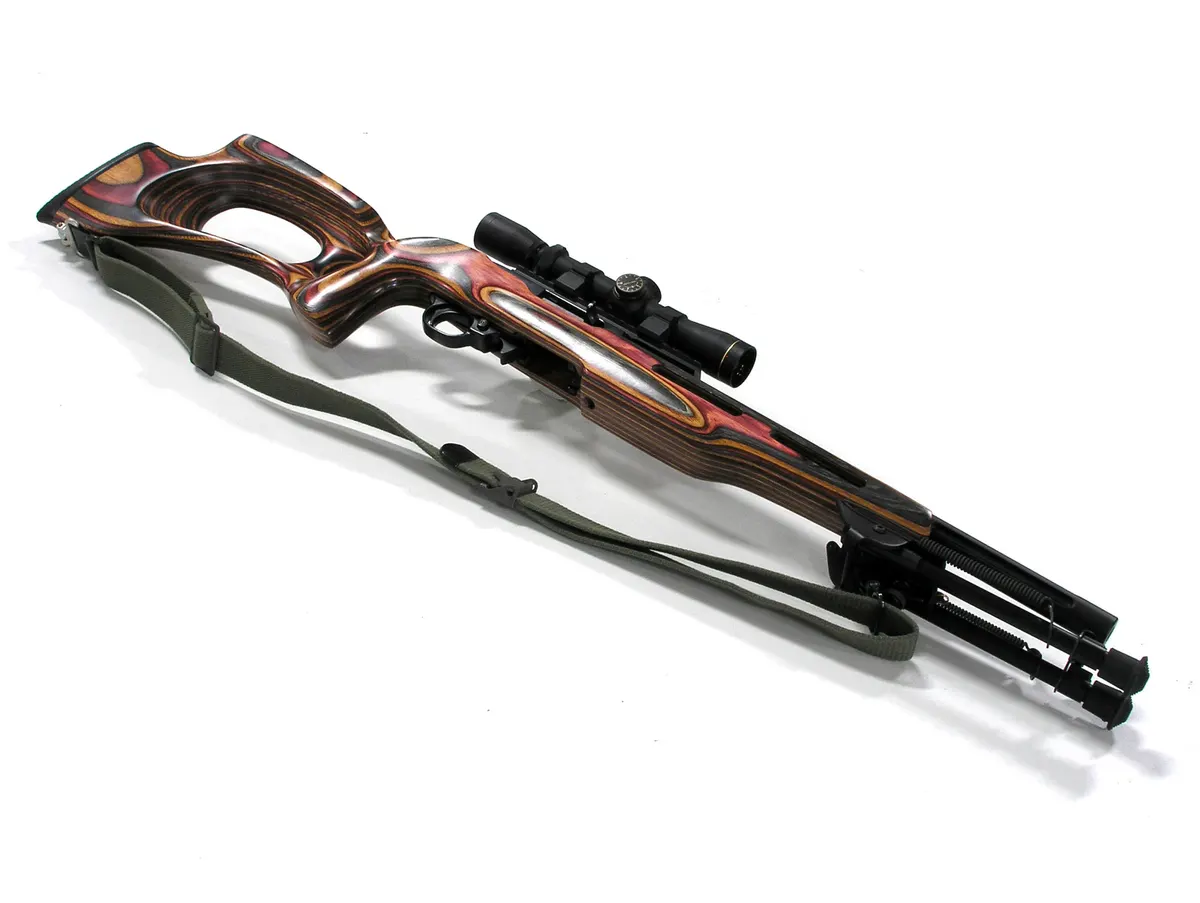
Blowback actions handle rimfire pressures easily for the same reason low pressure defines the cartridge in the first place. A rimfire case's modest pressure lets a simple unlocked bolt hold the chamber shut on spring weight and mass alone, without the locking lugs or gas systems a centerfire semi-automatic rifle usually needs, which is one more reason rimfire ammunition became the default training and sporting round rather than a duty cartridge.
01From the Model 1903 to Modern Military .22 Trainers
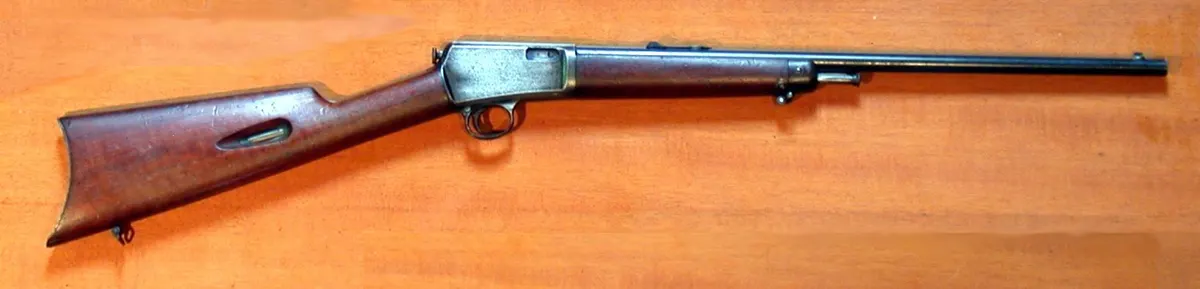
Winchester's chief engineer T.C. Johnson patented the mechanism behind the Winchester Model 1903 in 1901, and when it reached the market in 1903 it became the first semi-automatic .22 rimfire rifle sold commercially in North America, chambered for a dedicated .22 Winchester Automatic round before the later Model 63 switched to .22 Long Rifle.5 Winchester built roughly 126,000 of them between 1903 and 1932, establishing the sporting semi-automatic rimfire rifle as its own category well before most of its descendants existed.
Remington Arms chased the same low-cost rimfire market with the Remington Nylon 66, introduced in January 1959 at $49.95 with a nylon-resin stock and receiver in place of wood and steel, a blowback semi-automatic that sold more than a million copies by the early 1990s.6 The Marlin Model 60, introduced in 1960 and produced for six decades until 2020, went further still, selling more than 11 million rifles and standing for years as the best-selling .22 rimfire rifle in the world before the Ruger 10/22 finally overtook it.7 The Remington Model 552 filled the same tubular magazine sporting niche a few years earlier, proof that a rimfire cartridge's low pressure and light recoil support genuinely accurate rifles even in the cheapest production designs.

Armed forces put the same low-recoil, low-cost logic to a different use. Militaries issue AR and AK-pattern .22 conversions like the Armscor M16 22 and Armscor AK22, built by the Philippines' Armscor, and the American Smith & Wesson M&P 15-22 to teach new recruits sight picture, trigger control, and follow-through before they ever fire a full-power service rifle.8 Every one of those trainers still relies on the same rim-crush ignition Flobert and Smith & Wesson worked out in the 19th century, just packaged inside a semi-automatic rifle shaped to prepare a soldier for the full-power weapon waiting at the end of training.
01Notes and Sources
- "Rimfire vs Centerfire, Which is Better?", SilencerCo — silencerco.com ↩
- "A Brief History of .22 Rimfire Ammunition", Chuck Hawks — chuckhawks.com ↩
- "Rimfire vs. Centerfire Ammo, Key Differences and Best Uses", 45blast.com — 45blast.com ↩
- "The Ruger 10/22, History and Design", American Rifleman — americanrifleman.org ↩
- "Early Semi-Automatics, Winchester's First Self-Loading Rifles", American Rifleman — americanrifleman.org ↩
- "I Have This Old Gun, Remington Nylon 66", American Rifleman — americanrifleman.org ↩
- "The Marlin Model 60", GUNS Magazine — gunsmagazine.com ↩
- "Why Does the Military Use .22 Rimfire Rifles for Training?", Forgotten Weapons — forgottenweapons.com ↩


