

A semi-automatic rifle fires one round per pull of the trigger and reloads itself using the energy of that shot, cycling a fresh cartridge into the chamber without any further action from the shooter. That single mechanical fact separates it from the bolt-action rifle that came before it, whose shooter has to work a manual bolt handle between every shot, and from the assault rifle that eventually replaced it in most frontline infantry roles, which can also fire in bursts or fully automatically at the flip of a select-fire lever. A semi-automatic rifle sits one further step apart from the battle rifle built around a full-power cartridge such as 7.62x51mm NATO, and from the designated marksman rifle that descends from it, since many rifles in this category are chambered instead for a rimfire round barely capable of taking small game, or for an intermediate cartridge built for close and medium range rather than a full-power one. It sits a further step from the dedicated sniper rifle, which trades rate of fire for maximum precision at extreme distance, usually from a bolt-action platform outside this category entirely. Where a semi-automatic rifle sits against a carbine, a shortened rifle built for a soldier or vehicle crew who needs something handier than a full-length weapon, is mostly a matter of barrel length and role rather than a hard technical line, and several rifles below have been sold in both configurations at once.
The category is old enough that its own history runs alongside, rather than behind, the bolt-action rifles most late nineteenth-century armies actually carried. Winchester Repeating Arms Company sold a working self-loading .22 rifle three years before the Wright brothers' first powered flight, and the French army fielded the first genuinely mass-issued self-loading infantry rifle of any kind in the trenches of 1917, a generation before John Garand's rifle made the concept standard issue for an entire army. What follows traces that history forward from Winchester's earliest rimfire sporters through the world wars, the Cold War's competing national self-loaders, and the postwar civilian sporting and AR-15 pattern rifles that now account for the overwhelming majority of every semi-automatic rifle sold anywhere in the world.
01Winchester, Remington, and the First Self-Loading Sporting Rifles
The Winchester Model 1903 became the first semi-automatic rifle of any kind sold commercially in the United States, reaching dealers in March 1903, two years before Winchester Repeating Arms Company's own centerfire follow-up and roughly three years before a rival design from Remington Arms reached the market. Designer Thomas Crossley Johnson patented its blowback action in April 1901, only months after Winchester's nineteen-year partnership with John Browning collapsed over a royalty dispute, and the timing mattered. Winchester needed proof it could sell a genuinely new rifle without Browning's name on it, and the Model 1903 supplied that proof by selling roughly 126,000 units over a 29-year run.1 Johnson built the whole rifle around a deliberately proprietary .22 Winchester Automatic cartridge, sized so it could never chamber in an ordinary rimfire rifle and vice versa, a choice meant to keep dirty black-powder residue out of an unlocked breech but one that also locked buyers to a single ammunition source for the rifle's whole life.1
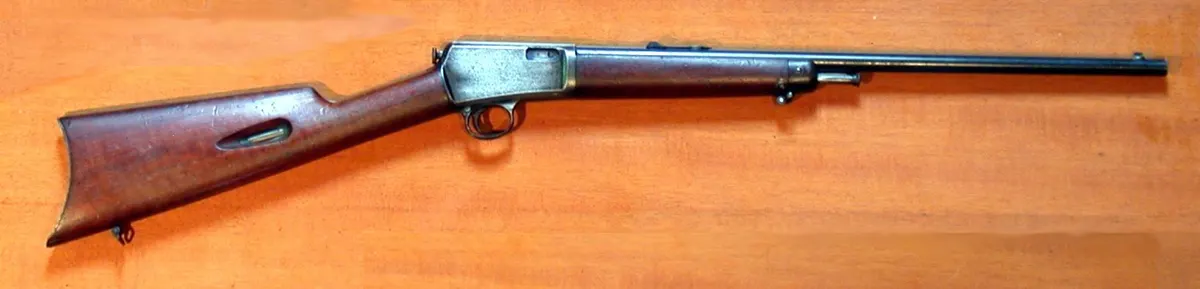
Johnson scaled the same patent up three more times, into the centerfire Winchester Model 1905, Winchester Model 1907, and Winchester Model 1910, each one chasing a heavier proprietary cartridge than the last. None matched the Model 1903's commercial success. The Model 1907, chambered for the .351 Winchester Self-Loading round, found genuine use in an unexpected role once the First World War began, mounted to a Lewis gun and fired by French and British aircrew observers as a sub-caliber gunnery trainer before those aviators ever handled a real machine gun aloft.1 The heaviest of the four, the Model 1910's .401 Winchester Self-Loading chambering, drew only modest French and Russian wartime interest before Winchester quietly let the whole self-loading family lapse. What finally beat it was Winchester's own hard-learned lesson, repeated half a century later by the Remington Nylon 66, that a self-loading .22 sells best when it fires ammunition every hardware store already stocks.
John Browning filed the patent behind the Remington Model 8 on October 16, 1900, and sold the finished long-recoil design outright to Remington rather than manufacturing it himself. Remington's Ilion, New York plant released it in 1905 as the Remington Autoloading Rifle, renamed it the Model 8 in 1911, and built roughly 80,600 rifles by the time an improved Model 81 took over in 1936, a run generally credited as the first commercially reliable high-power autoloading hunting rifle sold in the United States.1 FN Herstal in Belgium built a near-identical licensed version, the Browning Patent Modèle 1900, and roughly a hundred of those Belgian-made rifles saw an unusual wartime role of their own, mounted in French Aéronautique Militaire aircraft in the first year of the World War I, a stopgap answer to the same problem the Winchester Model 1907 solved for British and French aircrews before synchronized machine guns made a hand-cycled rifle in the cockpit unnecessary.1
The Remington Model 8's best-known moment came decades later, on May 23, 1934, when former Texas Ranger Frank Hamer carried a .35-caliber Model 8 with a special-order extended magazine into the ambush that killed Bonnie Parker and Clyde Barrow near Gibsland, Louisiana, alongside a second Model 8 fired by Deputy Sheriff Prentiss Oakley, whose opening shots are usually credited as the first to strike Barrow.1 Remington's own crossbolt safety lever on the Model 8, meanwhile, has been repeatedly cited by firearms historians as an influence on the selector lever Mikhail Kalashnikov fitted to the AK-47 roughly half a century later, a strange thread connecting a Browning-designed 1900s deer rifle to the most produced assault rifle in history.1 Both the Winchester and Remington self-loading families were purely civilian and law-enforcement products, no government adopted either as a standard-issue military rifle, and both remain the deepest starting point for the entire semi-automatic rifle category that follows.
01The First World War's Rush to Arm the Infantry Rifleman
France ran the twentieth century's first serious national program to replace an entire army's bolt-action rifle with a self-loading one, and it took two attempts to get anywhere close. The first, the Meunier rifle, was a long-recoil design chambered for a proprietary 7x57mm round that reached only 1,013 rifles built at the Manufacture Nationale d'Armes de Tulle before the French army cancelled the whole program in 1915, undone by the cost of retooling ammunition production for a cartridge no other French weapon used.2 That cancellation freed the same design team, Paul Ribeyrolles, Charles Sutter, and Louis Chauchat, who had also just rushed the Chauchat light machine gun into production, and their second attempt reused the existing Lebel infantry rifle's own barrel, stock, and trigger guard rather than starting clean. The result, the RSC 1917, was adopted in May 1916, reached mass production at Manufacture d'Armes de Saint-Étienne by April 1917, and put roughly 86,000 gas-operated rifles into French hands before the World War I armistice, making France the only major belligerent to field a genuinely mass-produced self-loading rifle to ordinary infantry riflemen during the war.2

The RSC 1917 was rationed rather than universal, issued at only about sixteen rifles per infantry company to marksmen judged capable of keeping its narrow gas port clean under trench conditions, since fouling stopped the action within roughly one hundred rounds if neglected.2 A shortened RSC 1918 follow-up fixed several of those complaints, though only about 4,000 were built before the armistice made large-scale production unnecessary, and France did not field a genuinely modern self-loading service rifle again until the postwar MAS-49 rifle, covered below. Germany later pressed captured RSC rifles of both patterns into service under occupation, arming rear-area garrison and militia units rather than front-line troops during the Second World War.2
Britain's own wartime effort, the Farquhar-Hill rifle, took a very different mechanical route, a gas-piston system feeding from a nineteen-round drum designed by Moubray Farquhar and Arthur Hill, and it very nearly reached mass production. The British army accepted it for service in 1918 as the Pattern 1918 and ordered up to 100,000 rifles, an order the Armistice cancelled before more than a handful of prototypes were ever completed.2 Half a world away, an obscure Chinese effort produced perhaps a dozen working examples of the General Liu rifle, a muzzle-trap gas rifle designed by General Liu Qingen and built partly with machinery from the American firm Pratt & Whitney, tested at Beijing's Nan Yuan Proving Ground in 1916.2 Liu's own stroke in 1919 and a shipment of production machinery that sank en route and only resurfaced years later ended the project before it ever reached the Hanyang Arsenal at meaningful scale, leaving it one of the least documented rifles in this entire category.
01Between the Wars, Pedersen, Holek, and the Search That Produced the Garand
John Pedersen's own contribution to the category very nearly became the standard-issue American infantry rifle rather than a footnote to it. The Pedersen rifle used a toggle-delayed blowback action chambered for a lighter proprietary .276 Pedersen round, and it beat John Garand's own early T3E2 prototype in a 1929 head-to-head trial, with a board recommending its adoption in January 1932.3 Army Chief of Staff Douglas MacArthur personally killed that recommendation the following month, citing the cost of replacing existing .30-caliber ammunition stocks across the whole Army during the Depression, and Garand's team spent the next several years reworking the rifle around the standard .30-06 round instead, a decision that shaped the rifle covered in the next section.3 Pedersen's own rifle also demanded cartridges finished with a hard wax coating to aid extraction, an added manufacturing step Ordnance officers used against it, and fewer than 150 examples were ever built across trial production in the United States, United Kingdom, and Japan combined.3
Emanuel Holek at Zbrojovka Brno built the ZH-29 around a long-stroke gas piston and an unusual bolt that tilts sideways into the receiver wall rather than up or down, offered across several calibers including a .276 Pedersen version tested unsuccessfully against Garand and Pedersen's own rifles in the same American trials.3 Total production across its 1929 to 1938 sales window, mostly export sales to China, never reached much beyond 500 rifles, though its short gas cylinder later resurfaced in a mechanically unrelated but visually similar Czechoslovak rifle two decades on. Italy's own effort, the Breda M1935 PG Rifle designed by Sestilio Fiorini, offered the Regio Esercito a rising-bolt gas rifle in three configurations, including a select-fire, burst-capable carbine, before Italian trials rejected all of them as too complex to maintain in the field and stayed with the bolt-action Carcano through the Second World War.3 Costa Rica bought roughly 800 of the select-fire Breda carbines instead, in 7x57mm Mauser, and a surviving example later helped Aberdeen Proving Ground engineers develop the burst-fire control device eventually fitted to the American M16A2 rifle.3
Two smaller, quieter programs closed out the interwar search. Danish designer Søren Bang's muzzle-trap gas system, refined at Springfield Armory into the M1922 Bang rifle, directly influenced the earliest gas-trap version of the Garand rifle itself before its own sliding muzzle cup proved too fouling-prone for field use, and the roughly 48,100 gas-trap M1 Garands Springfield built before switching to a drilled gas port in 1940 were mostly destroyed by Army order in 1947, making surviving originals extremely rare today.3 Poland's own Kbsp wz. 1938M, designed by Józef Maroszek, reached only around 150 rifles before the German invasion of September 1939 ended the program, and its own postwar afterlife turned genuinely strange, one surviving rifle bought by a Virginia collector in 1993 was seized by Homeland Security in 2013 after Poland claimed it as stolen state property, a dispute eventually settled with a payment to the collector and the rifle's return to Warsaw's Uprising Museum.3
02The M1 Garand and the Axis Rifles Built to Answer It
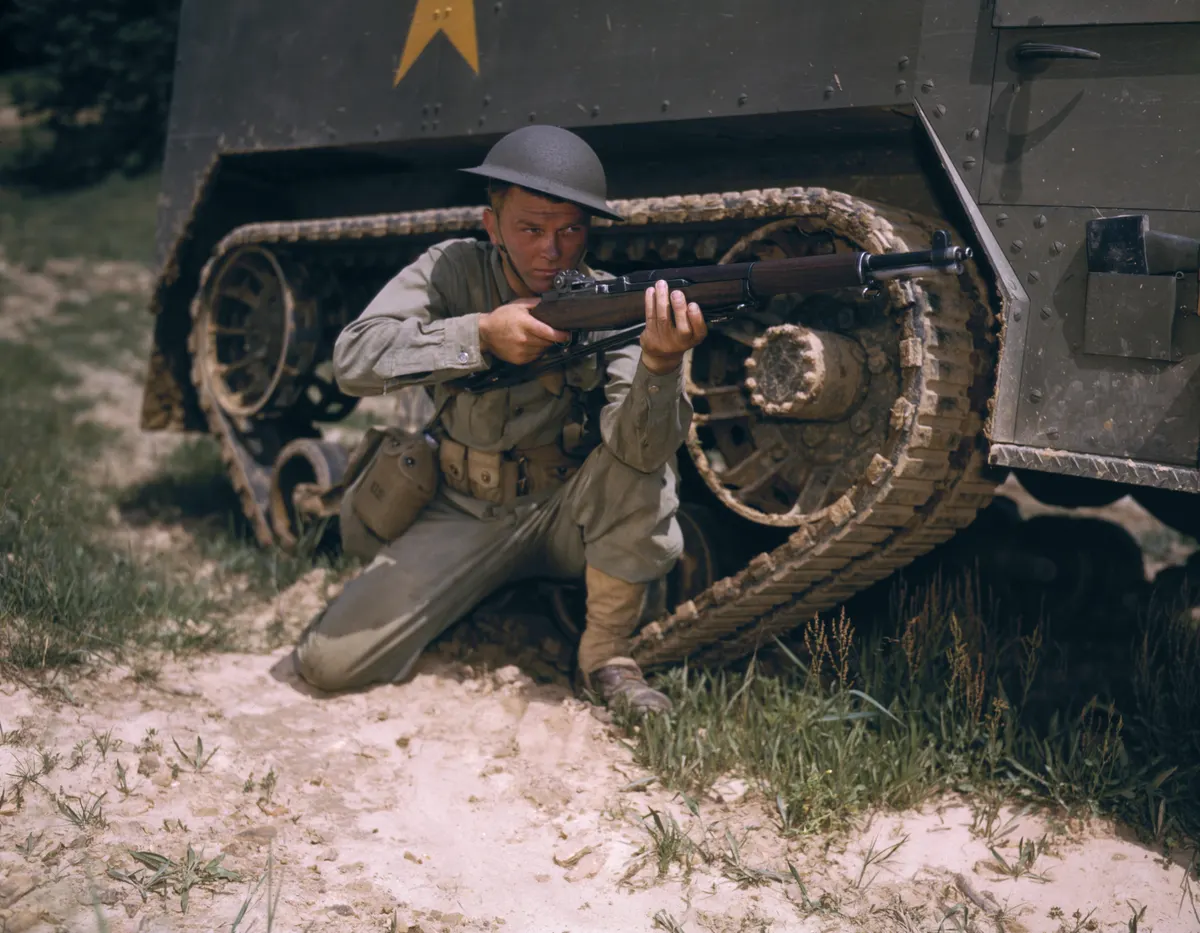
The M1 Garand became the first self-loading rifle to serve as the standard infantry arm of a major army when the United States formally adopted it on January 9, 1936. Designer John Cantius Garand, a government engineer at Springfield Armory who drew only his ordinary salary and assigned every patent right to the state, built a gas-piston operated rifle chambered for .30-06 Springfield and fed by an eight-round en bloc clip that ejected itself with a sharp metallic ring once empty, the sound most shooters call the Garand's ping.4 Firearms historians have found no verified wartime account of an enemy soldier actually using that sound to time an assault, and any soldier close enough to hear it was already close enough to be shot first, but the myth has outlived every debunking. What is not myth is the scale of production, Springfield Armory, Winchester Repeating Arms Company, International Harvester, and Harrington & Richardson built a combined 5,468,772 M1 rifles between 1937 and 1957, and General George S. Patton told the Army's Chief of Ordnance in January 1945 that the Garand was the greatest battle implement ever devised, a line that has followed the rifle ever since.4
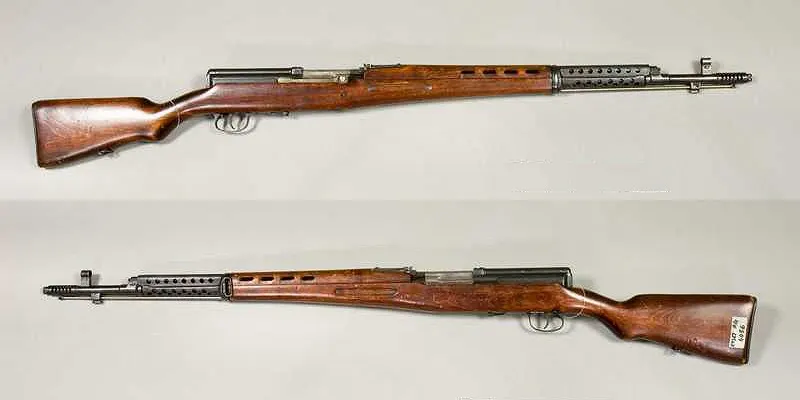
Soviet designer Fedor Tokarev answered a different requirement entirely with the SVT-40, a 7.62x54mmR gas-operated rifle rushed into a lightened, simplified redesign after its SVT-38 predecessor failed badly in the 1939 to 1940 Winter War against Finland, jamming on frozen lubricant and dropping magazines from a catch conscripts found too fragile.4 The Soviet Union built roughly 1.6 million SVT-38 and SVT-40 rifles combined before the German invasion of 1941 forced Tula's production line to evacuate eastward, at which point Soviet planners simply reverted to the far cheaper bolt-action Mosin-Nagant rifle rather than rebuild a complex self-loading rifle line under wartime pressure, a decision that reflects Soviet industrial capacity in 1941 and 1942 as much as any flaw in Tokarev's own design.4 Germany captured enough SVT-40s on the Eastern Front during Operation Barbarossa to reissue them under a captured-weapon designation, and Walther's engineers copied the SVT-40's barrel-ported gas system nearly unchanged into their own Gewehr 43, after Germany's first self-loading attempt, the Gewehr 41, had proven a genuine failure.4
The Gewehr 43 kept the earlier rifle's flapper-locking bolt but replaced its fouling-prone gas trap with the Soviet-style drilled port, and it reached German infantry from October 1943 chambered in 7.92x57mm Mauser, fed by a genuine ten-round detachable magazine, with roughly 50,000 examples fitted with a compact scope for sniper and marksman work.4 Total wartime output, 402,713 rifles, never came close to matching the millions of bolt-action rifles Germany fielded in the same years, and the Gewehr 43 arrived too late and in too small a number to change the war's outcome, though a postwar Brazilian derivative kept a version of its action alive into the 1950s.4
America's other wartime self-loader lost its own procurement fight against the Garand but found real combat use anyway. Boston patent lawyer and Marine reservist Melvin Johnson built the M1941 Johnson rifle around a short-recoil rotating bolt and a ten-round rotary magazine a soldier could top off without emptying it first, unlike the Garand's clip, and it matched or beat the Garand's hit percentage in May 1940 Quantico trials before losing the broader competition on logistics grounds, since the Garand already had a running production line at Springfield Armory.4 Cranston Arms built roughly 22,000 Johnson rifles mostly for a Dutch government-in-exile contract meant to arm the Royal Netherlands East Indies Army, and when Japan's invasion overran most of that shipment before it arrived, the US Marine Corps picked up the surplus for its Paramarine battalions, who carried it into the opening days of the Guadalcanal campaign at Gavutu in August 1942.4 Marine captain Robert Hugo Dunlap later credited a Johnson rifle with saving his life during the February 1945 Battle of Iwo Jima, and small numbers even reached Cuban exile forces at the 1961 Bay of Pigs invasion, among the last confirmed combat use of the design anywhere.4
Several smaller wartime programs filled out the same three years. Sweden's neutral Automatgevär m/42, built by Erik Eklund of Carl Gustafs stads gevärsfaktori, ran on a true direct gas impingement system with no piston at all, a design later widely credited as an influence on Eugene Stoner's own AR-15 gas system, and it later formed the technical basis for Egypt's Hakim rifle, covered in the next section.4 Britain and America each tried and abandoned a self-loading rifle project of their own during the war, the Smith & Wesson Model 1940 Light Rifle, a 9mm blowback carbine built to a British contract, proved too fragile for full-power British military ammunition and was rejected outright, while the EM-4 rifle, a short-recoil design by Sir Dennis Burney built alongside Britain's own postwar bullpup rifle trials, never advanced past a small batch of prototypes.4 Japan's Imperial Navy, rather than its Army, built the Type 4 rifle at Yokosuka Naval Arsenal, a direct reverse-engineered copy of captured M1 Garands rechambered for 7.7mm Arisaka ammunition, completing perhaps a hundred rifles before Japan's surrender in 1945 ended the program before any saw combat.4 Germany's own final wartime answer, the crude, stamped-steel Volkssturmgewehr built by the Wilhelm-Gustloff-Stiftung, used a gas-delayed blowback system workable only with the weaker intermediate round already feeding the StG 44, and roughly 10,000 were built in the war's final months for the improvised home guard.4
01The SKS, the Ljungman Pattern, and Postwar Europe's Own Self-Loaders
Soviet designer Sergei Simonov finished the SKS in 1945 by scaling down the operating system of his own anti-tank rifle, and the Soviet Army adopted it in 1949 as a 7.62x39mm gas-operated carbine with a fixed ten-round internal magazine and a permanently attached folding bayonet.5 Soviet frontline service lasted barely a decade, since doctrine wanted every rifleman able to fire fully automatically on demand, a capability only the incoming AK-47 could offer, but the SKS's own export and license history dwarfed its brief Soviet career. Moscow transferred full production rights to China in 1955, whose own license-built carbine armed the People's Liberation Army for roughly thirty years and reached a total output past nine million rifles, and separate licenses went out to North Korea, North Vietnam, East Germany, Romania, Bulgaria, Albania, and Poland through the 1950s and 1960s.5 American infantry carrying the semi-automatic M14 rifle faced Viet Cong and North Vietnamese fighters armed with the SKS throughout the early Vietnam War, a doctrinal echo across enemy lines since both rifles were built around aimed semi-automatic fire from a full or near-full-power cartridge rather than automatic fire from a lighter round, and the SKS turned up again decades later with Ukrainian territorial defense volunteers drawing on old Soviet-era depots during the opening weeks of the 2022 Russian invasion of Ukraine.5
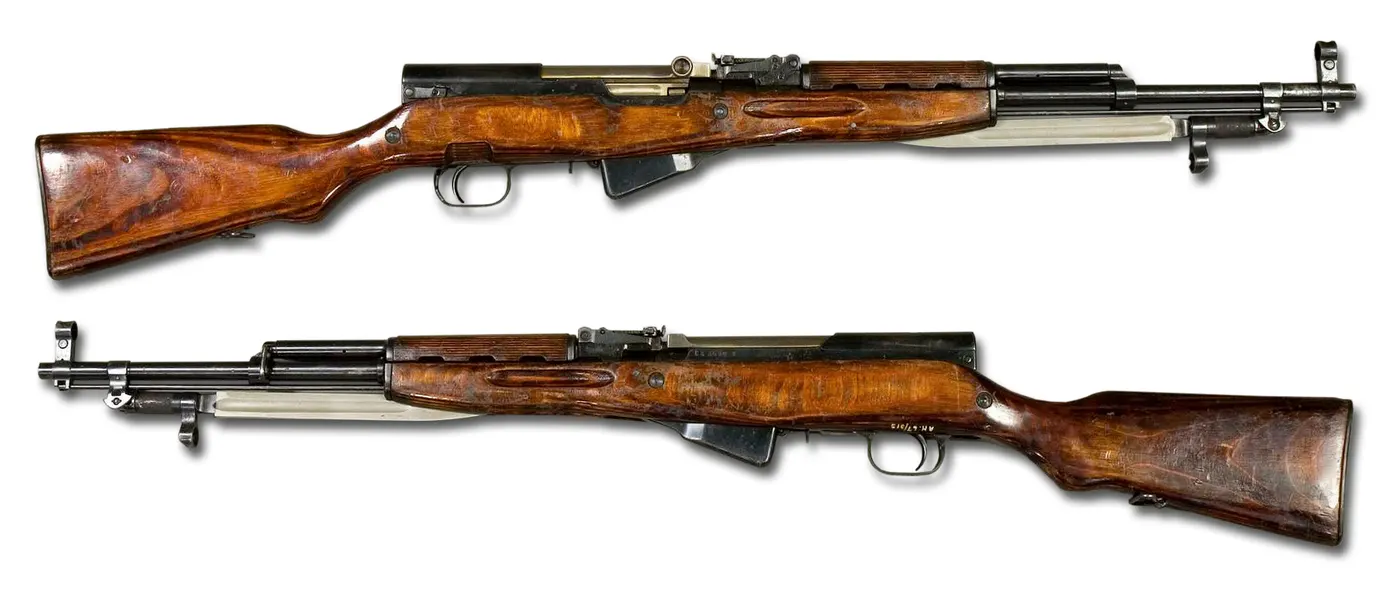
Yugoslavia took its own SKS license and turned it into something no Soviet original ever had, an integral 22mm rifle-grenade launcher built directly into the muzzle. The Zastava M59/66, nicknamed the papovka by Yugoslav troops, stayed the Yugoslav People's Army's standard infantry rifle through the 1960s and 1970s before a select-fire, Kalashnikov-pattern rifle replaced it, and its rifle grenades saw genuine combat use with Namibia's People's Liberation Army of Namibia against South African armored columns during the South African Border War, aimed deliberately at the engine blocks of Casspir armored personnel carriers.5
France's own postwar answer, the MAS-49 rifle, closed out a French self-loading project that had run since the RSC 1917 three decades earlier, adopted in July 1949 as the country's first standard-issue semi-automatic infantry rifle in 7.5x54mm French.5 Its direct gas impingement system, tracing back to a 1901 French experiment, avoided the added weight of a piston entirely, and its built-in grenade launcher let a soldier switch from ball ammunition to rifle grenades without fitting anything extra, a real advantage French paratroopers and Foreign Legion units leaned on heavily through the Algerian War's mountain fighting.5 The improved MAS-49/56 variant was still France's standard-issue rifle when a Foreign Parachute Regiment jumped into Zaire during the May 1978 Battle of Kolwezi, one of the last combat uses of the MAS-49 family before a bullpup rifle replaced it the following year.5
Czechoslovakia refused to simply copy the SKS at all, building the vz. 52 rifle around its own 7.62x45mm cartridge, a round that genuinely outperformed the Soviet 7.62x39mm in muzzle velocity, after Moscow declined to share technical data on its own new-generation weapons.5 Warsaw Pact politics eventually overruled Czechoslovak ballistics anyway, and after Czechoslovakia formally joined the pact in 1955 the rifle was rechambered to the Soviet round as the vz. 52/57, before a mechanically unrelated Czechoslovak service rifle replaced both within two years. Exported vz. 52-family rifles reached Egypt through the landmark 1955 Egyptian-Czechoslovak arms deal and, in far larger numbers, Cuba's Revolutionary Army, which carried the rifle into the defense against the 1961 Bay of Pigs invasion.5
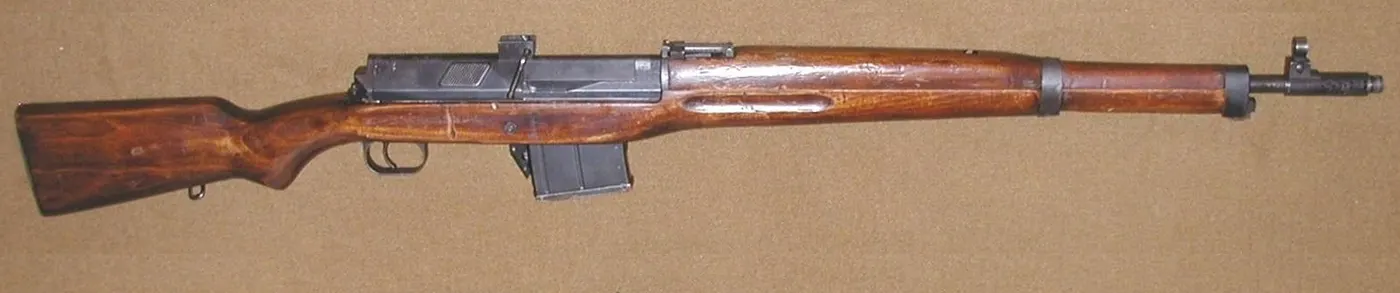
Egypt's own postwar rifle came from Sweden rather than the Soviet bloc. After the 1948 Palestine War exposed Egypt's own bolt-action shortfall, Gamal Abdel Nasser's government bought the actual production tooling for Sweden's Automatgevär m/42 and rebuilt it at Factory 54 in Maadi as the Hakim rifle, rechambered for the full-power 7.92x57mm Mauser ammunition Egyptian depots already held by the ton.5 Egyptian engineers added an integral muzzle brake to tame that heavier cartridge's recoil and an adjustable gas valve the Swedish original never needed, since Egypt's own surplus Mauser ammunition varied wildly in pressure between manufacturers, and roughly 70,000 Hakim rifles were built before Egypt switched to license-built AK-47 pattern rifles in the mid-1960s.5 A scaled-down 7.62x39mm derivative, the Rasheed carbine, followed in 1966, resembling the Soviet SKS closely enough through its own permanently attached folding bayonet that the two are still regularly confused.
America's own postwar coda to the Johnson rifle story stayed a genuine footnote rather than a fielded rifle. Melvin Johnson's wartime Daisy Mae Auto-Carbine, a scaled-down five-rifle prototype run for smaller-statured Dutch colonial troops, is well documented, but a later M1947 Johnson auto carbine said to have been built for an Argentine inquiry is directly disputed by a co-author of the definitive Johnson reference book as a paper concept that was never actually fabricated, a caution against treating every collector claim as settled fact.5
01Stoner's Rifle and the Civilian M14 Answer It Never Expected
The United States Army declared its own postwar battle rifle obsolete for general infantry issue by the mid-1960s, replacing it with a lighter select-fire design, but a Texas gun dealer named Elmer Ballance saw a civilian opportunity in the flood of surplus parts that followed. His M1A rifle, first built in Devine, Texas starting in 1971, reused genuine GI parts from that older battle rifle on newly cast receivers, and since federal law would not let him use the original military model name for a civilian semi-automatic rifle, the ATF's own insistence produced the name M1A instead, a label with no official military meaning at all.6 Robert Reese bought the operation in 1974, relocated it to Geneseo, Illinois, and the resulting Springfield Armory, Inc., a company with no corporate connection to the original government arsenal of the same name, has built the M1A continuously since, dominating NRA High Power and National Trophy rifle competition through the 1970s and 1980s until the Army Marksmanship Unit's 1991 win with AR-15 pattern rifles began shifting competitive shooters toward a lighter, more modular platform.6
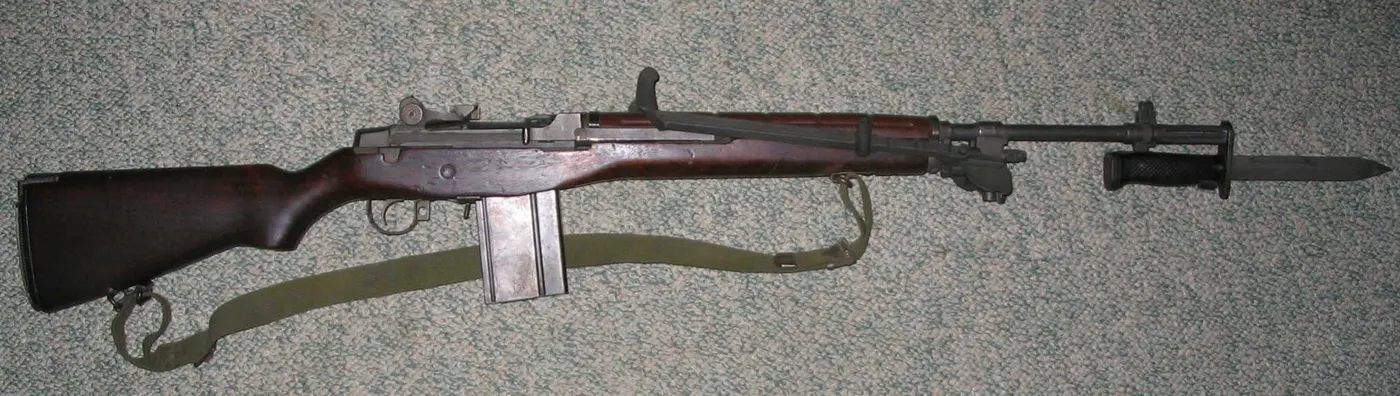
Heckler & Koch ran a nearly identical experiment in Germany around the same time, building a semi-automatic-only version of its own roller-delayed battle rifle specifically so West German army reservists could legally own a rifle handling exactly like their issued weapon. The resulting HK41 sold in tiny numbers, roughly 1,350 total with fewer than 400 ever imported to the United States, and a 1974 legal tightening forced Heckler & Koch to weld a receiver insert blocking any conversion toward automatic fire and rename the compliant version accordingly.6 A parallel rimfire-caliber trainer, the semi-automatic HK43, offered the same roller-delayed action scaled down from a select-fire carbine rather than a true rimfire conversion, built from 1974 to 1989 in similarly small numbers before becoming one of the rarest Heckler & Koch rifles on the American collector market.6
Eugene Stoner's own contribution to the category outgrew every rifle discussed so far combined. Stoner and ArmaLite built the first AR-15 prototypes in 1956 and 1957 as a lighter alternative to the era's standard battle rifle, sold the design and its trademark to Colt's Manufacturing Company in 1959, and Colt split the rifle in two directions at once, developing the select-fire military version for the armed forces while launching a semi-automatic-only civilian Sporter under the AR-15 name in 1964.6 That civilian Colt AR-15 sold slowly at first, its fixed carry handle and plastic furniture unfamiliar to hunters raised on wood-stocked bolt guns, and it stayed almost entirely a Colt product until the company's core patents expired in 1977, opening the whole AR-15-style rifle pattern to any manufacturer willing to build to the same magazine and receiver dimensions.6
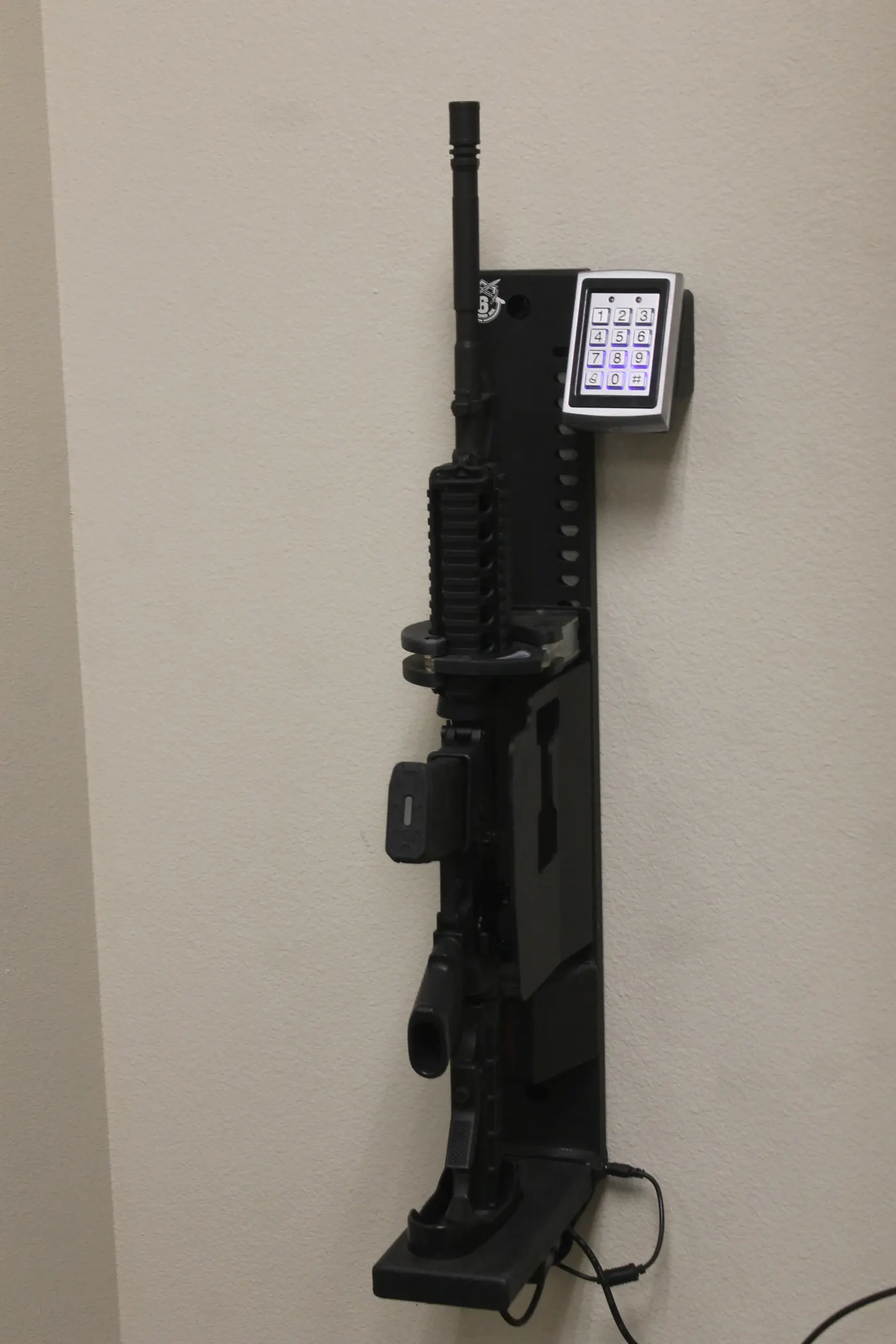
Growth after 1977 stayed slow for another two decades. Only around 29 companies were building AR-15-pattern rifles or major components by the year 2000, a figure that had grown roughly seventeenfold to an estimated 500 by 2015, and the National Shooting Sports Foundation coined the deliberate rebranding term modern sporting rifle in 2009 specifically to reposition the whole category as hunting and target equipment rather than a military look-alike.6 By the early 2020s cumulative American civilian production of AR-15 and AR-10 pattern rifles had passed 24 million units, a figure the industry itself has kept revising upward, making the pattern Eugene Stoner and Colt started in 1959 the single most produced rifle design in American history by a wide margin.6
01Ruger, Remington, and the Rimfire Rifle Every Kid Learned On
The postwar civilian sporting side of the category grew up entirely separate from any military program, built instead around cheap .22 Long Rifle ammunition and a generation of first-time shooters. Remington Arms got there first with the Remington Nylon 66, introduced in January 1959 as the first mass-produced rifle with a stock and receiver molded from a nylon resin DuPont developed at Remington's own request, a blowback rifle so reliable that company shooter Tom Frye fired three of them roughly 1,000 rounds an hour for thirteen straight days in October 1959, hitting 100,004 of 100,010 thrown wooden blocks and breaking a 52-year-old exhibition record.7 Remington sold more than 1,050,350 Nylon 66 rifles before ending production in 1989, and the rifle's own tubular magazine simplicity, chambered for plain .22 Long Rifle rather than any proprietary round, is exactly the lesson Winchester's earlier self-loading family had already taught the industry the hard way.
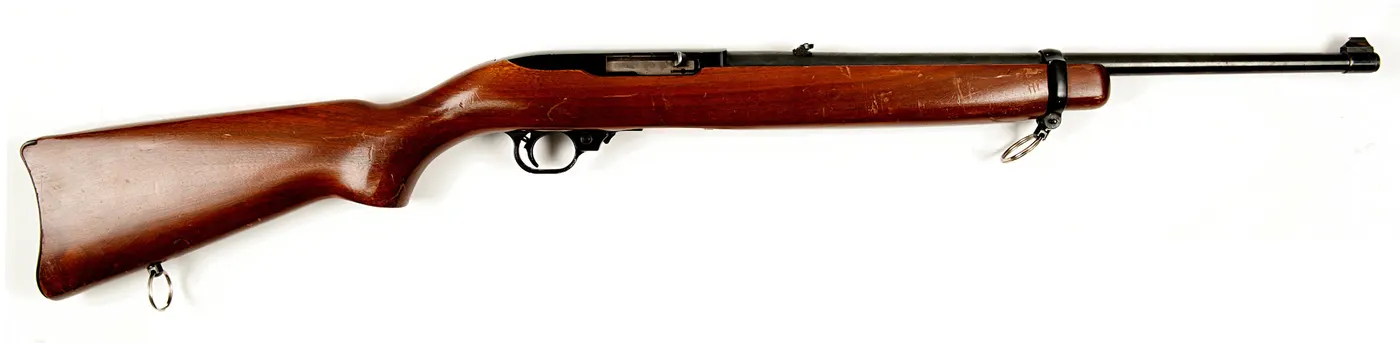
William B. Ruger answered with the Ruger 10/22 in 1964, a blowback carbine built around a patented rotary magazine reportedly inspired by an older lever-action rifle, feeding from a compact ten-round unit that sits entirely inside the stock rather than protruding below it.7 Ruger's own barrel-mounting system, a simple two-screw V-block clamp, let any owner swap barrels with an Allen wrench rather than a gunsmith, and that single choice built the largest aftermarket parts industry of any rimfire rifle ever sold, with more than seven million 10/22s produced since 1964 and complete rifles now assembled from zero factory Ruger parts.7 Marlin Firearms' own tube-fed Marlin Model 60, introduced in 1960 and built around Marlin's own Micro-Groove rifling, sold even more, roughly eleven million units before production finally ended in November 2020 once Sturm, Ruger & Co. acquired Marlin's assets out of Remington's own bankruptcy, choosing to revive Marlin's lever-action rifles rather than the discontinued Model 60 itself.7
Remington kept refining its own tube-fed sibling, the Remington Model 552 Speedmaster, sold from 1957 and unusual for cycling .22 Short, Long, and Long Rifle interchangeably from the same magazine, before adding the detachable-magazine Remington Model 597 in 1997 to compete more directly with the Ruger 10/22's magazine-fed convenience.7 A shorter-lived middle entry, the AR-15-styled Remington Model 522 Viper, lasted only from 1993 to 1998 before persistent plastic-magazine feed failures and heat-warped bolts ended it. Smith & Wesson built its own AR-15-pattern rimfire trainer, the Smith & Wesson M&P 15-22, explicitly so owners of the centerfire M&P15 could practice cheaply on an identical manual of arms, a rifle popular enough to draw a genuine 2016 safety controversy when a national shooting-education program banned it from events after several documented uncommanded discharges.7
Not every rimfire self-loader survived its own moment. Arcadia Machine & Tool's AMT Lightning 25/22, essentially a stainless-steel Ruger 10/22 clone with a 25-round magazine, ran only from 1984 to 1994 before Ruger's own trademark objections and the company's later bankruptcy ended the line. Czechoslovakia's CZ 511, descended from an earlier Zbrojovka Brno sporting design, sold into European markets for roughly three decades before a full redesign replaced it, and Marlin's own takedown Marlin Model 70P, nicknamed the Papoose, split into two pieces for storage inside a padded, floatable case aimed at campers and boaters rather than the ordinary hunting-and-plinking buyer its Model 60 sibling served.7 Taken together, this whole rimfire branch of the category represents, by unit count, more rifles built than every military semi-automatic program in this article combined, a genuinely larger commercial story than the battlefield rifles that usually dominate the category's popular image.
01Gas-Operated Hunting Rifles From Remington, Winchester, and Ruger
Remington's centerfire hunting line followed a rockier path than its rimfire siblings. The Remington Model 740, Remington's first gas-operated centerfire autoloader, reached hunters in 1955, and its 1960 successor, the Remington Model 742 Woodsmaster, became the best-selling centerfire semi-automatic hunting rifle in American history at 1,433,269 units, chambered mainly in .30-06 Springfield and .308 Winchester.8 That sales success came alongside a genuinely documented reliability problem, a two-lug bolt riding on soft aluminum receiver rails that wore unevenly under years of heavy use, earning the 742 and its direct successor the derisive nickname Jamomatic among American gunsmiths even as Remington sold well over a million of them.8

Remington's 1981 answer, the Remington Model 7400, moved from two locking lugs to three and added hardened steel rail inserts specifically to fix the 742's known failure point, while a parallel deluxe-grade Remington Model Four shared the same redesigned action in premium walnut furniture.8 Winchester's own rival, the Winchester Model 100, launched in 1961 as a gas-operated companion to Winchester's own lever-action Model 88, selling roughly 262,838 rifles in .308 Winchester, .243 Winchester, and a purpose-built .284 Winchester cartridge before Winchester abandoned the whole gas-operated hunting rifle category once the Model 100 was discontinued in 1973, walking away from a market Remington kept working for another three decades.8
Sturm, Ruger & Co. built its own gas-operated hunting carbine around a handgun cartridge rather than a rifle round. The rifle launched in 1961 under the marketing name Deerstalker, until Ithaca Gun Company objected that the name too closely resembled its own Deerslayer shotgun branding, and Ruger quietly renamed it the Ruger Deerstalker, better known afterward as the plain Ruger 44 Carbine, a .44 Remington Magnum gas-operated rifle whose short-stroke piston and rotating bolt let a hunter take a fast follow-up shot at whitetail deer in thick timber that a lever-action rifle's manual cycling could cost.8 Roughly 250,000 were built before the machined-steel receiver's cost forced Ruger to discontinue the line in 1985. A far rarer Ruger prototype from the same decade, the Ruger XGI, scaled the concept up to .308 Winchester and reportedly cracked its investment-cast receivers after a few thousand rounds, and Ruger abandoned it before full production ever began, leaving perhaps a couple hundred examples in collector hands today.
Italy's Benelli Armi entered the hunting-rifle side of the category comparatively late, in 2002, with the Benelli Argo, whose name stands for Auto Regulating Gas Operated and whose gas system traces directly back to the short-stroke dual-piston mechanism Benelli developed for its own combat shotgun.8 Later refinements, the Benelli Argo EL and Benelli Argo Comfortech, reworked the gas system's metallurgy and added a recoil-reducing stock, while a separate Benelli MR1 adapted the same action into an AR-15-styled 5.56mm utility rifle aimed at buyers who wanted that silhouette's ergonomics without its direct-impingement gas system.8 Germany's Sauer & Sohn built a rival modern hunting autoloader of its own, the Sauer 303, using an under-barrel short-stroke piston the company brands Smart Tube and marketing the rifle explicitly as a non-tactical option for European driven hunts, in calibers up to .338 Winchester Magnum.8
01Heckler & Koch's Roller-Delayed Rifles Reach the Civilian Market
Heckler & Koch built a separate civilian rifle family entirely outside the HK41 story covered above, aimed at European hunters rather than reservists. The Heckler & Koch SL6 and Heckler & Koch SL7, sold from the early 1980s in 5.56mm and 7.62mm respectively, reused the same roller-delayed blowback action from an older select-fire rifle family in a sporting-rifle profile aimed at licensed European hunters, before both were quietly discontinued through the 1990s.
A very different Heckler & Koch civilian rifle followed a newer, gas-piston assault rifle rather than the older roller-delayed family. The Heckler & Koch SL8, introduced in 1998, kept that assault rifle's polymer receiver, translucent magazine, and short-stroke gas-piston operated rotating bolt, but wrapped it all in a fixed thumbhole stock and a single-stack 10-round magazine specifically to satisfy the checklist written into America's 1994 federal assault weapons ban.9 Independent range testers recorded groups as tight as half a minute of angle from its heavy cold-hammer-forged barrel, genuinely competitive accuracy that a thumbhole stock and an awkward safety lever never quite overcame in reviewers' eyes, and Heckler & Koch discontinued the US-market rifle in 2010 before reintroducing it in 2021 with an updated optic rail.9
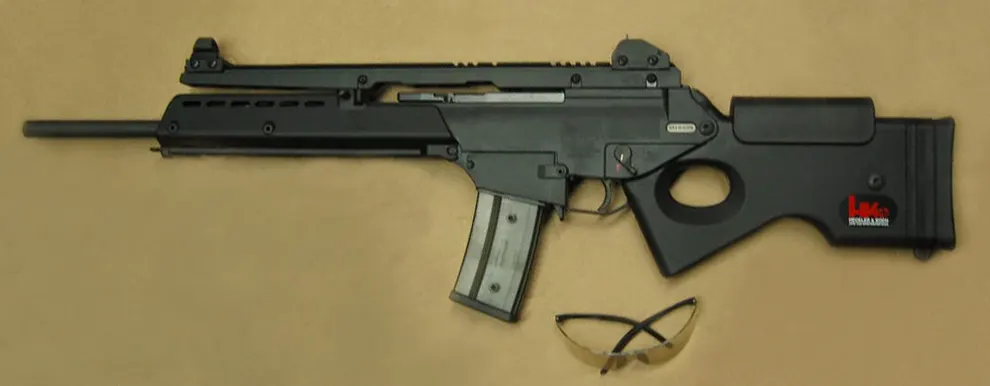
Heckler & Koch ran the same de-militarizing exercise a decade later on its newest and most celebrated military carbine. The Heckler & Koch MR223, sold from 2007, is a semi-automatic-only version of a short-stroke piston carbine developed with input from a US Army Delta Force team and later carried during the 2011 raid that killed Osama bin Laden, and the MR223 kept that carbine's seven-lug rotating bolt and fully ambidextrous controls unchanged, differing only in its fixed semi-automatic trigger group.9 France's own limited-edition F-S and F-C variants, built in runs of thirty to fifty rifles, marked the French military's own 2016 adoption of the same carbine's select-fire cousin to replace its longtime FAMAS service rifle.
PTR Industries of Aynor, South Carolina, built an entirely different answer to the problem America's own 1989 import ban had created for Heckler & Koch's older roller-delayed battle rifle family. Once a presidential executive order barred further importation of the semi-automatic HK91, Jose Luis Diaz's company bought genuine production tooling, blueprints, and gauges from Fábrica de Braço de Prata, a Portuguese state arsenal that had built licensed versions of the rifle for decades, and used it to build the PTR-91F entirely inside the United States, sidestepping import law altogether since the rifle is domestically manufactured rather than assembled from foreign parts.9
Romania's Cugir Arms Factory answered the same American civilian market with a Kalashnikov-pattern rifle rather than a roller-delayed one. The WASR-series rifles, whose name is a genuine acronym for the 1996 Wassenaar Arrangement export-control treaty rather than any Soviet-style model number, derive from Romania's own licensed AKM copy, and Century International Arms began importing the flagship WASR-10 in 2003, gaining a reputation as one of the cheapest genuine Kalashnikov-pattern rifles sold new anywhere.9 That reputation carried a darker second life. A 2011 multi-outlet investigation found WASR-10 rifles bought legally in the United States and smuggled south had become the single most common firearm traced to crime scenes in the Mexican drug war between 2006 and 2011, more than 500 recovered examples accounting for over 17 percent of all US-sourced firearms traced there in that period.9
01The AR-15 and AR-10 Pattern Become America's Default Rifle
Once Colt's original AR-15 patents expired in 1977, the rifle Eugene Stoner designed became a genuine multi-manufacturer category rather than a single company's product, and no rival built that transformation more visibly than Bushmaster Firearms International. Businessman Richard Dyke bought the failing operation for roughly $241,000 in 1976 and, once Bushmaster abandoned an earlier piston-driven survival-carbine concept for standard AR-15-pattern production, built the Bushmaster XM-15 into the best-selling AR-15-pattern rifle in America, outselling its ten largest competitors combined by 1999 on the strength of aggressive pricing and dealer incentives.10 Bushmaster's own rifles were also used in two of the most consequential episodes in American gun-control history, the October 2002 Beltway sniper attacks and the December 2012 Sandy Hook Elementary School shooting, the latter producing a landmark settlement that found a legal path around the federal liability shield Congress had passed in 2005.10
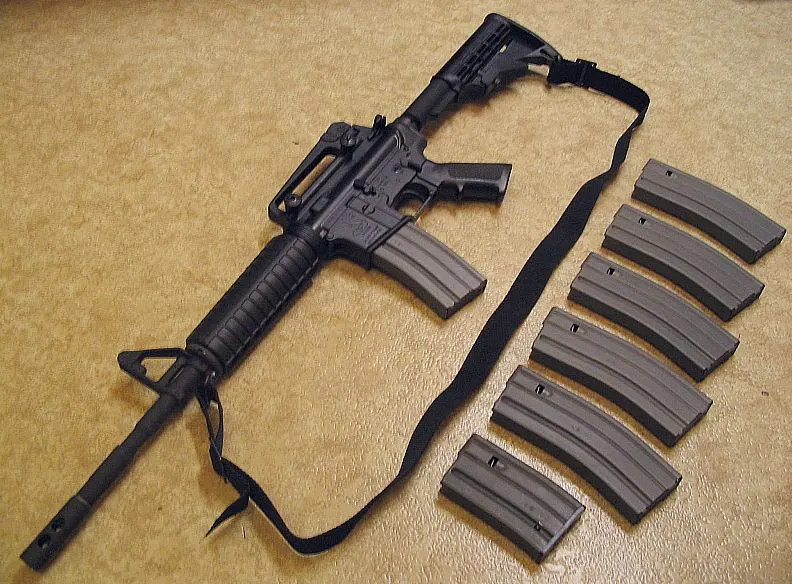
Smith & Wesson revived its own century-old Military and Police revolver branding for a rifle in January 2006, and the resulting Smith & Wesson M&P15 became one of the best-selling AR-15-pattern carbines in the country largely by undercutting Colt's own retail price on an otherwise nearly identical rifle.10 Smith & Wesson scaled the same platform up to .308 Winchester in 2013 as the AR-10-pattern Smith & Wesson M&P10, built on the SR-25 magazine standard that had already become the de facto standard for that class of rifle, and both M&P lines have since figured in some of the highest-profile American mass shootings of the past two decades, incidents that have kept the whole rifle pattern at the center of the country's gun-policy debate regardless of manufacturer.10
Sturm, Ruger & Co. tried a genuinely different mechanical answer before settling on the industry's mainstream one. The Ruger SR-556, launched in 2009, replaced the AR-15's direct-impingement gas tube with a two-stage short-stroke piston, joining a wave of piston conversions elsewhere in the industry that promised cooler, cleaner cycling at the cost of roughly a pound and a half of added weight and double the price of an ordinary AR-15.10 Ruger discontinued the SR-556 in January 2016 once its own direct-impingement Ruger AR-556, launched a year earlier at a price point less than half the SR-556's own, proved buyers wanted an affordable rifle far more than a piston system, and by 2019 the AR-556 had become the best-selling AR-15-pattern rifle in the United States by one major online marketplace's own annual sales tracking.10
Two later American designs pushed the AR-15's own bullpup and modular-caliber ideas further than any mainstream manufacturer had tried. Kel-Tec of Cocoa, Florida, built the Kel-Tec RFB, a 7.62x51mm bullpup rifle whose dual-extractor bolt carries each fired case forward through a chute above the barrel rather than ejecting it sideways past the shooter's cheek, a genuinely ambidextrous solution designer George Kellgren spent years tuning into reliability after the concept's 2007 SHOT Show debut.10 Desert Tech of West Valley City, Utah, built an even more ambitious bullpup, the Desert Tech MDR, engineered from its 2014 unveiling to let an owner swap barrel, bolt head, and ejection chute between 5.56x45mm, 7.62x51mm, and 6.5mm Creedmoor chamberings in about two minutes with a single hex tool, though the rifle took three troubled years to actually ship and Desert Tech discontinued the whole family in January 2024 in favor of a clean-sheet successor.10
01The AK Pattern Crosses Over Into Civilian Hands
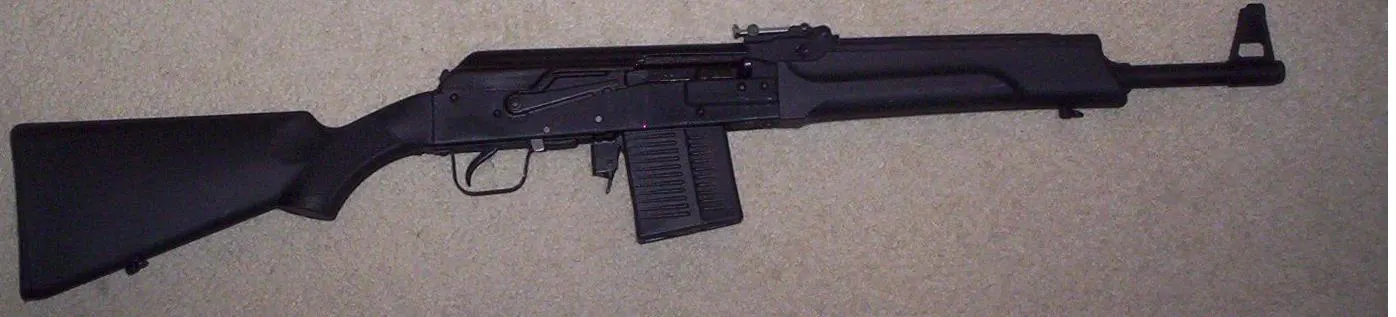
Russia's own Izhmash, renamed Kalashnikov Concern in 2013, built the civilian side of the Kalashnikov story with the Saiga semi-automatic rifle, originally a failed 1970s wildlife-control carbine that sold barely 300 units before Izhmash relaunched it in the early 1990s as a genuine AK-pattern hunting and sporting carbine built across seven separate calibers, from 7.62x39mm through .30-06 Springfield.11 The United States absorbed something close to 90 percent of Kalashnikov Concern's civilian export volume before a July 2014 US sanctions order, tied directly to Russia's actions in Ukraine and Crimea, cut off new Saiga imports overnight, sending secondary-market prices from around $600 to as high as $1,500 within two months.11
Zastava Arms of Serbia answered the same American demand with its own semi-automatic Zastava PAP series, a name Zastava had already used decades earlier on the unrelated Zastava M59/66 covered above, this time applied to civilian-legal derivatives of the company's own select-fire military rifles built across four calibers.11 Zastava's own thicker, RPK-derived 1.5mm receiver became the modern PAP series' main selling point against cheaper Romanian rivals, though a June 2025 Serbian export suspension, prompted by concern over Serbian-made arms surfacing on both sides of the war in Ukraine, briefly cut off new shipments before Zastava USA secured a narrow exception that November.11
Two smaller AK-pattern entries closed out the civilian side of the story with far less commercial success. Israeli manufacturer Command Arms and Accessories, working with Kalashnikov USA, built the AK Alfa in 2016 as a modernized Kalashnikov with AR-15-style ambidextrous controls and a folding stock, but a documented on-floor malfunction at its own 2017 SHOT Show unveiling foreshadowed a commercial failure in its intended Western market, its clearest fielding instead turning up years later with Nigerian special-forces units.11 Russia's own Berkut rifle, built from 1998 by KBP Instrument Design Bureau and TsKIB SOO, is not an AK derivative at all despite the family resemblance in its name, tracing its gas-operated action instead to an older sniper-rifle design, and it remains essentially undocumented outside Russian-language hobbyist sources, a reminder that this category's paper trail thins out well before its actual global reach does.11
01The Category Today
The semi-automatic rifle exists because a single mechanical idea, letting the fired cartridge's own energy load the next round, kept getting reinvented for whatever problem a given decade actually had. Winchester and Remington solved a civilian sporting demand in the 1900s. France solved a trench-warfare firepower gap in 1917. John Garand, Fedor Tokarev, and Walther's own engineers each solved the same infantry rifle problem within a few years of one another during the Second World War, by three different mechanical routes. Postwar Czechoslovakia, Egypt, Yugoslavia, and France each solved it again rather than simply importing someone else's answer, and the American civilian market solved it a final time, first with cheap rimfire plinkers, then with de-militarized battle rifles, and finally with the AR-15 pattern that now accounts for the overwhelming bulk of every rifle in this category sold anywhere.
What has not changed since Thomas Crossley Johnson patented his balanced blowback bolt in 1901 is the basic tradeoff every one of these rifles makes against its own bolt-action, battle rifle, or select-fire sibling, more shots fired faster in exchange for a heavier, more complex action and, in the earliest decades of the category, real reliability risk. The AR-15 pattern's own explosive growth after 1977, the AK pattern's parallel civilian spread through the Saiga and the WASR-10, and the ongoing use of seven-decade-old SKS and Zastava M59/66 rifles in Ukraine's own territorial defense units all trace back to that same tradeoff, decided a slightly different way by whichever country, company, or individual shooter happened to be solving the problem at the time.
02Notes and Sources
- Semi-Automatic Rifles archive, Winchester Model 1903, Winchester Model 1905, Winchester Model 1907, Winchester Model 1910, Remington Model 8, Military Archive, /en/weapons/winchester-model-1903, /en/weapons/winchester-model-1905, /en/weapons/winchester-model-1907, /en/weapons/winchester-model-1910, /en/weapons/remington-model-8 ↩
- Semi-Automatic Rifles archive, Meunier rifle, RSC 1917, Farquhar-Hill rifle, General Liu rifle, Military Archive, /en/weapons/meunier-rifle, /en/weapons/rsc-1917, /en/weapons/farquhar-hill-rifle, /en/weapons/general-liu-rifle ↩
- Semi-Automatic Rifles archive, Pedersen rifle, ZH-29, Breda M1935 PG Rifle, M1922 Bang rifle, Kbsp wz. 1938M, Military Archive, /en/weapons/pedersen-rifle, /en/weapons/zh-29, /en/weapons/breda-m1935-pg-rifle, /en/weapons/m1922-bang-rifle, /en/weapons/kbsp-wz-1938m ↩
- Semi-Automatic Rifles archive, M1 Garand, SVT-40, Gewehr 41, Gewehr 43, M1941 Johnson rifle, Automatgevär m/42, Smith & Wesson Model 1940 Light Rifle, EM-4 rifle, Type 4 rifle, Volkssturmgewehr, Military Archive, /en/weapons/m1-garand, /en/weapons/svt, /en/weapons/gewehr-41, /en/weapons/gewehr-43, /en/weapons/m1941-johnson-rifle, /en/weapons/automatgevar-m-42, /en/weapons/smith-wesson-model-1940-light-rifle, /en/weapons/em-4-rifle, /en/weapons/type-4-rifle, /en/weapons/volkssturmgewehr ↩
- Semi-Automatic Rifles archive, SKS, Zastava M59/66, MAS-49 rifle, vz. 52 rifle, Hakim rifle, M1947 Johnson auto carbine, Military Archive, /en/weapons/sks, /en/weapons/zastava-m59-66, /en/weapons/mas-49-rifle, /en/weapons/vz-52-rifle, /en/weapons/hakim-rifle, /en/weapons/m1947-johnson-auto-carbine ↩
- Semi-Automatic Rifles archive, M1A rifle, Heckler & Koch HK41, HK43, AR-15-style rifle, Colt AR-15, Military Archive, /en/weapons/m1a-rifle, /en/weapons/heckler-koch-hk41, /en/weapons/hk43, /en/weapons/ar-15-style-rifle, /en/weapons/colt-ar-15 ↩
- Semi-Automatic Rifles archive, Remington Nylon 66, Ruger 10/22, Marlin Model 60, Remington Model 552, Remington Model 597, Remington Model 522 Viper, Smith & Wesson M&P 15-22, Armscor M16 22, Armscor AK22, AMT Lightning 25/22, CZ 511, Marlin Model 70P, Military Archive, /en/weapons/remington-nylon-66, /en/weapons/ruger-10-22, /en/weapons/marlin-model-60, /en/weapons/remington-model-552, /en/weapons/remington-model-597, /en/weapons/remington-model-522-viper, /en/weapons/smith-wesson-m-p-15-22, /en/weapons/armscor-m16-22, /en/weapons/armscor-ak22, /en/weapons/amt-lightning-25-22, /en/weapons/cz-511, /en/weapons/marlin-model-70p ↩
- Semi-Automatic Rifles archive, Remington Model 740, Remington Model 742, Remington Model 7400, Remington Model Four, Winchester Model 100, Ruger Deerstalker, Ruger XGI, Benelli Argo, Benelli Argo EL, Benelli Argo Comfortech, Benelli MR1, Sauer 303, Military Archive, /en/weapons/remington-model-740, /en/weapons/remington-model-742, /en/weapons/remington-model-7400, /en/weapons/remington-model-four, /en/weapons/winchester-model-100, /en/weapons/ruger-deerstalker, /en/weapons/ruger-xgi, /en/weapons/benelli-argo, /en/weapons/benelli-argo-el, /en/weapons/benelli-argo-comfortech, /en/weapons/benelli-mr1, /en/weapons/sauer-303 ↩
- Semi-Automatic Rifles archive, Heckler & Koch SL6, Heckler & Koch SL7, Heckler & Koch SL8, Heckler & Koch MR223, PTR-91F, WASR series rifles, Military Archive, /en/weapons/heckler-koch-sl6, /en/weapons/heckler-koch-sl7, /en/weapons/heckler-koch-sl8, /en/weapons/heckler-koch-mr223, /en/weapons/ptr-91f, /en/weapons/wasr-series-rifles ↩
- Semi-Automatic Rifles archive, Bushmaster XM-15, Smith & Wesson M&P15, Smith & Wesson M&P10, Ruger SR-556, Ruger AR-556, Kel-Tec RFB, Desert Tech MDR, Military Archive, /en/weapons/bushmaster-xm-15, /en/weapons/smith-wesson-m-p15, /en/weapons/smith-wesson-m-p10, /en/weapons/ruger-sr-556, /en/weapons/ruger-ar-556, /en/weapons/kel-tec-rfb, /en/weapons/desert-tech-mdr ↩
- Semi-Automatic Rifles archive, Saiga semi-automatic rifle, Zastava PAP series, AK Alfa, Berkut rifle, Military Archive, /en/weapons/saiga-semi-automatic-rifle, /en/weapons/zastava-pap-series, /en/weapons/ak-alfa, /en/weapons/berkut-rifle ↩


