

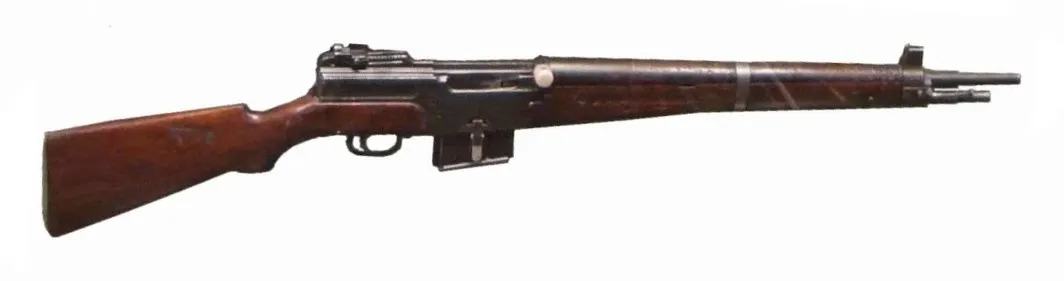

The MAS-49 rifle closed a French project that had run, on and off, for more than three decades. Formally adopted by the French Army in July 1949, the MAS-49 was the first semi-automatic design France committed to as a full standard-issue semi-automatic rifle, replacing a patchwork of bolt-action Berthiers, Lebels, American M1903A3 Springfields and M1917s, and captured German Karabiner 98k rifles that had equipped French units since the liberation.1 It chambers the 7.5x54mm French cartridge, weighs 4.7 kilograms empty, and feeds from a 10-round detachable box magazine rather than the clips or stripper-fed internal magazines most of its bolt-action predecessors used.1
- direct gas impingement action with only six moving parts, fast field-strip
- built-in rifle-grenade launching, no separate launcher attachment needed
- reputation for reliability in mud, dust and jungle humidity
- side-mounted scope rail let squads fit a marksman optic without armorer work
- 10-round magazine capacity, modest next to later 20-round battle rifles
- heavier and bulkier than paratroopers wanted in Indochina and Algeria
- limited export success outside France's own former colonies
- production delayed for years by cheaper American Lend-Lease surplus rifles
The rifle's designer of record was the state arsenal itself, the Manufacture d'Armes de Saint-Étienne (MAS), in France, but its core mechanism traces to a single French engineer named Rossignol, who built an experimental direct gas impingement rifle as early as 1901.5 MAS-49 production ran from 1949 into the mid-1960s for the original pattern and continued through 1978 for the shortened MAS-49/56 variant, totaling roughly 355,000 rifles across both versions before the FAMAS bullpup finally replaced them as the French service rifle beginning in 1979.1
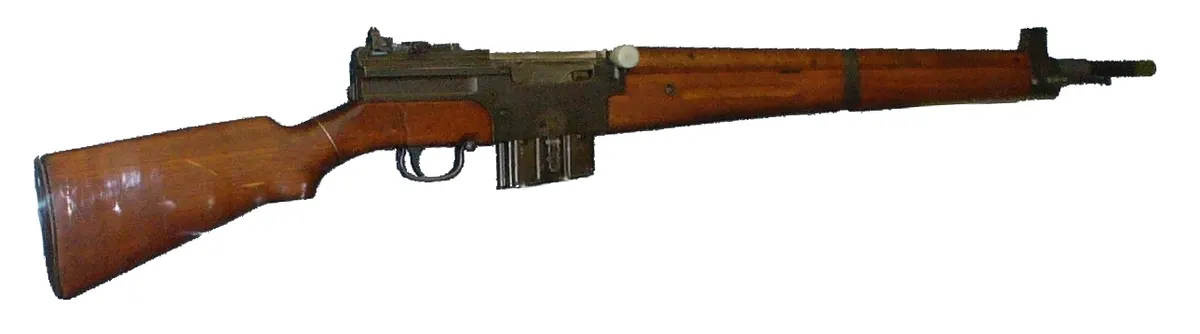
France's own rearmament math slowed the MAS-49 down before it even reached most units. Between 1951 and 1960 the United States shipped roughly 200,000 M1 Garand rifles and over 200,000 M1 and M2 carbines to French forces at little or no cost, and the French government had no incentive to fund large MAS-49 production runs while surplus American rifles sat in depots for free.1 The M1 Garand consequently outnumbered the MAS-49 in French hands for years even after the domestic rifle was officially standard.
The MAS-49's most distinctive feature sits at the muzzle rather than the receiver. Unlike the American M1 Garand or the Soviet SVT, which both needed a separate spigot or launcher device clamped onto the barrel to fire rifle grenades, the MAS-49 built its grenade-launching capability directly into the barrel and front sight assembly.1 A soldier could switch from ball ammunition to rifle grenades in seconds without fitting anything extra, a detail French doctrine leaned on heavily once the rifle reached Algeria in the mid-1950s.
The Direct Gas Impingement System France Pioneered Decades Early
The MAS-49 is gas-operated, but it uses direct gas impingement rather than a piston. Propellant gas bled from a port partway down the barrel travels through a tube straight into a chamber above the bolt carrier, pushing the carrier rearward without an intermediate piston rod.4 The system eliminates the extra mass and moving part a piston adds, and it was not new even in 1949. Rossignol first applied direct impingement to an experimental 6mm rifle in 1901, decades before Sweden's Ljungman AG-42 or Eugene Stoner's AR-15/M16 used the same basic principle.5 The MAS-49's version of the idea also avoided one flaw of France's own earlier attempt at the concept, the WWI-era RSC 1917, whose narrow gas port fouled quickly with carbon after repeated firing.2 MAS engineers routed gas fouling into the carrier rather than the bolt face itself, which kept the locking surfaces cleaner and made the rifle noticeably easier to maintain in the field.3
- First Production Year1949
- Service Entry Year1951
- Designermanufacture_d_armes_de_saint_etienne_design_bureau
- Weight (Empty)4.7 kg
- Currently In ServiceNo
- Notable Usersfrance_algeria_syria_lebanon_morocco_tunisia_and_former_french_african_colonies
Locking is handled by a tilting bolt, broadly similar in principle to the mechanism later used in the Belgian FN FAL and the American BAR, rather than the rotating bolt found in the M1 Garand or the SKS.3 Forgotten Weapons counts only six moving parts in the entire bolt and carrier group, which let French armorers field-strip the rifle in a few seconds without tools.3
- Cartridge7_5x54mm_french
- Calibre7.5 mm
- Case Length54 mm
- Calibre Class7_5mm
- Bullet Weight9 g
- RimfireNo
- Caseless AmmunitionNo
Ten Rounds, an Aperture Sight, and the APX L806 Marksman Scope
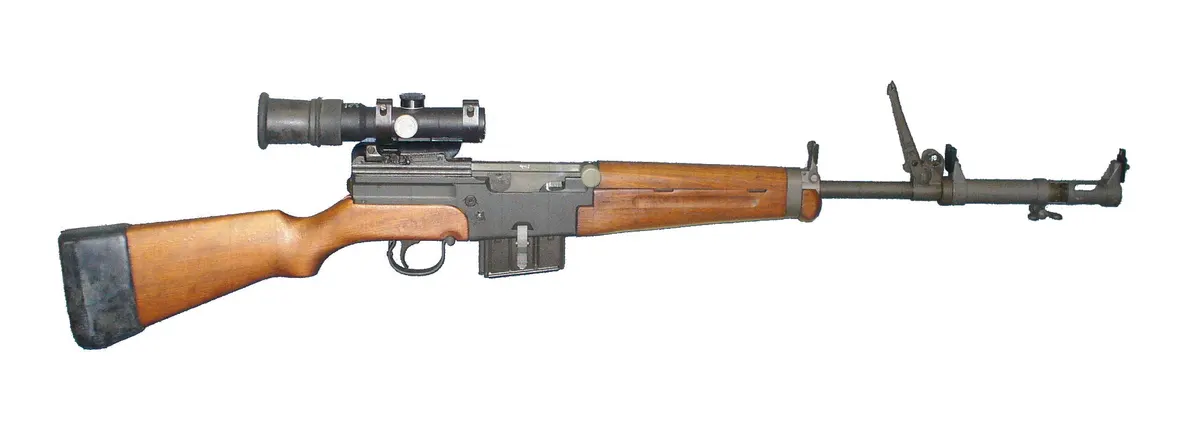
The base MAS-49 measures 1,100mm overall with a 580mm barrel, feeds from a detachable magazine holding 10 rounds of 7.5x54mm French, and can also be top-loaded with 5-round stripper clips while the magazine stays fitted.1 Sights consist of a hooded front post and an iron sights aperture rear sight adjustable from 200 to 1,200 meters, generous for a service rifle whose realistic point-target accuracy against a man-sized silhouette runs closer to 400 meters.4
- Action TypeGas-Operated
- Fire Modessemi_automatic_only
- Select FireNo
- Feed SystemDetachable Magazine
- Magazine Capacity10
A side rail machined into the left of the receiver let a squad fit the APX L806, officially the Modèle 1953 telescopic sight, a 3.85x scope that slid into place and locked with a small pressure lever without needing an armorer to drill or fit anything.8 Squads used the scoped MAS-49 as an improvised designated-marksman setup, stretching effective range out to roughly 800 meters against point targets, before the purpose-built FR F1 bolt-action sniper rifle replaced that role in French service in 1966.8 The rifle's muzzle velocity runs close to 820 meters per second with standard ball ammunition, and it carries a bayonet lug in most production examples, though the earliest 1949-pattern rifles mounted only a stacking hook at the muzzle rather than a true bayonet fitting.4
- Muzzle Velocity820 m/s
- Effective Range (point)400 m
- Effective Range (area)800 m
- Sighting Range1,200 m
The MAS-49/56's Integrated Muzzle Brake and Grenade Launcher
The base MAS-49 launched rifle grenades from a spigot built into the barrel and controlled fire with a gas cutoff valve, sending propellant gas past the action rather than cycling it during a grenade shot.1 The improved MAS-49/56, introduced in 1957, replaced that arrangement with a combined muzzle brake and 22mm NATO-standard grenade launcher, shortened the fore-end, and added ribbing and a spigot ring that positioned a rifle grenade correctly on the barrel without extra tools.4 An integral grenade-launching sight folded up from the front sight block, and a hinged gas cutoff lever let a soldier switch between direct-fire anti-tank grenades and indirect-fire anti-personnel rounds without changing any other setting.4 The improvements trimmed overall length to 1,020mm, barrel length to 525mm, and weight down to 4.1 kilograms, changes driven directly by paratrooper and Foreign Legion complaints about the earlier rifle's bulk in Indochina.1
- Barrel Length580 mm
- Sight Typeadjustable_aperture_rear_and_hooded_front_post
- Optic RailYes
- Iron SightsYes
- Overall Length1,100 mm
- Receiver Materialsteel
- Furniture Materialwood
- Folding / Collapsing StockNo
- Bullpup LayoutNo
- Total Production355,240
- Production Start1949
- Production End1978
- Variants3
From the RSC 1917 Trenches Rifle to the MAS-40 Prototype

France fielded the first mass-issued semi-automatic rifle of the First World War, the RSC 1917, named for its three designers, Ribeyrolles, Sutter and Chauchat.2 Roughly 85,000 RSC 1917 rifles and a further 4,000 of the shortened RSC 1918 pattern reached French infantry before the armistice, built in the 8mm Lebel cartridge inherited from the bolt-action Lebel rifle it was meant to eventually replace.2 Troops found the RSC heavy, long, and prone to gas-port fouling, and postwar analysis concluded the 8mm Lebel cartridge itself, with its rimmed case and steep taper, was never well suited to a semi-automatic action.2
France answered with a new cartridge, the 7.5x54mm French, and a long chain of interwar prototypes that eventually produced the MAS-38/39 trial rifle and, by 1940, the MAS-40.1 The MAS-40 saw only minor production before the German invasion of that year halted French rifle development entirely. Work resumed after liberation in 1944 with the MAS-44, distributed in small numbers mainly to French Navy units, followed by refinements labeled the MAS-44A, 44B, and 44C.1
Adoption in 1949 and the Slow Rearmament of a Broken Army
The MAS-49 itself was formally adopted in July 1949, folding in every lesson MAS engineers had drawn from the RSC rifles, the MAS-40, and the MAS-44 family.1 Widespread issue to French units did not begin until 1951, both because production ramped slowly and because the American M1 Garand and carbine shipments arriving under postwar military aid gave France a cheap alternative while its own arsenal caught up.1
The Manufacture d'Armes de Saint-Étienne Production Run
Every MAS-49 and MAS-49/56 came off the floor at the state-owned Manufacture d'Armes de Saint-Étienne, the same arsenal that had built the RSC rifles decades earlier and would go on to develop the FAMAS assault rifle. Roughly 80,000 base-pattern MAS-49 rifles were built between 1949 and 1965, and a further 275,000 of the improved MAS-49/56 followed between 1958 and 1978, for a combined production run of about 355,000 rifles.1 France also sold a batch of 6,000 rifles to Syria in 1953, built to a distinct contract specification.1
The MAS-49's decades of French service left it a recognizable presence on screen as well as in the field. French troops carry MAS-49 rifles in The Battle of Algiers (1966), where an FLN guerrilla is also shown fleeing with one after a police-station raid, and French gendarmes surround a hotel with MAS-49/56 rifles in The Day of the Jackal (1973).10
The First Indochina War and the Commandos Marines
Limited numbers of the MAS-49 reached First Indochina War units in the war's later stages, arriving too late and in too small a quantity to become the standard French rifle there, but proving serviceable enough that combat feedback shaped the later MAS-49/56.7 France's Commandos Marines, its elite naval infantry, were among the units most widely issued the rifle in Vietnam, where it earned a reputation for being dependable and hard-hitting against Viet Minh forces that were themselves increasingly armed with captured or Chinese-supplied SKS rifles and submachine guns.6
Other French small arms in Indochina included the bolt-action MAS-36, the CR39 folding-stock carbine, the Châtellerault Model 1924/29 automatic rifle, and the MAS-38 and MAT-49 submachine guns, the latter widely praised even after captured examples ended up in Viet Minh hands.7 Against that backdrop, the MAS-49's semi-automatic firepower and built-in grenade-launching capability gave French infantry a real edge in close engagements, even in the small numbers actually fielded before the war ended in 1954.
The Algerian War, Rifle Grenades Against the Djebel
The Algerian War was where the MAS-49 and, from 1957 onward, the MAS-49/56 saw their heaviest combat use. Lessons from Indochina applied directly in Algeria, where lightly-equipped French paratroopers and infantry needed to dominate rocky mountain terrain without hauling mortars or waiting for artillery support.6 Battle doctrine combined precise rifle fire with rifle grenades to suppress and eliminate FLN guerrillas pinned down by the FM 24/29 light machine gun and the AA-52, using the MAS-49/56's integral launcher to bring indirect fire onto positions no rifleman could reach with a flat trajectory alone.6
The Manufacture d'Armes de Saint-Étienne had shortened and lightened the MAS-49/56 specifically in response to complaints from Indochina and Algeria about the original rifle's bulk, and the shorter rifle proved better suited to mounted and airborne operations across Algeria's mountainous interior than the full-length 1949 pattern had been.6 The rifle earned enough loyalty among French Foreign Legion units during this period that some accounts describe it as the Legion's favorite rifle of the era, prized for reliability over the more delicate accuracy some riflemen might have preferred.6
Suez and Cyprus, a Rifle at the Edge of Empire
French airborne and ground units carried the MAS-49 during the Suez Crisis of 1956, part of the joint Anglo-French-Israeli operation against Egypt to seize control of the Suez Canal.1 The intervention was brief and politically costly for France and Britain both, but it added another data point to the MAS-49's combat record just as the improved MAS-49/56 was entering production.
By the late 1950s the MAS-49/56 was also equipping French forces well beyond metropolitan and North African postings, following French garrisons and Foreign Legion units to postings across sub-Saharan Africa and the Middle East as decolonization reshaped where French rifles actually served.
The Battle of Kolwezi, the MAS-49/56's Last Stand in 1978
By May 1978, the MAS-49/56 was nearing the end of its run as France's standard rifle, but it was still what French paratroopers carried when Colonel Philippe Erulin's 2nd Foreign Parachute Regiment (2e REP) jumped into Kolwezi, in what was then Zaire.11 Roughly 450 legionnaires dropped from 250 meters into the city's old hippodrome under fire, moving to rescue an estimated 3,000 European hostages held by FLNC rebels who had seized the mining town days earlier.11
Most paratroopers in the operation carried the MAS-49/56, still limited to a 10-round magazine, while French snipers used the newer FR F1 bolt-action rifle to engage rebels at ranges out to 300 meters.12 Fighting through May 18 to 22 secured roughly 2,800 European civilians for evacuation, cost five French paratroopers killed against an estimated 400 FLNC fighters killed or captured, and left behind roughly 1,500 captured rebel weapons.11
Erulin's paratroopers moved through Kolwezi over four days of house-to-house fighting, clearing FLNC positions street by street with rifle fire, grenades, and the occasional LRAC F1 rocket launcher against armored vehicles.11 Belgian paratroopers followed a day later to help secure the wider evacuation, and the operation is still studied as one of the last successful Western hostage-rescue jumps of the Cold War.11
Kolwezi stands as close to a closing chapter for the MAS-49/56 in frontline French service. The FAMAS began replacing it across the French Army the following year, and by the time France next deployed troops in significant numbers, the bullpup rifle, not the old direct-impingement MAS design, was standard issue.
The MAS-49/56, Shorter, Lighter, Redesigned for Algeria
The MAS-49/56 is the most numerous and best-documented variant, cutting overall length from 1,100mm to 1,020mm, barrel length from 580mm to 525mm, and weight from 4.7kg to 4.1kg while adding the combined muzzle brake and grenade launcher described above.1 It also added a proper spike bayonet mount, something the base 1949-pattern rifle lacked entirely.4 Roughly 275,000 MAS-49/56 rifles were built between 1958 and 1978, more than three times the production run of the original MAS-49, making the /56 pattern the version most collectors and museums actually encounter today.1
The Syrian Contract Rifles of 1953
Syria purchased roughly 6,000 MAS-49 rifles from France in 1953, built to a distinct export specification with serial numbers in the F33,000 to F39,000 range.1 These rifles carried a spike bayonet mount identical to the one used on the older bolt-action MAS-36, along with different stocks and metal fittings from the standard French-issue pattern, making them a recognizably separate production variant rather than simply surplus rifles resold secondhand.1 Decades later, examples of these Syrian-contract MAS-49 rifles resurfaced in rebel hands during the Syrian Civil War, a long afterlife for a Cold War-era arms sale.6
Collectors treat the Syrian contract rifles as a distinct sub-category from standard French-issue MAS-49 rifles precisely because of that separate serial range and hardware, and surviving examples with matching Syrian-marked furniture command a premium over ordinary surplus rifles on the current collector market.1
Sniper Configuration and Civilian .308 Conversions
Neither MAS-49 pattern needed a dedicated sniper variant in the formal sense, since the receiver-mounted scope rail let any standard rifle accept the APX L806 telescopic sight for designated-marksman use without factory modification.8 After French military retirement, substantial numbers of surplus MAS-49/56 rifles reached the American civilian market during the 1990s, and importers including Century Arms produced conversions rechambered for the commercially available .308 Winchester cartridge rather than the increasingly scarce 7.5x54mm French round, a conversion collectors distinguish clearly from any genuine French military variant.1
 EritreaACTIVE
 GreeceACTIVE
 AlgeriaRETIRED
 BeninRETIRED
 Burkina FasoRETIRED
 CameroonRETIRED
 Central African RepublicRETIRED
 ComorosRETIRED
 FranceRETIRED
 GabonRETIRED
 Ivory CoastRETIRED
 LebanonRETIRED
 MadagascarRETIRED
 MaliRETIRED
 MauritaniaRETIRED
 MonacoRETIRED
 MoroccoRETIRED
 NigerRETIRED
 Republic of the CongoRETIRED
 RwandaRETIRED
 SenegalRETIRED
 SeychellesRETIRED
 SyriaRETIRED
 TunisiaRETIRED
 ZimbabweRETIRED
| Year | Buyer | Quantity | Amount | Present Value (2025) |
|---|---|---|---|---|
| 1953 |  Syria | 6,000 | — | — |
France and Its Former Colonies
France issued the MAS-49 and MAS-49/56 as its standard rifle from 1951 until the FAMAS replacement beginning in 1979, with some reserve and second-line stock lingering into the following decade.1 Decolonization spread the rifle across a long list of former French territories that inherited or purchased French-pattern small arms after independence, including Algeria, Benin, Burkina Faso, Cameroon, the Central African Republic, Comoros, the Republic of the Congo, Ivory Coast, Gabon, Madagascar, Mali, Mauritania, Monaco, Morocco, Niger, Rwanda, Senegal, Seychelles, Tunisia, and Zimbabwe.1 Most of these forces received the rifle in modest numbers as military aid or purchased surplus stock, rather than through dedicated production contracts of their own.
Syria, Lebanon and the Middle East
Beyond its former African territories, France sold MAS-49 rifles directly to Syria under the 1953 contract described above, and Lebanon also fielded the rifle, reflecting France's continued arms relationships across the former Levant mandate territories long after formal French rule ended there.1 None of these operators still issue the MAS-49 as a first-line rifle today, and the honest answer to whether the MAS-49 is still in service anywhere is no standing army, though ceremonial guard units and irregular forces in a few former operator states may retain small numbers.1
The MAS-49 and the M1 Garand, Two Answers to the Same Problem
France and the United States reached the same conclusion, that infantry needed semi-automatic rifles, by two very different routes. The M1 Garand entered American service in 1936, thirteen years before the MAS-49, and fed from an 8-round en bloc clip that ejected automatically once emptied. The MAS-49 instead used a 10-round detachable box magazine that could be topped off with stripper clips without ejecting anything, a genuine practical advantage in a firefight where a partially-spent magazine did not need to be discarded and replaced.1
The two rifles also solved gas operation differently. The M1 Garand is gas-piston operated, with the piston built into its operating rod, while the MAS-49's direct impingement system skipped the piston entirely, feeding gas straight into a carrier above the bolt.4 Both approaches worked reliably in field service, but the MAS-49's built-in rifle-grenade launcher gave French infantry a capability the standard M1 Garand never had without a separate launcher attachment, a difference that mattered directly in Algeria's terrain.1
| Spec | MAS-49 | M1 Garand |
|---|---|---|
| Action | Direct gas impingement, tilting bolt | Gas piston, rotating bolt |
| Feed | 10-round detachable magazine | 8-round en bloc clip |
| Cartridge | 7.5x54mm French | .30-06 Springfield |
| Unloaded weight | 4.7 kg | 4.31 kg |
| Adopted | 1949 | 1936 |
By the time the MAS-49 reached French troops in numbers, the M1 Garand was already arming French units too, delivered as postwar American aid, which meant French soldiers in the early 1950s often had direct, side-by-side experience with both rifles years before either one saw its most significant combat. Where the M1 Garand's reputation rests overwhelmingly on the Second World War, the MAS-49's rests on France's postwar colonial wars, Indochina, Algeria, Suez, and finally Kolwezi in 1978, a service record shaped far more by counterinsurgency and airborne operations than by set-piece continental combat.


What caliber is the MAS-49 rifle? The MAS-49 is chambered for the 7.5x54mm French cartridge, firing a 9.0 gram (139 grain) bullet at approximately 820 meters per second from either the base MAS-49 or the shortened MAS-49/56 variant.1
Is the MAS-49 still in service anywhere today? No standing military still issues the MAS-49 or MAS-49/56 as a first-line rifle. France retired it in favor of the FAMAS beginning in 1979, and most former operator states retired their own stocks by the 1990s, though surplus examples still circulate among collectors and occasionally surface with irregular forces.1
How does the MAS-49 grenade launcher work? The base MAS-49 fires rifle grenades directly from a spigot built into the barrel, using a gas cutoff valve to protect the action. The improved MAS-49/56 replaced that arrangement with a combined muzzle brake and 22mm NATO-standard launcher, adding an integral folding sight and a hinged cutoff lever for both anti-tank and anti-personnel grenades.4
What is the difference between the MAS-49 and the MAS-49/56? The MAS-49/56, introduced in 1957, is shorter (1,020mm versus 1,100mm), lighter (4.1kg versus 4.7kg), and carries a proper bayonet mount and an improved grenade launcher the original MAS-49 lacked. It was developed specifically in response to complaints about the base rifle's bulk during the First Indochina War.1
Who manufactured the MAS-49 rifle? The French state arsenal, the Manufacture d'Armes de Saint-Étienne, designed and built every MAS-49 and MAS-49/56 rifle, along with the earlier RSC 1917, RSC 1918, and MAS-40 rifles that led to it.1
How much is a MAS-49 rifle worth today? Surplus MAS-49/56 rifles imported to the American civilian market during the 1990s now sell as collector's rifles, with used market values in the $900 to $1,100 range as of the mid-2020s, up sharply from prices closer to $300 in the early 2010s as surplus supply has dried up.1
- "MAS-49 rifle", Wikipedia — en.wikipedia.org ↩
- "Fusil Automatique Modèle 1917", Wikipedia — en.wikipedia.org ↩
- "MAS 49 Rifle", Forgotten Weapons — forgottenweapons.com ↩
- "MAS-1949 and 49/56", Modern Firearms — modernfirearms.net ↩
- "Direct Impingement", Historical Firearms — historicalfirearms.info ↩
- "The MAS-49 Was the Foreign Legion's Favorite Rifle", Trench Art (War Is Boring) — medium.com ↩
- "French Weapons of Indochine", Small Arms Review — smallarmsreview.com ↩
- "MAS-49 APX L806", Military Conflict, Vietnam Wiki — wiki.militaryconflictvietnam.com ↩
- "7.5x54mm French", Wikipedia — en.wikipedia.org ↩
- "MAS Rifle Series", Internet Movie Firearms Database — imfdb.org ↩
- "Battle of Kolwezi", Wikipedia — en.wikipedia.org ↩
- "1978 Battle of Kolwezi", French Foreign Legion Information — foreignlegion.info ↩