

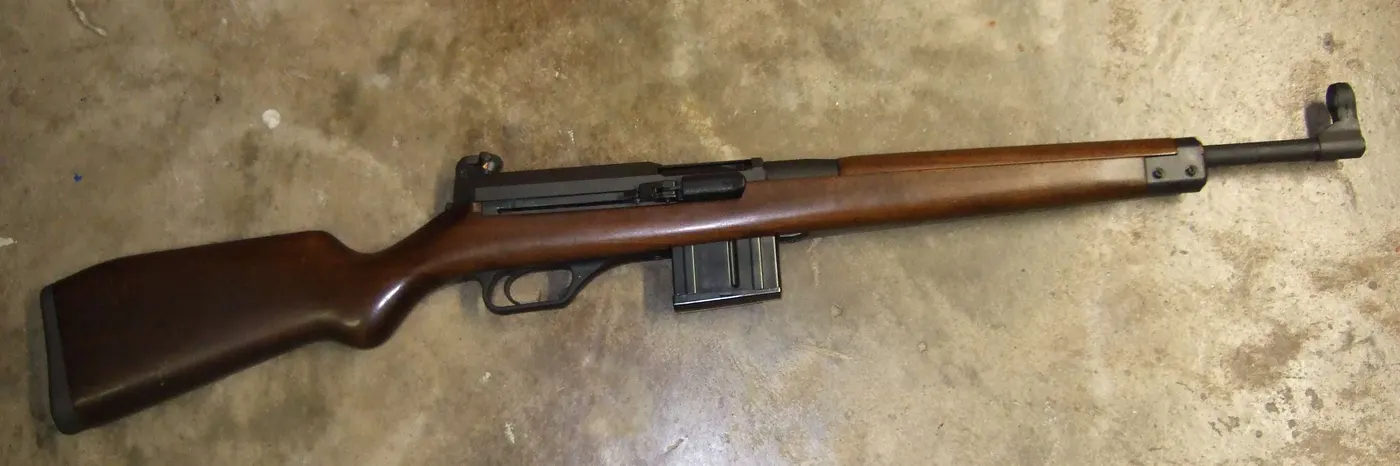

The Heckler & Koch SL7 is a semi-automatic sporting rifle chambered in .308 Winchester / 7.62x51mm NATO, built by the West German manufacturer Heckler & Koch around the same roller-delayed blowback action used in its Heckler & Koch G3 battle rifle.1 It belongs to a small family of semi-automatic rifles that German gunmakers built specifically to satisfy civilian firearms law rather than any military requirement, wearing a walnut hunting stock instead of the G3's military furniture while keeping the same locking system underneath.2 Production ran from 1980 to 1991, entirely in West Germany, before Heckler & Koch replaced the model with the newer SLB 2000.1
- Roller-delayed blowback action, no gas system to foul or maintain
- Reported sub-MOA accuracy from some owners with quality ammunition
- Genuine West German Heckler & Koch manufacturing quality
- Fast-cycling semi-automatic action suited to driven hunts
- Small, expensive, proprietary magazines rather than common G3-pattern ones
- Slow, tool-dependent field-stripping compared to a bolt-action rifle
- Never adopted by any military as a service weapon
- Very limited production, spare parts and magazines now scarce
The SL7 was never a solo product. It launched alongside the Heckler & Koch SL6, an otherwise identical rifle chambered in 5.56x45mm NATO, the two differing mainly in caliber and barrel-related dimensions while sharing the same receiver design, trigger mechanism, and sighting system.2 Both were themselves adapted from an existing Heckler & Koch hunting-rifle pair, the HK 660 and HK 770, with the SL6/SL7 versions adding shorter barrels and military-pattern sling swivels and steel buttplates on top of the same civilian action.2 That direction of development, hunting rifle first, paramilitary-configured sibling second, runs opposite to the more familiar story of a military rifle simply stripped down for civilian sale, and it separates the SL7 from a rifle like the Heckler & Koch HK41, which strips a full-automatic G3 down to semi-automatic rather than building up from a hunting action.
West German firearms law in the early 1980s drew a sharp line around anything that looked like a military assault rifle, and Heckler & Koch's answer was cosmetic as much as mechanical.3 A wood stock, a hooded front sight, and the absence of a pistol grip or flash hider let the SL7 read as an ordinary sporting rifle to regulators even though its internals were lifted straight from a select-fire service weapon.3 The company marketed it toward West German army reservists who wanted a rifle that handled like their issue G3 for weekend practice, and toward hunters, particularly for fast-paced driven hunts where a self-loading rifle offered a genuine practical edge over a bolt-action.2
High cost and West Germany's restrictive gun laws kept the SL7 a low-volume product throughout its production run, and it never reached the sales figures of more conventional bolt-action sporting rifles built by Sauer or other domestic manufacturers.3 Only a limited number were imported into the United States before US import restrictions tightened toward the end of the decade, and today surviving examples sell almost entirely into the collector and Heckler & Koch enthusiast market rather than as working hunting rifles, with well-kept examples commanding roughly 1,300 to 1,600 dollars as of the mid-2020s.4,1
Published weight figures for the Heckler & Koch SL7 disagree in a way worth flagging rather than glossing over. Several collector and technical references put the empty weight at 3.8 kg (about 8.4 to 8.5 lb), while other summaries list 3.6 kg, a number that actually matches the lighter 5.56mm SL6 rather than the heavier 7.62mm SL7 and looks like a mismatched carryover between the two closely related model entries.2,5 The 3.8 kg figure is the one backed by a source that lists both rifles side by side and distinguishes them, so it is treated here as the correct value for the SL7 specifically.2
- First Production Year1980
- Weight (Empty)3.8 kg
- Currently In ServiceNo
The rifle measures 1,010 mm overall with a 450 mm barrel, giving it carbine-length proportions rather than the longer profile of a full-size G3 or a traditional stalking rifle.1 One reviewer who owned several examples described the balance as excellent for a semi-automatic hunting rifle, comparing its natural pointing characteristics to a well-made shotgun.5
- Cartridge.308 Winchester / 7.62x51mm NATO
- Calibre7.62 mm
- Case Length51 mm
- Calibre Class7.62mm
- RimfireNo
- Caseless AmmunitionNo
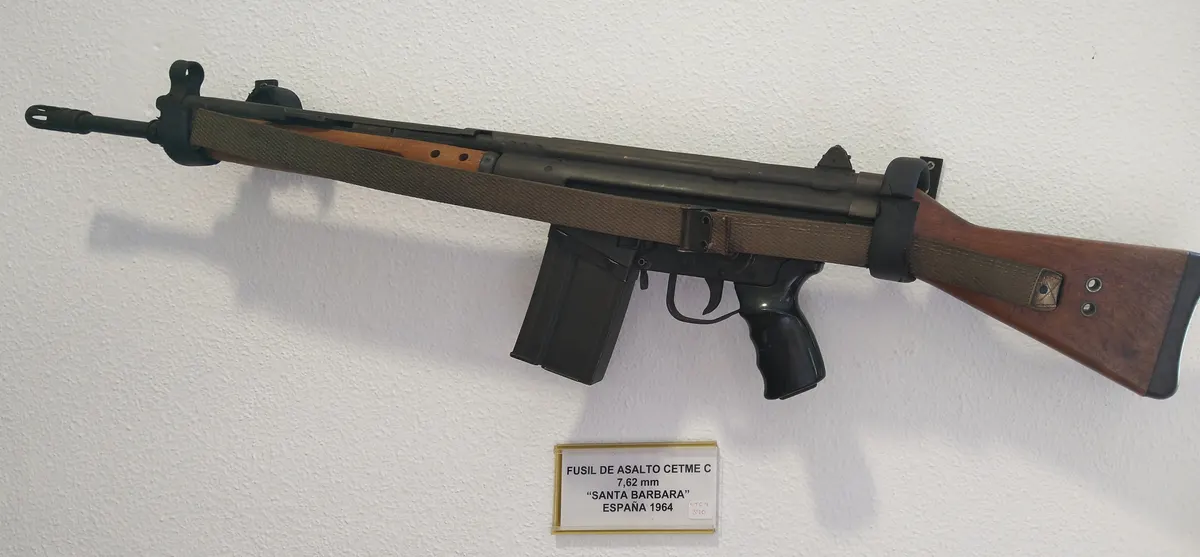
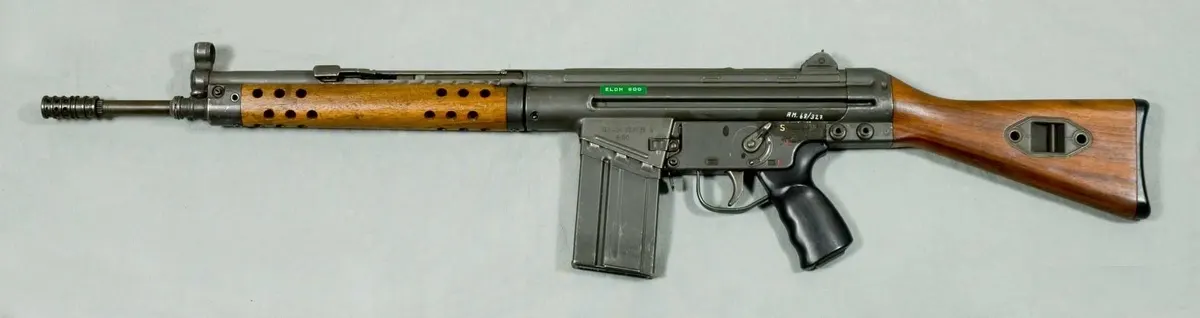
Mechanically, the SL7 uses the same roller-delayed blowback system that Spanish engineers developed for the CETME rifle and that Heckler & Koch scaled up into the G3.1,3 A pair of rollers delays the bolt's rearward travel just long enough for chamber pressure to drop to a safe level, which is why the rifle carries no gas port, piston, or regulator anywhere along the barrel. On the SL7 the charging handle sits further back and to the right than on a military G3, folding forward out of the way when not in use, a change that also shaved roughly a pound off the dry weight compared with the earlier hunting-rifle pattern it grew from.6
- Action TypeDelayed Blowback
- Fire Modessemi_automatic
- Select FireNo
- Feed SystemDetachable Magazine
- Magazine Capacity10
- Trigger Typesingle-stage, adjustable 12-16 N pull weight
Feeding comes from a detachable magazine in 3-round or 10-round capacities, both purpose-built for the SL7 rather than compatible with standard G3 magazines, since the rifle's magazine well was lengthened to accept .308 Winchester hunting ammunition loaded slightly longer than the roughly 2.82-inch NATO-spec G3 magazine allows.6 That single dimensional change is a large part of why SL7 magazines remain expensive and hard to find today, since they were never produced in anything like G3 magazine quantities and are not interchangeable with the much more common military-pattern box.
- Barrel Length450 mm
- Rifling Twist1-in-11-inch, polygonal
- Sight Typerotary rear aperture drum, hooded foresight
- Iron SightsYes
Sighting is a rotary rear aperture drum graduated from 100 to 400 meters, paired with a hooded foresight post, both compatible with Heckler & Koch's proprietary claw scope mount for a quick-detach optic.1,2 The barrel uses polygonal rifling with roughly a 1-in-11-inch twist, and the trigger is adjustable within a 12 to 16 newton pull-weight range, noticeably lighter and more refined than a standard G3's service trigger.3,6 Furniture throughout is walnut wood, finished with a factory urethane coating on most production rifles, with a ventilated wooden handguard intended to dissipate heat during rapid semi-automatic fire and a steel buttplate carried over from the rifle's military-pattern parent.5
- Overall Length1,010 mm
- Furniture Materialwood
- Folding / Collapsing StockNo
- Bullpup LayoutNo
- Ambidextrous ControlsNo
- Production Start1980
- Production End1991
- Variants3
Heckler & Koch introduced the SL6 and SL7 in the early 1980s at the intersection of two very different customer bases, army reservists and civilian hunters, both shaped by the same restrictive West German firearms law.3 Rather than starting from the G3 and stripping it down, the company started from its own HK 660 and HK 770 hunting rifles, which already used the roller-delayed blowback action in a civilian-legal wood-stocked package, and added shorter barrels along with sling swivels and steel buttplates borrowed from military practice.2 The result was a rifle that satisfied Germany's insistence on a non-military profile while still handling close enough to the issue G3 that a reservist could train with one at home.
Sources describe the SL6 and SL7 as intended for training reservists and, more tentatively, for arming elements of West German police, though no source found in this research confirms a specific police force or unit that formally adopted the rifle, and it should not be read as a documented law-enforcement service weapon.2,3 What is better documented is the abbreviation itself. SL stands for Selbstladegewehr, German for self-loading rifle, the same naming convention Heckler & Koch later reused for the unrelated Heckler & Koch SL8 target rifle built on the G36 action nearly two decades later.7
On the hunting side, the SL7's semi-automatic action found a real niche in Drückjagd, the fast-paced German driven hunt for wild boar and deer where dogs and beaters push game past a line of stationary hunters, a scenario that rewards a rifle capable of a rapid follow-up shot far more than a traditional bolt-action does.5 One American reviewer who used the rifle for stalking and horseback hunting called it a strong contender for the best semi-automatic hunting rifle built for that kind of work, praising its balance and natural pointing over raw magazine capacity.5
Import into the United States began in the early 1980s and continued through the middle of the decade before slowing sharply, a pattern that lines up with the tightening US regulatory climate around imported semi-automatic military-pattern rifles later in that decade.1 The George H. W. Bush administration's 1989 ban on importing semi-automatic rifles judged not to serve a genuine sporting purpose reshaped the US market for HK-pattern rifles broadly, though the SL7's wood stock and hunting-oriented configuration were closer to what regulators were trying to preserve than what they were trying to exclude, unlike the HK41's more overtly military-styled successor lines.8 West German production of the SL7 itself continued until 1991, when Heckler & Koch discontinued the SL6/SL7 pair in favor of the newer SLB 2000 hunting rifle series.1
Commercial success never matched the engineering behind the rifle. High unit cost next to a conventional hunting rifle, combined with German licensing hurdles for any military-pattern civilian firearm, kept total production modest across the whole run, and the SL7 remained a niche product throughout its life rather than a volume seller.3 That same scarcity is what drives today's collector market, where a clean example with its original claw mount and box now sells for several times its original commercial price.4
Three related models are documented alongside the base SL7. The HK 770 is effectively the SL7's civilian hunting-rifle parent rather than a downstream variant, sharing the same roller-delayed blowback action but fitted with a longer barrel, an integral flash-hider-style compensator, open rear leaf sights, and a more conventional sporting buttstock instead of the SL7's military-pattern furniture.1,6
The HK 940 is a long-action derivative chambered for cartridges too long to fit the SL7's own magazine and receiver, most commonly .30-06 Springfield or 7x64mm, typically fitted with a longer roughly 21-inch barrel for the larger case capacity.6,10 It uses the identical roller-delayed blowback operating principle scaled to handle the more powerful cartridge, and like the SL7 it remained a low-volume product aimed squarely at the hunting market rather than at reservists.10 Values for surviving HK 940 examples today run into the low-to-mid four figures, broadly in line with SL7 collector pricing.10
The rarest of the three, the SL7 Match, is a heavy-barrel precision derivative built to special order for the German wholesaler Wischo rather than sold through Heckler & Koch's normal commercial catalog.9 It combines the SL7's roller-delayed action with a longer, heavier PSG-1-pattern barrel, a competition-style stock with an adjustable cheekrest, and a muzzle weight for vibration damping, and it continued to appear as late as 1998 despite standard SL7 production having ended in 1991.9 It never entered series production and never displaced Heckler & Koch's dedicated PSG-1 precision rifle in either the police or civilian market, remaining instead one of the rarest and most obscure branches of the whole SL6/SL7 family.9
The Heckler & Koch SL7 was never formally adopted as service equipment by any national military or police force, and no source found in this research documents a confirmed institutional operator. Its closest connection to any state security structure is the West German army's practice of permitting reservists to privately own and train with a rifle matching their service G3, a regulatory allowance rather than a procurement contract, mirroring the arrangement later documented for the Heckler & Koch HK41.2,3 Beyond that, the SL7's real customer base was always civilian, split between Germany-based hunters buying it for driven-hunt use and a smaller number of buyers in the United States and elsewhere who acquired it through limited import channels before the rifle's production ended.1,4
Where the Heckler & Koch HK41 reached the civilian market by removing capability from an existing military rifle, the SL7 reached it by adding military-adjacent features to an existing hunting rifle, and that reversed development path is the real story behind comparing the two. Both end up as semi-automatic-only, roller-delayed blowback rifles chambered in 7.62x51mm NATO built by the same company for legally similar reasons, but the HK41 always looked and handled like a de-militarized G3, sling swivels, hooded sights and all, while the SL7 was built from the ground up to look like an ordinary wood-stocked sporting rifle even though the mechanism underneath is nearly identical.2,6
Set against a modern G3-pattern rifle like the American PTR-91F, the SL7 looks almost like a different category of product despite sharing the same underlying roller-delayed blowback lineage traced back through the G3 to Spain's CETME rifle. The PTR-91F is a high-volume, ongoing commercial rifle built from retooled G3-pattern machinery and finished in military-style polymer furniture aimed at the modern American sporting-rifle market, while the SL7 was a low-volume, discontinued West German product built specifically to avoid that military look, wearing a walnut stock and proprietary hunting magazines instead of anything G3-compatible.6
| Spec | HK SL7 | PTR-91F |
|---|---|---|
| Cartridge | .308 Winchester / 7.62x51mm NATO | 7.62x51mm NATO |
| Action | Roller-delayed blowback | Roller-delayed blowback |
| Stock | Walnut wood, sporting profile | Polymer, military-pattern |
| Origin and era | West Germany, 1980-1991 | United States, 2000s-present |
A buyer researching the SL7 today is almost always researching a collector's rifle rather than a working tool, since parts, magazines, and factory documentation are all scarce, whereas a PTR-91F buyer is choosing a currently produced rifle with an active parts and accessory market. That gap, not raw specification, is what actually separates the two rifles for anyone deciding between them now.

What is the Heckler & Koch SL7? It is a semi-automatic sporting rifle chambered in .308 Winchester / 7.62x51mm NATO, built by Heckler & Koch in West Germany between 1980 and 1991 using the same roller-delayed blowback action as the G3 battle rifle, but housed in a wood-stocked civilian hunting configuration.1,2
What caliber does the Heckler & Koch SL7 use? The SL7 is chambered in .308 Winchester, interchangeable in practice with military 7.62x51mm NATO ammunition, fed from a proprietary 3-round or 10-round detachable magazine that is not compatible with standard G3 magazines.1,6
Is the Heckler & Koch SL7 still in production? No. Production ended in 1991, when Heckler & Koch replaced the SL6/SL7 pair with the newer SLB 2000 hunting rifle series, and the SL7 has not been manufactured since.1
How much does a Heckler & Koch SL7 cost today? As a discontinued collector's rifle, a well-preserved SL7 typically sells for roughly 1,300 to 1,600 US dollars as of the mid-2020s, well above its original commercial price when new, with condition and included accessories like the original scope mount driving most of the variation.4
What is the difference between the Heckler & Koch SL7 and the SL6? The SL6 and SL7 share the same action, sights, and general layout, differing mainly in caliber, with the SL6 chambered in 5.56x45mm NATO and the SL7 in the larger 7.62x51mm NATO / .308 Winchester.2
- "Heckler & Koch SL7", Wikipedia — en.wikipedia.org ↩
- "Heckler-Koch HK SL-6 SL-7", Modern Firearms — modernfirearms.net ↩
- "H&K SL-6 and SL-7 Rifles at RIA", Forgotten Weapons — forgottenweapons.com ↩
- "H&K SL7 Price (2026)", We Buy Guns — webuyguns.com ↩
- "Personal Critical Review of Firearms - The HK SL7 rifle", Rocky Mountain Preparedness — mountainpreparedness.blogspot.com ↩
- "Heckler and Koch SL-7 and 770", Surplused — surplused.com ↩
- "Heckler & Koch SL8", Wikipedia — en.wikipedia.org ↩
- "Treasury Prohibits Importation of Certain Semiautomatic Assault Rifles", U.S. Department of the Treasury — home.treasury.gov ↩
- "H&K Prototype Sniper: the SL7 Match", Forgotten Weapons — forgottenweapons.com ↩
- "A Family Heirloom: Dad's Heckler and Koch Model 940", SOFREP — sofrep.com ↩