

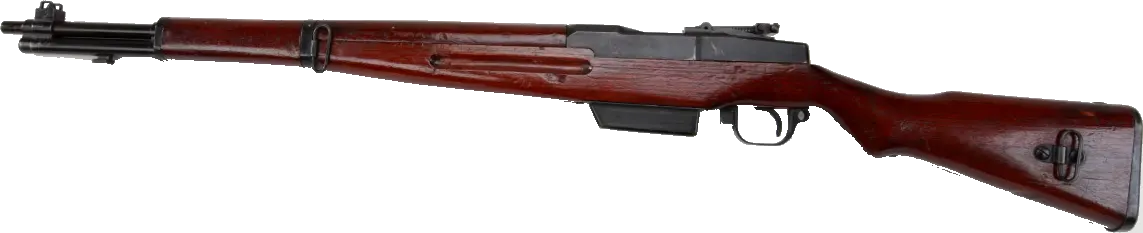

The Type 4 rifle is a Japanese semi-automatic rifle built in the last year of the Second World War as a near direct copy of the American M1 Garand, rechambered for the Japanese 7.7×58mm Arisaka cartridge. Fewer than 150 examples were ever assembled, none reached a combat unit, and the entire program collapsed with Japan's surrender in August 1945. It stands as one of the clearest copy-versus-original pairs in the whole semi-automatic rifles category, a wartime reverse-engineering project built from captured American rifles rather than a fresh design.
- direct, workable copy of a proven gas-operated action
- ten-round internal magazine held two more rounds than the Garand's en-bloc clip
- compatible with existing Arisaka 7.7mm stripper-clip ammunition
- assembled almost entirely by hand, with no dedicated production tooling
- persistent parts breakage and feeding failures never fully resolved
- war ended before a single rifle reached a fighting unit
Officially the weapon carries the designation Type 4, taken from the imperial year 2604 (1944) in which it was designed.2 Most English-language sources, and most collectors, still call it the Type 5 rifle, a mislabeling that appears to trace back to an American technical intelligence report published in 1946.1 Both names describe the same rifle. Type 4 is the correct designation, though Type 5 remains the term most readers are likely to search for.
The Imperial Japanese Navy, not the Army, ran the project.2 By 1944 the Navy had captured working examples of the M1 Garand and wanted a semi-automatic rifle of its own, while the Army had already committed fully to its bolt-action Arisaka-pattern rifles and had abandoned earlier semi-automatic efforts. Engineers at the Yokosuka Naval Arsenal in Japan took the Garand's gas-operated rotating-bolt action apart, kept its basic mechanism, and replaced the American en-bloc clip with a fixed internal magazine fed by Japanese stripper clips.
Production numbers vary by source, which is itself part of the Type 4 rifle's story. Most accounts put completed rifles somewhere between 50 and 125, out of parts sets for 150 to 250 more that were never finished.1,3,5 The spread is wide enough that no single figure can be called definitive, and the range itself is the honest answer rather than picking one number to sound precise.
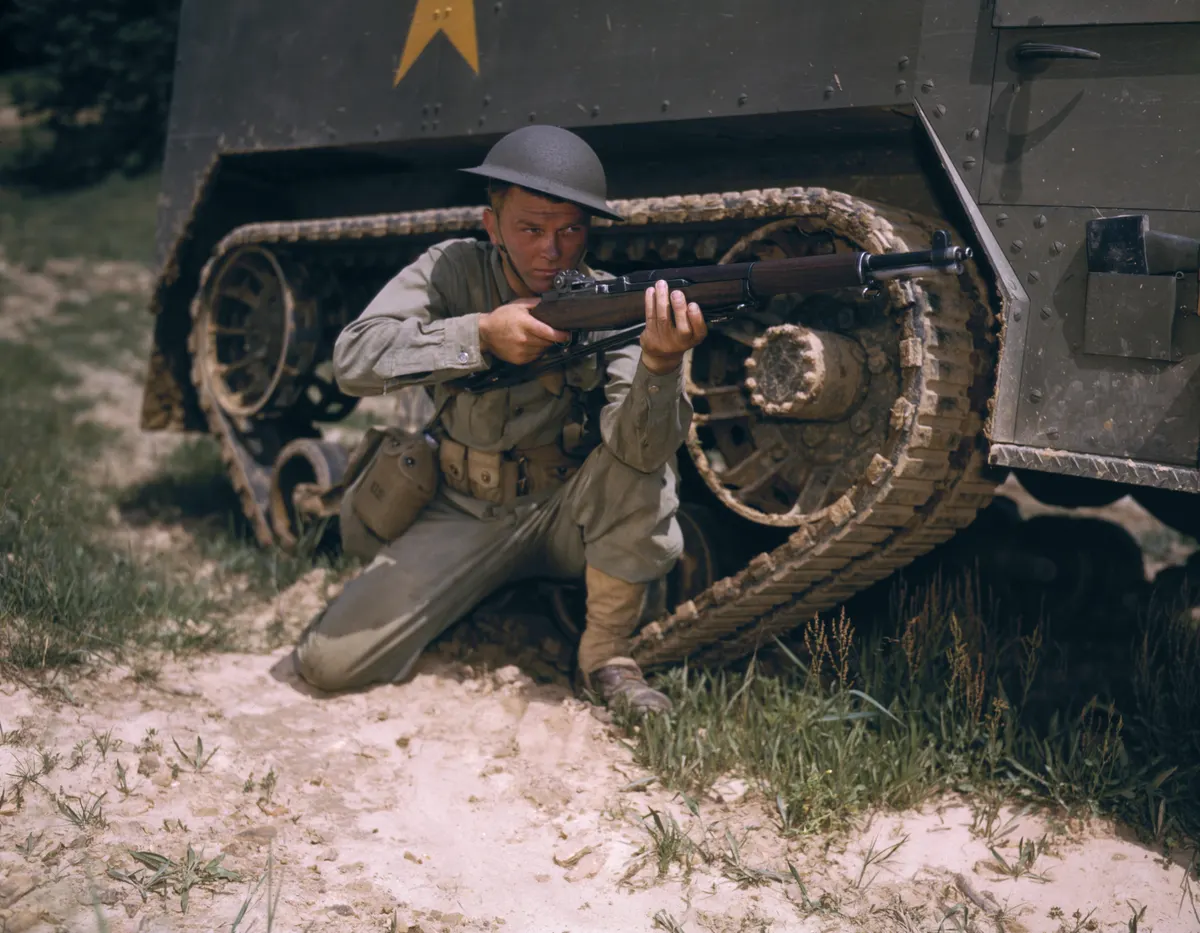
None of this reduces how directly the Type 4 rifle traces back to the Garand. Captured examples from the Philippines gave Japanese engineers a working blueprint, and the resulting rifle is best read as a wartime engineering response to an enemy weapon that outperformed anything in Japanese service, rather than as an independent design built from scratch. The cartridge, the internal magazine, the sights, and the stock construction are Japanese. The operating mechanism underneath is the Garand's.
That mix of a foreign action and Japanese-specific feed system, sights, and furniture is what makes the Type 4 rifle worth examining spec by spec rather than dismissing as a simple copy. The changes Japanese engineers made, and the ones they chose not to make, say as much about wartime Japan's industrial limits as they do about the rifle itself.
Trading the En-Bloc Clip for a Ten-Round Internal Magazine
The single biggest change Japanese engineers made to the M1 Garand's design was the feed system. The Garand loads its gas-operated action from an eight-round en-bloc clip that the shooter inserts as a single block and that ejects itself, with a distinctive metallic ping, once the last round fires. Japanese testers found that the en-bloc system would not feed 7.7×58mm Arisaka ammunition reliably once captured Garands were rechambered for it, because the case dimensions and rim geometry did not suit the Garand's clip-driven feed lips.1,3
- First Production Year1945
- Weight (Empty)4.097 kg
- Currently In ServiceNo
- Notable UsersImperial Japanese Navy
The fix was a 10-round fixed internal magazine, loaded from two five-round Arisaka Type 99 stripper clips pressed down through the top of the open action, the same way Japanese bolt-action rifles were loaded. This gave the Type 4 rifle two more rounds of on-board capacity than the Garand carried, though the loading method itself was slower and closer to a conventional bolt-action reload than the Garand's near-instant clip insertion.1 The magazine follower, feed lips, and floorplate were built new around the standard Japanese stripper clip rather than adapted from the Garand's clip latch, since the two feeding concepts have almost nothing mechanically in common.
- Cartridge7.7×58mm Arisaka
- Calibre7.7 mm
- Case Length58 mm
- Calibre Class7.7mm
- RimfireNo
- Caseless AmmunitionNo
Beyond the magazine, the Type 4 rifle wears its Japanese origin plainly. It uses a tangent-leaf rear sight in the Arisaka pattern instead of the Garand's aperture sight, Arisaka-style sling swivels mounted on the left side of the stock, finger grooves cut into the forend, and a two-piece wooden stock that is glued rather than through-bolted the way the Garand's is.3 The handguard has no ventilation cuts, unlike the Garand's, and every metal surface received a black paint finish rather than the Garand's blued steel.3 Surviving specimens show visibly rougher machining marks than a wartime American-made Garand, consistent with a program built under material shortages and without dedicated production tooling.3
- Action TypeGas-Operated
- Fire Modessemi-automatic
- Select FireNo
- Feed SystemInternal Magazine
- Magazine Capacity10
The Muzzle Velocity Puzzle
Sourcing on the Type 4 rifle's exact ballistics does not fully agree. One frequently cited figure puts muzzle velocity at 835 m/s (2,740 ft/s) from its 590mm barrel.4 That number sits noticeably above the standard 7.7×58mm Arisaka Type 99 ball load, which independent ammunition references place closer to 731 m/s (2,400 ft/s) fired from the longer 654mm barrel of the bolt-action Type 99 rifle.6 A shorter Garand-pattern barrel firing the same standard-pressure round would ordinarily be expected to produce a lower velocity than a longer one, not a substantially higher one, so the 835 m/s figure should be read with some caution rather than treated as settled. No wartime chronograph data for the Type 4 rifle specifically appears to survive in public sources, which leaves the discrepancy unresolved rather than explained.
- Muzzle Velocity840 m/s
- Barrel Length590 mm
- Sight Typetangent
- Optic RailNo
- Iron SightsYes
- Threaded BarrelNo
- Total Production125
- Production Start1944
- Production End1945
- Variants5
Prewar Japanese Semi-Automatic Rifle Trials
Japan's interest in semi-automatic rifles predates the Type 4 by more than a decade. In 1931 the Japanese Army asked designer Kijiro Nambu and two private firms, Nippon Special Steel and Tokyo Gas and Electric, to develop self-loading rifles alongside the Army's own Koishikawa Arsenal design.8 American designer John Pedersen visited Japan during this period and demonstrated his toggle-locked rifle, and Japanese observers reportedly believed at the time that Pedersen's action would become the standard the major Western militaries would adopt.8 Separately, Japan also evaluated the Czechoslovak ZH-29 rifle in the same decade, without adopting it either.1
None of these prewar programs reached production. Trials dragged on until 1937, when Japan's escalating war in China forced military production capacity toward existing bolt-action rifles, and the semi-automatic trials were shelved without a winner.8 It would take another captured foreign rifle, seven years later, to restart the idea.
Captured M1 Garands from Bataan
Japanese forces overran American positions in the Philippines in 1942, and the fall of Bataan in May of that year put working M1 Garand rifles into Japanese hands for the first time, along with additional stores found warehoused in Manila.2,3
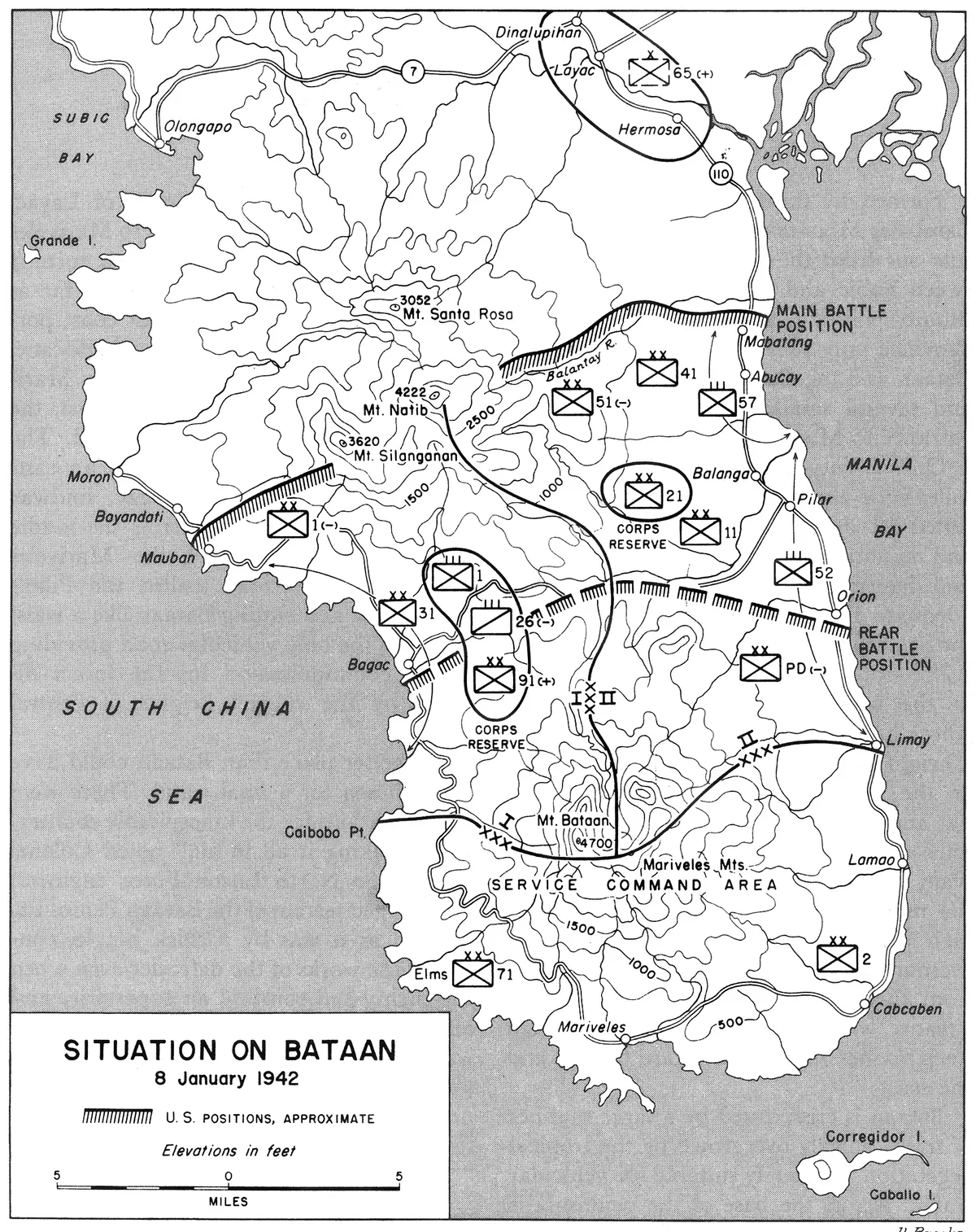
Some of these captured rifles were shipped back to Japan by the Navy for study.3 The M1 Garand's semi-automatic action was a genuine step ahead of anything in Japanese infantry service at the time, and IJN ordnance officers recognized it as such almost immediately, even though the Army had already walked away from its own prewar semi-automatic rifle efforts and showed little interest in restarting them.2
Two years passed before that recognition turned into an actual program. The Navy, not the Army, kept the idea alive, and it would take until 1944 for that interest to become a formal design effort.2,3
The Decision to Copy the Garand
Only in early 1944, with the war going badly and Japanese infantry firepower increasingly outmatched, did engineers rechamber 10 captured Garands to 7.7×58mm Arisaka as a test batch.1 Those trials confirmed the rifle could fire and cycle the Japanese cartridge, but also confirmed the en-bloc clip would not feed it reliably.1,3
That feeding failure was decisive. It ruled out the simpler option of rechambering captured Garands wholesale, and it meant Japanese engineers would have to redesign the feed system from the ground up rather than just swap the barrel and chamber.
The result was the fixed internal magazine and stripper-clip system described above. Formal design of a complete, Japanese-built copy began at the Yokosuka Naval Arsenal that same year.2,3
Reverse Engineering at Yokosuka
Engineers at Yokosuka went through five successive design iterations before settling on a production pattern, according to surviving development records.5 The earliest iterations experimented with novel Japanese-designed locking and stock-breakdown features rather than copying the Garand outright, but by the third iteration the locking mechanism itself had been replaced with the Garand's own proven rotating-bolt design, and later iterations dropped most of the remaining novel features in favor of tried-and-tested Garand equivalents.5
Testing exposed real problems that the arsenal never fully solved. Prototype rifles suffered parts breakage and feeding failures traced to inconsistent materials, tight gas-system tolerances, and the general shortage of skilled labor and machine tools that plagued Japanese industry by 1944 and 1945.5 The subcontracted assembly plant reportedly had no dedicated production machinery at all and was essentially hand-fitting rifles from arsenal-supplied parts, with none of its output passing final inspection before the war ended.5
That combination of shortages was not unique to the Type 4 rifle program. By 1944 and 1945, Allied submarine and bombing campaigns had cut deeply into Japan's supply of raw materials and skilled machinists, and every small-arms program still running in the country was competing for the same shrinking pool of tooling and trained labor.
Production Numbers That Do Not Agree, and the End at Surrender
By the time Japan surrendered in August and September 1945, sources describe anywhere from about 50 to roughly 125 completed Type 4 rifles, drawn from parts sets for 150 to 250 more that were never finished.1,2,3,5 Allied forces recovered around 20 rifles at Yokosuka after the surrender, taken for study or as war trophies, and an estimated 33 examples are thought to survive worldwide today in collections and museums.1,5
Mass production of the Type 4 rifle had been planned for later in 1945, and would likely have equipped at least some Japanese units had the war continued into an invasion of the home islands.2 Instead the surrender arrived first, and every partially completed rifle at Yokosuka and its subcontracted plant was left unfinished. In an ironic postscript, the United States itself later armed Japan's postwar Self-Defense Forces with genuine M1 Garand rifles, the same weapon Japan had spent 1944 and 1945 trying to copy.2
Surviving Type 4 rifles are now held by institutions including the National Firearms Museum in Fairfax County, Virginia, the Royal Armouries in Leeds, and the Cody Firearms Museum in Wyoming.1,5 Their rarity drives serious collector demand, with well-preserved examples reported to sell at auction for more than $50,000, including one sale around $65,000.5
Surviving development paperwork describes five successive design iterations of what became the Type 4 rifle rather than distinct named production variants.5 The first iterations retained some original Japanese engineering choices, including a two-piece stock held together partly by screws and small retaining nails rather than the Garand's simpler through-bolt arrangement. The locking mechanism was the first major Garand feature to be adopted outright, replacing an earlier novel design by the third iteration, and by the final iterations most of the remaining Japanese-original features had likewise given way to proven Garand equivalents, leaving a small number of genuinely distinct details as the only real difference between early and late guns.5 No separate carbine, sniper, or export variant of the Type 4 rifle is documented, a direct consequence of a program that never reached full production.

The Type 4 rifle never had an operator in the normal sense. The Imperial Japanese Navy was its sole intended user, developed to arm naval landing forces and base defense units with a weapon that could match the American rifles they increasingly faced, but the program never advanced past pre-production assembly before Japan's surrender.1,2 No unit is documented as having received or carried the Type 4 rifle operationally, and it saw no combat use in any theater of the war.1
The Type 4 rifle and the M1 Garand are about as close a copy-and-original pair as this leaf contains, which makes the comparison less about who built the better rifle and more about what each program was actually able to deliver. The M1 Garand was adopted in 1936, built by Springfield Armory and other American manufacturers at full industrial scale, and reached over 5.4 million rifles by the time production ended in 1957.1 The Type 4 rifle, designed eight years later from captured examples of that same Garand, never got past a few dozen to about 125 hand-assembled rifles before the war that created it also ended it.
| M1 Garand | Type 4 rifle | |
|---|---|---|
| Cartridge | .30-06 Springfield | 7.7×58mm Arisaka |
| Feed system | 8-round en-bloc clip | 10-round internal magazine, stripper-clip loaded |
| Weight (empty) | 4.31 kg | 4.10 kg |
| Total produced | approx. 5,468,772 | approx. 50-125 |
The magazine difference is the clearest illustration of how differently the two programs solved the same basic problem. The Garand's en-bloc clip was fast to load and self-ejecting, a genuine advance for its era, but it was also a piece of dedicated tooling that had to be manufactured to exact tolerances alongside the rifle itself. Japanese engineers, working from a captured example rather than original blueprints and without the industrial base to replicate that tooling reliably, fell back on the stripper-clip loading method already standard across Japanese bolt-action rifles. The result held two more rounds than the Garand but loaded more slowly, and it let the Type 4 rifle share ammunition-handling accessories with existing Japanese small arms rather than needing an entirely new supply item.
Scale is the other defining difference, and it says more about the two combatants' wartime industry than about either design. The M1 Garand's production numbers reflect a peacetime-adopted rifle backed by full American industrial mobilization for most of a decade. The Type 4 rifle's numbers reflect a crash wartime program, started late, dependent on captured foreign hardware as its starting point, and cut off by total defeat before it ever reached the scale its own designers intended. Judged purely as an engineering response, reverse-engineering a foreign semi-automatic rifle into domestic production within about a year and a half was not a small achievement for 1944 and 1945 Japan. Judged as a weapons program, it arrived too late to matter.


Is the Type 4 rifle the same weapon as the Type 5 rifle? Yes. Type 4 is the correct Japanese designation, taken from the imperial year 2604 (1944), but most English-language sources and collectors use Type 5, a name that appears to originate from a 1946 American intelligence report.1,2
How many Type 4 rifles were made? Sources disagree. Most estimates put completed, assembled rifles somewhere between 50 and 125, out of parts sets for 150 to 250 more that were never finished before Japan's surrender in 1945.1,3,5
Did the Type 4 rifle see combat? No. It never entered service with any Japanese Navy unit and saw no combat use before the war ended.1
What caliber is the Type 4 rifle? It is chambered for the 7.7×58mm Arisaka cartridge, the same round used in Japan's Type 99 bolt-action rifle, rather than the .30-06 Springfield cartridge of the M1 Garand it copies.1
How much is a Type 4 rifle worth today? Confirmed examples are extremely rare and sell to collectors well above $50,000 when they appear at auction, with one sale reported around $65,000.5 Given that rarity, buyers should treat any Type 4 rifle offered at an unusually low price with real skepticism.
- "Type 4 rifle", Wikipedia — en.wikipedia.org ↩
- "Type 4 Rifle — A Japanese Garand?", The Armory Life — thearmorylife.com ↩
- "RIA: Japanese Type 4 Garand Copy", Forgotten Weapons — forgottenweapons.com ↩
- "Arisaka Type 4 / Type 5 (Japanese Garand)", Military Factory — militaryfactory.com ↩
- "Type 4 rifle", Grokipedia — grokipedia.com ↩
- "7.7×58mm Arisaka", Wikipedia — en.wikipedia.org ↩
- "Type 5", Battlefield Wiki, Fandom — battlefield.fandom.com ↩
- "RIA: Japanese Trials Gas-Operated Pedersen Rifle", Forgotten Weapons — forgottenweapons.com ↩