

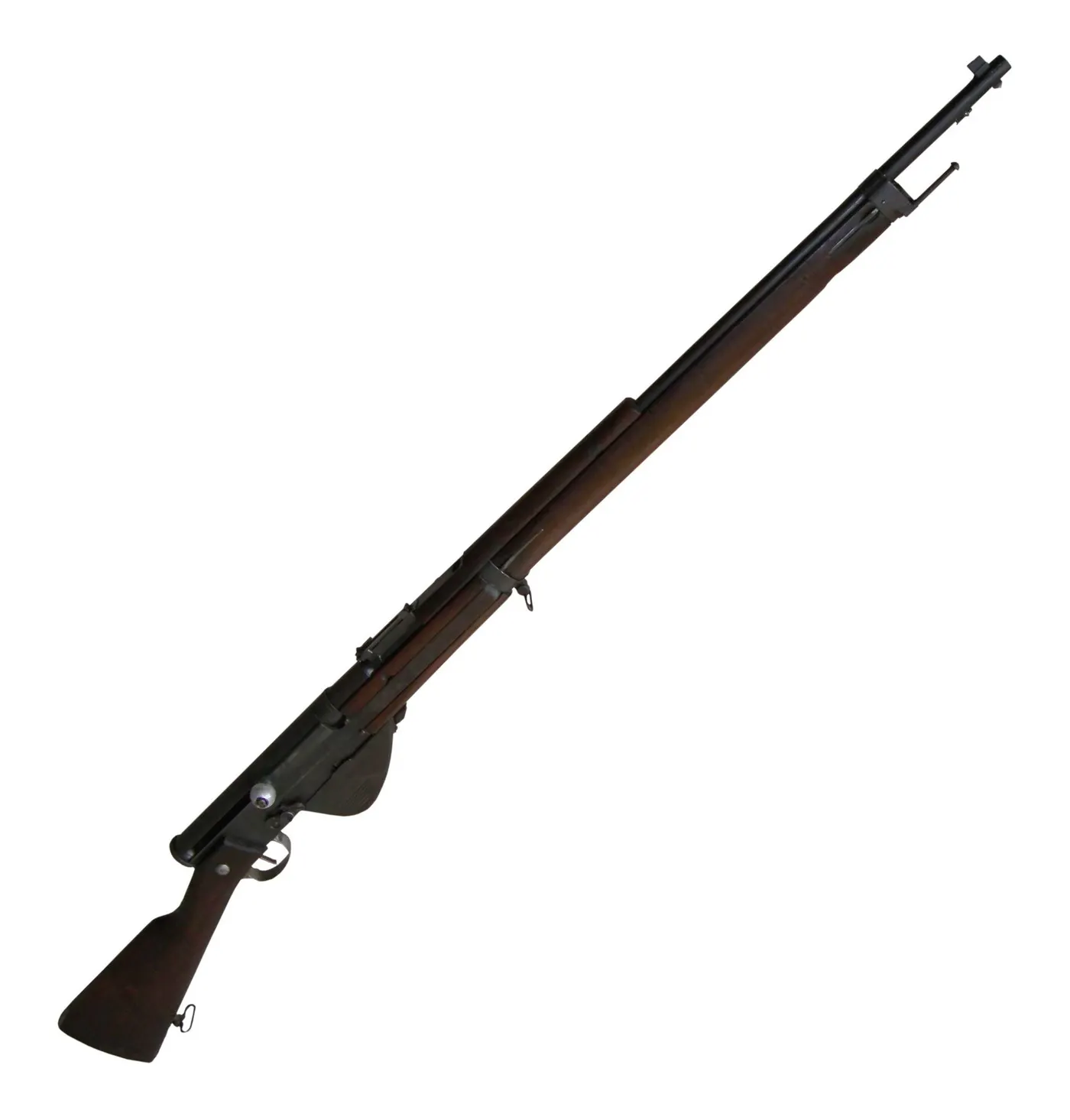

The Fusil Automatique Modèle 1917, known throughout its service life simply as the RSC 1917, was the semi-automatic rifle France issued to its front-line infantry during the final two years of the First World War1. Its name comes from the initials of the three men who designed it, Paul Ribeyrolles, Charles Sutter and Louis Chauchat, the same commission that had assembled a year earlier to rush the Chauchat machine rifle into production2. Ribeyrolles ran the Gladiator car and bicycle works outside Paris, Sutter was an army arms controller, and Chauchat was an artillery officer who had specialized in automatic weapons since 19112. Their rifle was gas-operated, fed from a 5-round internal magazine loaded through a hinged floor plate, and chambered for the standard 8×50mmR Lebel cartridge already stocked for every other French infantry rifle1.
- Genuine semi-automatic fire in trench warfare
- Reused cheap, familiar Lebel components
- Chambered common 8mm Lebel ammunition
- Selectively issued to skilled marksmen
- Small gas port fouled after roughly 100 rounds
- Open charging-handle slot let in mud and dirt
- Heavier and longer than the Lebel it supplemented
- Fragile feed clips caused stoppages
The RSC 1917 was not France's first attempt at a self-loading service rifle. That distinction belongs to the Meunier rifle, a mechanically more complex, long-recoil design chambered for a special 7mm round that the army adopted on paper in 1910 and then largely shelved once the cost of retooling ammunition production became clear3. When the Meunier program was formally cancelled in 1915, the same design effort that had just produced the Chauchat machine rifle picked up the semi-automatic rifle project, and did it far more cheaply by reusing the barrel, stock, handguard and trigger guard of the existing Lebel Model 1886 rifle3,4. That decision is why the RSC 1917 could be adopted in May 1916 and reach mass production at Manufacture d'Armes de Saint-Étienne by April 1917, a pace the Meunier program never came close to1.

France was, in fact, the only major belligerent that tried to put a mass-produced semi-automatic rifle into the hands of ordinary front-line riflemen during the First World War, ahead of the smaller-scale Russian and German semi-automatic efforts of the same years5. Roughly 86,000 RSC 1917 rifles left the Manufacture d'Armes de Saint-Étienne and Manufacture Nationale d'Armes de Tulle production lines before the armistice, though supply never came close to matching the size of the French Army1. Commanders issued it selectively, about 16 rifles per infantry company, reserved for marksmen and soldiers judged mechanically capable enough to keep the action clean under trench conditions1. It remains one of the earliest semi-automatic rifles fielded in real numbers by regular infantry rather than specialist units, a rank it holds alongside the Russian Fyodorov Automat of the same war.
The RSC 1917 used a long-stroke gas piston riding in a cylinder slung under the barrel, connected by a bent operating rod to a rotating bolt that locked into the receiver with radial lugs, a layout described by contemporary and modern sources alike as functionally close to the gas system the Americans would later use on the M1 Garand6. The gas port sat close to the muzzle and was deliberately narrow, and that narrowness was the rifle's central flaw. Propellant fouling built up quickly enough that armorers recommended cleaning the port after every 100 rounds fired, or the action would stop cycling and the rifle would need to be worked as a straight-pull manual repeater instead1,7.
- First Production Year1916
- Service Entry Year1916
- DesignerRibeyrolles, Sutter, Chauchat
- Weight (Empty)5.25 kg
- Currently In ServiceNo
- Notable UsersFrench Army, Nazi Germany (Volkssturm)
Loading was unusual for a French rifle of the period. Rather than top-feeding from an external clip like the Berthier rifle, the RSC 1917's magazine floor hinged downward, and a soldier pressed a proprietary 5-round clip up into the open action before swinging the floor plate shut again7. That clip was thin stamped metal, described by later collectors and gunsmiths as fairly flimsy, and a bent or dirty clip was a common source of feed failures in the field7.
- Cartridge8×50mmR Lebel
- Calibre8 mm
- Case Length50 mm
- Calibre Class8mm
- Bullet Weight12.8 g
- RimfireNo
- Caseless AmmunitionNo

The rifle weighed 5.25 kg empty and measured 1,331 mm overall with an 800 mm barrel, noticeably longer and heavier than the standard-issue Lebel infantrymen were used to carrying, which is exactly what troops complained about once the RSC 1917 reached the trenches in quantity during 19181. It retained a fixed bayonet lug, iron sights, and a wood-and-steel build typical of the period1.
- Action TypeGas-Operated
- Fire Modessemi-automatic
- Select FireNo
- Feed SystemInternal Magazine
- Magazine Capacity5
The charging handle rode in a long, open slot cut into the receiver so the bolt carrier could reach the gas piston, and that same slot was the rifle's second major weakness. It offered an easy path for mud and grit to reach the action, a problem the older, simpler bolt-action Lebel and Berthier rifles did not share7. Combined with the tight gas port, the RSC 1917 demanded a level of maintenance discipline that was difficult to sustain in a waterlogged, constantly-shelled trench line, which is the direct reason it was rationed to selected marksmen rather than issued army-wide1.
- Muzzle Velocity701 m/s
- Effective Range (point)1,000 m
- Barrel Length800 mm
- Sight Typeiron sights
- Optic RailNo
- Iron SightsYes
- Threaded BarrelNo
- Receiver Materialsteel
- Furniture Materialwood
- Folding / Collapsing StockNo
- Bullpup LayoutNo
- Ambidextrous ControlsNo
- Total Production86,000
- Production Start1916
- Production End1918
- Variants2
Development traces back to a French Army program that had been hunting for a semi-automatic replacement for the Lebel since 1900, testing roughly twenty competing designs across four state arsenals before settling on the Meunier rifle in 19106. The Meunier's own 7mm cartridge and higher production cost made it impossible to field quickly once war broke out in 1914, and only about 1,013 had been built by the time the program was abandoned in 1915, with roughly 300 of those sent to the front for trench trials3. That cancellation freed the personnel and budget that went straight into the RSC project under Paul Ribeyrolles, Charles Sutter and Louis Chauchat, the trio who had also just rushed the Chauchat light machine rifle into production for the 1916 offensives2,3.
The RSC 1917 was formally adopted in May 1916, reached mass production at Manufacture d'Armes de Saint-Étienne by April 1917, and was joined on the production line by Manufacture Nationale d'Armes de Tulle1. Wide distribution to infantry companies did not really begin until 1918, by which point roughly 86,000 rifles had been built and issue was still limited to about 16 per company1.
Soldiers who carried it recognized its advantage in a firefight, several aimed shots for every one a bolt-action rifleman could manage, but they also disliked its extra weight, its length, and how quickly it fouled if a man could not keep the gas port and magazine clean under fire1,7. Production ended in late November 1918, days after the armistice, with total output settling at roughly 86,000 rifles1.
By the time the improved RSC 1918 rifle was ready, the war was over, and France's rearmament path afterward did not stay with self-loading rifles at all. Budget pressure through the 1920s and 1930s, worsened by the cost of the Maginot Line, pushed the army back toward a cheaper, modernized bolt-action design chambered for a new rimless 7.5mm cartridge, which became the MAS-36 rifle adopted in 19369. France did not field a genuinely modern semi-automatic service rifle again until after the Second World War, when the MAS-49 rifle finally replaced the MAS-36 in front-line units9. Captured RSC rifles, meanwhile, did not disappear from service. German occupation authorities catalogued surviving stock as the Selbstlade-Gewehr 310(f) and issued them to rear-area Vichy security units and, late in the war, to Volkssturm home-guard formations scraped together from older men and boys1.
The RSC 1917's only real combat service came with the French Army on the World War I Western Front, where it was issued piecemeal to marksmen from 1917 through the armistice in November 19181.
The shortened RSC 1918 rifle arrived too late for that war, but a batch of the roughly 4,000 built saw real combat afterward in the Rif War of 1921 to 1926, where French colonial forces fought Abd el-Krim's Republic of the Rif in the mountains of northern Morocco4. Contemporary reports from that campaign judged the improved rifle a genuine success, crediting it with better accuracy and reliability than either the older RSC 1917 or the standard-issue Lebel4.
A smaller, involuntary chapter of RSC service came during the World War II occupation of France, when German forces requisitioned surviving RSC 1917 and RSC 1918 rifles from captured arsenal stock and reissued them as the Selbstlade-Gewehr 310(f)1. The reissued rifles armed rear-area garrison and militia units rather than front-line troops, reflecting wartime scarcity on the German side rather than any renewed confidence in the mechanism itself1.
Two distinct patterns of the rifle exist, separated by the lessons the French Army drew from a year of trench issue. The base RSC 1917 measured 1,331 mm overall with an 800 mm barrel and weighed 5.25 kg, used a proprietary bottom-loaded 5-round clip, and had no bolt hold-open feature6. The RSC 1918 cut the barrel to 580 mm and the overall length to 1,100 mm, added a last-round bolt hold-open, strengthened the magazine cover, reworked the gas system to resist fouling, and switched to standard Berthier-pattern clips so it could share ammunition-loading equipment with the rest of the army4,6.
| Spec | RSC 1917 | RSC 1918 |
|---|---|---|
| Overall length | 1,331 mm1 | 1,100 mm4 |
| Barrel length | 800 mm1 | 580 mm4 |
| Weight (empty) | 5.25 kg1 | 4.8 kg6 |
| Feed clip | Proprietary RSC clip7 | Standard Berthier clip4 |
Only around 4,000 RSC 1918 rifles were completed, most of them after the November 1918 armistice, because the design had been approved as the French Army's intended universal infantry rifle starting in 1919, a plan Germany's surrender made unnecessary at scale4.
Some later RSC 1917 rifles were retrofitted in the field or in depot with RSC 1918 parts. A number of both patterns were deliberately converted into non-automatic, straight-pull rifles by French armorers in the 1930s rather than being kept in front-line semi-automatic condition7.


The French Army was the RSC 1917's only significant operator, fielding it on the Western Front from 1917 and continuing to hold surplus stock in depots through the interwar years1. A residual number of RSC 1918 rifles equipped French colonial units in Morocco during the Rif War in the early 1920s4.
Late in the Second World War, captured RSC rifles of both patterns passed into German hands as the Selbstlade-Gewehr 310(f)1. They armed occupation garrison and Volkssturm units rather than any front-line German formation, which makes Germany a wartime user only in the narrow sense of having pressed captured stock into service1.
The RSC 1917's clearest point of comparison is the Meunier rifle it replaced on the drawing board, because the two rifles answer the exact same requirement with almost opposite engineering choices. The Meunier used long recoil operation, similar in principle to the contemporary Remington Model 8, and demanded a dedicated 7mm high-velocity cartridge that France would have had to build new production lines to supply3,6. The RSC 1917 traded that mechanical sophistication for cost and speed, running a gas piston action off the existing 8mm Lebel round and borrowing the Lebel's own barrel, stock and furniture3. The Meunier arguably had the more modern cartridge concept, but the RSC 1917 is the one that reached tens of thousands of French riflemen in the trenches, precisely because it was designed to be affordable rather than optimal3,1.
A useful contemporary comparison from outside France is Russia's Fyodorov Automat, fielded in small numbers on the Eastern Front at almost the same time. Both rifles represented a wartime power trying to push select-fire or semi-automatic capability down to ordinary infantry rather than reserving it for machine-gun crews, and both ran into the same wall after the war, cost and post-war army downsizing killed continued production of each design within a few years of the armistice5. The Fyodorov fired an intermediate rifle cartridge, unlike the RSC 1917's full-power 8mm Lebel round, which meant the Fyodorov could offer automatic fire in short bursts where the RSC 1917 could only cycle semi-automatically, one of the clearer role distinctions between two designs built for the same historical moment5.
Is the RSC 1917 still relevant to how people search for early semi-automatic rifles today? Mostly as a benchmark. Anyone comparing RSC 1917 vs Meunier rifle or asking how a WWI semi-automatic rifle worked is really asking why cost and reliability, not raw performance, decided which design France actually put into a soldier's hands.


What does RSC stand for on the Fusil Automatique Modèle 1917? RSC stands for Ribeyrolles, Sutter and Chauchat, the surnames of the three-man team that designed the rifle for the French Army2.
What caliber is the RSC 1917 chambered in? The RSC 1917 fires the standard French 8×50mmR Lebel cartridge, the same rimmed round used in the Lebel and Berthier bolt-action rifles it supplemented1.
Is the RSC 1917 still in service anywhere? No. It was withdrawn from French service after the interwar years and superseded by later designs, and today it survives only as a rare collector's rifle8.
Why didn't France keep building semi-automatic rifles after World War I? Budget constraints in the 1920s and 1930s, worsened by fortification spending on the Maginot Line, pushed France back to a cheaper modernized bolt-action rifle, the MAS-36, with a full semi-automatic replacement not arriving until the MAS-49 after World War II9.
How many RSC 1917 rifles were made? Roughly 86,000 were produced between 1916 and the armistice in November 1918, split between the Saint-Étienne and Tulle state arsenals1.
What is an RSC 1917 rifle worth today? Complete, functioning examples typically sell in the $7,000 to $15,000 range at auction, depending on originality, condition and provenance8.
- "Fusil Automatique Modèle 1917", Wikipedia — en.wikipedia.org ↩
- "Chauchat", Wikipedia — en.wikipedia.org ↩
- "Meunier rifle", Wikipedia — en.wikipedia.org ↩
- "France's Ultimate WW1 Selfloading Rifle: The RSC-1918", Forgotten Weapons — forgottenweapons.com ↩
- "Semiauto Rifles of WWI and Before", The Firearm Blog — thefirearmblog.com ↩
- "RSC M1917", Modern Firearms — modernfirearms.net ↩
- "French RSC Modele 1917 self-loading rifle", Forgotten Weapons — forgottenweapons.com ↩
- "RSC 1917 - Value & Selling Guide", WeBuyGuns — webuyguns.com ↩
- "MAS-36 rifle", Wikipedia — en.wikipedia.org ↩