

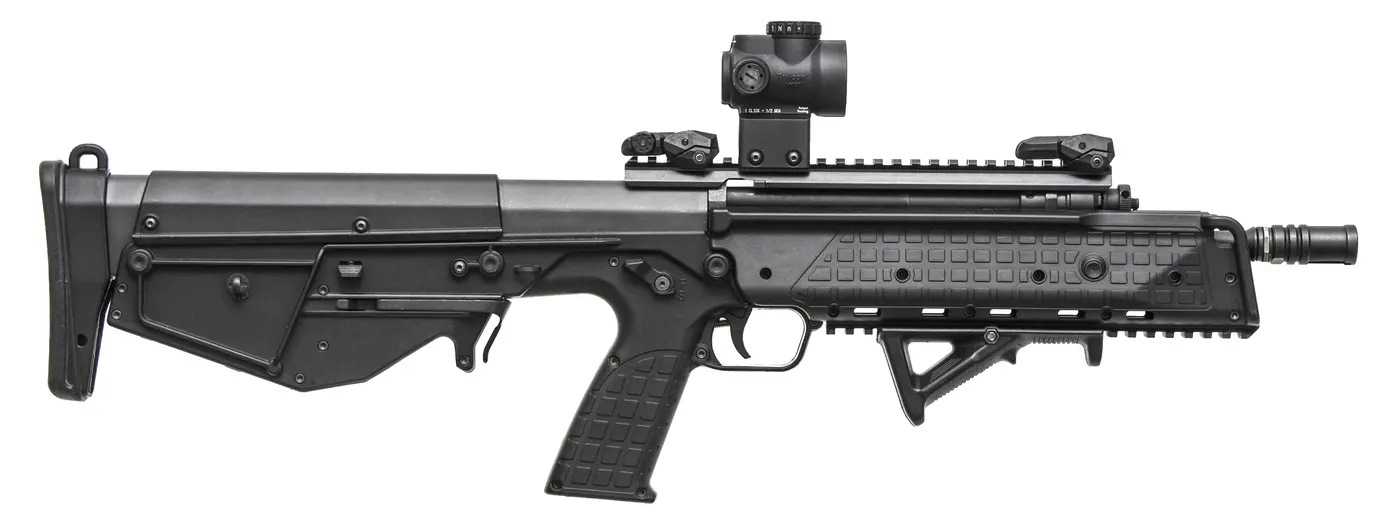

The Kel-Tec RDB is a semi-automatic bullpup rifle chambered in 5.56x45mm NATO, built by the Florida gunmaker Kel-Tec and first sold to civilian buyers in 2015.1 Its full designation, Rifle Downward-ejecting Bullpup, describes the feature that sets it apart from almost every other rifle in its class, a spent case does not fly out to the side of the receiver, it drops straight down through a chute behind the magazine well.1 That single mechanical choice is what the Kel-Tec RDB is known for, and it is the reason reviewers keep coming back to the rifle years after its release.
- Downward ejection works for left and right-handed shooters
- Compact overall length for a full-length 5.56 barrel
- Modular four-group construction eases maintenance
- Accepts standard AR-15/STANAG magazines
- Adjustable gas system tunes for ammunition or a suppressor
- Base model ships without iron sights
- Heavier, less crisp trigger pull than a direct AR-15 trigger
- Reported failures to extract if the gas system is poorly tuned
- Rear-mounted magazine release is easy to bump by accident
- No confirmed military or law-enforcement adoption
Designed by George Kellgren, the same engineer behind the Kel-Tec SUB-2000 carbine and the KSG shotgun, the RDB grew out of an earlier Kel-Tec bullpup, the Kel-Tec RFB.11 Where the RFB fired 7.62x51mm NATO and ejected forward over the handguard, the RDB was scaled down to the lighter, cheaper 5.56x45mm NATO cartridge and reworked around downward ejection instead.11,1 The result is a compact semi-automatic rifle that measures roughly the length of a submachine gun while keeping a full 17 inch barrel, a compromise that bullpup layouts exist specifically to solve.1

Unlike most rifles reviewed on this site, the RDB was never adopted by a state military or a police department, its market is almost entirely United States civilian shooters plus a handful of export markets that historically classified it as a sporting rifle.5 That civilian-only status does not make it a minor design, the bullpup-layout rifle sits alongside the IWI Tavor X95 and the Steyr AUG in most discussions of modern bullpup rifles, even though those two rivals carry decades of institutional service the Kel-Tec RDB never had.3
Kel-Tec priced the base RDB well under most competing bullpups, and that price gap, combined with the downward-ejection novelty, is a large part of why the Kel-Tec RDB still shows up in budget-bullpup buying guides more than a decade after launch.2 The remainder of this article covers how the mechanism actually works, where the design came from, the five production variants Kel-Tec has released, and how the RDB compares with the AUG and the Tavor X95 it is most often cross-shopped against.
The Short-Stroke Piston and the Downward-Ejection Cycle
The Kel-Tec RDB fires from a closed bolt using a short-stroke, gas-piston-operated system with a rotating bolt, the same broad family of operating system used on the AK-47 and the FN FAL rather than the direct-impingement system common on AR-15 pattern rifles.4,1 A regulator built into the barrel assembly lets the shooter dial the amount of gas tapped off to cycle the action, which is useful both for taming recoil with light loads and for running a suppressor without over-gassing the action.1
- First Production Year2015
- DesignerGeorge Kellgren
- Weight (Empty)3.04 kg
- Weight (Loaded)3.22 kg
- Currently In ServiceYes
The ejection cycle is the RDB's defining feature. Instead of throwing a spent case sideways through a port next to the shooter's face, the bolt drags the case rearward over the top of the magazine and drops it down a chute directly behind the magazine well.1 Kel-Tec fitted the bolt with dual ejectors specifically to keep that downward path reliable, and the company has demonstrated the rifle firing normally even held upside down, since gravity assists rather than fights the ejection path in that orientation.3 The practical benefit is that a right-handed shooter and a left-handed shooter can both fire the Kel-Tec RDB from either shoulder without brass striking their face, a problem that has dogged side-ejecting bullpups since the Steyr AUG popularized the layout in 1977.
- Cartridge5.56x45mm NATO
- Calibre5.56 mm
- Case Length45 mm
- Calibre Classintermediate
- RimfireNo
- Caseless AmmunitionNo
Four Modular Assembly Groups
Kellgren built the RDB around four separate assemblies held together with HK-style push pins, a Barrel Assembly Group (barrel, gas system, optics rail and handguard), a Receiver Assembly Group (the serialized steel receiver, buttpad and recoil buffer), a Bolt Assembly Group (bolt carrier, guide rod and recoil spring) and a Grip Assembly Group (trigger, hammer, magazine well and ejection port).1 That breakdown gives the Kel-Tec RDB a modular construction that is unusual among bullpups, most competing designs use one or two large receiver castings rather than four separately serviceable groups.1 In practice it means a barrel swap, a broken hammer spring or a damaged ejection chute can be repaired by replacing one assembly group rather than sending the whole rifle back to the factory.
- Action TypeGas-Operated
- Fire Modessemi-automatic
- Select FireNo
- Feed SystemDetachable Magazine
- Magazine Capacity30
- Trigger Typesingle-stage
A small aftermarket has grown up around that modularity. Third-party makers sell replacement buttpads, adjustable-length stock kits and enhanced triggers that bolt onto the Grip and Receiver Assembly Groups without any machining, a level of aftermarket support the more monolithic Steyr AUG and IWI Tavor X95 receivers do not accommodate as easily.12
- Barrel Length437 mm
- Rifling Twist1:7
- Sight Typeiron sights
- Optic RailYes
- Iron SightsNo
Ambidextrous Controls, Optic Rail and the Iron-Sight Gap
Every RDB control, the magazine release behind the pistol grip, the crossbolt-style safety and the reversible charging handle, was placed to work identically for left and right-handed shooters, and Kel-Tec markets the rifle as fully ambidextrous out of the box.2 A full-length Picatinny rail runs the top of the receiver for optics, but the base RDB-17 model ships without any iron sights at all, relying entirely on a mounted optic.1,4 That is worth stating plainly because it is a common point of confusion, only the RDB Survival variant includes flip-up iron sights as standard, and every other RDB model needs an aftermarket optic before it can be aimed.1
- Receiver Materialsteel
- Furniture Materialpolymer
- Folding / Collapsing StockNo
- Bullpup LayoutYes
- Ambidextrous ControlsYes
- Modularityhigh
The rifle feeds from a detachable magazine and accepts standard AR-15 and STANAG pattern magazines, though Kel-Tec ships most models with a 20-round magazine rather than the full 30-round magazine the platform is rated to accept.2,4 Reviewers have consistently flagged the trigger as the RDB's weakest control, a heavier and less crisp pull than a comparable AR-15 trigger, and several long-term owners report the trigger linkage wearing over a high round count.8 The rear-mounted magazine release has drawn similar criticism, it sits close enough to the shooter's support hand that gloved or large-handed shooters have reported bumping it loose by accident.8
- Production Start2015
- Variants5
George Kellgren, From Husqvarna to Kel-Tec
George Kellgren was born in Borås, Sweden, in 1943 and trained as a firearms designer at Husqvarna, the country's leading gunmaker at the time, before moving on to Sweden's Interdynamic AB.6 He relocated to the United States in 1979 and continued designing firearms for Intratec, where his best-known work was the compact TEC-9 pistol, and later for Grendel Inc.6 When Grendel closed in the mid-1990s under pressure from the 1994 Federal Assault Weapons Ban, Kellgren's machine shop, already producing Grendel's components, pivoted into building complete firearms under its own name, Kel-Tec CNC Industries, founded in 1991.6
Kellgren's Kel-Tec built a reputation on lightweight polymer pistols through the 1990s and 2000s before turning to rifles. The company's first bullpup, the Kel-Tec RFB, debuted at the 2007 SHOT Show chambered in 7.62x51mm NATO and used forward ejection, throwing spent cases out over the handguard rather than to the side.11 The RFB proved the underlying bullpup mechanism worked, but its full-power rifle cartridge and metric FAL magazines kept it heavier and pricier than Kel-Tec's usual compact designs.11
From the M43 Prototype to the 2015 RDB Launch
Kel-Tec first showed a 5.56mm bullpup derivative of the RFB concept at the 2014 SHOT Show under the internal name M43, a steel-and-wood-stocked prototype that never reached mass production.11 The production rifle that did reach the market, renamed the RDB for its new downward-ejection system, launched in 2015 as a lighter, cheaper alternative to the RFB built specifically around the 5.56x45mm NATO cartridge.11,1 Early marketing leaned hard on the idea of a bullpup done right, positioning the downward-ejection port as a direct fix for the side-ejection problem that had limited left-handed use of bullpups since the AUG.3
In 2019, the NRA recognized Kellgren with its Golden Bullseye Pioneer Award, honoring the cumulative body of designs that includes the RDB alongside the SUB-2000, the KSG shotgun and Kel-Tec's long run of compact polymer pistols.7 Kel-Tec has continued expanding the RDB family since the original 2015 launch, adding four further production variants without changing the core downward-ejection mechanism.2
The rifle remains in production in the United States and continues to sell through Kel-Tec's normal commercial dealer network, still marketed on the strength of its downward ejection and ambidextrous handling rather than any institutional contract.2
Kel-Tec has released five production configurations of the RDB since 2015, all sharing the same 5.56x45mm NATO chambering, a 1 in 7 inch twist barrel and the same downward-ejection action, differing mainly in barrel length, stock and furniture.2
The RDB-17, sometimes just called the RDB, is the original configuration with a 17.3 inch barrel, a fixed stock and a Zytel polymer handguard, and it remains the baseline against which every later variant is measured.2 The RDB-C swaps in a hunter-style pistol grip and a reshaped handguard, changes that were driven partly by state compliance rules and that also made the rifle legal to sell in several states where the standard RDB configuration is restricted.5
The RDB Survival, also sold as the RDB-S, cuts barrel length to roughly 16 inches, adds an adjustable length of pull and includes the flip-up iron sights the base RDB-17 lacks, aimed at buyers who want a packable rifle rather than a range gun.5,2 The RDB Defender keeps a similar 16 inch barrel but switches to an aluminum M-LOK handguard and a collapsible-length stock for a more tactical-carbine footprint, while the RDB Hunter goes the other direction with a longer 20.5 inch threaded barrel, a sling-swivel bipod stud and a reduced 10-round magazine to meet hunting regulations in states that cap magazine capacity for big-game rifles.2
Every RDB variant shares the same receiver architecture, magazine well and downward-ejection chute, so the differences between them are almost entirely external rather than mechanical, a buyer choosing between an RDB-17 and an RDB Defender is choosing a stock and handguard configuration, not a different action.2
Across the five variants, Kel-Tec has kept factory pricing within a narrow band, the base RDB-17 the least expensive and the RDB Defender's aluminum M-LOK handguard and collapsible stock the most expensive addition, reflecting the extra parts fitted rather than any change to the rifle's underlying gas-piston action.2
The clearest way to place the Kel-Tec RDB against its two most obvious rivals, the Steyr AUG and the IWI Tavor X95, is by asking who actually issued each rifle. The AUG became Austria's standard service rifle in 1978 and went on to arm the militaries of Australia, Ireland and several other states, while the Tavor X95 replaced the M16 and M4 as the Israel Defense Forces' standard infantry rifle in the 2010s.3 The Kel-Tec RDB has never been adopted by any military or police force, it exists purely as a commercial civilian rifle, and that gap in institutional testing and procurement is the real dividing line between it and its two rivals, not raw specifications.5
Where the Kel-Tec RDB does compete directly is on ejection handling and price. The Steyr AUG ejects to the right and cannot be fired left-handed without swapping the bolt and ejection port for a mirrored set, a limitation the RDB's downward-ejection chute avoids entirely.3 The IWI Tavor X95 solved the same left-handed problem differently, with a user-swappable ejection port that can be reconfigured for either shoulder, which works but still requires the shooter to commit to one side at a time rather than switching shoulders freely the way the RDB's downward path allows.3 Against both rivals, the Kel-Tec RDB undercuts on price by a wide margin, a large part of why it keeps appearing in budget bullpup comparisons even though neither the AUG nor the Tavor X95 was ever designed to compete on cost.2
The tradeoff is finish quality and testing depth. Military service on the scale the AUG and Tavor X95 have seen forces years of institutional reliability testing and field feedback that a rifle sold only to civilian buyers never receives, and reviewers consistently describe the Kel-Tec RDB's trigger and gas-system tuning as rougher than either rival's.8,3 For a buyer choosing a bullpup rifle, the practical question is not which design is objectively superior but whether ambidextrous handling at a lower price is worth trading against the AUG's and the Tavor X95's decades of combat-tested refinement.


Is the Kel-Tec RDB reliable? Owner and reviewer reports describe the Kel-Tec RDB as reliable once the adjustable gas system is correctly tuned for the ammunition in use, but note that an under-gassed or over-gassed setting can cause failures to extract or feed, a tuning step most AR-15 pattern rifles do not require.8
What caliber is the Kel-Tec RDB chambered in? Every production Kel-Tec RDB variant is chambered in 5.56x45mm NATO (interchangeable with .223 Remington) and uses a 1 in 7 inch rifling twist.2
How much does a Kel-Tec RDB cost? Kel-Tec's factory suggested retail prices for the RDB family run from roughly 800 US dollars for the base RDB-17 up to around 1,000 US dollars for the RDB Defender, well under most other production bullpup rifles on the American market.2
What is the difference between the Kel-Tec RDB and the RDB-S? The RDB-S, marketed as the RDB Survival, has a shorter roughly 16 inch barrel, an adjustable length of pull and factory flip-up iron sights, while the base RDB-17 has a longer 17.3 inch barrel, a fixed stock and no iron sights at all.5,2
Is the Kel-Tec RDB legal in Canada? No. Canada's government prohibited the Kel-Tec RDB, the RDB-C and the Kel-Tec RFB by regulation on December 5, 2024, reversing an earlier non-restricted classification the RCMP's Firearms Reference Table office had given the rifle after its 2015 launch.9,10
Is the Kel-Tec RDB used by any military or law enforcement agency? No confirmed military or law-enforcement adoption of the Kel-Tec RDB has been documented, it remains a civilian commercial rifle sold through Kel-Tec's normal dealer network in the United States.5
- "Kel-Tec RDB", Wikipedia — en.wikipedia.org ↩
- "RDB Bullpup Rifles w/ Smooth Trigger & Downward Ejection in 223/5.56", KelTec — keltecweapons.com ↩
- "Kel-Tec RDB: A Unique Bullpup Rifle Design", American Rifleman — americanrifleman.org ↩
- "Kel-Tec RDB (series) Semi-Automatic Bullpup Rifle", Military Factory — militaryfactory.com ↩
- "RDB vs RDB-S, Which is the better bullpup", Calibre Magazine — calibremag.ca ↩
- "George Kellgren", Wikipedia — en.wikipedia.org ↩
- "2019 NRA Golden Bullseye Pioneer, George Kellgren of Kel-Tec", Shooting Illustrated — shootingillustrated.com ↩
- "Is the Kel Tec RDB known for its reliability", The Gun Zone — thegunzone.com ↩
- "Regulations Amending the Regulations Prescribing Certain Firearms and Other Weapons, Components and Parts of Weapons, Accessories, Cartridge Magazines, Ammunition and Projectiles as Prohibited or Restricted, SOR/2024-248", Canada Gazette — gazette.gc.ca ↩
- "The Kel-Tec RDB Is Coming to Canada, and It's Non-Restricted", Calibre Magazine — calibremag.ca ↩
- "Kel-Tec RFB", Wikipedia — en.wikipedia.org ↩
- "KelTec RDB Adjustable Stock Kit", Haga Defense — hagadefense.com ↩