

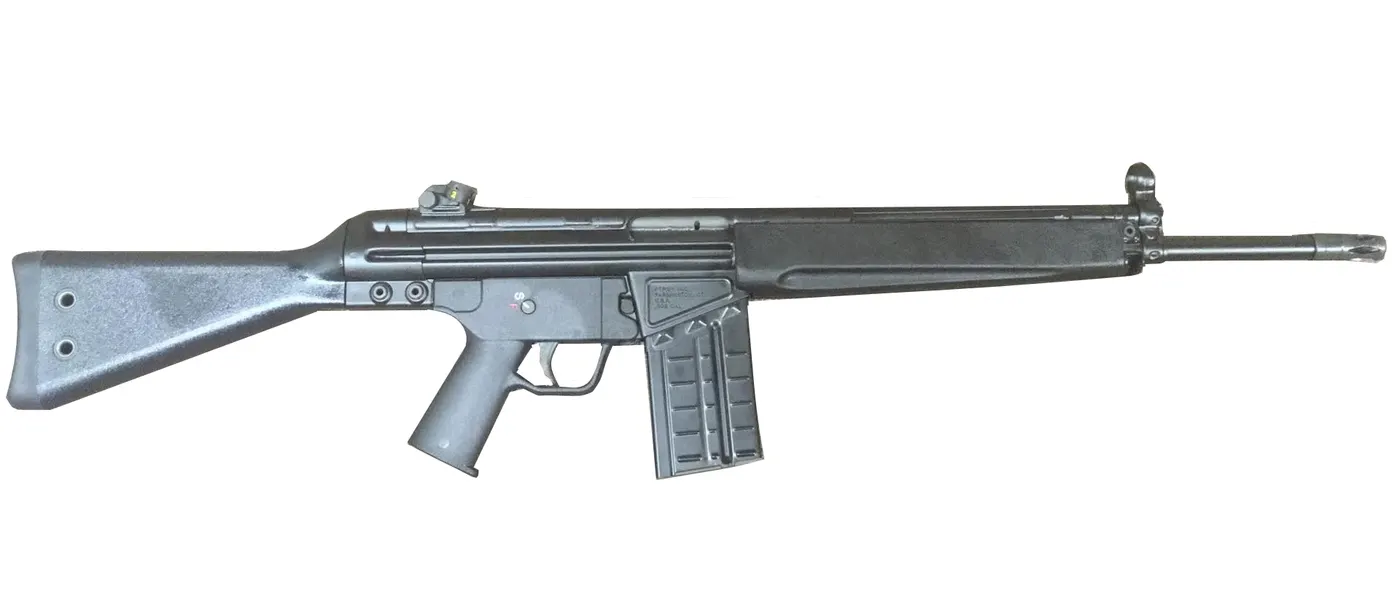

The PTR-91F is a semi-automatic-only 7.62x51mm NATO rifle built in Aynor, South Carolina by PTR Industries on genuine production tooling that once belonged to a Heckler & Koch-licensed factory in Portugal.1 It exists because Heckler & Koch itself stopped selling a semi-automatic G3 to American civilians. The HK91, the German company's own civilian-legal version of the Heckler & Koch G3, was cut off from importation by an executive order signed by President George H. W. Bush in 1989, and only about 48,817 HK91s had reached the United States before that door closed.2 The PTR-91F fills exactly the gap that decision left behind, using the same roller-delayed blowback mechanism, the same stamped-steel receiver pattern, and much of the same tooling as the rifle it replaces, but built entirely inside the United States rather than imported from Germany.
- genuine G3-pattern tooling, not a reverse-engineered copy
- full-power 7.62x51mm NATO cartridge in a semi-automatic-only civilian platform
- no import restrictions, fully domestic manufacture
- simple, gas-free roller-delayed action inherited from the G3
- lifetime warranty from a single accountable US manufacturer
- fit and finish reports are inconsistent between individual rifles
- long, heavy, and front-loaded compared to modern civilian sporting rifles
- limited aftermarket compared to AR-pattern rifles
- no state military or law-enforcement adoption of note
PTR Industries did not invent this rifle pattern. It bought the ability to build it. A Connecticut company called JLD Enterprises, founded in 1997 by Jose Luis Diaz, began building its first HK91-pattern rifles from surplus parts gathered from multiple countries, then secured a dedicated deal for original tooling, blueprints, and gauges from Fábrica de Braço de Prata, an H&K-licensed military arsenal in Portugal.3 The 91F designation marks the oldest and most recognizable configuration in the lineup, an 18 inch heavy target barrel paired with a fixed polymer stock, distinguishing it from the later GI, A3S, and MSG91 models covered in Variants below.4
Unlike the original G3, which armed dozens of national militaries across the Cold War, the PTR-91F was never adopted by a state armed force. It is sold into the American civilian and law enforcement market, one of a handful of semi-automatic rifles built specifically to keep a discontinued military design available to civilian shooters once its original manufacturer withdrew it.5 The rifle's detachable-magazine feed and 20-round box magazine are unchanged from the military G3 pattern, and its delayed-blowback action needs no gas port, piston, or adjustable regulator, a design trait it shares directly with its German ancestor.
PTR Industries positions the 91F as a base-model rifle in its current catalog, priced below the company's precision-oriented MSG91 and pistol-format PDW lines. When shoppers search for PTR-91F price or PTR-91F specifications, the 91F is usually the configuration those listings describe first, since it is the longest-running and most widely reviewed model PTR Industries sells.6
A Roller-Delayed Action Copied Almost Unchanged from the G3
The PTR-91F fires from the same two-piece bolt as the Heckler & Koch G3. A bolt head and bolt carrier are linked by two lateral rollers that brace against locking recesses in the barrel extension, and chamber pressure forces those rollers inward to drive the carrier rearward once pressure has already dropped, a delay mechanism that needs no gas system at all.8 PTR Industries builds this mechanism from the original G3 pattern of components, and the fluted chamber that floats the spent case off the chamber wall during extraction is carried over as well.9 There is essentially no design divergence here. The mechanical heart of the PTR-91F is the mechanical heart of the G3, produced on tooling directly connected to it rather than reverse-engineered from measurements of an existing rifle.
- First Production Year2002
- DesignerHeckler & Koch, CETME, PTR Industries, Inc.
- Weight (Empty)4.41 kg
- Currently In ServiceNo
- Notable UsersHaiti
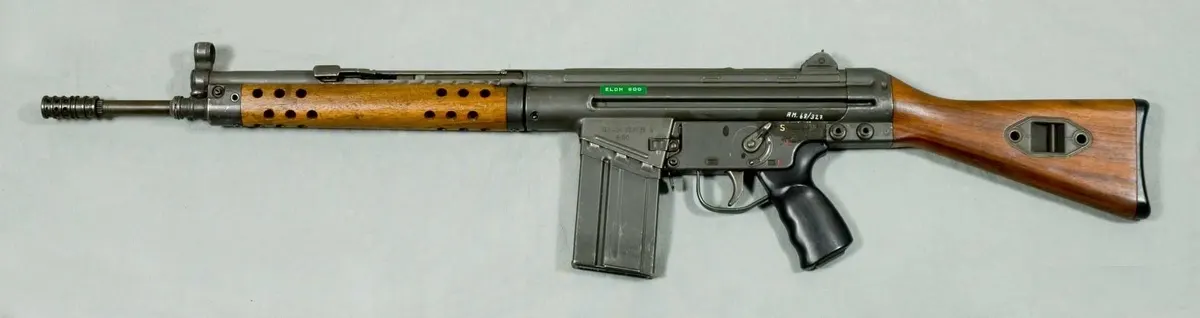
Where the PTR-91F departs from a standard military G3 is in furniture and barrel profile rather than mechanism. It ships with an 18 inch heavy target barrel, noticeably thicker than the G3's own 450mm service barrel, intended to reduce barrel whip and improve consistency for range shooting rather than combat portability.10 The fixed polymer stock gives an overall length of roughly 40.5 inches and an empty weight close to 9.75 pounds (about 4.4 kilograms), a few ounces heavier than a standard G3A3 due to that heavier barrel contour.11
- Cartridge.308 Winchester, 7.62x51mm NATO
- Calibre7.62 mm
- Case Length51 mm
- Calibre Class7.62mm
- RimfireNo
- Caseless AmmunitionNo
The rifle retains the G3's rotary drum rear sight, hooded front post, and the claw-type scope mount machined into the receiver, so period and modern optics built for the G3 pattern fit the PTR-91F without modification. Standard G3-pattern 20-round steel magazines interchange freely between a PTR-91F, a genuine HK91, and a military G3, a level of parts compatibility the tooling-sharing arrangement was specifically built to preserve.12
- Action TypeDelayed Blowback
- Fire Modessemi-automatic only
- Select FireNo
- Feed SystemDetachable Magazine
- Magazine Capacity20
Domestic Manufacture and Why It Avoids Import Law Entirely
Because the PTR-91F is manufactured start to finish in the United States rather than assembled from foreign parts, it sidesteps the law that shaped so much of the G3-pattern civilian market. 18 U.S.C. § 922(r) limits an assembled semi-automatic rifle to no more than ten imported parts from a list of twenty the ATF treats as countable, a rule written specifically to stop foreign-made receivers from being dressed up with a handful of domestic parts to dodge the 1989 import restrictions.13 Reported counts put a PTR-91 built rifle at around seven US-sourced parts on that list, well under the ceiling, and because PTR Industries actually forges, machines, and assembles the receiver, barrel, and stock domestically rather than importing a foreign receiver, the rifle is not legally an assembled import at all.14 That is a meaningfully different legal position from firearms built around genuine surplus HK91 parts kits, which do have to track their imported-parts count carefully to stay compliant.
- Muzzle Velocity790 m/s
- Effective Range (point)800 m
- Barrel Length457 mm
- Sight TypeRear: 4 positions rotary diopter, Front: hooded post
- Optic RailYes
- Iron SightsYes
- Furniture Materialplastic
- Folding / Collapsing StockNo
- Bullpup LayoutNo
- Ambidextrous ControlsYes
- Modularityclaw-mount optic rail (fixed stock, no bipod on base 91F)
- Production Start2002
The 1989 Import Ban That Created a Market Gap
The German-made HK91, Heckler & Koch's semi-automatic civilian counterpart to the G3, was prohibited from further importation into the United States by executive order in 1989, part of a broader crackdown on imported semi-automatic rifles under the sporting-purposes test in federal gun law.16

Heckler & Koch responded by discontinuing the HK91 rather than continuing to sell a version reworked to qualify as a sporting rifle, a path some rivals pursued instead. The company's own SR9, a modified HK91-series rifle with its flash suppressor, bayonet lug, and pistol grip removed, was built specifically to try to satisfy that sporting-purposes test, but it never replaced the HK91 as a mainstream product.17
Roughly 48,817 HK91s had entered the country before the ban, and once that supply stopped, no new German-made semi-automatic G3-pattern rifles were coming into the United States at all.18 That fixed, shrinking supply is what turned original HK91s into collector pieces commanding several thousand dollars each in later years, and it is exactly the gap an American manufacturer building the same rifle domestically could fill without touching import law at all.19
JLD Enterprises Buys the Tooling
That gap is what Jose Luis Diaz set out to fill. In 1997 he founded JLD Enterprises in Farmington, Connecticut, and the company's first HK91-pattern clone rifles were assembled largely from surplus parts gathered from multiple countries.20 JLD then negotiated a dedicated deal for original production tooling, blueprints, gauges, and a large stock of surplus parts from Fábrica de Braço de Prata, the Portuguese arsenal that had built licensed Heckler & Koch G3 rifles for decades, giving JLD the ability to build rifles on the same equipment that had produced genuine G3s.21
JLD began producing rifles under the PTR-91 name in 2002, initially built to comply with the 1994 federal assault weapons ban, meaning no threaded barrel, no bayonet lug, no adjustable stock, and no magazine holding more rounds than the ban's capacity limit.22
The earliest PTR-91F configuration, with its fixed stock and heavy target barrel, dates to this compliance-driven period. When the federal ban expired in 2004, JLD and its successor were free to reintroduce more of the original military rifle's features across the wider product line.23
PTR Industries Becomes an Independent Manufacturer
In 2005, the major assets of JLD Enterprises were purchased by a newly formed company, PTR-91 Inc, with Diaz staying on as a partner until he left in late 2010.25 For its first several years the company's business model still leaned on importing surplus HK91-pattern parts kits and assembling them domestically rather than machining new parts in-house.
That changed after Diaz's departure. New management shifted the company toward genuine in-house manufacture, adding significant machining and fabrication capability in 2011 and 2012 rather than continuing to rely on imported components.26

In 2014 the company relocated to Aynor, South Carolina and formally incorporated as PTR Industries, Inc, the name and location it still operates under today.27
That move from parts-kit assembly to true manufacturing matters for the PTR-91F specifically, because it changed what building the same rifle actually meant. Early production PTR-91F rifles built by JLD leaned more heavily on genuine surplus H&K components pulled from the Portuguese tooling stock, while later PTR Industries production of the same model is built from parts machined in South Carolina to the original tooling's specifications rather than assembled from old parts bins.28
The 91F sits at one end of a fairly wide PTR-91 product family, all sharing the same roller-delayed action and 7.62x51mm NATO chambering but differing in furniture, barrel profile, and finish. The PTR-91 GI, introduced in 2011, deliberately returns to Cold War-era G3 military styling, with a fixed A2-pattern buttstock and a narrower handguard closer to a genuine issue rifle than the 91F's heavier target profile.29 The PTR-91 GIR and 91FR variants are essentially the GI and 91F configurations finished in a corrosion-resistant nitride coating rather than the standard parkerized finish.30 The PTR-A3S uses a fully collapsible A3-pattern paratrooper stock and a polymer M-LOK handguard, aimed at buyers who want an adjustable length of pull that the fixed-stock 91F does not offer.31
At the precision end, the PTR-MSG91 pairs an 18 inch fluted heavy barrel with a bipod, a rail system, and an adjustable stock, effectively PTR Industries' own reading of the military G3SG/1 designated marksman configuration.32 A pistol-format line, the PTR-91 PDW/PDWR, shortens the barrel to 8.5 inches with a welded scope mount and no shoulder stock at all, regulated in the United States as a pistol rather than a rifle.33
Since 2010 the company has also sold a scaled-down PTR-32 series chambered in 7.62x39mm, sharing the same roller-delayed mechanism and furniture options as the 91F but built on a shorter action for the smaller cartridge, aimed at buyers who want the G3-pattern trigger group and controls in a lighter, less expensive package.34
None of these later variants replaces the 91F. It remains in the current catalog as the company's baseline heavy-barrel target configuration, the model most directly descended from the earliest JLD-era production.
Parts compatibility runs across the whole family, so a magazine, sight, or handguard bought for a PTR-32 or a PTR-A3S will generally not fit the 91F's 7.62x51mm NATO receiver, but accessories built for other 91-series rifles usually do.


The PTR-91F Against a Genuine Surplus-Parts HK91 Clone
The PTR-91F's most direct rival is another American G3-pattern civilian rifle, most notably Century International Arms' C91 line, which is assembled from genuine Heckler & Koch surplus parts kits rather than newly machined components.35 In theory the two should be close to identical, since both trace back to the same G3 tooling and dimensions. In practice, enthusiast and collector accounts describe the comparison as close but not settled. Early PTR and C91 rifles built from the same surplus parts stock are often described as essentially indistinguishable in fit, finish, and reliability, while more recent PTR Industries production, built from freshly machined parts rather than old surplus stock, is generally reported to have a cleaner finish, at some cost to the built-from-real-HK-parts claim that appeals to some collectors.36
| PTR-91F | Heckler & Koch G3 | |
|---|---|---|
| Action | Roller-delayed blowback | Roller-delayed blowback |
| Fire control | Semi-automatic only | Select-fire |
| Receiver | Stamped steel, US-made | Stamped steel |
| Barrel | 18 in heavy target profile37 | 450mm (17.7 in) service profile38 |
| Adoption | US civilian and law enforcement only | 80+ national militaries |
Quality control is the recurring theme in that comparison rather than the mechanism itself. Multiple gun-shop and forum accounts describe individual PTR rifles arriving with fit or function problems serious enough to need warranty work, a complaint rarely leveled at the tightly toleranced military-contract G3 production lines that supplied dozens of armed forces for decades.39 That gap says more about civilian small-batch manufacturing consistency than about the underlying roller-delayed design, which performs identically in both rifles when correctly assembled.
The other real difference is legal status rather than performance. The G3 was built to arm state militaries and was exported, licensed, and adopted by more countries than almost any other Cold War rifle. The PTR-91F was built specifically because that route closed for American civilians in 1989, and it exists entirely inside the domestic semi-automatic civilian market the G3 itself was never sold into.


How does the PTR-91F work? The PTR-91F fires from a roller-delayed blowback action, the same mechanism used in the Heckler & Koch G3. A two-piece bolt braced by lateral rollers delays extraction just long enough for chamber pressure to drop, with no gas port or piston involved anywhere in the cycle.40
What are the PTR-91F's specifications? The PTR-91F fires 7.62x51mm NATO/.308 Winchester from a 20-round detachable box magazine, has an 18 inch heavy target barrel, a fixed polymer stock, and weighs approximately 9.75 pounds (4.4 kilograms) unloaded with an overall length near 40.5 inches.41
Is the PTR-91F still in production? Yes. PTR Industries continues to manufacture the 91F alongside its wider G3-pattern rifle lineup at its Aynor, South Carolina facility.42
How does the PTR-91F compare to a real HK91? Both use the identical roller-delayed blowback mechanism and were built on related or identical tooling, since the PTR-91F descends directly from Portuguese-made Heckler & Koch G3 production equipment. Fit and finish vary more between individual PTR rifles than between genuine HK-made rifles, according to collector and gunsmith accounts, though the core action performs the same way in both.43
Why is there no imported Heckler & Koch semi-automatic G3 rifle anymore? A 1989 executive order barred further importation of the German-made HK91 into the United States under the federal sporting-purposes test, and Heckler & Koch chose to discontinue that model rather than redesign it to qualify, leaving the American market to companies like PTR Industries that build the pattern domestically instead.44
- "PTR rifle", Wikipedia — en.wikipedia.org ↩
- "Sell My Heckler and Koch HK91 for How Much? (2026 Value Update)", CashForArms — cashforarms.com ↩
- "What is the history of PTR Industries and the HK91?", Ronin's Grips — blog.roninsgrips.com ↩
- "PTR-91F For Sale - Price and Used Value", Blue Book of Gun Values — bluebookofgunvalues.com ↩
- "What military uses PTR 91?", The Gun Zone — thegunzone.com ↩
- "PTR-91 Review: G3/HK-91 Legacy Rifle", Gun University — gununiversity.com ↩
- "PTR rifle", Wikipedia — en.wikipedia.org ↩
- "Roller-delayed blowback", Wikipedia — en.wikipedia.org ↩
- "PTR-91 Review: G3/HK-91 Legacy Rifle", Gun University — gununiversity.com ↩
- "PTR-91F For Sale - Price and Used Value", Blue Book of Gun Values — bluebookofgunvalues.com ↩
- "PTR-91F For Sale - Price and Used Value", Blue Book of Gun Values — bluebookofgunvalues.com ↩
- "HK91 vs PTR91 GI", HKPRO Forums — hkpro.com ↩
- "922r Compliance Explained: Rules for Imported Firearms", Lynx Defense — lynxdefense.com ↩
- "PTR-91 / 922r compliance", HKPRO Forums — hkpro.com ↩
- "922r Compliance Explained: Rules for Imported Firearms", Lynx Defense — lynxdefense.com ↩
- "An Official Journal Of The NRA — A Look Back at the Heckler & Koch G3 Rifle", American Rifleman — americanrifleman.org ↩
- "Heckler & Koch SR9", Wikipedia — en.wikipedia.org ↩
- "Sell My Heckler and Koch HK91 for How Much? (2026 Value Update)", CashForArms — cashforarms.com ↩
- "Sell My Heckler and Koch HK91 for How Much? (2026 Value Update)", CashForArms — cashforarms.com ↩
- "What is the history of PTR Industries and the HK91?", Ronin's Grips — blog.roninsgrips.com ↩
- "What is the history of PTR Industries and the HK91?", Ronin's Grips — blog.roninsgrips.com ↩
- "PTR rifle", Wikipedia — en.wikipedia.org ↩
- "PTR rifle", Wikipedia — en.wikipedia.org ↩
- "What is the history of PTR Industries and the HK91?", Ronin's Grips — blog.roninsgrips.com ↩
- "JLD PTR History?", HKPRO Forums — hkpro.com ↩
- "About PTR", PTR Industries — ptr-us.com ↩
- "About PTR", PTR Industries — ptr-us.com ↩
- "PTR 91 Quality/Durability/Reliability in 2020", HKPRO Forums — hkpro.com ↩
- "PTR rifle", Wikipedia — en.wikipedia.org ↩
- "PTR-91FR For Sale - Price and Used Value", Blue Book of Gun Values — bluebookofgunvalues.com ↩
- "PTR 91 PTR-A3S Semi Auto Rifle", Fin Feather Fur Outfitters — finfeatherfur.com ↩
- "PTR rifle", Wikipedia — en.wikipedia.org ↩
- "PTR 91 PDWR .308 WIN PISTOL", Classic Firearms — classicfirearms.com ↩
- "PTR rifle", Wikipedia — en.wikipedia.org ↩
- "PTR-91 vs HK 91", Glock Talk Forums — glocktalk.com ↩
- "PTR 91 Quality/Durability/Reliability in 2020", HKPRO Forums — hkpro.com ↩
- "PTR-91F For Sale - Price and Used Value", Blue Book of Gun Values — bluebookofgunvalues.com ↩
- "Heckler & Koch G3", Modern Firearms — modernfirearms.net ↩
- "PTR-91 vs HK 91", Glock Talk Forums — glocktalk.com ↩
- "Roller-delayed blowback", Wikipedia — en.wikipedia.org ↩
- "PTR-91F For Sale - Price and Used Value", Blue Book of Gun Values — bluebookofgunvalues.com ↩
- "About PTR", PTR Industries — ptr-us.com ↩
- "PTR 91 Quality/Durability/Reliability in 2020", HKPRO Forums — hkpro.com ↩
- "An Official Journal Of The NRA — A Look Back at the Heckler & Koch G3 Rifle", American Rifleman — americanrifleman.org ↩