

A bullpup is a rifle configuration where the action and magazine sit behind the trigger group, inside or behind the pistol grip and stock, rather than forward of the trigger as on a conventional rifle. Relocating the receiver rearward lets a bullpup carry a full-length barrel while trimming several inches off overall length. The layout appears across the battle rifles, DMR and semi-automatic rifles categories as a simple yes or no capability, not one option among several rival actions.
A conventional rifle keeps its action between the shooter's two hands, balancing the weapon's weight but forcing the stock to extend behind it to reach the shoulder. A bullpup collapses that length by using the stock as the action housing instead. The trigger no longer acts directly on the sear, a bar or rod carries the pull backward through the stock, and the chamber and ejection port end up close to the shooter's cheek.1,2
01The Thorneycroft Carbine and Britain's Long Bullpup Detour
The first credited bullpup is the Thorneycroft carbine, patented in 1901 by Scottish engineer James Baird Thorneycroft after Second Boer War complaints that Britain's infantry rifle was too long for mounted troops. It moved a bolt-action .303 British rifle's magazine behind the trigger, producing a carbine roughly 7.5 inches shorter and 10 percent lighter than the Lee-Enfield it was meant to replace, though the British Army rejected it for a single universal short rifle instead.3,4
United Kingdom engineers revisited the idea after World War II with the EM-2, adopted in 1951 before NATO cartridge standardization forced a reversal. The EM-2 is often called the ancestor of the SA80, the Steyr AUG and the FAMAS, a claim that does not hold up since the SA80 actually descends from the AR-18 pattern rifle.5 The AUG itself, developed from 1970 by Karl Wagner at Steyr in Austria, was adopted as the Sturmgewehr 77 in 1977. Steyr credits its fast acceptance to how easily it was learned, a claim worth treating cautiously.6
02How the Trigger Bar and Ejection Port Actually Work
Mechanically, a bullpup's core move is simple. The bolt and magazine move behind the trigger, into the space a conventional stock leaves empty, so the stock serves as both shoulder rest and receiver housing.7 Because the trigger now sits forward of the sear, nearly every bullpup needs a mechanical linkage running back through the stock, the reason bullpup trigger pulls tend to feel heavier than a conventional rifle's direct-acting trigger.1
The same rearward shift puts the ejection port close to the shooter's cheek, a particular hazard for left-handed shooters who share that side with the case and the muzzle blast.8
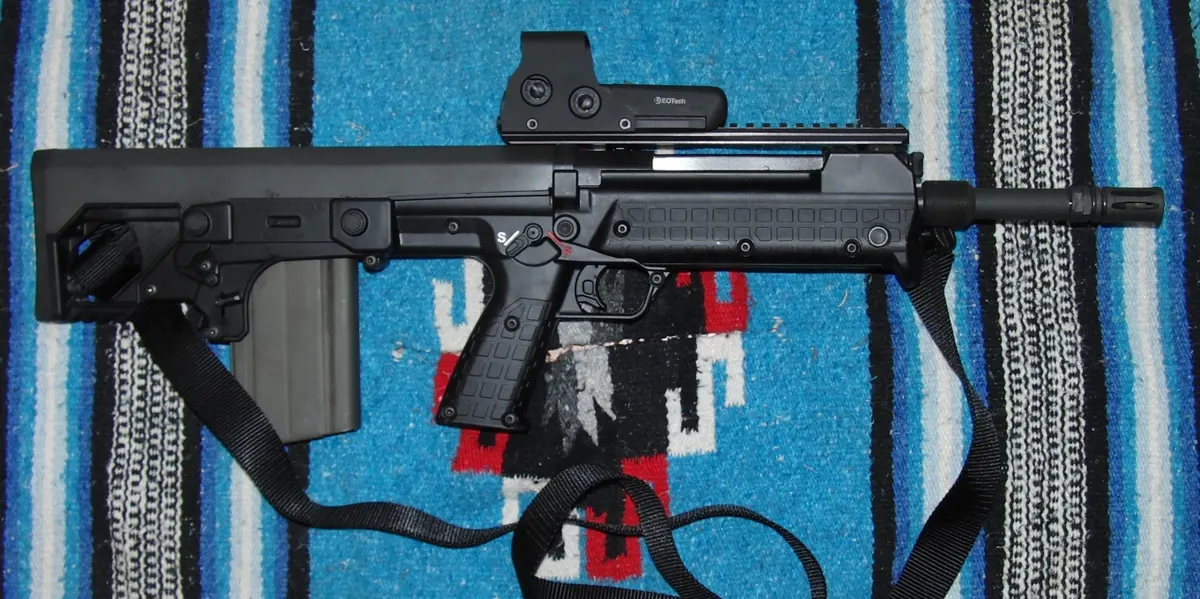
The Kel-Tec RFB, built by Kel-Tec in the United States, routes spent brass forward through a chute over the barrel and out the gas block instead of sideways, though brass can build up there and jam the action.9
The IWI Tavor 7, built by Israel Weapon Industries in Israel, takes a more conventional route, pairing an ambidextrous charging handle with a case deflector and a left-side ejection port that can be blocked off entirely for a left-handed shooter.8
01From Austrian Conscripts to a Chinese Marksman Rifle
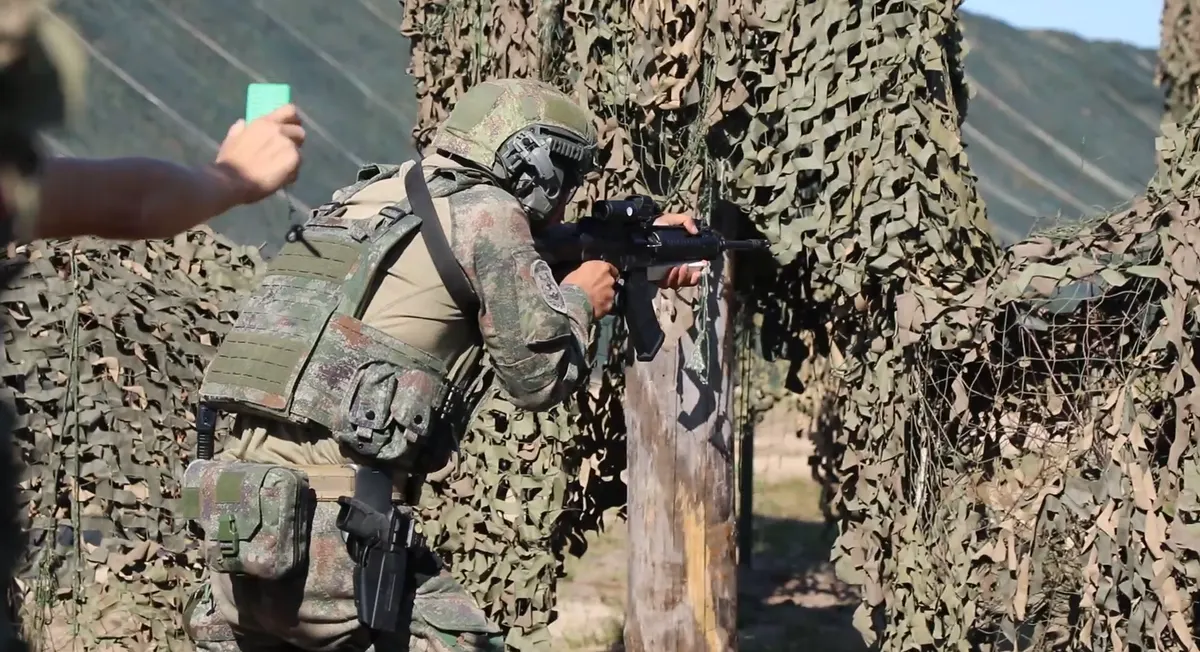
Once the AUG proved the layout viable for ordinary infantry use, other countries built their own versions. The People's Republic of China fielded its QBZ-95 in 1995, built by Norinco, grouped with the SA80, FAMAS and AUG as fellow bullpups. The related QBU-88, adopted in the late 1980s for a proprietary 5.8x42mm round, is a gas-operated bullpup built as a designated marksman rifle within the DMR category.10,11
The Desert Tech MDR pushes the bullpup layout further still. Ambidextrous with a quick barrel swap between .308 Winchester and .223 Wylde, it earned a trigger rated among the crispest of any bullpup and roughly 1 MOA accuracy at 100 yards, though its recoil tested no softer than a comparable conventional rifle.12
The American Model 45A, built in the Philippines in 1945, paired a bullpup rifle and light machine gun hybrid with magazines from the M1918 Browning automatic rifle, developed independently of Britain's postwar programs and never leaving prototype stage.13
Australia pursued its own bullpup for jungle warfare, the KAL1 General Purpose Infantry Rifle, after complaints the standard L1A1 SLR was too heavy for the terrain. It never entered service, and Australia adopted the AUG-derived F88 Austeyr in 1989 instead.14
Britain's own EM-4 rifle, nicknamed the Burney rifle, illustrates how many early bullpup attempts failed quietly before the AUG made the layout commercially viable. Trialled in 1946 and 1947, it was abandoned by 1948.15
01Notes and Sources
- "What's Killing the Bullpup (and How to Cure It)", The Firearm Blog — thefirearmblog.com ↩
- "Do Bullpups Have Better Balance? A Different Perspective", The Firearm Blog — thefirearmblog.com ↩
- "Thorneycroft, A Victorian Bullpup Rifle with Volley Sights", Forgotten Weapons — forgottenweapons.com ↩
- "A STEAMPUNK Bullpup? It's the Thorneycroft Carbine, Old Chap!", The Firearm Blog — thefirearmblog.com ↩
- "British EM-2, The Best Cold War Battle Rifle that Never Was", Forgotten Weapons — forgottenweapons.com ↩
- "The Illustrious History of the AUG", Steyr Arms USA — steyr-arms.us ↩
- "Bullpup history, part 1", Modern Firearms — modernfirearms.net ↩
- "The new IWI Tavor 7 in .308 Win, official details", The Firearm Blog — thefirearmblog.com ↩
- "RFB Rifle", KelTec — keltecweapons.com ↩
- "Type 95 / QBZ-95 assault rifle", Modern Firearms — modernfirearms.net ↩
- "QBU-88", Modern Firearms — modernfirearms.net ↩
- "[Review] Desert Tech MDR. Finally.", The Firearm Blog — thefirearmblog.com ↩
- "US Model 45A", Forgotten Weapons — forgottenweapons.com ↩
- "KAL1 General Purpose Infantry Rifle", Wikipedia — en.wikipedia.org/wiki/KAL1_General_Purpose_Infantry_Rifle ↩
- "EM-4 rifle", Wikipedia — en.wikipedia.org/wiki/EM-4_rifle ↩


