

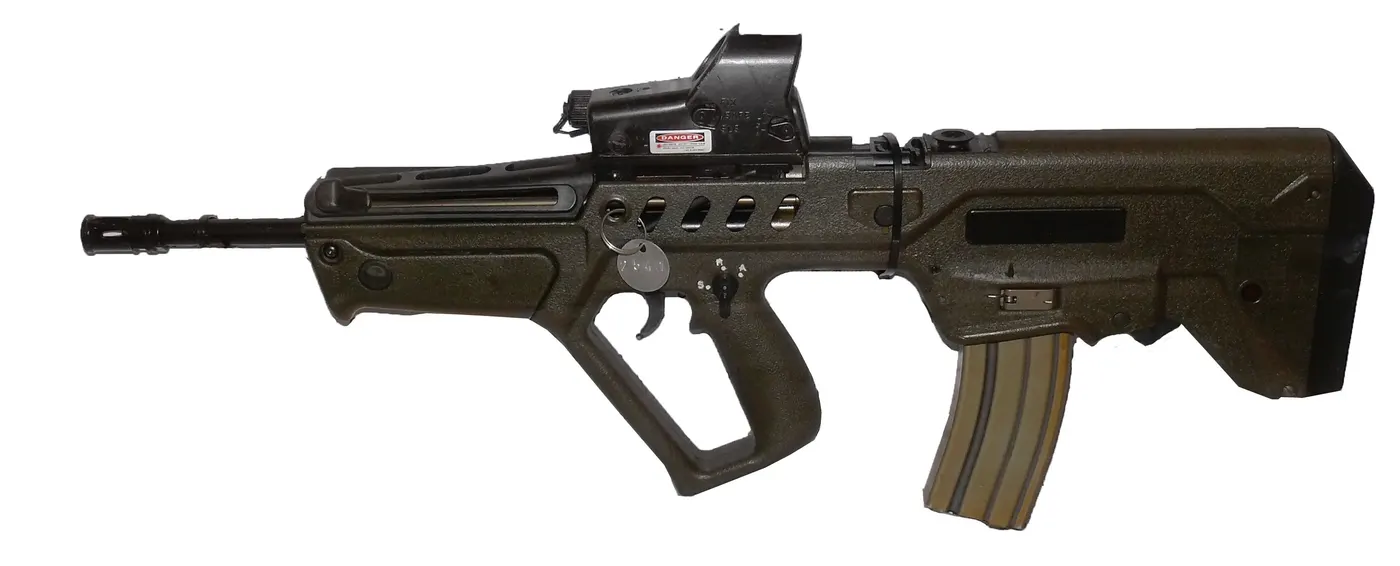

The IWI Tavor, fielded by the Israel Defense Forces as the TAR-21 (Tavor Assault Rifle, 21st century), is a bullpup assault rifle chambered in 5.56×45mm NATO. Unlike a conventional rifle, its action and magazine sit behind the pistol grip rather than in front of it, which lets the whole weapon measure roughly 720 mm while still carrying a 457 mm barrel, close to a full-length rifle's ballistic performance in a package barely longer than many carbines. It replaced the Armalite AR-15-pattern M16/M4 family as Israel's standard infantry weapon through the 2000s, a transition that took over a decade from first prototype to full-scale issue.
- compact overall length without losing barrel length
- ambidextrous ejection, reconfigurable for left or right-handed shooters
- six points of body contact for stability
- proven reliable in sand and dust after early fixes
- widely exported and locally produced abroad
- trigger feel criticized as mushy compared to rifle-length designs
- weight balanced toward the shoulder, unfamiliar to soldiers trained on the M16
- bullpup layout complicates shooting around left-side cover for right-handed users
- early production plagued by sand-ingress and gas-venting problems
{{photo-req side=right q="IDF soldier Tavor TAR-21 rifle" caption="An Israeli soldier carrying the TAR-21, the compact bullpup that began replacing the M16 in IDF service after 2001" alt="Israeli soldier holding an IWI Tavor TAR-21 rifle"}}
The rifle was designed by Israel Military Industries (IMI) and is manufactured today by Israel Weapon Industries (IWI), the private company spun out of IMI's small-arms division in 2005.1 Development began in the aftermath of the 1982 Lebanon War, when Israeli infantry commanders concluded that a standard-length M16 was awkward for the vehicle-and-urban-heavy way Israeli forces actually fought, and a bullpup design was chosen specifically to keep barrel length (and therefore muzzle velocity and range) while shrinking the weapon enough to use comfortably inside an armored personnel carrier or a Gaza alleyway.2 The Tavor family later produced the smaller X95 carbine (a related but separately catalogued weapon, see Variants), which has since taken over as the IDF's primary frontline rifle while the original TAR-21 continues in reserve and specialist units.
Roughly 720 rifles' worth of documented total production spans more than two decades, and the weapon remains in active service with dozens of national militaries, police forces, and, through commercial and licensed variants, civilian shooters. Chambered for the same 5.56×45mm NATO round used by the Steyr AUG and the M4, the Tavor was built to answer a specific question search engines still ask today, whether the Tavor is still in service, and the answer is yes, both as the IDF's TAR-21/CTAR-21 in reserve and training roles and, more prominently, as the X95 that superseded it on the front line.
The IWI Tavor TAR-21's action is a gas-operated, long-stroke piston system with a rotating bolt, mechanically closer to the M1 Garand and the AK-47 than to the direct-impingement AR-15 the rifle was designed to replace.2 IWI's engineers deliberately avoided a direct-impingement gas system, betting that a piston would tolerate sand, mud, and long intervals without cleaning better than the M16's gas tube, a concern rooted directly in complaints about the M16 in the desert and urban environments Israeli units actually fought in. The bet mostly paid off, though early Tavor test rifles suffered fine sand working into the chamber and receiver, a flaw identified over roughly two years of trials and fixed through a series of small sealing and tolerance changes before the design was finalized.2
- First Production Year1995
- Service Entry Year2001
- DesignerIsrael Military Industries
- Weight (Empty)3.27 kg
- Currently In ServiceYes
- Notable UsersIsrael Defense Forces, Angolan Army, Azerbaijani Army, Brazilian military, Cameroonian Army, Chadian Ground Forces, Colombian special forces, Chilean Investigations Police, Cypriot Special Forces
At 3.27 kg empty and firing at a cyclic rate commonly cited between 750 and 950 rounds per minute (the DB figure of 850 rpm sits in the middle of that published range), the Tavor cycles a 910 m/s muzzle velocity, translating to roughly 3,930 joules of muzzle energy, broadly in line with other 5.56mm service rifles of its generation.3 Effective point-target range is rated around 550 m, again typical for the cartridge rather than exceptional, the Tavor's design advantage was never about range, it was about handling a rifle-length barrel inside a much shorter overall envelope.
- Cartridge5.56×45mm NATO
- Calibre5.56 mm
- Case Length44.7 mm
- Calibre Classintermediate
- Bullet Weight4 g
- RimfireNo
- Caseless AmmunitionNo
{{photo-req side=left q="Tavor rifle ambidextrous ejection port" caption="The Tavor's ejection port can be relocated from right to left, one of the design's more unusual bullpup features" alt="Close-up of the IWI Tavor's ejection port and charging handle"}}
- Action TypeGas-Operated
- Fire Modesselective fire
- Select FireYes
- Feed SystemDetachable Magazine
- Magazine Capacity30
- Cyclic Rate of Fire850
- Trigger Typesingle-stage
- Safety Typelever
One of the Tavor's more unusual mechanical features is true ambidextrous operation, the ejection port can be moved from right to left side (and the bolt handle correspondingly relocated) to configure the rifle for a left-handed shooter, something few bullpup rivals of the era offered without a separate left-hand-only production run.4 Doing so requires partial disassembly rather than a tool-free lever, so it is normally set once per issued rifle rather than swapped in the field. The weapon feeds from STANAG-pattern 30-round detachable magazines, uses a single-stage trigger, and carries a lever safety. Reviewers have repeatedly singled out the trigger as the design's weakest point, the long linkage a bullpup needs to connect a rearward-mounted trigger to a forward-mounted sear inherently adds slack and creep that a conventional rifle's short, direct trigger bar avoids, and the Tavor's trigger has been described as mushy next to contemporaries built around a direct sear.4
- Muzzle Velocity910 m/s
- Muzzle Energy3,930
- Effective Range (point)550 m
The receiver and furniture are polymer, chosen for weight and corrosion resistance over the aluminum forgings common on AR-pattern rifles, and later production carries Picatinny rails for the Meprolight MP-21 reflex sight or the ITL MARS laser-equipped sight, alongside flip-up backup iron sights.5 The rifle is suppressor-ready and supports a folding, collapsing-capable stock configuration on export and civilian derivatives, though the core IDF-issue TAR-21 keeps a fixed polymer buttstock rather than a folder. IWI markets a modularity package around the base rifle, optic rails, grenade launcher compatibility on the GTAR-21 variant, and suppressor mounting, that let a single receiver pattern serve infantry, designated-marksman, and grenadier roles without a wholesale redesign.
- Barrel Length457 mm
- Rifling Twist1:7
- Rifling Grooves6
- Sight TypeBackup iron sights and integrated Picatinny rails are provided for the Meprolight MP 21, ITL MARS with integrated laser
- Optic RailYes
- Iron SightsYes
- Receiver Materialpolymer
- Furniture Materialpolymer
- Folding / Collapsing StockYes
- Bullpup LayoutYes
- Modularitymultiple variants, optic rails, grenade launcher compatibility, suppressor ready
- Production Start1995
Israeli planners began looking seriously at a bullpup replacement for the M16 family in the years following the 1982 Lebanon War, where the standard-length rifle proved cumbersome for mechanized infantry dismounting from armored vehicles and for the close-quarters fighting typical of Israeli urban and border operations.1 A formal development effort, later named Tavor after the biblical Mount Tabor, got underway inside Israel Military Industries in the early 1990s under lead designer Zalmen Shebs, with the program more concretely dated to 1994-1995 when the first coherent prototypes appeared.1,2
{{photo-req side=right q="Givati Brigade soldiers Israel" caption="Soldiers of the Givati Brigade, one of the first IDF units issued early-production Tavor rifles for field evaluation in 2001" alt="Israeli Givati Brigade infantry soldiers"}}
IMI put prototypes in front of IDF evaluators in 1997, but formal adoption did not follow immediately, the design needed years of further trials, including the sand-ingress problems mentioned above, before the military was satisfied. Extended head-to-head testing against the incumbent M4A1 carbine ran through 2001-2002, comparing reliability, accuracy, ergonomics, and ease of maintenance, and the Tavor came out ahead on enough of those measures that the IDF selected it as the future standard rifle.2 The Givati Brigade's training company received early-issue rifles in November 2001 for further field evaluation, a limited rollout rather than a full fleet swap.
Actual large-scale procurement did not arrive until 2003, when the IDF formally committed to buying the TAR-21 in quantity as the future standard-issue rifle, and full production-quality units only began reaching infantry units from around 2006, replacing M16s progressively rather than in a single fleet-wide swap.1 That gap, roughly five years between formal selection and widespread issue, reflected both production ramp-up at IMI/IWI's Ramat HaSharon plant and the scale of re-equipping an entire conscript military's small-arms inventory. The 2005 privatization that turned IMI's Magen small-arms division into the independently owned Israel Weapon Industries, purchased by businessman Samy Katsav's SK Group, happened in the middle of that rollout, a detail later scrutinized by Israel's State Comptroller, who found procedural and valuation shortcomings in how cheaply the division had been sold.6
The Tavor's combat debut came during the Second Intifada (2000-2005), while the rifle was still in limited pre-adoption issue to select units, giving the IDF its first real urban-combat data on the design before the wider 2003 procurement decision.1 It saw significantly wider use in the 2006 Lebanon War against Hezbollah, one of the first large-scale conventional engagements where Tavor-equipped units fought alongside M16-armed counterparts, and in the Gaza War (2008-2009), known in Israel as Operation Cast Lead, where the compact CTAR-21 variant was carried by the Givati and Golani brigades and, according to IDF accounts, functioned without major stoppages through sustained urban fighting.7
{{photo-req side=left q="Operation Cast Lead Gaza 2009 IDF infantry" caption="Israeli infantry during Operation Cast Lead in Gaza, 2008-2009, where Tavor-equipped Givati and Golani units saw sustained urban combat" alt="IDF soldiers during the 2008-2009 Gaza War"}}
Tavor-armed Israeli infantry and border-police units have also carried the rifle through smaller, more frequent engagements tied to the broader Iran-Israel proxy conflict, including the 2006 Gaza-Israel conflict, a shorter round of cross-border fighting that predated the larger 2008-2009 war.1 These lower-intensity operations rarely generate the kind of detailed after-action reporting that a full war does, but they account for a large share of the rifle's actual trigger time in Israeli service.
The Tavor's export footprint put it into several other conflicts far from Israel. Azerbaijan, which acquired TAR-21s around 2008, fielded them during the Second Nagorno-Karabakh War against Armenia in 2020.1 Georgia, an early Tavor customer from around 2001, used the rifle in the brief but intense Russo-Georgian War of August 2008, fought against a much larger Russian force. In the Russo-Ukrainian War, Ukrainian units have fielded locally marked Fort-221 rifles, the Ukrainian-licensed derivative of the Tavor TAR built under a 2008 agreement between IMI and the state manufacturer RPC Fort, alongside genuine Israeli-made TAR-21s and X95s.9 India's Tavor holdings, concentrated in special-forces units after a 2002 purchase of roughly 3,070 rifles, have seen use in counter-insurgency operations tied to the long-running insurgency in Jammu and Kashmir and the broader Kashmir conflict.1 In Latin America, Colombia's special-operations and national-police units have carried the Tavor through the decades-long Colombian conflict against FARC remnants and other armed groups.
The base TAR-21 carries the full 457 mm barrel and represents the original infantry-rifle configuration. The CTAR-21 (Commando TAR) shortens the barrel to 380 mm for vehicle crews, special forces, and close-quarters units, and became more widely issued across the IDF than the full-length TAR-21 itself once commanders judged the shorter length preferable for most infantry roles.2 The GTAR-21 adds an integrated mount for the M203 40mm grenade launcher, giving infantry squads an organic grenadier weapon built on the same receiver rather than a separate platform. The STAR-21, a designated-marksman configuration pairing a bipod with a Trijicon ACOG 4x optic, saw more limited issue and was eventually phased out of IDF service in favor of dedicated designated marksman rifle platforms.
{{photo-req side=right q="Fort-221 rifle Ukraine" caption="The Fort-221, Ukraine's RPC Fort-built derivative of the Tavor TAR, produced under a 2008 license from Israel Military Industries" alt="Ukrainian Fort-221 rifle, a licensed Tavor derivative"}}
The family's most consequential offshoot is the Micro Tavor (MTAR-21), renamed and marketed today as the IWI Tavor X95. Selected by the IDF in 2009 as the successor infantry rifle, the X95 shrinks the receiver further, reworks ergonomics, and began reaching front-line infantry from 2013, progressively taking over the role the original TAR-21 had only recently established. The X95 is covered as its own separate weapon record given how distinctly it has been marketed, adopted, and exported from the original TAR-21, but the two share the same core piston-driven bullpup mechanism and much of their parts commonality, and IWI itself treats X95 as the current-production evolution of the Tavor line rather than an unrelated design. A later Tavor 7 battle rifle, chambered in 7.62×51mm NATO, extends the same bullpup architecture up to a full-power rifle cartridge, a configuration IWI has since also offered to militaries wanting a bullpup battle rifle rather than an intermediate-caliber assault rifle.
License and semi-domestic production spread the Tavor design well beyond Israeli manufacture. Ukraine's RPC Fort built the Fort-221 (TAR-pattern) and Fort-224 (X95-pattern) under a 2008 IMI license, though independent observers have questioned how much of the early production was genuinely manufactured in Ukraine versus imported from Israel and simply rebranded, a full domestic line was only meant to start once a substantial order arrived, and that order was slow to materialize.9 India pursued two separate paths, a state-run Ordnance Factory Board effort to build an X95 derivative called Zittara that never reached real production, followed by a private 2016 joint venture between IWI and the conglomerate Punj Lloyd, later Punj Lloyd Raksha Systems, which has since built India-made X95 rifles that have themselves found export buyers among African militaries.10 Commercially, IWI's American subsidiary sells the semi-automatic-only Tavor SAR to US civilian shooters (over 50,000 shipped by early 2016) and a Canadian-legal TC-21 semi-auto variant has been available since 2008.2


| Year | Buyer | Quantity | Amount | Present Value (2025) |
|---|---|---|---|---|
| 2008 |  Azerbaijan | — | — | — |
| — |  Angola | — | — | — |
| — |  Cameroon | — | — | — |
| — |  Colombia | — | — | — |
| — |  Chile | — | — | — |
| — |  India | — | — | — |
| — |  Ukraine | — | — | — |
The Israel Defense Forces remain the Tavor's home operator, though the TAR-21 itself now shares frontline duty with, and is gradually being outnumbered by, the newer X95 variant within Israeli service. Beyond Israel, the rifle's largest single confirmed purchase is India's 2002 order of roughly 3,070 units for special-forces use, later supplemented by locally built X95 rifles under the Punj Lloyd partnership.10 Thailand operates the largest raw quantity in the DB record, some 76,000 rifles, reflecting a large-scale police and paramilitary procurement rather than a small special-forces buy.
{{photo-req side=right q="Nagorno-Karabakh region map" caption="A map of the Nagorno-Karabakh region, where Azerbaijani forces fielded Tavor rifles during the 2020 war against Armenia" alt="Map of the Nagorno-Karabakh conflict region in the South Caucasus"}}
Smaller but strategically notable holdings include Azerbaijan (acquired around 2008) and Georgia (around 2001), both former Soviet states that turned to Israeli small arms suppliers rather than legacy Warsaw Pact designs, and Chad (2006) and a broad spread of African militaries, including Angola, Cameroon, Kenya, Ethiopia, Nigeria, Rwanda, Senegal, and Zambia, most acquired through smaller commercial export contracts rather than headline government-to-government deals. In Latin America, Colombia, Chile (through its Investigations Police), Peru, Mexico (from 2011), Guatemala, Honduras, and Uruguay all field the rifle in police or special-operations roles.
In Europe, North Macedonia, Portugal, and Cyprus (through Cypriot special forces) operate it, and Ukraine fields both genuine Israeli-made rifles and the domestically marked Fort-221/224 derivatives. Small numbers also appear in Vietnam, Turkmenistan, Ivory Coast, Morocco, and the Philippines. In the United States, the semi-automatic Tavor SAR is not military issue but has been adopted by several municipal and county law-enforcement agencies as a patrol carbine, alongside its much larger civilian commercial sales.2 Turkey and Brazil also appear among documented operators, generally in specialist or evaluation quantities rather than as a primary service rifle.
The Tavor's most natural rival for a bullpup-design comparison is the Steyr AUG, the Austrian rifle that pioneered mainstream bullpup adoption two decades earlier, in 1978, and against which every later bullpup design, the Tavor included, is implicitly measured. Where the AUG uses a translucent polymer magazine and an integrated 1.5x optic as its signature features, the Tavor instead bet on full Picatinny-rail modularity and true ambidextrous ejection, letting operators fit modern red-dot or magnified optics of their choice and reconfigure the same rifle for left-handed shooters without a dedicated left-hand receiver, something the AUG's fixed-ejection layout never offered as cleanly.4 Both share the bullpup's core tradeoff, a full-length barrel in a shorter overall package, at the cost of a longer, less crisp trigger linkage that reviewers of both rifles have criticized in similar terms.
The Tavor's other defining rivalry is not with a bullpup at all but with the M4A1 carbine it beat in IDF trials and effectively replaced. The two represent opposite answers to the same problem, the M4 shortens a rifle-length design by cutting barrel length and accepting the resulting ballistic loss, while the Tavor keeps the full barrel and shortens the receiver instead. IDF evaluators in 2001-2002 judged the Tavor ahead on reliability and ergonomics for Israeli conditions, sand, urban CQB, mechanized dismounts, though the M4 pattern remains the far more widely used rifle worldwide and continues to see continuous refinement through platforms like the Heckler & Koch HK416, itself a piston-operated answer to the same direct-impingement reliability concerns that shaped the Tavor's own gas system choice.
| Spec | IWI Tavor (TAR-21) | Steyr AUG A1 |
|---|---|---|
| Cartridge | 5.56×45mm NATO | 5.56×45mm NATO |
| Barrel length | 457 mm | 508 mm (standard) |
| Weight (empty) | 3.27 kg | approx. 3.6 kg |
| Action | Long-stroke gas piston | Short-stroke gas piston |
| Adopted | 2001 (IDF) | 1978 (Austria) |


What caliber does the IWI Tavor use? The IWI Tavor fires the 5.56×45mm NATO cartridge from a 30-round STANAG-pattern detachable magazine, the same intermediate caliber class as the M16/M4 family and most other modern NATO-standard assault rifles.3
Is the IWI Tavor still in service? Yes. The Israel Defense Forces still field Tavor-family rifles, though the newer X95 variant has taken over most frontline infantry issue since 2013, with the original TAR-21 continuing in reserve, specialist, and export use.1 Numerous export operators, from Thailand's police to Colombian special forces, also keep the rifle in active service.
How does the Tavor's bullpup design work? The Tavor places its action, chamber, and magazine well behind the trigger and pistol grip rather than in front of them, the layout that defines a bullpup rifle. This lets the weapon carry a nearly full-length 457 mm barrel while the overall rifle measures only 720 mm, shorter than an M4 carbine with its stock extended.2
What is the difference between the Tavor TAR-21 and the Tavor X95? The X95, originally called the Micro Tavor (MTAR-21), is a further-shrunk, ergonomically reworked evolution of the same piston-driven bullpup mechanism, selected by the IDF in 2009 and issued from 2013 onward as the TAR-21's successor. It is treated as a separate model in production and export terms even though it shares the TAR-21's core operating system.
Who manufactures the Tavor rifle? The Tavor was designed by Israel Military Industries and is manufactured by Israel Weapon Industries (IWI), the privately held successor to IMI's small-arms division since a 2005 restructuring, based in Ramat HaSharon, Israel.6 Licensed variants have also been built abroad, notably Ukraine's Fort-221/224 and India's Punj Lloyd-built X95 rifles.
What is the effective range of the IWI Tavor? The Tavor's point-target effective range is rated at roughly 550 m, in line with other 5.56mm service rifles, reflecting the cartridge's ballistic limits rather than any Tavor-specific advantage or shortfall.3
- "IWI Tavor", Wikipedia — en.wikipedia.org ↩
- "Decidedly Different, The IWI Tavor", American Rifleman — americanrifleman.org ↩
- "Tavor TAR-21 assault rifle", Modern Firearms — modernfirearms.net ↩
- "The Tavor TAR-21, a better Bullpup?", The Loadout Room — loadoutroom.com ↩
- "IWI TAR-21 (Tavor) Assault Rifle / Carbine / Designated Marksman Rifle (DMR)", Military Factory — militaryfactory.com ↩
- "Israel Weapon Industries", Wikipedia — en.wikipedia.org ↩
- "What Rifle Does the IDF Use? (2023 Update)", Buffalo Rifles — buffalorifles.org ↩
- "When Israeli Infantry Enters Gaza, They'll Carry Tavor Assault Rifles", Forbes — forbes.com ↩
- "Fort 221, The Ukrainian Tavor TAR", Forgotten Weapons — forgottenweapons.com ↩
- "Tavor in India, Israeli Assault Rifle's Journey and Prospects in India", Strategic Front — strategicfront.org ↩