

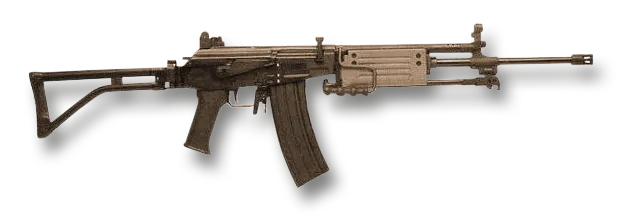

The IWI Galil is an Israeli gas-operated, select-fire assault rifle built around a rotating-bolt action lifted almost directly from a Finnish rifle rather than designed from scratch. Its designers, Yisrael Galili and Yakov Lior, based the first prototypes on the receiver of the Valmet RK 62, a Finnish-refined AK-47 derivative built by Valmet, and the earliest Galil test rifles were literally built on imported RK 62 receivers before Israel Military Industries began machining its own.1 The result chambered the 5.56×45mm NATO cartridge (with a 7.62×51mm NATO variant, the Galatz, following later) and entered Israeli Defense Forces service in 1972, just ahead of the 1973 Yom Kippur War.
- AK-derived reliability in sand, mud, and heat
- accurate for a Kalashnikov-pattern action, closer to M16-class hit probability
- multiple configurations (ARM, AR, SAR, Galatz) from one action
- folding stock and night sights standard from the outset
- decades of proven combat and licensed-production history
- notably heavy for a 5.56mm rifle, especially the ARM
- expensive to machine compared to stamped-receiver AKs or polymer M16-pattern rifles
- squad-automatic-weapon role hampered by fixed barrel and small magazines
- eventually displaced in IDF front-line service by M16/M4-pattern rifles
Reportedly, Galili's own surname was chosen partly because it echoed Kalashnikov, and early prototypes were informally nicknamed "Balashnikov" inside the design bureau before the more Hebrew Galil name stuck.2 The rifle went on to be adopted, licensed, or copied by more than fifty countries, produced under license in South Africa as the Vektor R4, in Colombia by Indumil, and in Myanmar as the MA-1 family, among others.3,4
{{photo-req side=right q="IMI Galil ARM assault rifle rifle museum display" caption="An IMI Galil ARM with bipod deployed, the Israeli Defense Forces' original front-line configuration of the rifle." alt="IMI Galil ARM assault rifle with folding bipod and carrying handle"}}
Israel's own military never fully embraced the Galil as a total replacement for the FN FAL it initially targeted. American M16 rifles and M16A1s arrived in large numbers as US military aid in the mid-1970s, undercutting the domestic rifle on cost even as the IDF kept Galils in mechanized, armor, and reserve units for decades.5 The assault rifles category the Galil belongs to is defined by exactly this kind of select-fire, intermediate-cartridge, magazine-fed rifle, and the Galil is one of the clearest Cold War examples of a country reverse-engineering a rival's proven action into a fully domestic weapons family rather than importing one outright.
The production Galil weighs 3.75 kg empty and 4.35 kg loaded, fires from a 35-round detachable magazine, and has a 650 rpm cyclic rate with a 460mm barrel.6 Muzzle velocity for the 5.56mm loading runs close to 950 m/s, with an official effective range figure around 410 meters, respectable for the class but not class-leading.6 Those numbers put it in the same broad performance bracket as contemporaries like the Steyr AUG and the SIG SG 550, though the Galil's gas-piston-operated action and machined-steel receiver trade weight for ruggedness in ways a polymer bullpup does not.
- First Production Year1972
- Service Entry Year1972
- DesignerYisrael Galili, Yakov Lior
- Weight (Empty)3.75 kg
- Weight (Loaded)4.35 kg
- Currently In ServiceYes
{{photo-req side=right q="Galil rifle bolt carrier disassembled field strip" caption="The Galil's rotating-bolt gas-piston mechanism, machined from a solid steel billet rather than stamped sheet steel like the AK-47 it is derived from." alt="Disassembled Galil rifle showing the bolt carrier and gas piston"}}
- Cartridge* 5.56×45mm NATO * 7.62×51mm NATO * .30 carbine (Magal variant)
- Calibre5.56 mm
- Case Length44.7 mm
- Calibre Classintermediate
- Bullet Weight4 g
- RimfireNo
- Caseless AmmunitionNo
The Machined Receiver and Why It Made the Rifle Heavy
Unlike the AK-47's stamped-sheet-steel receiver, which is prone to cracking under sustained 5.56mm pressures at that wall thickness, Israel Military Industries machined the Galil's receiver from a solid steel billet.7 That solved a real durability problem, the rifle earned a reputation for shrugging off sand, dust, and neglect in the way Kalashnikov-pattern rifles generally do, but it also made the ARM configuration weigh roughly 9.6 lb (4.35 kg) loaded, unusually heavy for a 5.56mm-class weapon and heavier than a contemporary M16A1 by a wide margin.7 Later IWI Galil ACE models addressed this directly by moving to a polymer lower receiver, cutting weight while keeping the same basic operating system.
- Action TypeGas-Operated
- Fire Modessafe, semi-auto, full-auto
- Select FireYes
- Feed SystemDetachable Magazine
- Magazine Capacity35
- Cyclic Rate of Fire650
- Trigger Typesingle-stage
- Safety Typeselector switch
Fire Modes, Magazine, and the Bottle Opener
The Galil offers safe, semi-automatic, and full-automatic fire through a AK-style side selector, feeds from a 35-round steel detachable magazine, and mounts a folding stock as standard, a genuinely unusual feature at the time for a Kalashnikov-derivative issued to a full conscript army. Sights are flip-up apertures with tritium inserts for night use.6 The best-known idiosyncratic detail is a bottle opener built into the rear handguard ferrule that also retains the bipod legs. It was not a novelty add-on, it was a direct response to Israeli reservists chronically bending magazine feed lips by using them to pry bottle caps, a problem the Uzi submachine gun had suffered from for the same reason.8 Several ARM-configuration rifles also carry a folding wire cutter integrated into the bipod, useful in a country crossed by agricultural and border fencing.
- Muzzle Velocity950 m/s
- Effective Range (point)410 m
The Israeli Defense Forces originally fielded three 5.56mm configurations built on the same receiver. The ARM (Automatic Rifle-Machine gun) added a bipod, carrying handle, and the bottle-opener handguard, and became the standard front-line infantry rifle. The AR stripped those features for support and military-police troops. The SAR shortened the barrel for vehicle crews and specialist units.9 A dedicated 7.62×51mm NATO Galil Sniper (Galatz) followed in 1983, and a compact personal-defense-weapon variant known as the Micro Galil (MAR) appeared later for close-protection and vehicle-crew roles.
- Barrel Length460 mm
- Sight TypeFlip-up rear aperture with protective ears, flip-up tritium night sights, hooded front post
- Iron SightsYes
- Receiver Materialsteel
- Furniture Materialpolymer, wood (early variants)
- Folding / Collapsing StockYes
- Bullpup LayoutNo
- Modularitymultiple configurations (ARM, AR, SAR)
- Production Start1972
- Production End1998
Israel's search for a new standard rifle began after captured AK-47 rifles impressed IDF ordnance officers with their tolerance for sand, dust, and neglect during the 1967 Six-Day War, qualities the service's FN FAL rifles lacked in Sinai desert conditions.10 Rather than adopt the Soviet design outright, which was politically and logistically impossible for Israel to source, the IDF ran a competitive trial in the late 1960s and early 1970s pitting Yisrael Galili and Yakov Lior's AK-derived submission against the American M16A1, the Stoner 63, the Heckler & Koch HK33, and a rival domestic design from Uziel Gal (designer of the Uzi).11 Galili and Lior's rifle won, and Israel Military Industries began production in 1972 under the name Galil, after the Hebrew word for the Galilee region.
{{photo-req side=right q="Yisrael Galili Israeli weapons designer portrait" caption="Yisrael Galili, the Israel Military Industries engineer who co-designed the Galil with Yakov Lior and whose surname the rifle carries." alt="Portrait of Israeli firearms designer Yisrael Galili"}}
The timing worked against the new rifle almost immediately. The 1973 Yom Kippur War broke out before the Galil could be issued in numbers, and Israel emerged from that war flooded with American M16 and Colt 653 rifles supplied as military aid, weapons that were suddenly cheaper for Israel to field than its own domestic design.5 Only a limited number of Galils saw combat in 1973. It took the 1982 Lebanon War and Operation Litani before the Galil appeared on the battlefield in large numbers, carried by Israeli paratroopers and infantry through the Golan Heights and southern Lebanon, where its tolerance for desert grit and minimal cleaning requirements over the FN FAL it replaced was borne out in practice.12
{{photo-req side=right q="Israeli paratroopers Lebanon 1982 war infantry" caption="Israeli infantry in southern Lebanon during the 1982 Lebanon War, where the Galil first saw sustained combat use in large numbers." alt="Israeli soldiers on patrol during the 1982 Lebanon War"}}
Special-operations use came earlier and more famously. Israel's Sayeret Matkal commandos carried a mix of Uzi submachine guns and Galil ARMs during the July 1976 raid on Entebbe Airport in Uganda, in which 100 Israeli soldiers killed the hijackers holding Air France passengers, destroyed several Ugandan Air Force MiG fighters on the ground, and rescued 102 hostages in a single night operation.13
Despite the combat pedigree, the Galil's own government never fully committed to it as the sole IDF service rifle. Israeli infantry increasingly preferred the lighter, more accurate M16 and, later, the M4, and by roughly the year 2000 the Galil had been substantially phased out of front-line IDF infantry service in favor of American-pattern rifles, remaining in reserve, armor, and support-unit inventories for years afterward.14 Production for export and licensed foreign lines continued past that point, and Israel Weapon Industries (the successor to Israel Military Industries' small-arms business) eventually replaced the original Galil in its own catalog with the modernized IWI Galil ACE, introduced from 2008 with a polymer lower, left-side charging handle, and Picatinny rail furniture.15
Beyond the 1982 Lebanon War and Operation Litani, Galil rifles equipped multiple sides of the long South African Border War, both as South African-purchased original Galils and, from 1980, as domestically produced Vektor R4 rifles that became the standard service weapon of the South African Defence Force.3 The rifle also armed government and irregular forces through the decades-long Guatemalan Civil War, where Guatemala's army fielded Galils acquired from Israel from 1982 onward, and Israeli-supplied Galils reportedly reached Contra and Sandinista-adjacent forces during the Nicaraguan Revolution and its aftermath, part of a broader pattern of Israeli small-arms exports to Central America during the Cold War.16
{{photo-req side=right q="South African Defence Force soldier Vektor R4 rifle border war" caption="A South African soldier with a Vektor R4, the licensed Galil derivative that became the standard SADF service rifle during the South African Border War." alt="South African Defence Force soldier carrying a Vektor R4 assault rifle"}}
In Colombia, where Indumil has produced the Galil under license for the national army for decades, captured examples have also armed FARC guerrillas fighting that same army, a case of a licensed domestic rifle circulating on both sides of an internal conflict.17 The 2003 Iraq War in Iraq and the broader Arab Spring uprisings after 2010 also saw Galils in service with forces equipped by Israel or drawing on decades-old regional stockpiles, though by that period the rifle's role in most of these conflicts was as a secondary or reserve weapon rather than the primary infantry arm it had been in the 1980s.
{{photo-req side=right q="Myanmar Tatmadaw soldier MA1 rifle" caption="A Myanmar Tatmadaw soldier with an MA-1 rifle, the domestically produced Galil AR derivative built with Israeli technical assistance." alt="Myanmar army soldier carrying an MA-1 assault rifle derived from the Galil"}}
- ARM (Automatic Rifle-Machine gun): the original front-line IDF configuration, with folding bipod, carrying handle, and the bottle-opener handguard.
- AR (Automatic Rifle): the ARM's fittings removed, issued to support troops and military police.
- SAR (Short Automatic Rifle): a shortened-barrel carbine for vehicle crews and specialists.
- Galatz / Galil Sniper: a 7.62×51mm NATO designated-marksman variant introduced in 1983, roughly 50 percent heavier than a comparable M16-pattern sniper rifle at around 14 lb, later adopted by Indian special forces as their standard DMR after a 2002 order for 200 rifles.18
- Magal: a .30 Carbine training/police variant using the same action, chambered down for lower-cost practice ammunition, reflected in the DB's cartridge spec entry for the Galil family.
- Micro Galil (MAR): a compact personal-defense-weapon derivative for vehicle crews and close-protection details.
- Vektor R4 / R5 / R6: South African-produced Galil AR and SAR derivatives with a lengthened polymer stock and magazine, built by Lyttelton Engineering Works (now Denel Land Systems) from 1980; the R6 is a further-shortened personal-defense-weapon variant for armored-vehicle crews introduced in the 1990s.3
- MA-1 / MA-2 / MA-3 / MA-4: Myanmar's Galil AR-derived family, produced domestically with Israeli technical assistance and issued across the Tatmadaw's frontline infantry battalions, with the MA-3 a folding-stock carbine and the MA-4 a grenadier variant.4
- Galil ACE / IWI Galil ACE: the modernized successor line from Israel Weapon Industries, in production since 2008 with a polymer lower receiver, ambidextrous controls, and modern rail furniture.
- Licensed and derivative lines also existed in Italy (Bernardelli's Mod.377/378 semi-automatic variants, produced by Vincenzo Bernardelli in the 1980s) and Vietnam (Z111 Factory production of Galatz-pattern rifles).19


{{photo-req side=right q="Indian special forces sniper rifle training" caption="An Indian special forces sniper team, the branch of India's armed forces that standardized on the 7.62mm Galil Sniper (Galatz) after a 2002 order for 200 rifles." alt="Indian special forces soldier with a sniper rifle during training"}}
The Galil's user list runs to more than 50 countries across five decades, reflecting both direct Israeli export sales and multiple licensed-production lines. Original adopter Israel fielded the rifle from 1972, with South Africa following in 1975 (ahead of full domestic R4 production from 1980), and Portugal's airborne infantry adopting 5.56mm AR and ARM versions the same year.3 Guatemala received the largest single documented inventory in the DB record, with roughly 15,000 rifles acquired from 1982 during the Guatemalan Civil War, while Indonesia (1980), Peru (1982), Mexico (1984), Costa Rica (1984), and Italy (1986, via Bernardelli-built semi-automatic variants) followed through the 1980s.
Later adopters skew toward smaller specialist purchases rather than full-army rearmament. India acquired 200 Galil Sniper (Galatz) rifles in 2002 to standardize the designated-marksman role across its special forces units, Brazil recorded 555 units from 2001, Sierra Leone 112 units, and Nepal 2,000 units.18 Colombia (2010) and Chile (2014) represent more recent entries in the DB operator list, alongside long-standing users including Estonia, Kenya, Uganda, Rwanda, Vietnam, Myanmar (via the domestically built MA series), the Philippines (1981), El Salvador (1981), and the United States, where small numbers circulate with civilian shooters and limited law-enforcement or evaluation use rather than as a standard-issue service rifle.
The most instructive comparison for the Galil is not a Western M16-pattern rifle but the Vektor R4, because the R4 is not a separate design, it is the same Galil action re-engineered by a country that could not simply buy IMI's finished product. South Africa faced an arms embargo through the 1970s and 1980s and needed both a domestic manufacturing base and a rifle better suited to soldiers' average height and build than the original Israeli stock length, so Lyttelton Engineering Works lengthened the buttstock, switched the furniture and magazines to polymer, and put the R4 into full-scale production as the SADF's standard rifle from 1980.3 The two rifles share the same rotating-bolt, gas-piston operating system and roughly the same weight problem, but the R4 lineage (through the R5 carbine and further-shortened R6 personal-defense variant) shows a client state iterating the base Galil design more aggressively for its own doctrine than Israel itself did after the 1980s.
Against the FN FAL it replaced in first-line IDF service, the Galil traded the FAL's proven 7.62×51mm NATO stopping power and simpler production for AK-pattern desert reliability and a lighter intermediate cartridge, exactly the tradeoff the IDF's own 1967 desert-warfare experience had pushed it toward. Against the M16A1 that eventually displaced it, the balance runs the other way, the Galil is heavier and costlier to machine, but tolerates sand and neglect noticeably better without the M16's contemporary reputation for stoppages in harsh field conditions.
| Spec | IWI Galil (ARM) | Vektor R4 |
|---|---|---|
| Cartridge | 5.56×45mm NATO | 5.56×45mm NATO |
| Loaded weight | ~4.35 kg | ~4.8 kg (longer stock, heavier furniture) |
| Action | Gas-piston, rotating bolt | Gas-piston, rotating bolt (same lineage) |
| Standard magazine | 35-round detachable | 35-round detachable |
| Adopted | 1972 (Israel) | 1980 (South Africa) |
Is the Galil still in service anywhere. Yes, in reserve and specialist roles in Israel and as a front-line rifle in a number of the countries listed above, though it has not been Israel's primary infantry rifle for roughly a quarter century.


What is the IWI Galil chambered in? The standard Galil fires the 5.56×45mm NATO cartridge, with the separate Galatz sniper variant chambered in 7.62×51mm NATO and a .30 Carbine training variant known as the Magal.6
Is the Galil an AK-47 or an M16? Neither exactly. The Galil's rotating-bolt gas-piston action derives from the AK-47 by way of the Finnish Valmet RK 62, while its 5.56mm NATO chambering and general accuracy standard were pursued to match Western rifles like the M16 the IDF also fielded.1
How much does an IWI Galil cost? Original military-issue Galils were not sold as a commercial product, but the modernized civilian Galil ACE derivative retails in the $1,600 to $1,800 range in the United States, roughly double a comparable AR-15-pattern rifle, reflecting the machined receiver's higher production cost.20
Why did Israel stop using the Galil as its main rifle? Cost and weight. American M16 and M4 rifles arrived as military aid after the 1973 Yom Kippur War at a lower cost to Israel than continued Galil production, and Israeli troops generally found the M16 lighter and easier to shoot accurately, leading to a gradual phase-out of the Galil from front-line IDF infantry service by around 2000.14
Who still manufactures Galil-pattern rifles? Colombia's Indumil continues Galil production under license, and Israel Weapon Industries sells the modernized Galil ACE as the direct successor product to international customers.15
- "IWI Galil", Wikipedia — en.wikipedia.org ↩
- "The History of the Galil: Israel's First Battle Rifle", Pew Pew Tactical — pewpewtactical.com ↩
- "The R4 Rising: South Africa's Galil Evolution", SOF Magazine — sofmag.com ↩
- "DI MA-1", Wikipedia — en.wikipedia.org ↩
- "Why the Galil failed", The Hebrew Hammer — thehebrewhammer.net ↩
- "IWI Galil ARM / SAR Assault Rifle / Carbine / Submachine Gun (SMG) / Designated Marksman Rifle (DMR)", Military Factory — militaryfactory.com ↩
- "IWI Galil Ace Review: Pros, Cons & Range-Tested Verdict", Warrior Poet Supply Co — warriorpoetsupplyco.com ↩
- "This 1970s military rifle actually came with a built-in bottle opener (seriously!)", Military Times — militarytimes.com ↩
- "South African Galils: The R4, R5, R6, and LM Series", Forgotten Weapons — forgottenweapons.com ↩
- "Israel Has Its Own AK-47: Meet the Galil Rifle", The National Interest — nationalinterest.org ↩
- "The Israeli Galil: Then & Now", American Rifleman — americanrifleman.org ↩
- "Classic Guns: The Israeli Galil", Shooting Illustrated — shootingillustrated.com ↩
- "Ephod Combat Vest", Wikipedia — en.wikipedia.org ↩
- "IWI Galil: Israel's Legendary Fighting Rifle", American Rifleman — americanrifleman.org ↩
- "A History of the Galil Rifle: Evolution, Design, and Global Impact", Churchill Shooting Budapest — churchillshootingbudapest.com ↩
- "IMI Galil: An Israel's derivative of legendary AK-47", Combat Operators — combatoperators.com ↩
- "List of equipment of the National Army of Colombia", Wikipedia — en.wikipedia.org ↩
- "11 Most Used Weapons by Indian Special Forces", SSBCrack — ssbcrack.com ↩
- "Galil", Internet Movie Firearms Database — imfdb.org ↩
- "GALIL New and Used Price, Value, & Trends 2026", True Gun Value — truegunvalue.com ↩