

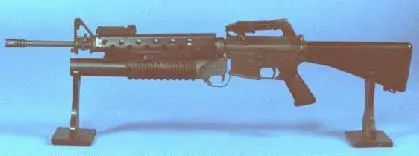

The M16A1 is the definitive Vietnam War-era version of the American 5.56x45mm NATO assault rifles, standardized in February 1967 as the fix for a rifle that had briefly become one of the most distrusted weapons ever issued to American troops. Built by Colt's Manufacturing Company on the basic pattern of Eugene Stoner's and L. James Sullivan's earlier Armalite AR-15, the M16A1 added a chrome-plated chamber and bore and, most visibly, a forward assist plunger on the right side of the receiver, a feature the original M16 (then designated XM16E1) had shipped without. Those two changes, backed by an overhauled maintenance and training program, turned a rifle that had jammed badly enough to trigger a congressional investigation into the standard American infantry weapon for the next two decades.
- light weight versus contemporaries like the AK-47 or M14
- low recoil, controllable in automatic fire
- chrome-plated chamber/bore solved the worst corrosion failures
- forward assist lets a soldier seat a stuck bolt without field-stripping
- direct-impingement gas system fouls the action directly, demanding frequent cleaning
- early ball-powder ammunition caused catastrophic extraction failures that cost lives before the fix
- aluminum receiver and thin barrel profile are less tolerant of abuse than steel-framed rivals
- 20-round magazine (until 1970s upgrades) gave less firepower than the AK-47's 30-round standard
Colt manufactured the bulk of M16A1 production alongside secondary contractors Harrington & Richardson and General Motors' Hydra-Matic division, and total worldwide production of the M16 family (spanning the M16A1 and its successors) runs to roughly 8 million rifles. The M16A1 formally replaced the M14, the standard-issue battle rifle it succeeded, as the standard United States service rifle in 1969, stayed in first-line American service until the M16A2 took over between 1983 and 1986, and remained in frontline use with dozens of allied and client-state militaries for decades afterward. It is chambered in 5.56×45mm NATO, weighs 2.89 kg empty, cycles at roughly 700-800 rounds per minute, and fires from a 20-round (later 30-round) detachable magazine through a gas-operated, direct-impingement action.
Even in 2026, versions of the M16A1 remain in active or reserve service across a long list of countries that received them through Cold War-era military aid, licensed production deals, or Vietnam-era battlefield capture and reissue, including Israel, the Philippines, South Korea, Thailand, and Turkey. Search interest in phrases like M16A1 specifications, M16A1 vs AK-47, and is the M16A1 still in service reflects how much of the rifle's reputation, both good and bad, still traces back to its 1966-1970 baptism in Vietnam.
The Chrome Chamber and Forward Assist That Ended the Jamming Crisis
The M16A1's identity is inseparable from the failures of its immediate predecessor. The original XM16E1 entered Vietnam in 1965 marketed by Colt as a low-maintenance, almost self-cleaning rifle, a claim so aggressive that the Army initially issued few cleaning kits and little maintenance training with it.1 That marketing collided with a quiet change to the rifle's ammunition specification. The Army had switched from the extruded IMR propellant Stoner designed the rifle around to a dirtier-burning ball powder (Olin Mathieson's WC846), adopted mainly because it was cheaper to produce at the volumes Vietnam required.2 Ball powder fouled the gas-operated direct-impingement action far faster than IMR had, and combined with an unplated barrel and chamber prone to corrosion in Vietnam's humidity, it produced a specific, well-documented failure. A fired case would swell and stick in the chamber, and without a way to force the bolt closed or clear a stuck case except by ramming a cleaning rod down the bore, soldiers were left holding a dead rifle in a firefight.3
- First Production Year1966
- Service Entry Year1967
- DesignerEugene Stoner; L. James Sullivan
- Weight (Empty)2.89 kg
- Currently In ServiceYes
- Notable UsersUnited States Armed Forces; ARVN Rangers; Canadian Forces; Israeli Defense Forces; Philippine Marines; South Korean military; Palestinian Security Forces; Taliban; Colombian military; Brazilian Marine Corps; Brunei Royal Armed Forces; Cambodian military; Chilean Marine Corps; Costa Rican forces; Cypriot National Guard; Indonesian Military Academy; Malaysian Army; Moroccan forces; New Zealand Defence Force; Pakistani military; Peruvian military; Singapore Armed Forces; Thai military; Turkish Land
Reports of jammed rifles and dead Marines reached Washington by late 1966, and in May 1967 the House Armed Services Committee formed a special panel under Missouri Representative Richard Ichord to investigate.4 The Ichord Committee's October 1967 report placed the blame squarely on the ball-powder ammunition switch and on the Army's failure to chrome-plate the chamber from the start, not on soldiers' cleaning habits as some officials had claimed.2 By the time that report landed, the fix was already reaching the field. The improved XM16E1, standardized as the M16A1 on 28 February 1967, added a chrome-plated chamber and bore to resist corrosion and case-sticking, plus the now-signature forward assist plunger that let a soldier manually seat a bolt that had not gone fully into battery, a capability the original M16 had deliberately omitted because Stoner considered it unnecessary on a well-maintained rifle.1 New cleaning kits, solvents, and a genuine maintenance training program went out alongside the hardware fix.3 Confidence recovered slowly. By 1970, the improved rifle and updated ammunition specification had brought the M16A1's failure rates down to levels the Army considered acceptable, four years after the rifle had first been rushed to Vietnam.3
- Cartridge5.56×45mm NATO
- Calibre5.56 mm
- Case Length45 mm
- Calibre Classintermediate
- RimfireNo
- Caseless AmmunitionNo
Externally, the M16A1 is recognizable by its triangular handguards, carrying-handle rear sight, and (through most of its production life) a birdcage flash suppressor that replaced the earlier three-prong duckbill type in 1967, largely because the open prongs snagged on jungle vegetation and were prone to bending.5 The rifle's detachable magazine started at 20 rounds. A 30-round magazine, matching the standard capacity of the Kalashnikov rifles American troops faced in Vietnam, entered issue only in the early 1970s.3 Standard iron sights use an aperture rear sight adjustable for windage integrated into the carrying handle and a post front sight, effective to roughly 550 meters on a point target and out to 800 meters for area/suppressive fire, with a claimed maximum range near 3,600 meters. The rifle retains a bayonet lug and is grenade-launch capable, both direct inheritances from the M14-era doctrine it replaced, even though neither capability saw heavy use compared to the M203 grenade launchers later paired with the M16A2.
- Action TypeGas-Operated
- Fire Modessafe, semi-automatic, automatic
- Select FireYes
- Feed SystemDetachable Magazine
- Magazine Capacity20
- Drum / Belt Capacity0
- Cyclic Rate of Fire700
- Trigger Typeselector switch
- Safety Typeselector switch
{{photo-req side=right q="M16A1 rifle Vietnam War soldier jungle" caption="A U.S. infantryman carries an M16A1 on patrol in South Vietnam." alt="American soldier holding an M16A1 rifle in the field during the Vietnam War"}}
- Muzzle Velocity960 m/s
- Effective Range (point)550 m
- Effective Range (area)800 m
- Maximum Range3,600 m
The rifle is select-fire, with a three-position selector (safe, semi-automatic, automatic) rather than the three-round-burst setting later added on the M16A2. Its receiver is machined aluminum alloy with plastic furniture, keeping unloaded weight to 2.89 kg, dramatically lighter than the wood-and-steel M14 it replaced (roughly 5 kg loaded) and noticeably lighter than a loaded AK-47. That weight saving, combined with the mild recoil of the intermediate 5.56mm cartridge, is the single biggest reason infantry units fought to keep the rifle even during the worst of the 1966-67 jamming crisis, and it remains the core argument for the M16 pattern's continued dominance among Western military rifles.
- Barrel Length508 mm
- Rifling Twist1:12
- Sight Typeiron sights (aperture rear, post front)
- Optic RailNo
- Iron SightsYes
- Threaded BarrelNo
The M16A1's original 1:12 rifling twist was matched to the lighter 55-grain M193 ball cartridge of the Vietnam era and gave excellent accuracy with that load, but it could not reliably stabilize the heavier 62-grain M855 round NATO adopted in the 1980s, one reason the M16A2 moved to a faster 1:7 twist rather than simply updating the M16A1's barrel.3 Muzzle velocity out of the M16A1's 508mm barrel runs close to 960 m/s, giving the 5.56mm cartridge a flat trajectory inside its point-target range of roughly 550 meters, though the direct-impingement gas system that made that velocity and weight possible is also the mechanism most directly responsible for the fouling problems of the rifle's first years in the field.
- Receiver Materialaluminum alloy
- Furniture Materialplastic
- Folding / Collapsing StockNo
- Bullpup LayoutNo
- Ambidextrous ControlsNo
- Modularityupper receiver swap for different barrel lengths and accessories
- Total Production8,000,000
- Production Start1966
From ArmaLite's AR-15 to a Congressional Investigation
{{photo-req side=right q="Eugene Stoner rifle designer portrait" caption="Eugene Stoner, the ArmaLite engineer whose AR-15 design became the M16 and, after the 1967 fix, the M16A1." alt="Portrait of firearms designer Eugene Stoner"}}
Eugene Stoner designed the original AR-15 at ArmaLite in the late 1950s as a lightweight, small-caliber alternative to the heavier 7.62mm battle rifles then standard in NATO armies. Colt bought the manufacturing rights in 1959 after ArmaLite struggled to sell the design, and by 1963 the U.S. Air Force had adopted a select-fire military variant as the M16, followed by Army testing that produced the improved XM16E1.1 Early combat feedback from Vietnam was genuinely strong. During the November 1965 Battle of Ia Drang, then-Lieutenant Colonel Hal Moore's 1st Battalion, 7th Cavalry used the rifle in one of the war's fiercest engagements and came away crediting it as a real advantage against North Vietnamese Army regulars armed with AK-47s.6
That early success made the reliability collapse of 1966 more jarring. Marine and Army units in heavy contact reported jammed rifles at rates that alarmed their own chains of command, and letters home from Marines fighting around Con Thien and along the DMZ describing dead comrades found next to disassembled, jammed M16s reached the American press and Congress simultaneously.4 The Ichord Committee hearings of 1967 forced the Army to acknowledge the ball-powder and unplated-chamber problems publicly, an unusually blunt admission for a weapons program mid-war.2 The M16A1's February 1967 standardization, with its chrome bore and forward assist, was the direct institutional response, and it arrived just as the Vietnam War was consuming American ground forces at its highest tempo.3
{{photo-req side=left q="Ichord Committee M16 hearing 1967 congress" caption="The Ichord Committee investigated the M16's Vietnam-era reliability failures in 1967." alt="Congressional hearing room related to the 1967 M16 rifle investigation"}}
By 1969 the M16A1 had formally replaced the M14 as the U.S. Army's standard rifle, cementing the switch from the 7.62mm battle rifle concept to the lighter intermediate-caliber assault rifle across the entire American military, a shift NATO allies would spend the next decade following.3 A 1970 Department of Defense review credited the switch to the M16 family with saving an estimated 20,000 American lives in Vietnam compared to continued reliance on the M14, largely through the extra ammunition a soldier could carry and the controllability of the lighter rifle in close jungle engagements.3 Per-unit cost through the war years ran close to $106, a fraction of the M14's cost and part of why the rifle scaled so quickly to a conscript army.7
Production spread beyond Colt as the rifle's reputation recovered. Harrington & Richardson and General Motors' Hydra-Matic division both built M16A1s under contract during the peak Vietnam years to meet demand Colt alone could not fill.1 Overseas, Colt licensed full local production to three allied governments during the 1970s and 1980s. South Korea's Busan Arsenal built roughly 600,000 M16A1s between 1974 and 1985, the Philippines' Elisco Tool Manufacturing produced about 150,000 for its own armed forces between 1974 and 1986, and Singapore's Chartered Industries built the locally designated M16S1, the country's standard service rifle from 1973 until 1999.8 Those licensed lines, alongside direct U.S. military aid shipments, are the reason M16A1-pattern rifles remain in service or reserve stocks across Southeast Asia and the Middle East decades after American front-line units moved to the M16A2 and later the M4 carbine.
Vietnam, and a Long Tail of Cold War and Post-Cold War Combat
The Vietnam War is where the M16A1 was made and nearly broken as a weapon system, and it remains the conflict most associated with the rifle in popular memory, both for the Ia Drang-era successes and for the 1966-67 jamming failures that cost American lives before the chrome-chamber fix reached units in the field.3,4 The rifle stayed in first-line U.S. service through the rest of the Cold War, including the 1983 invasion of Grenada (Operation Urgent Fury), where 82nd Airborne paratroopers and Marines carried M16A1s as their standard individual weapon in one of the last major U.S. combat operations before the M16A2 replaced it in front-line units.9
{{photo-req side=right q="82nd Airborne Grenada 1983 Urgent Fury soldiers" caption="U.S. 82nd Airborne troops during Operation Urgent Fury in Grenada, 1983, still equipped with the M16A1." alt="American paratroopers during the 1983 invasion of Grenada"}}
Outside direct American use, the M16A1's export and license-production footprint put it into a long list of regional conflicts. Israel absorbed roughly 60,000 M16A1s through the U.S. Military Assistance Program from around 1975 onward, and Israeli troops used the rifle alongside and, in many units, in preference to the domestically designed Galil, citing its lighter weight and better accuracy even though the Galil borrowed its own layout from the AK-47 action.10 The Philippines and South Korea both fielded license-built M16A1s in internal counterinsurgency operations for decades after their production lines closed, and Thailand and Turkey received M16A1s through Cold War-era security assistance programs that kept the rifle in reserve or second-line service long after the U.S. itself had transitioned away from it. Iraq, Kuwait, and other Gulf-region operators acquired stocks through separate Cold War and post-Gulf War security relationships, extending the rifle's operational life into conflicts far removed from the jungle warfare it was designed and fixed for.
The M16A1 also turned up in a British special-forces role during the 1982 Falklands War. Rather than issue its standard L1A1 self-loading rifle, the Special Air Service's D and G Squadrons carried M16A1s, several fitted with underslung M203 grenade launchers, valuing the lighter weight and automatic-fire option over the 7.62mm rifle the rest of the British Army used. SAS troops used the M16A1 in the raid on Pebble Island, destroying Argentine aircraft on the ground in one of the war's better-known special-forces actions.11
{{photo-req side=left q="El Salvador civil war army soldiers weapons 1980s" caption="Salvadoran government troops during the 1980s civil war, a conflict in which tens of thousands of M16A1 rifles were supplied by the United States." alt="Salvadoran army soldiers during the 1980s civil war"}}
The M16A1 was also the primary infantry rifle of the U.S.-backed side in the Salvadoran Civil War. Washington delivered more than 32,000 M16A1 and M16A2 rifles to El Salvador's army between 1980 and 1993 as it replaced older G3 battle rifles, and a striking number of the M16A1s captured from FMLN guerrillas over the course of the war traced by serial number back to weapons the United States had originally shipped to the South Vietnamese Army before the fall of Saigon in 1975, meaning some individual rifles saw combat in two unrelated wars fifteen years apart.12 Guerrilla forces backed by Cuba and the Soviet Union fought that war largely with a mix of captured M16A1s and Warsaw Pact-pattern rifles, making El Salvador one of the clearest Cold War proxy battlegrounds where the American and Soviet rifle families faced off directly, just as they had in Vietnam a decade and a half earlier.
The M16A1 sits between the original M16/XM16E1 and the later M16A2 in the family's development, and most of what distinguishes it from its neighbors is incremental rather than a clean break. Against the original M16, the M16A1 added the chrome-plated chamber and bore and the forward assist described above, plus the switch from the fragile three-prong flash suppressor to the more durable birdcage type in the same 1967 timeframe.5 Against the M16A2 that replaced it in U.S. service through 1983-1986, the M16A1 lacks the M16A2's heavier barrel profile, its case-deflector for left-handed shooters, its adjustable rear sight for windage and elevation, its three-round-burst-only fire control (versus the M16A1's full-automatic setting), and its standard 1:7 rifling twist optimized for the heavier M855 cartridge rather than the M16A1's 1:12 twist tuned to the lighter original M193 round.
Licensed and derivative production added its own minor variants. Singapore's M16S1, built by Chartered Industries of Singapore, is functionally a localized M16A1 with folding sights and a bipod-mounting change adapted for jungle warfare in Southeast Asia.8 Philippine and South Korean production lines built M16A1s to the original Colt specification under license rather than introducing distinct sub-variants, though parts compatibility and finish quality varied by production batch and era.
 AfghanistanACTIVE
 AlbaniaACTIVE
 Antigua and BarbudaACTIVE
 ArgentinaACTIVE
 AzerbaijanACTIVE
 BahrainACTIVE
 BangladeshACTIVE
 BarbadosACTIVE
 BelizeACTIVE
 BoliviaACTIVE
 BruneiACTIVE
 CambodiaACTIVE
 CameroonACTIVE
 CanadaACTIVE
 Central African RepublicACTIVE
 ChileACTIVE
 ColombiaACTIVE
 Costa RicaACTIVE
 CyprusACTIVE
 Czech RepublicACTIVE
 Democratic Republic of the CongoACTIVE
 DjiboutiACTIVE
 Dominican RepublicACTIVE
 EcuadorACTIVE
 EgyptACTIVE
 El SalvadorACTIVE
 FijiACTIVE
 FranceACTIVE
 GabonACTIVE
 GeorgiaACTIVE
 GhanaACTIVE
 GreeceACTIVE
 GrenadaACTIVE
 GuatemalaACTIVE
 HaitiACTIVE
 HondurasACTIVE
 HungaryACTIVE
 IndiaACTIVE
 IndonesiaACTIVE
 IraqACTIVE
 IsraelACTIVE
 ItalyACTIVE
 Ivory CoastACTIVE
 JamaicaACTIVE
 JapanACTIVE
 JordanACTIVE
 KenyaACTIVE
 KuwaitACTIVE
 LatviaACTIVE
 LebanonACTIVE
 LesothoACTIVE
 LiberiaACTIVE
 LithuaniaACTIVE
 MalaysiaACTIVE
 MauritiusACTIVE
 MexicoACTIVE
 MonacoACTIVE
 MongoliaACTIVE
 MoroccoACTIVE
 NepalACTIVE
 NicaraguaACTIVE
 NigeriaACTIVE
 North KoreaACTIVE
 OmanACTIVE
 PakistanACTIVE
 Papua New GuineaACTIVE
 PeruACTIVE
 PhilippinesACTIVE
 PortugalACTIVE
 QatarACTIVE
 RomaniaACTIVE
 SenegalACTIVE
 SerbiaACTIVE
 Sierra LeoneACTIVE
 SomaliaACTIVE
 South AfricaACTIVE
 Sri LankaACTIVE
 SudanACTIVE
 SurinameACTIVE
 SyriaACTIVE
 TaiwanACTIVE
 ThailandACTIVE
 TunisiaACTIVE
 TurkeyACTIVE
 UgandaACTIVE
 UkraineACTIVE
 United Arab EmiratesACTIVE
 United KingdomACTIVE
 BrazilRETIRED
 BurundiRETIRED
 DenmarkRETIRED
 EstoniaRETIRED
 MyanmarRETIRED
 PanamaRETIRED
 SingaporeRETIRED
 South KoreaRETIRED
 SwedenRETIRED
 United StatesRETIRED
The United States fielded the M16A1 as its standard service rifle from 1967 (as a formal designation) and 1969 (as the M14's full replacement) until the M16A2 phase-in of 1983-1986, after which the rifle moved to reserve, training, and eventually surplus status.3 Beyond American service, the rifle's operator list is unusually long for a Cold War infantry weapon, a direct consequence of both licensed production and heavy U.S. security-assistance shipments. Confirmed current or historical operators include Israel (from 1975 via military aid), the Philippines and South Korea (both former license-production sites), Singapore (as the locally built M16S1, in service 1973-1999), Thailand and Taiwan (from around 1970), Turkey, Iraq, Kuwait, the United Kingdom, and a long list of Latin American, Caribbean, and African states that received stocks through Cold War security assistance or later surplus transfers, including Colombia, Brazil, Chile, and Malaysia.
{{photo-req side=left q="South Korean soldier M16A1 rifle" caption="A South Korean soldier with a locally license-built M16A1, produced at Busan Arsenal from 1974." alt="South Korean military M16A1 rifle in use"}}
Notably, the M16A1 also ended up in the hands of irregular and non-state forces that captured or acquired stocks originally supplied to allied governments, including groups in Afghanistan and various African conflicts, underscoring how widely the rifle proliferated beyond its original Cold War distribution channels. Several operators retired the M16A1 from front-line service decades ago (Singapore in 1999, most NATO states through the 1980s and 1990s) while others, particularly smaller militaries with limited defense budgets, kept M16A1-pattern rifles in reserve or second-line units into the 2020s.
The United Kingdom is an unusual entry on this list, since it never adopted the M16A1 as a general-issue rifle. Its Special Air Service operated the M16A1 as a unit-level choice through the 1970s and into the 1982 Falklands War specifically because the standard-issue L1A1 was heavier and lacked automatic fire, a case of an elite unit overriding its own army's rifle procurement rather than a national adoption decision. That pattern, a handful of specialist or reserve units keeping M16A1s in inventory long after a country's main infantry force switched to something else, repeats across several of the smaller operators on this list.
The M16A1 and the AK-47, a Cold War Rivalry Defined by Doctrine, Not Just Specs
No comparison defines the M16A1 more than the one forced on it in Vietnam's jungles against the Soviet-designed AK-47. The two rifles solved the same problem, an effective intermediate-caliber infantry rifle, in almost opposite ways. The AK-47 uses a long-stroke gas piston and generous internal clearances that tolerate mud, sand, and neglect at the cost of practical accuracy beyond roughly 300 meters, while the M16A1's direct-impingement system and tighter tolerances deliver noticeably better inherent accuracy and a flatter-shooting 5.56mm cartridge, but demand real cleaning discipline that Vietnam-era troops initially did not get.3 American units frequently found NVA and Viet Cong dead carrying AK-47s that still functioned after being buried in mud, a durability the early XM16E1 could not match, which is precisely the gap the M16A1's chrome-plated bore was built to close.2 The AK-47's fixed 30-round magazine capacity from its introduction also gave it a firepower edge over the M16A1's original 20-round magazines, an advantage the U.S. only matched when 30-round M16 magazines entered issue in the early 1970s.3
| Spec | M16A1 | AK-47 |
|---|---|---|
| Cartridge | 5.56×45mm NATO | 7.62×39mm |
| Empty weight | 2.89 kg | ~3.8-4.3 kg |
| Cyclic rate | 700-800 rpm | ~600 rpm |
| Standard magazine | 20 rd (30 rd from early 1970s) | 30 rd |
| Effective range (point) | ~550 m | ~300-400 m |
Against its own direct predecessor, the Armalite AR-15/original M16, the M16A1's story is less about a rival than about the same rifle fixed. The core mechanism, cartridge, and weight are unchanged. What separates the two is entirely the chrome-plated chamber and bore, the forward assist, and the maintenance program the Army built around them once it accepted the ball-powder ammunition change had been the primary cause of the 1966-67 failures rather than soldier neglect.2 Later in its career, the M16A1 also stood as the baseline every subsequent Western assault rifle project measured itself against, from the Steyr AUG and SIG SG 550 to the Heckler & Koch HK416 decades later, all of which inherited some version of the lightweight, small-caliber, high-capacity formula the M16A1 helped prove viable under sustained combat conditions, even after its rocky start.


Is the M16A1 still in service anywhere? Yes, in limited numbers. While the United States retired the M16A1 from front-line units by the mid-1980s, several countries that received the rifle through Cold War military aid or built it under license, including the Philippines, parts of Latin America, and some Southeast Asian reserve forces, still hold M16A1-pattern rifles in second-line, reserve, or training roles.
What is the difference between the M16 and the M16A1? The M16A1 added a chrome-plated chamber and bore to resist corrosion and stuck cartridges, plus a forward assist plunger to manually seat a bolt that failed to lock fully into battery, both fixes for the reliability failures the original M16 (then designated XM16E1) suffered in Vietnam in 1965-1966.
Why did the M16A1 jam so badly in Vietnam? The Army's switch to a dirtier-burning ball propellant for mass production, combined with an unplated barrel and chamber prone to corrosion, caused fired cases to stick badly enough to disable the rifle in combat, a problem serious enough to trigger a 1967 congressional investigation before the M16A1's chrome-chamber fix and a new maintenance program resolved it.
What caliber does the M16A1 use? The M16A1 is chambered in 5.56×45mm NATO, firing from a 20-round (later 30-round) detachable box magazine at a muzzle velocity of roughly 960 m/s.
How much did an M16A1 cost? Wartime unit procurement cost ran close to $106 per rifle during the Vietnam War, a fraction of the cost of the M14 rifle it replaced.
Who manufactured the M16A1? Colt's Manufacturing Company was the prime contractor, with Harrington & Richardson and General Motors' Hydra-Matic division building additional rifles under contract during peak Vietnam War production, and South Korea, the Philippines, and Singapore later building the rifle under license for their own armed forces.
- "A (Not So Brief) History of the M16", Pew Pew Tactical — pewpewtactical.com ↩
- "U.S. M16: A Half-Century of America's Combat Rifle", American Rifleman — americanrifleman.org ↩
- "How And Why The M16 Failed In Vietnam (And Is It Reliable Today?)", Pew Pew Tactical — pewpewtactical.com ↩
- "The M16's Darkest Days: How the Rifle Failed Soldiers in Vietnam", 19FortyFive — 19fortyfive.com ↩
- "M16A1 Birdcage Flash Hiders", Retro Rifles — retrorifles.com ↩
- "\"This is My Rifle\" - From the Hill Fights in Vietnam to Today: The History of the M16", Marine Corps Association — mca-marines.org ↩
- "How much did an M16 cost during the Vietnam War?", Quora — quora.com ↩
- "M16 rifle", Wikipedia — en.wikipedia.org ↩
- "The Guns of Grenada: Operation Urgent Fury", American Rifleman — americanrifleman.org ↩
- "IDF says 'shalom' to the M-16", The Times of Israel — timesofisrael.com ↩
- "SAS - Weapons - M16 & Variants", Elite UK Forces — eliteukforces.info ↩
- "Weapons of the Salvadoran Civil War", Wikipedia — en.wikipedia.org ↩